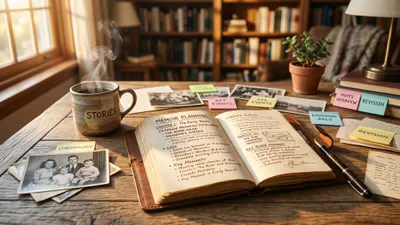
You can interview your family members and turn their stories into a book — even if you have zero journalism experience.
In this guide, you’ll learn:
- The exact questions that unlock deep family stories (not surface-level small talk)
- How to set up, record, and structure a family interview session
- The oral history techniques used by the Smithsonian and StoryCorps
- How to handle sensitive topics without damaging relationships
Here’s the step-by-step process.
Why Interview Family Members for a Book?
Interviewing family for a book means sitting down with relatives, asking structured questions, and recording their answers to preserve stories that would otherwise disappear.
Every family has stories that exist only in someone’s memory. Your grandmother’s immigration journey. Your uncle’s career switch that changed everything. The reason your family moved across the country in 1987.
These stories vanish when the people who lived them are gone. A family history book captures them permanently.
The Library of Congress estimates that millions of personal stories disappear every year because no one thought to record them. You don’t need professional training. You need a plan, the right questions, and a willingness to listen.
How to Prepare for a Family Interview
Preparation separates a rambling conversation from an interview that produces usable material for your book. Here’s what to do before you sit down.
Research What You Already Know
Before your first interview, write down everything you already know about your family’s history. Dates, locations, names, and major events. This prevents you from wasting interview time on facts you can verify through documents.
Check family records, old photo albums, and any existing letters or journals. The Smithsonian’s oral history guide recommends that well-prepared interviewers know what’s already documented — and use the interview to uncover what documents can’t tell you.
Choose the Right Family Members First
Start with the oldest living relatives. Their memories span the most time and cover events no one else witnessed firsthand.
Map out who knows what:
- Grandparents: Family origins, immigration stories, cultural traditions, wartime experiences
- Parents: Family dynamics, career decisions, relationship stories, the “why” behind big moves
- Aunts and uncles: Alternate perspectives on shared events, stories your parents won’t tell
- Cousins: Childhood memories from a different angle, family reunions, shared traditions
You’ll often discover that different family members remember the same event in completely different ways. That’s not a problem — it’s what makes a book about your family history compelling.
Set Up Your Recording Equipment
Never rely on note-taking alone. You’ll miss nuance, exact phrasing, and emotional details that make scenes come alive on the page.
Recommended recording setup:
- Smartphone voice memo app: Place the phone on the table between you, screen down to reduce distraction
- External microphone (optional): A lavalier mic improves audio quality for longer interviews
- Backup recording: Run a second device if the interview is with an elderly relative you may not get to interview again
- Video (optional): Captures gestures, facial expressions, and the physical setting — invaluable for writing vivid scenes later
Test your recording setup before the interview. Record a 30-second test in the same room and play it back. If you can’t hear clearly, move closer or switch to a better microphone.
Schedule Strategically
Interview sessions should run 60 to 90 minutes maximum. Longer sessions exhaust both you and your interviewee, and the quality of stories drops sharply after the first hour.
Schedule morning or early afternoon sessions when energy is highest. Avoid holidays and large gatherings — your relative will be distracted and less likely to open up about personal stories.
Plan for multiple sessions with key family members. One interview rarely captures everything. Tell your relative upfront: “I’d love to talk a few times over the next month.”
The Best Questions to Ask Family Members
The questions you ask determine whether you get surface-level facts or the deep, emotional stories that make a book worth reading.
Open-Ended Story Questions
These questions produce the longest, richest answers. Use them as your primary tools:
- “What’s your earliest memory of our family?”
- “Tell me about the house you grew up in — what did it look like, smell like, sound like?”
- “What was the hardest decision you ever made?”
- “What’s something about our family that younger generations don’t know?”
- “Tell me about a time you were truly scared.”
- “What’s the funniest thing that ever happened at a family gathering?”
- “What do you wish someone had told you when you were 20?”
Notice the pattern: each question asks for a specific story, not a fact. “Where were you born?” gets a one-word answer. “Tell me about the place where you grew up” gets a scene.
Questions That Reveal Character
These questions help you write your family members as real, complex people — not flat characters:
- “What were your parents like when no one was watching?”
- “What’s a rule you broke that you’re glad you broke?”
- “What did you want to be as a child, and what changed?”
- “Who in our family do you admire most, and why?”
- “What’s something you’ve never told anyone in the family?”
Questions About Specific Eras and Events
Tie questions to historical moments your family lived through:
- “Where were you when [major historical event] happened? What did you do?”
- “How did [war/recession/pandemic] change your daily life?”
- “What was your neighborhood like in the [decade]?”
- “How did your family handle money during hard times?”
These questions produce material that grounds your family story in a specific time and place — essential for writing a memoir that feels real to readers who weren’t there.
Follow-Up Questions That Go Deeper
The best material often comes from your second or third follow-up question. Keep these in your back pocket:
- “What happened next?”
- “How did that make you feel at the time?”
- “Who else was there?”
- “What did you do after that?”
- “Why do you think that happened?”
- “Tell me more about that.”
StoryCorps — the nonprofit that has recorded over 600,000 interviews archived at the Library of Congress — trains interviewers to ask “tell me more” more than any other question. It works because it shows you’re genuinely interested, which encourages your subject to go deeper.
How to Conduct the Interview
Having good questions isn’t enough. How you conduct the interview determines whether your family member relaxes and opens up — or stays guarded and surface-level.
Create a Comfortable Environment
Interview your relative in their home whenever possible. People tell better stories in familiar surroundings. The kitchen table works well — it’s associated with conversation, not interrogation.
Practical setup tips:
- Sit at a 90-degree angle (side by side at a corner), not directly across — it feels less like a formal interview
- Bring their favorite snack or make coffee together first
- Keep the recording device visible but not between you — on the table to the side
- Remove distractions: silence phones, turn off the TV, close the door
Start With Easy Questions
Never lead with “tell me about the hardest thing you’ve been through.” Start with warm-up questions:
- “I’d love to hear about where you grew up.”
- “What were holidays like when you were a kid?”
- “What was your first job?”
These low-stakes questions build momentum and trust. Your relative will naturally move into deeper territory once they’re comfortable and talking.
Listen More Than You Talk
The Smithsonian’s oral history interviewing guide emphasizes one rule above all others: the interviewer’s job is to listen, not to talk.
Aim for a 20/80 split. You talk 20% of the time (asking questions and brief follow-ups). Your relative talks 80%. Resist the urge to share your own stories, correct details, or fill silences.
Silence is your most powerful tool. When your relative finishes an answer, wait 3-5 seconds before asking the next question. People often add their most revealing details in those quiet moments after they think they’re done.
Handle Sensitive Topics Carefully
Family interviews inevitably touch difficult ground — divorce, addiction, financial hardship, family conflict, loss.
How to navigate sensitive territory:
- Ask permission first: “I’d like to ask about [topic]. Is that okay?”
- Give them an exit: “You can skip anything you don’t want to discuss.”
- Never press if they resist — you can return to the topic in a later session
- Acknowledge emotion: “Thank you for sharing that. I know it isn’t easy.”
If you’re writing about sensitive family material, read our guide on ethical memoir writing before you publish. The stories you collect in interviews carry real responsibility.
Take Brief Notes During the Recording
Even with a recording running, jot down quick notes:
- Timestamps for especially powerful moments (e.g., “23:15 — story about grandma’s garden”)
- Follow-up questions that come to mind while they’re talking
- Sensory details you notice in the room (these help you write scenes later)
- Emotions you observe — tears, laughter, long pauses
These notes become your roadmap when you sit down to write.
How to Organize Interview Material Into a Book
Raw interview recordings are not a book. Here’s how to transform hours of conversation into a structured manuscript.
Transcribe Your Interviews
Transcribe every interview — either manually or using AI transcription tools. A full transcript lets you search for specific quotes, identify themes, and rearrange material without re-listening to hours of audio.
AI transcription tools like Otter.ai or Descript can handle this in minutes. Review the transcript against the audio for accuracy, especially with names, places, and dates.
Identify Themes and Story Arcs
Read through all your transcripts and highlight recurring themes:
- Stories that multiple people mentioned (these are your strongest material)
- Moments of change — moves, marriages, losses, breakthroughs
- Emotional peaks — the stories that made you or your interviewee cry, laugh, or go silent
- Contradictions — where two family members remember the same event differently
These themes become your chapter structure. A memoir outline built from real interview material is stronger than one you create from memory alone.
Choose Your Book Structure
Family interview material works in several structures:
| Structure | Best For | Example |
|---|---|---|
| Chronological | Multi-generational family saga | Start with grandparents, end with present day |
| Thematic | Exploring a family pattern or value | Chapters on resilience, humor, faith, etc. |
| Single narrator | One person’s life story | A biography of your parent or grandparent |
| Multiple voices | Capturing different perspectives | Each chapter is a different family member |
| Hybrid | Complex family stories | Chronological backbone with thematic detours |
If you’re building a life story template, use your interview themes as the chapter framework rather than defaulting to a generic timeline.
Write Scenes, Not Summaries
Your interviews give you the raw material to write scenes — not just tell readers what happened.
Summary (weak): My grandmother came to America in 1952 and found life difficult at first.
Scene (strong): Grandma Rosa stepped off the boat in New York harbor on a Tuesday in March 1952 with two suitcases and $14. “I didn’t speak a word of English,” she told me, leaning forward in her kitchen chair. “I just followed the crowd and hoped someone would point me in the right direction.”
The difference? Direct quotes from your interviews. Sensory details you noted during the conversation. Specific facts (the day, the money, the suitcases) that only an interview could produce.
Using AI to Turn Interview Transcripts Into a Book
If you have hours of interview transcripts and feel overwhelmed by the writing process, AI tools can help you organize and draft your manuscript.
Our Pick — Chapter
Chapter lets you paste interview transcripts directly into the editor and use AI to identify themes, suggest chapter structures, and draft scenes from your raw material. You keep full control of the voice and story — the AI handles the heavy lifting of organization and first drafts.
Best for: Turning interview transcripts into a structured book draft Pricing: $97 one-time (nonfiction) Why we built it: Because most family stories never become books — not because the stories aren’t good enough, but because the writing process feels too overwhelming.
With over 10,000 authors, Chapter is purpose-built for exactly this kind of project. You don’t need writing experience. You need your interview recordings and a willingness to shape the material.
If you’re working with AI prompts for memoir writing, Chapter integrates those workflows directly into the book-building process. You can also follow our guide on how to write a memoir with AI for the complete 30-day workflow.
Common Mistakes to Avoid
- Waiting too long to start — Memory fades and people pass. Interview your oldest relatives first, even if your book plan isn’t finalized.
- Asking yes/no questions — “Did you like school?” gets a one-word answer. “What do you remember most about school?” gets a story.
- Interviewing in groups — Family members censor themselves around each other. One-on-one interviews produce more honest material.
- Not recording — Your memory of a two-hour conversation will miss 90% of the details. Always record.
- Treating the interview like an interrogation — This is a conversation, not a deposition. If your relative feels pressured, they’ll shut down.
- Skipping follow-up sessions — One interview isn’t enough. The best stories surface in the second or third conversation, after trust is built.
How Long Does It Take to Interview Family for a Book?
Interviewing family for a book typically takes 4 to 8 weeks of active interviewing, followed by weeks or months of writing. Most family history books require 5 to 15 individual interview sessions, each lasting 60 to 90 minutes.
The timeline depends on how many family members you’re interviewing and how complex your family story is. A single-person biography (your mother’s life story, for example) might need 4-6 sessions with that person plus 2-3 sessions with others who know them.
A multi-generational family history book with 10+ interviewees could take 3-6 months just for the interview phase.
What Equipment Do You Need to Interview Family?
You need a smartphone with a voice recording app and a quiet room. That’s genuinely it for getting started.
For higher-quality recordings, add a clip-on lavalier microphone ($15-30) and use a dedicated recording app like Voice Memos (iPhone) or Easy Voice Recorder (Android). If you plan to include video in your project, a tripod and your phone camera work well.
Professional oral historians at institutions like the Smithsonian use broadcast-quality equipment, but for a family book project, smartphone audio is more than sufficient. The content of the conversation matters far more than production quality.
Can You Write a Family Book Without Interviews?
You can write a book about your life from your own memories, but a family book based on interviews is almost always richer and more accurate. Memory is unreliable — we all remember events through our own lens.
Interviews give you:
- Direct quotes that bring characters to life on the page
- Multiple perspectives on the same events
- Details you never knew — most families have stories that only surface when someone asks
- Emotional texture — hearing someone’s voice crack or laugh while telling a story tells you what matters to them
If you can’t interview someone in person, consider phone calls, video calls, or even written questionnaires. A biography written without primary source interviews reads like a Wikipedia article. One built from real conversations reads like a story.
FAQ
How do you interview a family member for a book?
Interview a family member for a book by scheduling a 60-90 minute one-on-one session in their home, recording the conversation with a smartphone, and asking open-ended questions like “Tell me about the house you grew up in.” Listen more than you talk, use follow-up questions to go deeper, and plan multiple sessions with each person.
What questions should I ask my parents for a family history book?
The best questions for a family history book ask for stories, not facts. Start with “What’s your earliest childhood memory?” and “Tell me about your parents.” Move to “What was the hardest decision you ever made?” and “What do you wish your children knew about your life?” Avoid yes/no questions — ask questions that begin with “tell me about” or “describe.”
How many interviews do you need for a family book?
Most family history books require 5 to 15 individual interviews, each lasting 60-90 minutes. Interview your primary subject 3-6 times and supporting family members 1-2 times each. Plan for multiple sessions with key people — the deepest stories emerge in the second or third conversation after trust is established.
Should I record family interviews or take notes?
Always record family interviews — never rely on notes alone. A recording captures exact quotes, emotional tone, and details you’ll miss while writing. Use a smartphone voice memo app placed on the table between you. Take brief notes alongside the recording to mark timestamps for powerful moments and jot down follow-up questions.
How do you handle sensitive topics in family interviews?
Handle sensitive topics in family interviews by asking permission first: “I’d like to ask about [topic] — is that okay?” Give your relative an exit by saying “You can skip anything.” Never press if they resist. Acknowledge emotion when it surfaces. Return to difficult topics in later sessions after trust deepens. Read about ethical memoir writing before publishing sensitive material.