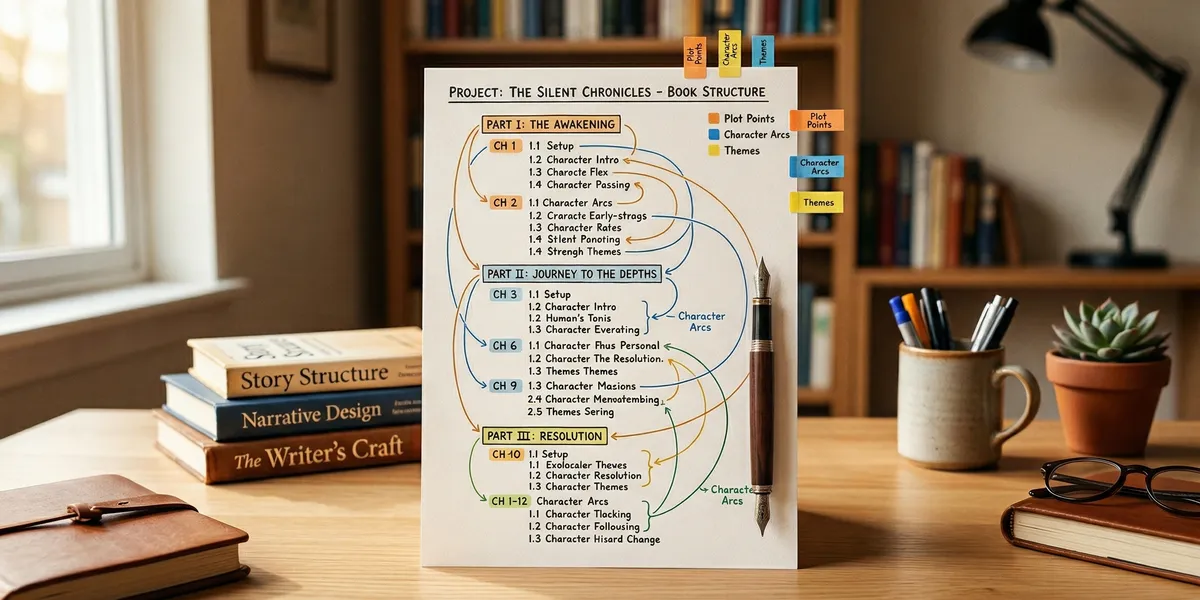
A strong outline turns a vague book idea into a clear writing plan. Learning how to outline a book saves you months of revision, prevents writer’s block, and gives your manuscript a solid structure from page one. The right method depends on how you think, what genre you write, and how much flexibility you need.
This guide covers seven proven outlining methods — from rigid chapter-by-chapter frameworks to freeform visual approaches. Each includes step-by-step instructions, best-use cases, and honest trade-offs so you can pick the one that fits your writing style.
Why Outlining Matters
Writers who outline before drafting finish their books faster. A study from the University of Chicago’s writing program found that structured planning reduces total project time by helping authors avoid dead ends and major rewrites.
An outline also keeps your reader’s experience front and center. When you map out the flow of ideas (nonfiction) or the arc of a story (fiction), you catch pacing problems before they become 80,000-word problems.
You don’t need to follow your outline rigidly. Think of it as a GPS route — you can take detours, but you always know how to get back on track. If you’re still in the early stages, our guide on how to start writing a book covers the groundwork before outlining.
Method 1: Traditional Chapter-by-Chapter Outline
The classic approach. You list every chapter in order and write a brief summary of what each one covers.
Who It’s Best For
Nonfiction authors, especially those writing how-to books, memoirs with chronological structure, or business books. Also works for plotters who want a clear roadmap before drafting.
Step-by-Step Process
- Define your book’s core promise. What will the reader know or feel by the final page?
- List 10-15 chapter topics. Each chapter should deliver one major idea or story beat.
- Write a 2-3 sentence summary for each chapter. Include the key takeaway and any supporting examples.
- Arrange chapters in logical order. For nonfiction, build from foundational concepts to advanced ones. For fiction, follow your plot structure.
- Add sub-sections under each chapter. Break each chapter into 3-5 sections with one-line descriptions.
Pros and Cons
Pros: Easy to understand. Gives you a complete picture of the book. Makes writing each chapter straightforward because you always know what comes next.
Cons: Can feel rigid. Requires you to know most of your content before you start. May stifle discovery-based writers who find their best ideas during drafting.
Check out our book outline template for a ready-made version of this format.
Method 2: Mind Mapping
Mind mapping is a visual brainstorming technique where your book’s central theme sits in the middle of a page, and related ideas branch outward like a tree.
Who It’s Best For
Visual thinkers. Writers who have lots of ideas but struggle to organize them linearly. Nonfiction authors researching a broad topic. Fiction writers in early world-building stages.
Step-by-Step Process
- Write your book’s central topic in the middle of a large page or digital canvas. Tools like Miro or MindMeister work well digitally.
- Draw branches for major themes or sections. These become your potential chapters.
- Add sub-branches for supporting ideas, examples, and research. Don’t censor — include everything.
- Color-code branches by type. Use one color for stories, another for data, another for action steps.
- Identify clusters and gaps. Look for branches with too many or too few sub-topics.
- Convert the map into a linear outline. Arrange the branches into a chapter sequence.
Pros and Cons
Pros: Captures ideas without forcing linear structure too early. Reveals connections between topics you might miss with a list. Feels creative and low-pressure.
Cons: Can become messy with complex books. Requires a second step to convert into a usable writing plan. Doesn’t work well for writers who think in sequences.
Method 3: The Snowflake Method
Developed by novelist Randy Ingermanson, the Snowflake Method starts with a single sentence and expands outward in controlled layers — like a snowflake growing from a crystal.
Who It’s Best For
Fiction writers who want detailed outlines but feel overwhelmed by the scope of a full novel. Also effective for nonfiction authors who need to develop complex arguments layer by layer.
Step-by-Step Process
- Write a one-sentence summary of your book. Keep it under 25 words. This is your hook.
- Expand that sentence into a full paragraph. Include the setup, three major turning points, and the ending.
- Write a one-page summary for each major character. Cover their motivation, goal, conflict, and arc.
- Expand each sentence of your paragraph into a full paragraph. You now have a one-page synopsis.
- Expand each paragraph into a full page. This gives you a multi-page outline with all major scenes.
- Create a spreadsheet of scenes. List each scene with its chapter, POV character, and purpose.
Pros and Cons
Pros: Builds complexity gradually, so you never feel overwhelmed. Forces you to nail the core story before adding details. Produces a thorough outline.
Cons: Time-intensive — the full process can take weeks. Feels mechanical to writers who prefer intuitive approaches. Works best for fiction with clear narrative arcs.
Method 4: Beat Sheet (Save the Cat)
The Save the Cat beat sheet, created by screenwriter Blake Snyder and adapted for novels by Jessica Brody, breaks a story into 15 specific “beats” — emotional turning points that keep readers engaged.
Who It’s Best For
Fiction writers, especially in genres with strong narrative expectations (romance, thriller, fantasy, mystery). Writers who want proven pacing structure without inventing one from scratch.
Step-by-Step Process
- Learn the 15 beats. Key ones include Opening Image, Theme Stated, Catalyst, Midpoint, All Is Lost, and Final Image.
- Write one sentence for each beat. Map your story’s events to each required moment.
- Assign page or word count targets. The Catalyst should hit around the 10% mark. The Midpoint lands at 50%.
- Expand each beat into a scene or chapter summary. Add character details, setting, and emotional tone.
- Check your pacing. Make sure the beats flow naturally and the story doesn’t stall between turning points.
Pros and Cons
Pros: Battle-tested structure used in thousands of successful novels and films. Prevents sagging middles. Gives you specific targets for where key events should land.
Cons: Can make stories feel formulaic if followed too rigidly. Less useful for literary fiction or experimental structures. Requires learning the beat sheet framework first.
Method 5: Reverse Outline
Instead of outlining before you write, you write first — then create an outline from your draft. This method works as both a revision tool and a planning method for writers who resist pre-writing structure.
Who It’s Best For
Pantsers (discovery writers) who can’t outline before drafting. Writers revising a messy first draft. Authors who’ve written significant material but lost track of the structure.
Step-by-Step Process
- Write your first draft or a large chunk of material. Don’t worry about structure.
- Read through the draft and summarize each chapter or section in one sentence.
- List those summaries in order. This is your reverse outline.
- Identify structural problems. Look for repeated ideas, missing logic, pacing issues, and chapters that don’t advance the book’s promise.
- Rearrange, cut, and add. Use the reverse outline to restructure before revising the prose.
Pros and Cons
Pros: Doesn’t require any outlining before you write. Reveals the actual structure of your draft. Powerful revision tool.
Cons: Only works after you have a draft, so it can’t prevent first-draft problems. Time-consuming because you write before organizing. May lead to significant rewrites.
Method 6: The Sticky Note Method
Grab a stack of sticky notes and write one scene, chapter, or idea per note. Then arrange them on a wall, table, or board until the order feels right.
Who It’s Best For
Tactile thinkers who need to physically move pieces around. Writers juggling multiple subplots or timelines. Anyone who feels paralyzed staring at a blank document.
Step-by-Step Process
- Brainstorm every scene, chapter, or idea you have. Write one per sticky note. Use large notes for major beats and small ones for details.
- Sort notes into groups. For fiction: acts or storylines. For nonfiction: sections or themes.
- Arrange notes in sequence on a flat surface. A wall or large table works best.
- Step back and evaluate the flow. Look for gaps, clusters that need splitting, and notes that don’t belong.
- Rearrange until the structure clicks. Move, remove, or add notes freely.
- Transcribe the final arrangement into a written book outline.
Pros and Cons
Pros: Extremely flexible. Makes reorganizing painless. Engaging and tactile. Great for visual and kinesthetic learners.
Cons: Hard to save or share (unless you photograph it). Doesn’t work well for detailed outlines. Notes can fall off walls — use painter’s tape.
Method 7: Synopsis-First Approach
Write a complete narrative summary of your book — like the description on the back cover, but longer and more detailed. Then use that synopsis as your outline.
Who It’s Best For
Writers who think in narrative rather than bullet points. Fiction authors querying agents (since you’ll need a synopsis anyway). Nonfiction authors who want to pitch their book before writing it.
Step-by-Step Process
- Write a 1-2 page narrative summary of your entire book. Cover the beginning, middle, and end. Include major characters and key turning points.
- Expand to a 5-10 page synopsis. Add subplots, supporting characters, and chapter-level detail.
- Mark natural chapter breaks in the synopsis. Wherever the topic or scene shifts, draw a line.
- Extract a chapter list from the marked synopsis. Each section becomes a chapter with a built-in summary.
- Use the synopsis as your writing guide. Refer back to it as you draft each chapter.
Pros and Cons
Pros: Feels like writing rather than planning. Produces a document useful for queries and proposals. Tests whether your book idea sustains a full narrative.
Cons: Can feel like writing the book twice. Harder to reorganize than bullet-point outlines. Requires strong summarization skills.
Choosing the Right Method for Your Book
The best outlining method is the one you’ll actually use. Here’s a quick decision framework:
- You write nonfiction and want clarity: Start with Method 1 (Chapter-by-Chapter) or Method 7 (Synopsis-First).
- You’re a visual thinker: Try Method 2 (Mind Mapping) or Method 6 (Sticky Notes).
- You write fiction and want proven structure: Use Method 4 (Beat Sheet) or Method 3 (Snowflake).
- You hate outlining: Start writing, then use Method 5 (Reverse Outline) to find your structure after the fact.
You can also combine methods. Many authors mind map first, then convert their map into a chapter-by-chapter outline. Others use a beat sheet for the macro structure and sticky notes for individual scenes.
For a deeper look at structuring your full manuscript, see our guide on how to write a book.
Common Mistakes to Avoid
Over-outlining. An outline that runs 50 pages is a rough draft pretending to be a plan. Keep it concise enough that you can reference it at a glance.
Outlining too early. If you haven’t clarified your book’s central promise or target reader, no outline method will save you. Nail the concept first.
Treating the outline as sacred. Your outline is a tool, not a contract. When you discover better ideas during drafting, update the outline instead of forcing the old plan.
Skipping the emotional arc. Nonfiction authors often outline information flow but forget about reader engagement. Map how the reader’s understanding and motivation should shift across chapters.
Using someone else’s method just because it’s popular. The Snowflake Method works brilliantly for some writers and drives others to abandon their book. Choose based on how your brain processes information.
Not testing your outline with a sample chapter. Write one chapter from your outline before committing to the full draft. If the outline doesn’t translate into compelling prose, revise the outline — not the prose.
How AI Tools Speed Up Book Outlining
Modern book writing tools can accelerate the outlining process significantly. AI-assisted platforms analyze your topic, suggest chapter structures, and help you organize ideas faster than starting from a blank page.
Chapter.pub uses AI to generate complete nonfiction book outlines based on your topic and target audience. You describe your book’s premise, and the platform produces a structured chapter-by-chapter framework you can customize. It’s a one-time $97 purchase — no subscription — and over 2,100 authors have used it to plan and write their books.
AI outlining doesn’t replace your creative decisions. It gives you a starting point you can reshape, saving the hours you’d spend staring at a blank page trying to figure out what goes where.
FAQ
How detailed should a book outline be?
Detailed enough that you know what each chapter covers, but brief enough that writing still feels creative. For most authors, 1-3 sentences per chapter works well. If you find yourself writing full paragraphs for each section, you’ve crossed into drafting territory.
Can you write a good book without an outline?
Yes. Many successful authors — Stephen King famously among them — write without outlines. However, most pantser authors still use some form of structure, even if it’s a mental list of key scenes. The reverse outline method (Method 5) lets you get the benefits of outlining after your first draft.
How long does it take to outline a book?
Most authors spend 1-4 weeks on their outline, depending on the method and book complexity. A simple chapter-by-chapter outline for a nonfiction book might take a weekend. A full Snowflake Method outline for a complex novel could take a month. AI tools like Chapter.pub can generate a first-pass outline in minutes.
Should fiction and nonfiction books be outlined differently?
Generally, yes. Nonfiction outlines focus on information architecture — what the reader needs to learn and in what order. Fiction outlines focus on narrative arc — what happens, to whom, and what’s at stake. That said, the methods in this guide work across both genres. Methods 1, 2, 6, and 7 adapt easily to either. Methods 3 and 4 lean fiction. Method 5 works for anything you’ve already drafted.
What’s the best free tool for outlining a book?
Scrivener offers a free trial with strong outlining features including a corkboard view (digital sticky notes). Google Docs works for simple chapter-by-chapter outlines. For mind mapping, Coggle has a generous free tier. If you want AI-assisted outlining for nonfiction, Chapter.pub provides complete outline generation as part of its writing platform.