You can outline a dystopian novel in a weekend, and the outline will be stronger than a general story outline because dystopia gives you something most genres do not: a system with rules. Once you know the rules, the plot is largely a question of who breaks which one, and what the system does about it.
In this guide, you’ll learn:
- The premise test that tells you whether your dystopian idea can carry 90,000 words
- How to define your regime as a set of mechanics instead of a mood
- The three-timeline method that keeps worldbuilding, character arc, and reader reveals in sync
- A complete dystopian beat sheet with percentage markers you can drop straight into a chapter grid
Here is the nine-step process, in the order that actually works.
Step 1: Test Your Premise Before You Outline Anything
A dystopian premise is strong enough to outline when it can be stated in one sentence containing a rule, a cost, and a person who cannot pay it. If your idea only has an atmosphere — grey city, cruel government, scared people — you have a setting, not a story.
Try the sentence out loud. “In a society where memories are taxed, a records clerk discovers her own childhood was repossessed.” Rule: memories are taxed. Cost: repossession. Person: the clerk who administers the system.
Compare that to “a totalitarian regime controls everything.” Nothing to outline. No specific pressure, no specific victim, no specific breaking point.
If your premise fails the test, do not fix it by adding more oppression. Fix it by narrowing. One rule, applied with total consistency, generates more plot than ten vague ones — the reason dystopian fiction built on a single extrapolated idea tends to outlast the kitchen-sink kind.
Quick check: write three different characters your rule would harm in three different ways. If you can only think of one, the rule is too narrow. If you can think of twenty, it is too broad.
Step 2: Write the Regime Rules Sheet
Regime rules sheet — A one-page document listing the specific mechanisms your dystopian government uses to hold power, written as concrete procedures rather than adjectives.
Before any beats, write down how the system actually functions. Six categories cover almost every dystopia:
| Mechanism | The question to answer | Example from published fiction |
|---|---|---|
| Surveillance | Who watches, how, and with what gaps? | Telescreens in Nineteen Eighty-Four |
| Scarcity | What is rationed, and who allocates it? | Food and districts in The Hunger Games |
| Sorting | How are people categorized, and when? | Aptitude testing in Divergent |
| Narrative | What story does the state tell about itself? | Historical revision in Fahrenheit 451 |
| Enforcement | What happens to violators, visibly and invisibly? | The Eyes in The Handmaid’s Tale |
| Escape valve | What controlled release keeps people compliant? | The Games themselves, as spectacle |
That last row is the one most outlines skip. Real authoritarian systems survive by giving people something — a lottery, a promotion track, a permitted vice. Build one in and your regime stops feeling like cardboard.
Fill each row with a procedure, not a feeling. Not “surveillance is everywhere” but “every doorway logs a retinal scan, results are reviewed weekly, and the backlog runs eleven days.” That eleven-day backlog is a plot hole your protagonist can climb through in Act Two. If you want more depth here, how to write a dystopian government breaks down regime types in detail.
Step 3: Build the Control-Cost Ledger
Here is the outlining tool almost nobody uses, and it is the fastest way to find your plot. For every mechanism on your rules sheet, write what it costs the regime to maintain.
Surveillance costs analysts. Rationing costs distribution networks. Sorting costs testing infrastructure and the officials who administer it. Every control has a bill attached, and somebody is paying it.
Now ask: what happens when a cost rises? A drought raises the price of rationing. A generation of low birth rates raises the price of sorting. The regime must then squeeze harder, and squeezing harder is what turns a stable dystopia into a story.
This is why The Hunger Games opens in a Games year with a volunteer, and why The Handmaid’s Tale is set during a fertility collapse. The system is under strain. Strain is plot.
Your ledger gives you three things at once: the inciting pressure, the antagonist’s genuine motivation, and a reason the story happens now rather than fifty years earlier. Write it in one sitting and your outline will stop feeling arbitrary.
Step 4: Choose Your Protagonist’s Position Inside the System
Dystopian protagonists come in four positions, and each one produces a different novel. Pick deliberately, because the position determines what your character can see and when.
- The complicit insider — administers the system, then discovers what it does. Slow burn, strongest irony, hardest first act.
- The compliant citizen — believes the story, then stops. The classic awakening arc; think Winston Smith or Guy Montag.
- The excluded outsider — was never offered the deal. Fast start, but you must work harder to explain the system to readers.
- The unwilling symbol — pulled into resistance by circumstance rather than conviction. Best for series, because belief can develop across books.
The insider position is underused and it solves your exposition problem for free: a character whose job is the system can explain the system without the narrative stopping to lecture.
Write one paragraph on what your protagonist believes on page one and one on what they believe on the last page. The distance between those two paragraphs is your character arc, and every beat in the next step exists to move them along it.
Step 5: Run the Three-Timeline Method
Most dystopian outlines fail in the middle because the writer tracks only plot. Track three timelines side by side instead — three columns on one page.
Timeline A — The regime timeline. What the system is doing, whether or not the protagonist notices. A crackdown scheduled for month four. A quota that tightens in winter. This timeline runs on its own logic and does not wait for your hero.
Timeline B — The character timeline. What your protagonist believes, wants, and risks, scene by scene. This is the awakening arc.
Timeline C — The reveal timeline. What the reader knows, and in what order. Dystopia lives or dies on controlled disclosure. Reveal the whole system in chapter two and there is no dread left.
Lay them in parallel and the failure modes become visible immediately. If Timeline A is empty for eighty pages, your world is passive. If B and C move in lockstep, you have no dramatic irony. If C outruns B, readers get bored waiting for the protagonist to catch up.
The best dystopian middles stagger these deliberately: the reader learns something in chapter nine that the protagonist does not learn until chapter nineteen, and those ten chapters are unbearable in the good way.
Step 6: Map the Dystopian Beat Sheet
Dystopian novels bend standard structure in one specific way: the midpoint is a discovery about the world, not just a reversal of fortune. Use these percentage markers over your chosen structure — the three-act structure and the Save the Cat beat sheet both work fine underneath.
| % of book | Beat | Dystopian function |
|---|---|---|
| 0–5% | Ordinary oppression | Show the rule working normally, from inside |
| 8–12% | The crack | A small inconsistency the protagonist cannot unsee |
| 12–20% | Refusal and rationalization | They try to make the crack fit their beliefs |
| 20–25% | Point of no return | An act that cannot be undone or explained away |
| 25–50% | Learning the machine | Allies, false allies, the rules behind the rules |
| 50% | The system reveal | The truth about what the regime actually is or wants |
| 50–70% | Committed resistance | Acting on the reveal, with mounting cost |
| 70–75% | The crushing | The regime wins decisively; an ally is lost or turned |
| 75–85% | Dark night and reframe | The goal changes from winning to something survivable |
| 85–95% | Climax | Direct collision with the mechanism, not just a villain |
| 95–100% | The compromised ending | Something changes; something does not |
Two notes on the last row. Dystopian endings that hand the reader total victory tend to feel false, because the genre’s whole argument is that systems outlive individuals. Endings that hand the reader total defeat tend to feel airless. Aim for a cost the reader can weigh: the wall comes down but the protagonist cannot go home.
Note also that the climax should target the mechanism, not merely the man. Killing a dictator is a thriller ending. Breaking the surveillance grid, exposing the archive, or publishing the ledger is a dystopian one.
Step 7: Design the Opposition as a Person and a Structure
Your antagonist needs two layers, and outlining only one is the most common structural mistake in the genre.
The structural antagonist is the system: impersonal, procedural, incapable of being reasoned with. It creates the constraints.
The personal antagonist is one human who represents it: a handler, a warden, a mentor who turns out to be an administrator. This is who your protagonist argues with, and who gets to say the regime’s best line.
Give the personal antagonist a real argument. Not “we do this because we enjoy power” but “we do this because the alternative killed forty million people and you are too young to remember.” A dystopia is only frightening when the case for it is genuinely tempting.
Outline three scenes where the antagonist is right about something. Readers remember those scenes far longer than the escape sequences.
Step 8: Turn the Outline Into a Chapter Grid
Now convert beats into chapters. A dystopian novel typically runs 80,000–100,000 words for adult fiction and 60,000–80,000 for young adult, which at roughly 2,500 words per chapter means 30–40 chapters. Build a grid with six columns:
- Chapter number
- POV and location
- Scene goal — what the protagonist is trying to get
- Obstacle — which regime mechanism blocks it
- Outcome — usually “yes, but” or “no, and”
- Reveal delta — what the reader now knows that they did not before
Column four is the dystopian-specific one. If a chapter’s obstacle is not traceable to a row on your rules sheet, that chapter probably belongs in a different book. Column six catches pacing problems: three chapters in a row with an empty reveal delta is where readers put the book down.
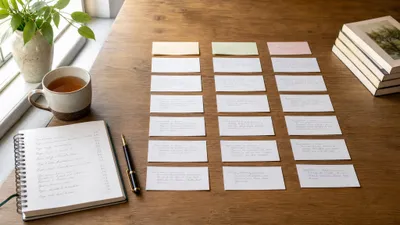
Fill the grid in passes. First pass: the eleven beats from step six, placed at their percentage positions. Second pass: the chapters that get you between them. Third pass: obstacles and reveal deltas. If you want a reusable structure to start from, the novel outline template covers the general scaffolding this grid sits on.
Fair warning on tools — a chapter grid is where AI drafting software becomes genuinely useful, because you are producing a large amount of structured, repetitive planning text. Chapter was built for exactly this stage: you give it the premise and rules sheet, it generates the chapter-by-chapter grid, and you rewrite the rows that are wrong. Over 5,000 books have been built on the platform, and the outlining stage is where most authors say it saves the most time. Whether you use software or index cards, the grid itself is the deliverable.
Step 9: Pressure-Test the Outline Before You Draft
Run these five checks. Each one catches a failure that is expensive to fix at 60,000 words.
- The bystander test. Pick a minor character and describe their week under the regime. If nothing interesting happens to them, your world only works when the camera is pointed at the hero.
- The competence test. Read your outline as the regime. Would a competent authority really let this happen? If your protagonist succeeds because officials are stupid, the dystopia is not frightening.
- The removal test. Delete the oppressive system and see if the plot still runs. If it does, you have written a thriller in costume.
- The date test. Ask when the regime took power and who is old enough to remember before. Living memory creates conflict between generations that nothing else can.
- The unpaid-cost test. Return to your control-cost ledger. Every mechanism that appears in the climax should have had its cost shown earlier, or the ending will feel invented.
Fix the failures in the outline. A restructure at outline stage costs an afternoon; the same restructure in a finished manuscript costs a month.
Common Mistakes to Avoid
- Opening with the history of the regime. Readers do not need the founding. They need to watch the rule work on a person in chapter one, in a normal week.
- Outlining oppression instead of pressure. Scenes where bad things happen to good people are not plot. Plot requires a protagonist making choices with consequences.
- A regime with no supporters. Every real authoritarian system has enthusiastic believers who benefit. Outline at least two.
- Reveals that arrive all at once. Splitting one big secret into three staged disclosures roughly triples the tension for zero extra words.
- Symbolic names and shouted themes. If a character is called Truth Seeker, the outline is doing the theme’s job for it. Let the mechanism carry the argument.
- Skipping the escape valve. Without a permitted pleasure or a promised reward, your citizens’ compliance is never fully believable.
How Long Should It Take to Outline a Dystopian Novel?
Outlining a dystopian novel takes most writers between one and three weeks of part-time work. Budget roughly two days for the premise test and rules sheet, two days for the control-cost ledger and character position, three days for the beat sheet, and a week for the chapter grid and pressure tests.
Rushing the rules sheet is the false economy. Every hour spent making the regime’s mechanics specific saves several hours of mid-draft rewriting, because a specific system tells you what can and cannot happen in every scene.
Do You Need to Worldbuild Before You Outline?
You need enough worldbuilding to outline, not a finished world. The rules sheet from step two is the minimum: six mechanisms, written as procedures. Geography, history, and technology can be filled in during drafting, because those details rarely change your plot structure.
Reverse the order and you will spend six months on maps and languages without a story. Outline first, then expand the world into the gaps the outline exposes — the approach covered further in these worldbuilding tips.
Can You Outline a Dystopian Series Instead of a Standalone?
Yes, and the structural rule is simple: each book breaks one mechanism, and the final book breaks the system. Book one might expose the surveillance grid, book two the resource network, book three the founding lie.
Give every book its own complete arc with a compromised ending, then let the unresolved mechanisms carry readers forward. Series that stall usually did the opposite — they defeated the system in book one and had to invent a new threat.
FAQ
How do you outline a dystopian novel?
To outline a dystopian novel, start with a one-sentence premise containing a rule, a cost, and a victim, then write a regime rules sheet of six mechanisms. Add a control-cost ledger, choose your protagonist’s position in the system, map the eleven-beat dystopian structure, and convert it into a chapter grid.
What is the structure of a dystopian novel?
Dystopian novels follow three-act structure with a world-revealing midpoint. Act One shows the rule working normally and cracks it; Act Two escalates through learning the machine to a system reveal at 50%; Act Three delivers a climax aimed at the mechanism itself and a compromised ending rather than total victory.
How long is a dystopian novel?
Adult dystopian novels typically run 80,000 to 100,000 words, while young adult dystopian runs 60,000 to 80,000 words. At an average 2,500 words per chapter, that means roughly 30 to 40 chapters — the number your chapter grid should target before you start drafting.
What is the difference between dystopian and post-apocalyptic outlines?
The difference is who holds power. A dystopian outline centers on a functioning system with rules to break, so the plot follows control and resistance. A post-apocalyptic outline centers on collapse and scarcity, so the plot follows survival and rebuilding. Many novels blend both, starting post-apocalyptic and ending dystopian.
Should you outline the ending before drafting a dystopian novel?
Yes — outline the ending first, because the ending defines what the mechanism means. Knowing whether the surveillance grid falls, holds, or is replaced tells you which costs to plant in Act One. Dystopian endings are arguments, and you cannot build the evidence without knowing the verdict.
Related Reading
- How to Write a Dystopian Novel — the drafting side, once your outline is done
- How to Write a Dystopian Government — deeper regime design
- How to Outline a Novel: 7 Methods — pick the outlining system underneath the beat sheet
- 100+ Dystopian Writing Prompts — for finding a premise that passes step one
- How to Write a Sci-Fi Novel — for dystopias with heavy speculative technology
- Rising Action — the Act Two escalation your grid depends on
- The Opposite of Dystopia — utopian counterpoints worth understanding
External references worth your time: Duck Prints Press on three-act planning for dystopian novels, Writer’s Digest on writing dystopian fiction, bibisco’s dystopian novel guide, the Encyclopaedia Britannica entry on dystopia, and MasterClass on dystopian fiction conventions.