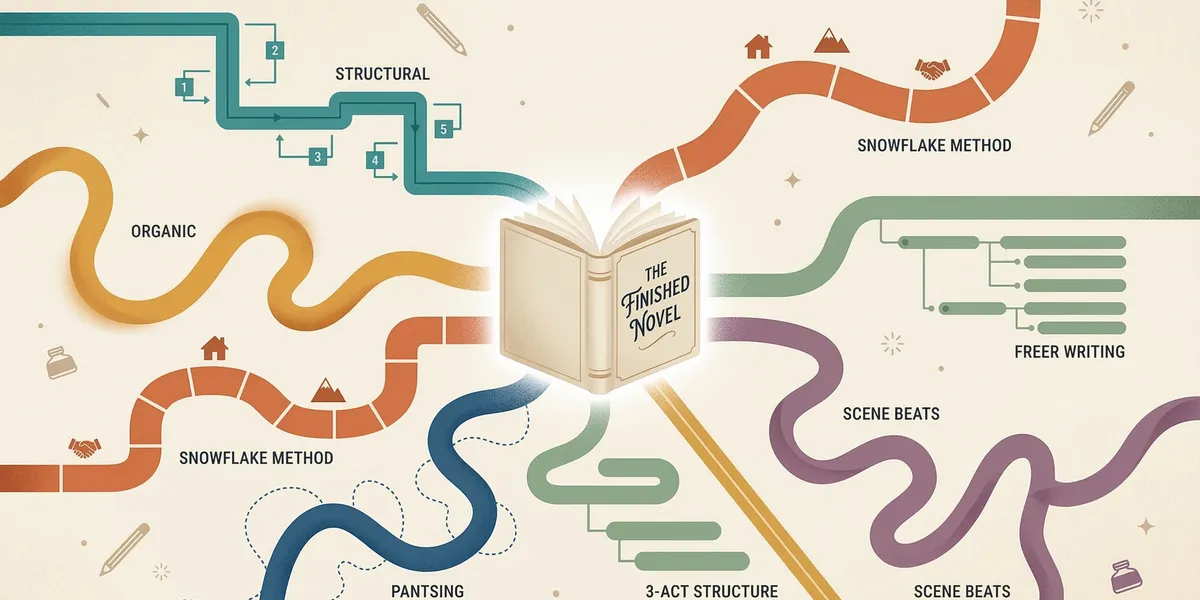
There is no single right way to outline a novel. Some writers need 50 pages of notes before they type Chapter One. Others need a napkin sketch. The question is not whether to outline. It is which method fits the way your brain works.
Here are seven proven approaches, from the most structured to the most freeform.
1. The Three Act Structure outline
The three act structure divides your novel into setup (25%), confrontation (50%), and resolution (25%). Your outline identifies the key turning points between acts and fills in the major scenes.
How it works:
- Define your protagonist’s starting state and central conflict
- Identify the inciting incident (end of setup / start of Act 1)
- Plan the midpoint reversal that splits Act 2
- Define the climax and resolution
- Fill in major scenes between these pillars
Best for: Writers who want a framework but not a rigid template. The three act structure gives you four major waypoints and lets you find the rest through writing.
Limitations: The middle 50% is a lot of unstructured territory. Writers who need more granular guidance may stall in Act 2.
2. The Save the Cat Beat Sheet outline
The Save the Cat beat sheet gives you 15 specific story beats with page-percentage targets. It is the three act structure with more granular checkpoints.
How it works:
- Map each of the 15 beats (Opening Image through Final Image)
- Assign approximate word counts or page numbers to each beat
- Write a sentence or paragraph describing what happens at each beat
- Use the beat sheet as your writing roadmap
Best for: Writers who get lost in the middle of a draft. The beat sheet tells you exactly where to put your midpoint, your “all is lost” moment, and every major turn in between.
Limitations: Can feel formulaic if followed too rigidly. Works best when treated as a flexible guide, not a straitjacket.
3. The Snowflake Method
The Snowflake Method builds an outline through progressive expansion: one sentence becomes a paragraph, becomes a page, becomes a four-page synopsis, becomes a scene list.
How it works:
- Write a one-sentence summary of the novel
- Expand to a five-sentence paragraph
- Create one-page character summaries
- Expand the paragraph to a one-page synopsis
- Continue expanding through 10 total steps
Best for: Writers who are overwhelmed by starting big. The Snowflake Method never asks you to do more than expand what you already have. Each step is manageable.
Limitations: The process can take two weeks or more before you write a word of the actual novel. Some writers lose momentum during the planning phase.
4. Scene cards
Scene cards put each scene on an index card (physical or digital) with key information: what happens, whose POV, the conflict, and the outcome.
How it works:
- Brainstorm every scene you can imagine for your story
- Write each on a separate card with a one-sentence summary
- Arrange the cards in sequence
- Identify gaps where scenes are missing
- Rearrange until the flow feels right
Best for: Visual thinkers and writers who need to see the whole story at once. Moving physical cards around a table or corkboard gives you a spatial relationship with your plot.
Limitations: Can produce a list of events without emotional throughlines. You need to check that the sequence builds tension and advances character arcs, not just moves characters through locations.
What to put on each card
- Scene number and chapter
- POV character
- One-sentence summary of what happens
- The conflict (what does the character want? what stops them?)
- How the scene ends (what changes?)
- Emotional tone or shift
5. Mind mapping
Mind maps start with a central idea and branch outward, connecting characters, themes, plot points, and scenes in a non-linear web.
How it works:
- Put your central concept or conflict in the middle
- Branch out to major characters, themes, and plot threads
- Add sub-branches for specific scenes, relationships, and details
- Look for connections between branches
- Convert the map to a linear outline when ready
Best for: Writers who think in connections rather than sequences. If your story has multiple interwoven plotlines or complex thematic relationships, a mind map lets you see how everything relates.
Limitations: A mind map is not a narrative. At some point you must convert it to a sequential plan. Some writers find this translation step difficult.
6. The synopsis outline
A synopsis outline is exactly what it sounds like: you write a prose summary of your entire novel, typically three to five pages, hitting every major plot point.
How it works:
- Write the story as if you are telling a friend what happens
- Cover every major turning point and character shift
- Include the ending (this is not a book jacket, it is a blueprint)
- Use this as your drafting guide, expanding each paragraph into chapters
Best for: Writers who think in prose, not structure. If frameworks feel foreign but you can talk through your story, a synopsis outline lets you plan in your natural mode.
Limitations: Without structural awareness, a synopsis can meander. It helps to check your synopsis against a framework like the three act structure to ensure it has balanced proportions.
7. The tentpole method
The tentpole method is the minimalist option. You identify five to seven “tentpole” scenes, the moments that hold up the story, and write toward them. Everything between the tentpoles is discovered during drafting.
How it works:
- Identify the opening scene
- Identify the inciting incident
- Identify the midpoint
- Identify the “all is lost” moment
- Identify the climax
- Optionally add one or two more pivotal scenes
- Write toward each tentpole, discovering the connecting scenes along the way
Best for: Writers who fall between plotters and pantsers. The tentpole method gives you enough direction to avoid getting lost but enough freedom to discover your story in the writing.
Limitations: The spaces between tentpoles can still produce sagging middles. If you tend to wander without structure, you may need more waypoints than five.
Comparing all seven methods
| Method | Structure level | Planning time | Best for |
|---|---|---|---|
| Three Act | Medium | 1-3 days | Writers wanting a framework |
| Save the Cat | High | 3-5 days | Writers who get lost in Act 2 |
| Snowflake | Very high | 1-2 weeks | Overwhelmed by starting big |
| Scene cards | Medium-high | 3-7 days | Visual, spatial thinkers |
| Mind map | Low-medium | 1-2 days | Connection-based thinkers |
| Synopsis | Medium | 1-2 days | Prose-native thinkers |
| Tentpole | Low | 1 day | Plotter-pantser hybrids |
How to choose your method
If you have never outlined before: Start with the tentpole method. It is the lowest commitment and will teach you whether more structure helps or hinders your process.
If you know your plot but cannot find the middle: Use Save the Cat. Its granular beats solve the Act 2 problem.
If you have a big idea but no plot: Use the Snowflake Method. It builds plot from the ground up.
If you think visually: Scene cards or mind maps will match how your brain works.
If you just want to start writing: The tentpole method gives you five landmarks and says “go.” That might be all you need.
There is no wrong answer. The best outline method is the one that gets you to a finished draft. Try one, and if it does not work, try another. The methods are tools, not religions.
Outlining vs pantsing
Outlining is not the only way. Some writers, called “pantsers” or “discovery writers,” write with no plan at all. Most successful novelists fall somewhere on the spectrum between full outliner and full pantser. Stephen King famously writes without outlines. J.K. Rowling planned Harry Potter with detailed spreadsheets. Both approaches produced extraordinary novels.
The key insight: if your current approach is not producing finished drafts, try moving in the other direction. Stuck without an outline? Try one. Bored with an outline? Try writing a discovery draft. The goal is a finished book, not loyalty to a method.