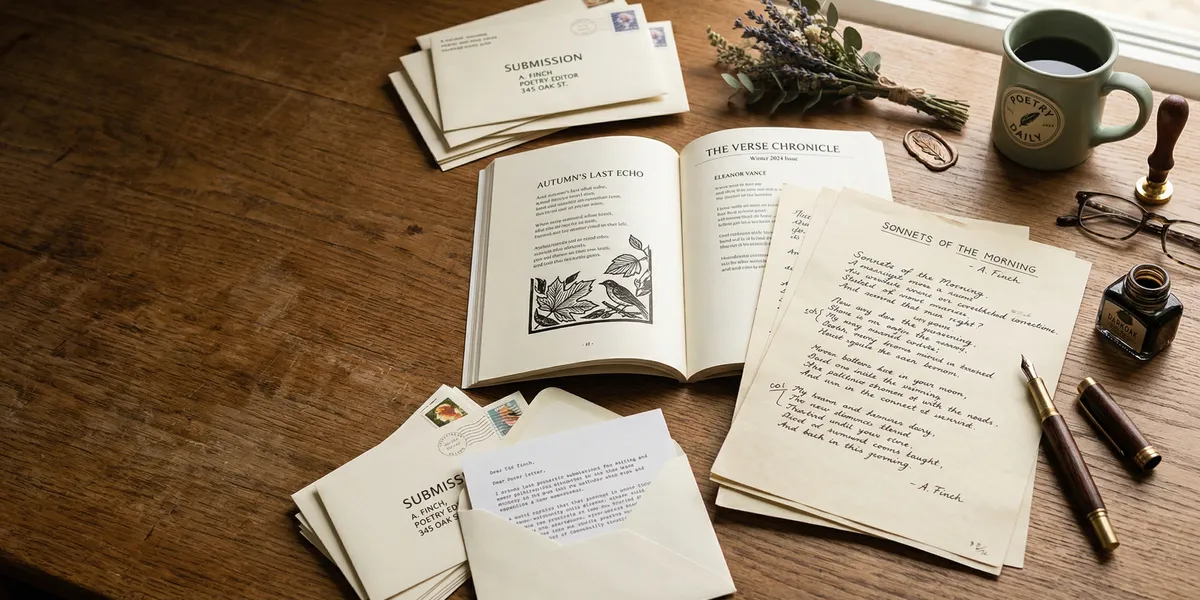
Yes, you can publish a poem — and you have more options today than at any point in literary history. Literary magazines, online journals, poetry anthologies, self-published chapbooks, and social media platforms all accept poetry from emerging and established writers. This guide walks you through every path to publication, from your first submission to building a body of published work.
Understand the poetry publishing landscape
Before you submit anything, it helps to know what the playing field looks like. Poetry publishing operates differently from book publishing, and knowing the terrain saves time and frustration.
Literary magazines and journals remain the primary path for individual poems. Nearly 1,000 literary magazines actively accept poetry submissions in the US alone, ranging from prestigious print journals like Poetry Magazine to small online zines run by volunteer editors. Most publish individual poems, though some accept themed sequences or longer works.
Acceptance rates vary widely. Top-tier journals accept roughly 1-2% of submissions. Poetry Magazine, published by the Poetry Foundation, receives over 100,000 poems per year. Mid-tier journals hover around 2-5%, while newer or community-focused publications may accept 10-30% of what they receive. These numbers are not meant to discourage you — they are meant to set realistic expectations and encourage volume.
There is no single path. Some poets build careers through literary journal credits. Others self-publish chapbooks. Some gain audiences entirely through Instagram or social media. Many combine all three. The best strategy depends on your goals.
Choose where to submit your poetry
Your first decision is where your poem belongs. Each publication type serves a different purpose.
Literary magazines and journals
These are the traditional home for poetry publication. They range from university-affiliated quarterlies to independent online journals.
Print journals include publications like The Paris Review, Poetry Magazine, Ploughshares, and The Kenyon Review. Publication in these carries prestige and often counts toward writing residencies, grants, and MFA applications.
Online journals include publications like Rattle, The Adroit Journal, Tinderbox Poetry Journal, and hundreds more. Many online journals now carry equal weight to print in the literary community, and they reach wider audiences since readers can access them for free.
University journals are run by MFA programs and English departments. The Iowa Review, Pleiades, Crazyhorse, and Hayden’s Ferry Review are examples. These publications are often more open to emerging poets and can be a strong starting point.
Poetry anthologies
Anthologies collect multiple poets around a theme, form, or identity. Open calls for anthology submissions appear on sites like NewPages and the Community of Literary Magazines and Presses (CLMP). Anthology credits look strong on a cover letter because they show your work was selected to fit alongside other published poets.
Poetry contests and prizes
Many journals run annual poetry contests with cash prizes and publication. Entry fees typically range from $15-25, but winners receive $500-2,000 plus publication. Major contests include the Yale Younger Poets Prize, the National Poetry Series, and individual journal prizes.
Weigh contest fees carefully. At $20 per entry across dozens of contests, costs add up fast. Prioritize contests from journals you already read and respect.
Self-publishing a poetry collection
Self-publishing gives you full control over your work and earns higher royalties per sale. This path works especially well for chapbooks (short collections, typically under 40 pages) and full-length collections.
Amazon KDP lets you publish poetry ebooks and paperbacks for free using print-on-demand. You set your price, design your cover, and Amazon handles printing and distribution. IngramSpark offers higher print quality and access to bookstore distribution, though it charges setup fees.
For a deeper look at self-publishing platforms and costs, see our guides on how to publish a book for free and the best self-publishing platforms.
Online and social media platforms
Social media has created an entirely new path for poets. Rupi Kaur built a publishing career on Instagram before landing a traditional deal. Platforms where poets gain audiences include Instagram (visual poetry), TikTok (#BookTok and #PoetryTok), Substack (newsletter-style poetry), and personal blogs.
These platforms do not replace journal publication for credentialing purposes, but they can build a readership that traditional publishing rarely provides.
How to submit poetry to literary magazines
This is the core process most poets follow. Each step matters — editors reject technically good poems all the time because the submission was sloppy, off-theme, or sent to the wrong place.
Step 1: Research publications that fit your work
Read the journals you want to submit to. This is not optional advice — it is the single most important step. Reading a journal’s recent issues tells you whether your style, voice, and subject matter align with what they publish.
Start with these free resources:
- Poets & Writers Literary Magazines Database — nearly 1,000 journals with submission guidelines and contact info
- The Submission Grinder — free searchable database with response time statistics
- Duotrope — paid database ($5/month) with detailed acceptance rate statistics and submission tracking across 3,800+ poetry publishers
Step 2: Read submission guidelines carefully
Every journal publishes specific submission guidelines. Follow them exactly. Common requirements include:
- Simultaneous submissions: Most journals now allow them, meaning you can send the same poem to multiple publications at once. Always withdraw promptly if a poem is accepted elsewhere.
- Previously published work: Most journals only accept unpublished poems. Anything posted on a blog, social media, or personal website may count as published — check each journal’s policy.
- Number of poems: Journals typically accept 3-5 poems per submission. Do not send 1 poem when they ask for 3-5, and do not send 10 when they ask for 3-5.
- Formatting: Standard formatting is 12pt Times New Roman or similar, single-spaced, with your name and contact info on the first page or in a cover letter.
- Reading periods: Many journals only read submissions during specific windows. Submitting outside the reading period means your work goes unread.
Step 3: Prepare your submission package
A complete submission typically includes:
Your poems. Choose your strongest work. Send poems that fit together thematically or tonally — editors read all 3-5 poems in a batch, and a cohesive set makes a stronger impression than random selections.
A cover letter. Keep it short — three to four sentences. Include your name, the titles of the poems you are submitting, and 2-3 relevant publication credits if you have them. If you have no credits, that is fine. Do not apologize for being an emerging poet, and do not explain your poems.
A bio. Most journals request a brief bio (50-100 words) in third person. Include your name, where you live, any notable publication credits, and one personal detail.
Step 4: Submit through the right channel
Most journals now use Submittable for online submissions. Create a free account — you will use it repeatedly. Some journals accept submissions via email, and a handful still accept postal mail only.
Submission fees are increasingly common, typically $3 per submission through Submittable. Some journals offer free submission periods or waive fees for financial hardship.
Step 5: Track your submissions and follow up
Keep a spreadsheet or use a tracking tool like Duotrope to record where you sent each poem, when you submitted, and the journal’s expected response time. Most journals respond within 1-6 months. If you have not heard back after the stated response window plus an additional month, a polite follow-up email is appropriate.
Do not take rejections personally. Most published poets have dozens or hundreds of rejections. A poem rejected by one journal may be exactly what another editor is looking for.
Build a submission strategy that works
Random submissions waste time and money. A focused strategy improves your odds significantly.
Aim for 3-5 submissions per month. With each submission going to a different journal, you will have 15-25 poems circulating at any given time. This volume is important — even at a 5% acceptance rate, 60 submissions per year should yield 2-3 acceptances.
Tier your target publications. Split your submission list into three tiers:
| Tier | Description | Examples |
|---|---|---|
| Reach | Top-tier, low acceptance rate | Poetry Magazine, The Paris Review |
| Target | Mid-tier, good reputation | Rattle, The Adroit Journal, Crazyhorse |
| Foundation | Newer or community journals | Local literary magazines, emerging online journals |
Send your best work to reach publications, strong work to target publications, and everything to foundation publications. As you accumulate credits, your reach tier becomes more realistic.
Keep writing new poems. Your submission pipeline should always include recent work. If you are only submitting poems from two years ago, your submission practice is outpacing your creative practice.
Publish a poetry chapbook or collection
Once you have a body of work — published or unpublished — a chapbook or full-length collection is a natural next step.
Chapbooks are short collections of 15-30 poems, typically 20-40 pages. Many independent presses run annual chapbook contests, and self-publishing a chapbook through Amazon KDP costs nothing upfront.
Full-length collections are 48-80 pages and represent a more significant achievement. Most traditional poetry presses accept manuscripts through open reading periods or contests. Some well-regarded poetry presses include Graywolf Press, Copper Canyon Press, and BOA Editions.
Our Pick — Chapter
If you are ready to turn your poems into a finished book, Chapter helps you organize, format, and structure a full poetry collection or chapbook. The AI writing tools can assist with ordering your poems, writing section introductions, and crafting your author bio — while the final creative work stays entirely yours.
Best for: Poets compiling a chapbook or collection who want help with the book-building process Pricing: $97 one-time (nonfiction tools) Why we built it: Turning loose poems into a structured collection is harder than writing the poems themselves. Chapter handles the book logistics so you can focus on the art.
Common mistakes to avoid
- Not reading the journal before submitting. This is the most common reason for rejection. Sending experimental poetry to a journal that publishes traditional verse — or vice versa — wastes everyone’s time.
- Submitting first drafts. Revise your poems thoroughly before submitting. Workshop them with other writers if possible. First drafts rarely survive an editorial reading.
- Ignoring submission guidelines. Wrong formatting, too many poems, submitting outside reading periods — these get you rejected before an editor reads a single line.
- Giving up after a few rejections. Publishing poetry requires persistence measured in months and years, not days. Budget for dozens of rejections per acceptance.
- Paying for publication. Legitimate journals do not charge poets to publish their work. Submission fees are normal, but any journal that asks you to pay for publication is a vanity press, not a literary magazine.
FAQ
How long does it take to get a poem published?
Most literary journals take 1-6 months to respond to submissions. Building up your first few publication credits typically takes 6-18 months of consistent submitting. The timeline depends on how often you submit, the quality of your work, and how well you target appropriate journals.
Do I need an MFA to publish poetry?
No. An MFA can provide training, community, and connections, but it is not required for publication. Many successful published poets have no formal creative writing degree. Editors evaluate poems on their own merits, not the author’s credentials.
Should I publish poems on social media first?
Be cautious. Most literary journals require that submitted poems be unpublished, and many consider social media posts as prior publication. If you want to submit to journals, keep those poems off social media until after they are accepted and published. You can share other poems freely — just maintain a separate pool of work for journal submissions.
How much does it cost to submit poetry?
Many journals accept free submissions. When fees apply, they typically range from $3 (standard Submittable fee) to $25 (contest entry fees). You can keep costs low by prioritizing journals with free submission periods and avoiding contests until you have some publication credits.
Can I submit the same poem to multiple journals?
Yes, if the journal allows simultaneous submissions — and most do. Always check each journal’s policy. When a poem is accepted, immediately withdraw it from all other journals where it is under consideration. Failing to do this burns bridges with editors.