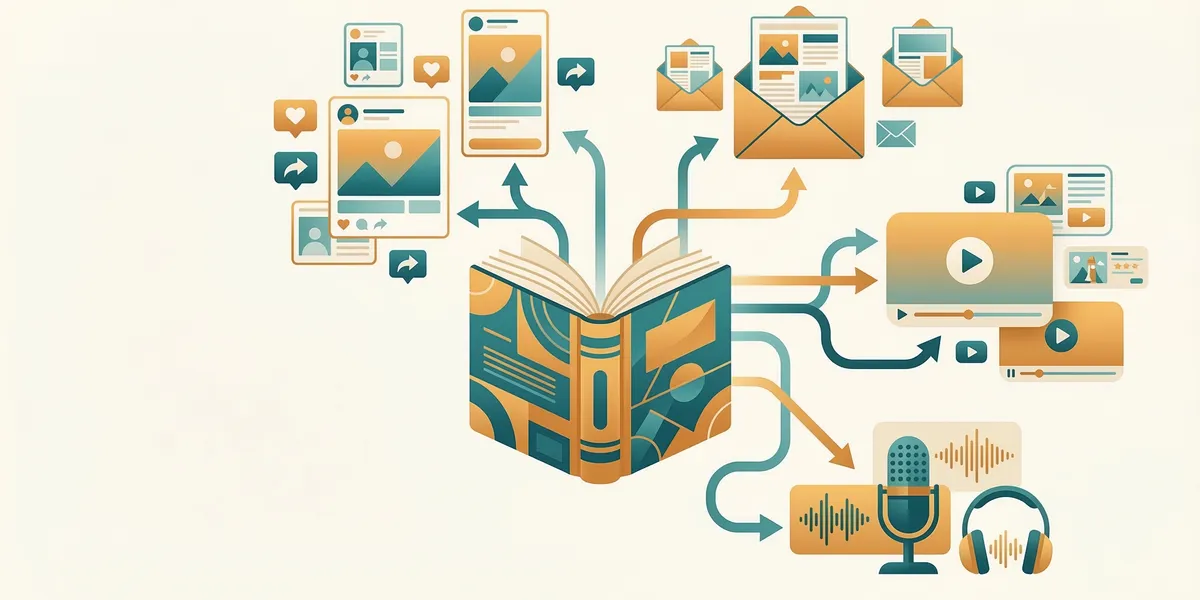
A 50,000-word book contains enough raw material for six months of daily content across every platform you use. Most authors publish their book, share a few launch posts, and never touch that material again. That is a massive waste.
The math is straightforward. A typical nonfiction book has 12 to 20 chapters. Each chapter holds 2 to 3 blog post topics, 10 to 15 social media quotes, a newsletter issue, and a podcast episode outline. Multiply that across every format and you are looking at 100 to 300 individual pieces of content from a single manuscript.
The multiplication principle
One book is not one piece of content. It is a content library waiting to be unpacked.
Here is what a 15-chapter nonfiction book produces when you repurpose strategically:
| Content Type | Per Chapter | Total (15 Chapters) |
|---|---|---|
| Blog posts | 2-3 | 30-45 |
| Social media quotes | 10-15 | 150-225 |
| Email newsletters | 1-2 | 15-30 |
| Podcast/video episodes | 1 | 15 |
| Infographics | 1 | 15 |
| Lead magnets | 0.5 | 7-8 |
| Total minimum | 230+ |
The key insight is that each format reaches a different audience segment. Someone who reads your blog may never open your emails. A person scrolling TikTok will never see your long-form LinkedIn post. Repurposing is not repetition — it is reaching new people with ideas they would otherwise miss.
According to the Content Marketing Institute’s 2025 report, 73% of B2B marketers say content repurposing is their most effective strategy for scaling output without scaling team size. For solo authors, the leverage is even greater because you already have the source material written.
10 ways to repurpose your book
1. Turn each chapter into 2 to 3 blog posts
Every chapter contains a main argument and supporting points. The main argument becomes one blog post. Each major supporting point becomes its own standalone post.
A chapter on “pricing your services” becomes three posts: “How to Set Your Consulting Rate,” “The Psychology of Premium Pricing,” and “5 Pricing Mistakes That Cost Consultants Clients.” Each targets a different keyword and solves a different search query.
If you wrote your book with Chapter, your chapters are already structured with clear sections that map directly to blog topics. The AI-assisted outlining process tends to create well-segmented content that repurposes cleanly.
2. Pull social media quotes and carousels
Go through your manuscript and highlight every sentence that stands alone as a complete thought. Look for:
- Contrarian statements (“Most authors waste 90% of their book’s marketing potential”)
- Statistics or data points
- Frameworks or models you named
- Short stories or anecdotes that fit in a caption
Turn these into quote graphics for Instagram, carousel slides for LinkedIn, or text posts for X. A single chapter typically yields 10 to 15 quotable moments. Tools like Canva or Buffer make batch-creating social graphics fast.
3. Create an email newsletter series
Your book’s table of contents is a ready-made email series. Each chapter becomes one newsletter issue — a condensed version of the key takeaway with a personal reflection or update added.
A 15-chapter book gives you 15 weeks of weekly newsletters. Add an intro email, a wrap-up email, and a few bonus emails between chapters, and you have four months of email content planned out.
According to Litmus’s 2025 email benchmark report, email marketing returns an average of $36 for every $1 spent. An author newsletter built from your book content is one of the highest-ROI marketing activities available.
4. Record podcast or YouTube episodes per chapter
Each chapter is a 20 to 40 minute conversation waiting to happen. You already know the material — you wrote the book. Record yourself discussing the chapter’s key ideas, sharing the stories behind the research, and adding updates since publication.
If you have a podcast, this gives you 15 or more episodes. If you don’t, consider starting a YouTube channel where you teach each chapter’s core lesson in 10-minute videos. Riverside.fm and Descript make solo recording and editing simple.
5. Build an online course from your book
Your book’s structure is a course curriculum. Each chapter becomes a module. Each section within a chapter becomes a lesson.
The difference between a $15 book and a $500 course is delivery format and interaction. Add video walkthroughs, worksheets, templates, and a community component, and you have transformed the same intellectual property into a premium product.
Authors who use their book as a course foundation report conversion rates of 5 to 15% from book readers to course buyers, according to Teachable’s creator economics report.
6. Develop a webinar or workshop
Take your book’s most compelling chapter — the one that gets the most reader feedback — and expand it into a 60-minute workshop. Add interactive elements, live Q&A, and a deeper dive into the implementation steps.
Webinars work as lead generation (free) or revenue (paid workshops at $47 to $197). Either way, the content already exists in your manuscript. You are packaging it for a live audience.
7. Extract lead magnets
Your best chapter, a key framework, or a particularly useful section makes an excellent lead magnet. Pull it out, format it as a standalone PDF, and offer it as a free download in exchange for an email address.
Options include:
- A “quick start” version of your book’s main framework
- A checklist based on your step-by-step chapters
- The first three chapters as a free sample
- A companion worksheet for your most actionable chapter
8. Build a speaking presentation deck
Every chapter contains a 15 to 20 minute presentation. Structure it as: hook (the chapter’s opening story), problem (what the chapter addresses), framework (your solution), examples (from the book), and call to action.
Authors who speak regularly report that their book is the single best credibility builder for landing gigs. According to the National Speakers Association, published authors command 30 to 50% higher speaking fees than non-published experts in the same field.
9. Create infographics from key frameworks
If your book contains any frameworks, models, processes, or step-by-step systems, those are infographic material. A visual representation of your methodology gets shared on Pinterest, LinkedIn, and in other people’s presentations.
Tools like Canva and Piktochart let you create professional infographics without design skills. Focus on your book’s signature frameworks — the ones readers reference most.
10. Write short ebook spinoffs
Take a single chapter or a cluster of related chapters and expand them into a focused short ebook (5,000 to 15,000 words). These work as:
- Amazon Kindle Short Reads (a separate listing that drives traffic to your main book)
- Lead magnets with higher perceived value than a PDF
- Niche-targeted content for a specific audience segment your main book addresses broadly
A business book might spin off into “The Manager’s Quick Guide to [Specific Topic]” or “The Freelancer’s Version of [Your Framework].”
The batch content creation system
Repurposing works best when you batch the process rather than creating content one piece at a time.
Step 1: The content extraction day (4 hours)
Go through your entire manuscript and extract:
- Every quotable sentence (for social media)
- Every main argument per chapter (for blog posts)
- Every story or anecdote (for newsletters and talks)
- Every framework or process (for infographics and courses)
Put these in a spreadsheet organized by chapter and content type.
Step 2: The batch creation days (2 to 3 hours per format)
Pick one format and create all the content for it at once. Write all 30 blog post outlines in one session. Design all 15 infographics in another. Record all podcast episodes in a single week.
Batching reduces context-switching and produces more consistent content. Chapter’s AI writing tools can help draft blog posts from your chapter notes, turning a full day of writing into a few hours of editing.
Step 3: Schedule over 6 months
Spread your content across a 6-month calendar:
| Month | Focus | Output |
|---|---|---|
| 1-2 | Blog posts + social media | 15 posts, 60 social graphics |
| 2-3 | Email series + lead magnets | 15 emails, 3 lead magnets |
| 3-4 | Podcast/video episodes | 15 episodes |
| 4-5 | Course development | 1 course launch |
| 5-6 | Speaking + partnerships | 3-5 presentations |
This schedule means you are publishing new content from your book for half a year after launch, keeping momentum going long past the typical two-week launch window.
Tools for each repurposing format
| Format | Recommended Tools |
|---|---|
| Blog posts | Chapter for AI-assisted drafting, WordPress or Ghost for publishing |
| Social media | Canva for graphics, Buffer or Hootsuite for scheduling |
| ConvertKit or Mailchimp for sequences | |
| Podcast | Riverside.fm for recording, Descript for editing |
| Course | Teachable, Kajabi, or Thinkific |
| Infographics | Canva or Piktochart |
| Lead magnets | Google Docs to PDF, or Designrr for formatted ebooks |
| Presentations | Google Slides, Keynote, or Pitch |
Common mistakes to avoid
- Repurposing without adapting. A blog post is not a chapter copy-pasted. Each format has different expectations for length, structure, and tone. Rewrite for the medium.
- Trying every format at once. Pick 2 to 3 formats that match where your audience spends time. Ignore the rest until those are running smoothly.
- Forgetting the call to action. Every piece of repurposed content should lead somewhere — your email list, your book page, your website. Do not create orphan content.
- Never updating. Your book’s ideas evolve as you learn more. Update repurposed content with new insights, data, and examples. Stale content stops performing.
- Skipping platform building. Repurposed content works best when you have a home base (website, email list) that captures the attention you generate on social platforms.
FAQ
How soon after publishing should I start repurposing?
Start immediately. Ideally, begin extracting content during the editing phase so you have material ready for launch week. The first 90 days after publication are when reader interest is highest.
Does repurposing hurt my book sales?
No. Repurposed content is marketing for your book, not a replacement for it. Giving away a chapter’s key insight in a blog post makes people want the other 14 chapters. According to BookFunnel’s author survey, authors who actively repurpose content report 25 to 40% higher book sales compared to those who rely solely on launch-week promotion.
Can I repurpose fiction the same way?
Yes, but the formats differ. Fiction repurposing focuses on behind-the-scenes content (how you built the world, character backstories, deleted scenes), aesthetic content for BookTok and Instagram, and companion content like character guides or maps.
What if my book is already a year old?
Repurposing has no expiration date. Evergreen nonfiction is especially valuable because the content stays relevant. Starting a repurposing campaign a year after publication can create a “second launch” effect that reignites sales.