You can self-publish a children’s book for as little as $0 upfront using print-on-demand platforms — or invest $2,000-$8,000 for a professionally illustrated picture book. Either way, the process is straightforward once you know the steps.
In this guide, you’ll learn:
- How to choose the right format for your children’s book (board book, picture book, chapter book)
- Where to find illustrators and how much they cost
- Which self-publishing platforms work best for children’s books
- How to price, market, and actually sell copies
Here’s the complete process from manuscript to published book.
What Type of Children’s Book Are You Publishing?
Before you spend a dime, nail down your book’s category. Each format has different word counts, page counts, illustration needs, and production costs.
| Category | Age Range | Word Count | Page Count | Illustrations |
|---|---|---|---|---|
| Board Book | 0-3 | 0-100 | 8-16 | Every page, bold/simple |
| Picture Book | 3-8 | 200-1,000 | 32 (standard) | Every spread, full color |
| Early Reader | 5-9 | 1,000-5,000 | 32-64 | Spot illustrations |
| Chapter Book | 6-10 | 8,000-12,000 | 64-120 | Occasional spot art |
| Middle Grade | 8-12 | 20,000-55,000 | 150-300 | Cover only (usually) |
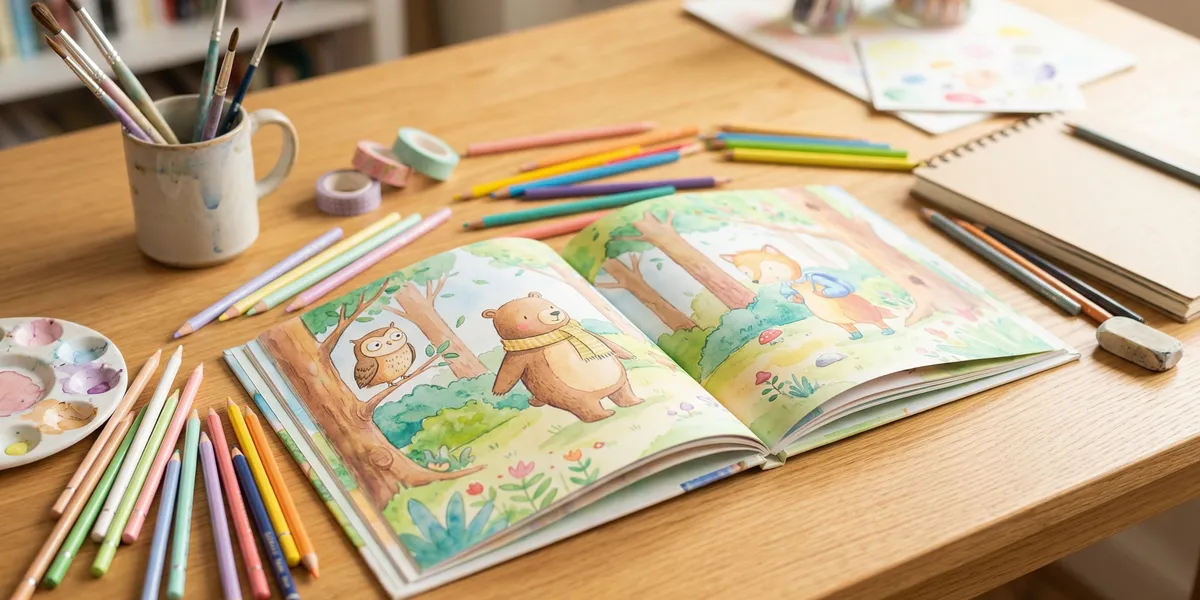
Picture books are the most common choice for first-time self-publishers. They’re 32 pages, heavily illustrated, and aimed at ages 3-8. Most of this guide focuses on picture books, but the publishing steps apply to all categories.
Your age category determines everything — the story’s themes, vocabulary level, plot complexity, and how much you’ll spend on illustrations. Get this wrong, and your book won’t land with the right audience.
How to Write Your Children’s Book Manuscript
Your manuscript needs to be tight. Picture books use around 500-800 words — every single one matters.
Write your text separately from any illustration notes. Keep sentences short. Read the story out loud to hear the rhythm. Children’s books thrive on repetition, rhyme (optional), and emotional beats that young readers connect with.
If you’re writing a chapter book or middle grade novel, you have more room to develop plot and character. But the same principle applies: children’s writing demands clarity and economy that most adult fiction doesn’t require.
Practical tip: Write your page breaks into the manuscript. For a 32-page picture book, you have roughly 14-15 spreads of story content (after title page, copyright, etc.). Map each spread to 1-3 sentences and a visual idea.
Our Pick — Chapter
Chapter’s AI writing assistant helps you draft and refine your children’s book manuscript. Outline your story, generate age-appropriate text, and edit until every word earns its place.
Best for: Authors who want a structured writing workflow with AI-powered drafting and editing Pricing: $97 one-time (nonfiction) | Varies (fiction) Why we built it: Writing a children’s book means choosing every word carefully — Chapter helps you get there faster without sacrificing quality.
How to Get Illustrations for Your Children’s Book
Illustrations make or break a children’s book. For picture books, they carry at least half the storytelling weight.
You have four main options:
Hire a Professional Illustrator
This is the gold standard. A professional children’s book illustrator charges between $1,500 and $5,000+ for a 32-page picture book, depending on style, experience, and complexity.
Where to find illustrators:
- Reedsy — curated marketplace with vetted children’s book illustrators
- Fiverr / Upwork — budget options starting around $500 for a full book
- SCBWI (Society of Children’s Book Writers and Illustrators) — professional directory
- Instagram / Behance — search children’s book illustration hashtags
Illustrate It Yourself
If you have artistic skills, this saves thousands. Use tools like Procreate (iPad), Adobe Illustrator, or even Canva for simpler styles. Just make sure your art is print-resolution (300 DPI minimum).
Use AI-Generated Illustrations
AI image tools like Midjourney, DALL-E, and Stable Diffusion can generate children’s book-style illustrations. The quality has improved dramatically, but you’ll need consistency across characters and scenes — which remains a challenge.
Important consideration: Some publishing platforms and contests don’t accept AI-generated artwork. Check the policies of your target platform before committing to this approach.
Collaborate With an Art Student
Art schools are full of talented illustrators building portfolios. You can often find a collaborator willing to work for a lower fee or a revenue-share arrangement.
No matter which route you choose: Get a signed contract or agreement specifying who owns the artwork. For hired illustrators, you want a “work for hire” agreement that gives you full rights to the illustrations.
How to Edit a Children’s Book
Don’t skip editing just because your book is short. In fact, shorter books need tighter editing — there’s nowhere for weak writing to hide.
You need two types of editing:
Developmental editing catches structural problems. Is the pacing right? Does the emotional arc land? Is the vocabulary appropriate for your target age? A developmental editor for a picture book costs $200-$500.
Copy editing and proofreading catches grammar, spelling, and consistency errors. Expect $100-$300 for a picture book.
Budget-friendly alternatives: Join a critique group through SCBWI or online communities like r/ChildrensBooks. Beta readers who are parents, teachers, or librarians give invaluable feedback on whether the story actually works for kids.
Read the book aloud to actual children. Watch their faces. Note where they fidget, where they laugh, where they lose interest. That feedback is worth more than any editorial letter.
How to Format and Design Your Children’s Book
Children’s book design is more complex than adult book formatting. You’re working with text-image integration, bleed areas, and trim sizes that vary by format.
Choose Your Trim Size
Common children’s book sizes:
- 8.5” x 8.5” — square, popular for picture books
- 8” x 10” — portrait orientation, classic picture book size
- 10” x 8” — landscape orientation, great for panoramic illustrations
- 6” x 9” — standard for chapter books
Amazon KDP supports specific trim sizes for paperback. Check their current specifications before finalizing your design.
Interior Layout
Use professional layout software:
- Adobe InDesign — industry standard, but steep learning curve
- Canva — easier for beginners, has children’s book templates
- Affinity Publisher — affordable one-time purchase, professional results
- BookSirens / Atticus — simplified book formatting tools
Critical detail: Set up your pages with proper bleed (0.125” typically) if your illustrations extend to the edge of the page. Without bleed, you’ll get white borders where you don’t want them.
Cover Design
Your cover sells the book. It needs to work as a thumbnail on Amazon — which means bold colors, clear title text, and an illustration that pops at small sizes.
Hire a cover designer ($200-$500) or design it yourself if you’re confident. The cover should match the interior illustration style exactly.
How to Get an ISBN for Your Children’s Book
An ISBN (International Standard Book Number) identifies your book in the global marketplace. Here’s what you need to know:
Option 1: Buy your own ISBN. A single ISBN costs $125 through Bowker (the only authorized U.S. seller). A pack of 10 costs $295. Buying your own means you’re listed as the publisher, giving you full control.
Option 2: Use a free ISBN from your platform. Amazon KDP, IngramSpark, and other platforms offer free ISBNs. The catch: the platform is listed as the publisher, not you. This limits your ability to distribute through other channels.
Recommendation: If you’re serious about building a publishing business, buy your own ISBNs. If this is a one-off passion project, a free KDP ISBN works fine.
You’ll need separate ISBNs for each format — paperback, hardcover, and ebook each require their own number.
Where to Self-Publish Your Children’s Book
Choosing the right platform affects your royalties, distribution reach, and print quality. Here are the best options:
Amazon KDP (Kindle Direct Publishing)
Best for: Maximum reach and ease of use
- Free to publish
- Paperback and hardcover available
- Access to the world’s largest book marketplace
- 60% royalty on paperbacks (list price minus printing cost)
- Ebook publishing included
- Step-by-step KDP guide
Limitation: Print quality is good but not exceptional for heavily illustrated books. Color reproduction can be inconsistent.
IngramSpark
Best for: Wide distribution and bookstore placement
- Distributes to 40,000+ retailers, libraries, and schools worldwide
- Higher print quality options
- Hardcover with dust jacket available
- Setup fee of $49 per title (sometimes waived with promotions)
- Better for reaching bookstores and libraries
Lulu
Best for: Budget-friendly printing and niche formats
- No setup fees
- Good color printing quality
- Supports unusual trim sizes
- Lulu Direct for selling from your own website
BookBaby
Best for: Authors who want done-for-you services
- Packages from $399+
- Handles formatting, distribution, and printing
- Good for authors who don’t want to manage the technical details
Best strategy: Publish on Amazon KDP for reach, and IngramSpark for bookstore and library distribution. Many successful children’s book authors use both.
How Much Does It Cost to Self-Publish a Children’s Book?
Here’s a realistic cost breakdown for a 32-page picture book:
| Expense | Budget Range | Professional Range |
|---|---|---|
| Illustrations | $500-$1,500 (Fiverr/AI) | $2,000-$5,000 |
| Editing | $0 (beta readers) | $300-$500 |
| Cover Design | $0 (included w/ interior) | $200-$500 |
| Interior Layout | $0 (DIY with Canva) | $300-$800 |
| ISBN | $0 (free from KDP) | $125 (Bowker) |
| Copyright Registration | $0 (optional) | $35-$55 |
| Proof Copies | $10-$30 | $10-$30 |
| Total | $510-$1,530 | $2,970-$6,885 |
You can publish for even less if you illustrate the book yourself or use AI-generated art. The full breakdown of self-publishing costs covers strategies for every budget.
Print-on-demand means no inventory risk. You don’t pay for a print run upfront. Books are printed when customers order them, so your only costs are the creative production.
How to Price Your Self-Published Children’s Book
Pricing a children’s book requires balancing production costs, market expectations, and royalty math.
Typical price ranges:
- Picture book (paperback): $9.99-$16.99
- Picture book (hardcover): $16.99-$24.99
- Chapter book (paperback): $7.99-$12.99
- Ebook: $2.99-$5.99
Amazon KDP royalty math example: If your 32-page color picture book costs $4.50 to print on KDP and you price it at $12.99, your royalty is approximately ($12.99 x 0.60) - $4.50 = $3.29 per copy.
Check competing titles in your category on Amazon. Price competitively — especially for your first book. You can always raise prices once you build reviews and a readership.
How to Market a Self-Published Children’s Book
Publishing is only half the work. Here’s how to actually sell copies.
Optimize Your Amazon Listing
Your Amazon listing is your storefront. Get these elements right:
- Title and subtitle with relevant keywords (“A Bedtime Story About Kindness for Ages 3-5”)
- Book description that speaks to parents (they’re the buyers)
- Categories — select the most specific children’s book categories available
- Keywords — use all 7 keyword slots with relevant search terms
- A+ Content — add enhanced images and description if you have a brand registry
Build a Launch Strategy
- Set a launch date 2-4 weeks out
- Gather advance reviews — give free copies to parent bloggers, teacher friends, librarians
- Run a KDP free promotion or countdown deal during launch week
- Post on social media — Instagram and TikTok are strong for children’s books
- Email your network — personal outreach converts well for first-time authors
Target the Right Audiences
Your readers are children. Your buyers are adults. Your marketing speaks to parents, grandparents, teachers, and librarians.
School and library visits are one of the highest-converting marketing channels for children’s book authors. Even virtual visits work well. Contact local schools and libraries to set up readings.
Book fairs and markets put your book directly in the hands of buyers. Invest in a tablecloth, a sign, and a stack of books. The in-person experience sells children’s books better than almost any online tactic.
For a deeper dive into book marketing strategies, check out how to market a self-published book.
Common Mistakes to Avoid
- Writing for adults, not children. Your book should entertain kids, not impress other adults. Read it to actual children before publishing.
- Skimping on illustrations. For picture books, bad illustrations will sink even a great story. Invest here above all else.
- Ignoring trim size specifications. Each platform has specific requirements. Upload the wrong dimensions and your book will look amateurish.
- Not getting a proof copy. Always order a physical proof before making your book available for sale. Colors, text size, and binding can look very different in print.
- Pricing too low. Children’s books are premium products. A $4.99 picture book signals low quality to parents. Price at $9.99+ for paperback.
How Long Does It Take to Self-Publish a Children’s Book?
Self-publishing a children’s book typically takes 3-12 months from finished manuscript to published book. The timeline depends almost entirely on illustrations.
If you illustrate the book yourself or use AI tools, you could publish within 4-8 weeks. Hiring a professional illustrator usually takes 2-6 months for a complete picture book, depending on their schedule and your revision process.
The publishing steps themselves — formatting, uploading, and getting approved — take less than a week on most platforms. Amazon KDP typically makes your book available within 24-72 hours of approval.
Can You Make Money Self-Publishing Children’s Books?
Yes — but set realistic expectations. Most self-published children’s books sell between 50-500 copies. A well-marketed picture book on Amazon can earn $500-$5,000 in its first year.
The authors who earn real income from children’s books typically:
- Publish multiple titles (series do especially well)
- Invest in professional illustrations that compete with traditionally published books
- Actively market through schools, libraries, and social media
- Build an author platform with a website and email list
Chapter.pub has helped over 2,147 authors bring their book ideas to life, with some generating $13,200 from their first book and landing speaking gigs for audiences of 20,000+. The right tools and workflow make a real difference.
Do You Need a Publisher for a Children’s Book?
No — self-publishing gives you more control and higher royalties. Traditional publishers offer advances and wider distribution, but they also take 85-92% of your book’s revenue and control your creative decisions.
Self-publishing lets you:
- Keep 60-70% of royalties (vs. 8-15% with traditional)
- Control your cover, illustrations, and pricing
- Publish on your timeline (traditional can take 2-3 years)
- Retain all rights to your work
The trade-off: you handle (or hire out) editing, illustration, design, and marketing yourself. For a detailed comparison, see self-publishing vs. traditional publishing.
FAQ
How much does it cost to self-publish a children’s book?
Self-publishing a children’s book costs between $500 and $7,000, depending on whether you hire professional illustrators, editors, and designers. The biggest expense is illustrations, which range from $500 for budget options to $5,000+ for professional work. You can publish for under $100 if you create your own artwork and use free platform tools.
Can I self-publish a children’s book on Amazon?
Yes, you can self-publish a children’s book on Amazon through Kindle Direct Publishing (KDP) for free. KDP supports paperback, hardcover, and ebook formats. You upload your manuscript and cover files, set your price, and your book goes live within 24-72 hours. You earn approximately 60% royalty on paperback sales.
Do I need an illustrator for a children’s book?
You need illustrations for picture books and board books, but you don’t necessarily need to hire an illustrator. You can illustrate the book yourself, use AI illustration tools, or collaborate with an art student. For chapter books and middle grade novels, illustrations are optional — a strong cover design may be sufficient.
How many pages should a children’s picture book be?
A standard children’s picture book is 32 pages, including the title page, copyright page, and story pages. This gives you approximately 14-15 spreads of story content. Page counts for children’s books are always multiples of 8 (16, 24, 32, 40, or 48 pages) due to how printing signatures work.
What age group should I write my children’s book for?
Choose your age group before writing a single word. The main categories are board books (0-3), picture books (3-8), early readers (5-9), chapter books (6-10), and middle grade (8-12). Your target age determines word count, vocabulary, themes, and illustration style. This guide to writing a children’s book covers each category in detail.