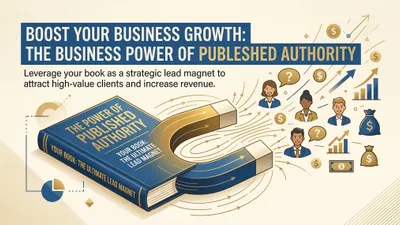
You use a book to get clients by putting it into sales conversations, not bookstores. The copies you hand out, mail, and reference on calls do the persuading that a proposal cannot.
In this guide, you’ll learn:
- The four places a book earns clients: the sales call, the leave-behind, cold outreach, and the stage
- How to move a reader from page one to a booked discovery call without a hard pitch
- How to reprice and reposition your services once you’re the person who wrote the book
- How to track which clients actually came from the book
Here’s how each play works.
How Does a Book Actually Get You Clients?
A book gets you clients by collapsing the trust-building phase of a sale. A prospect who reads 150 pages of your thinking arrives at the call already convinced you know the problem — so the conversation skips credibility and goes straight to scope, timeline, and price.
That shift shows up in the money. In a survey of 150 U.S. professionals, published authors billed $345 an hour versus $251 for non-authors — a 37% premium for the same work. Among consultants and advisors, published authors won the engagement 52% to 67% of the time, against 33% to 48% for non-authors.
The revenue follows the same pattern. The 2024 Business Book ROI Study of 300+ business authors found that for authors earning more than $25,000 from their book, 69% of that revenue came from sources other than book sales — consulting, speaking, and workshops.
So stop measuring the book by copies sold. Measure it by calls booked.
This guide assumes you already have a book, or are close. If you’re still deciding what to write, start with how to write a book for your coaching business or the broader authority book playbook. If you want the funnel side — landing pages, email capture, and the back-end value ladder — that lives in the lead generation book guide. This post is about the conversations.
Play 1: How to Use Your Book in a Sales Conversation
Use your book on a sales call by referencing it as shared context, never as a credential. Saying “chapter four covers this exact failure mode — did that section land for you?” turns a pitch into a diagnostic conversation, because the prospect is now discussing your framework instead of evaluating your résumé.
The mistake is announcing you wrote a book. Everyone on the call already knows. Announcing it makes you the salesperson. Referencing it makes you the author whose ideas are on the table.
Send the book before the call, not after
Ship a physical copy the moment a qualified prospect books time with you. Two things happen: the meeting almost never gets cancelled, because a physical object arrived with their name on it, and roughly a third of prospects will have skimmed the relevant chapter.
If the call is inside 48 hours, send a PDF of the two chapters that match their situation. Not the whole book — two chapters. A specific, small ask gets read.
Run the call off your own framework
Open the call by naming the framework from the book and asking which stage they’re in. You now control the diagnostic vocabulary of the entire sale.
This is the quiet advantage. When a prospect describes their problem using your chapter names, competing vendors have to argue against a model the prospect already believes.
Let the book handle the objection you hate
Every service business has one objection that eats calls — “we tried this before,” “our situation is different,” “can we do this in-house?” Write the honest answer into a chapter, then point at it.
“That’s the question I wrote chapter seven about. Read it tonight and tell me tomorrow if it changes your read.” An objection answered in print reads as considered. The same words spoken live read as defensive.
Play 2: How to Use Your Book as a Leave-Behind
Use your book as a leave-behind by handing a copy to every prospect at the end of every meeting, with one line: “I’d like you to have this — it’s how we think about the problem you just described.” A book survives the desk purge that kills every brochure and one-pager.
That survival is the whole point. A capability deck gets deleted. A book sits on a shelf, spine out, with your name on it, in a room where your buying committee meets.
Sign it. Write the prospect’s name and one specific sentence about their situation on the title page. A signed copy is now non-transferable and un-throw-away-able — it belongs to that person.
Where the leave-behind earns its keep:
- End of a discovery call — the memory anchor while they compare vendors
- Conferences and industry events — a book beats twelve business cards
- Board and committee meetings — the copy that stays in the room after you leave
- Referral partners — accountants, lawyers, and agencies who send you work need something to hand their own clients
- Existing clients — one copy for the client, three for the peers they’ll recommend you to
Budget for this properly. Author copies through print-on-demand run a few dollars each. Giving away 300 copies a year to qualified prospects costs less than one month of paid ads and converts at a rate ads never touch.
Play 3: How to Use Your Book for Cold Outreach
Use your book for cold outreach by mailing a signed copy with a one-paragraph note to a short list of named, high-value targets. A padded envelope gets opened by an executive assistant and placed on the desk. A cold email gets filtered.
The economics only work at low volume and high contract value. Twenty-five books to twenty-five named executives, at roughly $8 all-in per package, is a $200 campaign. If one becomes a $30,000 engagement, nothing else in your marketing comes close.
The note that goes inside — four sentences, no more:
- Why this person specifically (something real about their company, not a merge field)
- Which chapter you think is relevant to them and why
- A single sentence on what you do
- A low-friction ask: “If it’s useful, I’d welcome 20 minutes.”
Never ask for the meeting in sentence one. The gift does the work; the ask just needs to be findable.
Follow up eight to ten days later with one short email referencing the book by name. Response rates on book-anchored follow-ups run far ahead of standard cold email because the recipient has a physical reminder of you sitting three feet away.
Play 4: How to Turn Readers Into Discovery Calls
Turn readers into discovery calls by putting one specific, low-commitment offer inside the book and repeating it in three places: the end of the strongest chapter, the final chapter, and the author bio. Vague invitations to “get in touch” convert nobody.
The offer should be a diagnostic, not a sales call. “Book a 20-minute [framework name] audit” outperforms “schedule a consultation” because it names a deliverable and caps the time.
Where to place the invitation:
| Placement | What to offer | Why it works |
|---|---|---|
| End of your strongest chapter | The audit or scorecard | Peak conviction moment, before the reader drifts |
| Final chapter | A structured next step | The reader just finished — momentum is highest |
| Author bio | Your URL and the offer restated | The most-read page in any nonfiction book |
| Resource appendix | Templates behind an email opt-in | Captures readers not ready to talk yet |
Keep the URL short, brandable, and typeable from a paperback — yourname.com/audit, not a tracked link with a query string. Print readers type URLs by hand.
For the list-building side of this — opt-in pages, nurture sequences, and what to sell on the back end — see the lead generation book guide and the $60K book-as-lead-magnet case study.
One more thing that converts far above its effort: client stories inside the book. A reader who sees their own situation described in a case study self-identifies as your next client. If your book is thin on these, case studies in nonfiction books covers how to build them.
How to Price Your Services Off the Back of Your Book
Raise your rates within 90 days of publishing, and use the book as the stated justification. Business authors commonly report raising rates 30% to 50% within a year of publishing, citing the book directly.
The logic a buyer accepts: they aren’t paying for hours, they’re paying for the methodology — and the methodology is now documented, published, and independently verifiable. That’s a different purchase than generic consulting time.
How to run the increase:
- Set the new rate for all new prospects on publication day. Don’t phase it in.
- Grandfather existing clients for one renewal cycle, and tell them you’re doing it. Goodwill plus an anchor.
- Rename your core engagement after the book’s framework. “The [Framework] Sprint” is not comparable to a competitor’s hourly rate — and non-comparable is the point.
- Add a top tier you didn’t offer before. Some percentage of readers want the author, not the associate, and will pay for it.
Do not discount the book itself to drive volume. A free book aimed at unqualified readers fills your calendar with people who wanted free advice. Charge full price, then give copies away deliberately to people you’ve chosen.
How to Position Your Offer So the Book Sells It For You
Position your offer by making your paid service the obvious next step after the book’s last chapter, not a different product. The book should teach the what and the why completely — and leave the doing as the thing you’re hired for.
Get this wrong in either direction and the book stops selling. Hold back the good material and readers feel short-changed, then never call. Include the full implementation, and readers thank you and do it themselves.
The line that works: give away the entire map, sell the guide. Readers finish knowing exactly what has to happen, and most of them realize they don’t want to run it alone.
Your positioning should also narrow. A book called The Retention Playbook for B2B SaaS generates fewer readers and dramatically more clients than Grow Your Business. Specific books attract specific buyers with specific budgets. Thought leadership book strategy goes deeper on choosing that lane.
How to Use Your Book to Get on Stages and Podcasts
Use your book to get booked by pitching the framework, not the book. Event programmers and podcast hosts don’t want an author interview — they want a session their audience will act on. The book is your proof you can deliver it.
Speaking is where book-driven client acquisition compounds. Fee ranges reported across the industry put newer speakers around $2,500 to $5,000 and bestselling authors at $20,000 to $50,000 — and every one of those rooms is full of qualified prospects who just watched you be the expert for 45 minutes.
Two mechanics multiply the return:
- Bulk copies in the deal. Ask the organizer to buy a copy for every attendee as part of your fee. You get paid, they get a takeaway, and 200 books land on 200 desks.
- A room-only offer. End the talk with an audit or resource page created for that event. It’s the only reliable way to convert a stage into a pipeline.
The tactical detail on getting booked lives in how to get speaking gigs with a book and how to get on podcasts as an author. For sustained visibility between gigs, LinkedIn for nonfiction authors covers turning chapters into posts that keep the book in circulation.
How to Track Whether Your Book Is Actually Getting You Clients
Track your book’s client impact by asking every new prospect where they first encountered you, and logging the answer in your CRM as a required field. Book-sourced clients rarely arrive through a trackable link — they arrive through a referral from someone who read it.
The four numbers worth tracking:
| Metric | How to capture it | Healthy signal |
|---|---|---|
| Calls sourced from the book | Required “how did you hear about us” field | Rising share of total pipeline |
| Copies placed with qualified prospects | Count what you mail and hand out | 200-400 per year for most solo consultants |
| Close rate: readers vs. non-readers | Tag deals at creation | Readers should close meaningfully higher |
| Average deal size: readers vs. non-readers | Same tag, compare at close | Readers should skew larger |
Give it two to four quarters before you judge. Books work on a referral delay — the copy you hand out in March produces a call in November when the reader changes jobs or a colleague asks for a recommendation.
Common Mistakes to Avoid
- Treating launch week as the campaign. Launch is the smallest part. The book earns clients in year two and three, one conversation at a time — which is why business book marketing strategy is a multi-year plan, not a two-week push.
- Optimizing for bestseller lists instead of buyers. A rank spike from a discount promotion brings readers with no budget. Ten copies in the right hands beat 10,000 in the wrong ones.
- Keeping the book off the sales call. Most authors never mention the book in the conversations where it would do the most work.
- Hiding the offer. If the book has no clear next step, readers who wanted to hire you simply won’t find the door.
- Writing for peers. A book aimed at impressing other consultants will not be read by the people who write checks.
- Running out of stock. Keep 50 copies in the office. The leave-behind play dies the week you have nothing to hand over.
How Many Clients Can a Book Realistically Get You?
A well-targeted book typically produces a handful of high-value clients per year rather than a flood of small ones — often three to ten engagements for a solo consultant placing a few hundred copies annually. The number is small; the contract values are not.
Run your own math before you judge that. If your average engagement is $25,000 and the book produces four a year, it’s a $100,000 asset that keeps working with no ad spend attached to it.
How Long Does It Take for a Book to Start Getting Clients?
Expect first client conversations within 30 to 60 days of publishing, and meaningful pipeline by month six. Early results come from your existing network, who buy in the first weeks. The compounding referral effect takes two to four quarters to show up.
That lag is why most authors quit too early. The book that produced nothing in month three is often the one producing steady inbound in month eighteen — because copies are still circulating.
What If You Don’t Have the Book Yet?
The plays above need a finished book, and the usual blocker isn’t strategy — it’s the year most consultants assume writing takes. It doesn’t have to.
Our Pick — Chapter
Chapter turns your existing expertise — frameworks, client notes, talks you already give — into a structured nonfiction manuscript, chapter by chapter, in your own voice. You direct the outline and edit the drafts; it removes the blank-page problem that stalls most consultant books.
Best for: Consultants, coaches, and agency owners who have the expertise and the client stories but not six free months. Pricing: $97 one-time (nonfiction). Why we built it: 10,000+ authors have used Chapter to write books, and the pattern that keeps showing up is exactly this one — a service business owner whose book was worth more as a client-acquisition asset than as a product. Chapter has been featured in USA Today and the New York Times.
Real results from that group: one Chicago consultant published a short book on his methodology and landed a $13,200 client from a single reader who called him cold. An Amazon FBA coach generated $60,000 in 48 hours from a book used as the entry point to his coaching offer. Another author turned a book into a speaking gig in front of 20,000 people.
If you want the writing side of this in detail, see writing a book for your business clients.
FAQ
How do you use a book to get clients?
You use a book to get clients by treating it as a sales asset rather than a product — mailing it before discovery calls, handing signed copies to prospects as a leave-behind, referencing its framework during the sale, and placing one specific low-friction offer inside it that converts readers into booked calls.
Do you need to sell a lot of books to get clients from one?
No. Book sales and client acquisition are separate outcomes. Business authors earning $25,000+ from a book get roughly 69% of that revenue from consulting, speaking, and workshops rather than royalties. A few hundred copies placed with qualified prospects outperforms thousands sold to strangers.
Should you give your book away free to prospects?
Give it away selectively, never universally. A signed copy handed to a qualified prospect is a high-value gift that gets read. A free download offered to everyone attracts readers with no budget and devalues the book. Keep the retail price full and choose your recipients deliberately.
How much can you raise your rates after publishing a book?
Most business authors raise rates 30% to 50% within a year of publishing, and survey data shows published professionals billing around $345 per hour versus $251 for non-authors. The justification buyers accept is that they’re buying a documented, published methodology — not generic hours.
How long should a client-getting book be?
Aim for 120 to 180 pages, roughly 25,000 to 40,000 words. Long enough to prove depth and feel substantial in a prospect’s hand, short enough that a busy executive actually finishes it. A finished book beats a comprehensive one that never gets read.
What should you write about if you want clients, not readers?
Write about the single expensive problem your best clients hire you to solve, and document your complete method for diagnosing it. Narrow beats broad: a specific book attracts fewer readers and far more qualified buyers, because the people who pick it up already have the budget and the pain.