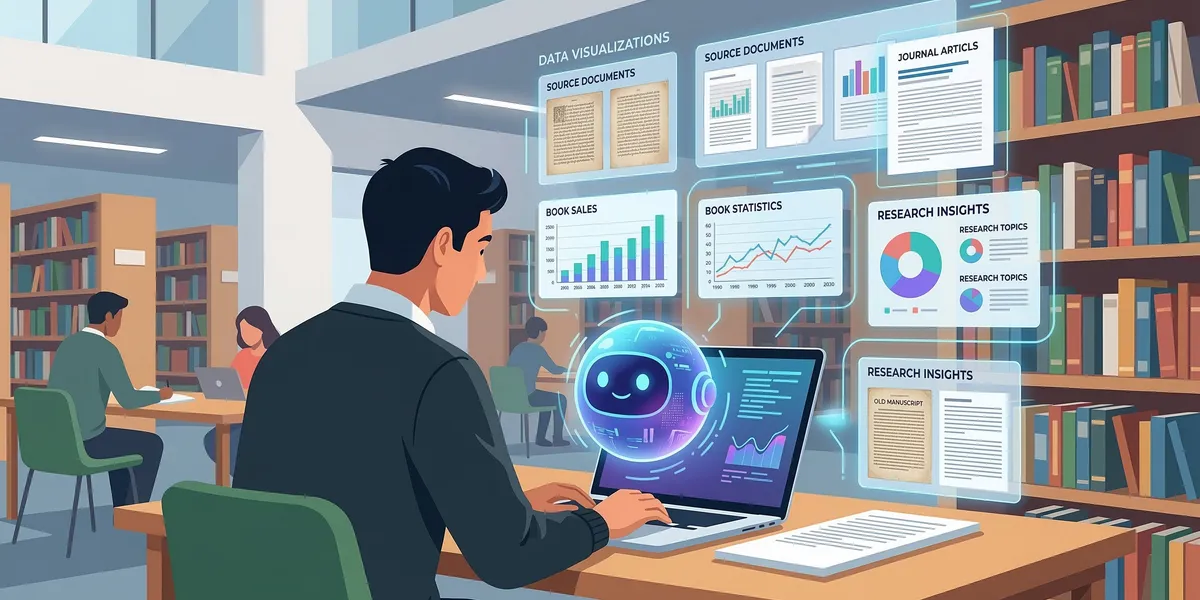
AI changed book research the same way search engines changed it in the 2000s — not by replacing the work, but by collapsing the time between question and useful answer.
Used correctly, AI tools cut research time by half or more. Used incorrectly, they fill your manuscript with confident-sounding information that is partially or completely wrong. The difference comes down to knowing what AI research tools are good at, what they are bad at, and how to verify everything before it reaches your reader.
What AI is good at for research
AI research tools have genuine strengths that traditional research cannot match for speed.
Synthesizing large volumes of information
Feed an AI tool a 50-page report and ask for the 5 key findings relevant to your book topic. What would take you 90 minutes of reading takes 30 seconds. This works for academic papers, government reports, industry analyses, and long-form journalism.
The synthesis is not perfect — AI occasionally misses nuance or emphasizes the wrong point — but as a first pass to identify what deserves deep reading, it is extremely effective.
Exploring multiple angles on a topic
Ask ChatGPT “What are 10 different perspectives on [your book topic]?” and you get a map of the intellectual landscape in seconds. This is especially valuable early in the research process when you are still defining your book’s angle and need to understand the conversation you are entering.
Traditional research finds these perspectives sequentially as you encounter different sources. AI surfaces them simultaneously, giving you a bird’s-eye view before you commit to a direction.
Finding patterns across sources
“Here are summaries of 8 studies on [topic]. What patterns do they share? Where do they contradict each other?” This kind of cross-source analysis is where AI adds the most value. Human researchers do this naturally but slowly. AI does it instantly, though it requires human judgment to evaluate whether the patterns it identifies are meaningful.
Brainstorming research questions
Before you know what to search for, AI helps you figure out what questions to ask. “I’m writing a book about [topic] for [audience]. What are the 20 questions my readers are most likely to have?” produces a research agenda in seconds that would otherwise require survey data or audience interviews.
Generating outlines from research
Once you have collected your sources, AI turns raw research into structured outlines. “Here are my research notes on [topic]. Organize these into a chapter structure for a nonfiction book targeting [audience].” The output is a first-draft outline that shows how your research might fit together narratively.
What AI is bad at for research
These limitations are not minor caveats. They are fundamental constraints that can destroy your book’s credibility if ignored.
Primary sources
AI does not conduct original research. It cannot interview experts, run experiments, observe events, or gather data that does not already exist in its training data. If your book depends on original findings, you must generate them through traditional research methods.
This means AI is useful for secondary research (analyzing what others have found) but cannot replace primary research (discovering new information yourself).
Recent events and current data
AI training data has a cutoff date. Even with web access features, AI tools are unreliable for breaking news, recent statistics, or events from the past few months. If your book covers current trends, verify all recent data directly against the original source.
Accuracy of specific claims
This is the critical weakness. AI generates text that reads like verified fact but may be partially or fully fabricated. Common failure modes:
- Invented studies. “A 2024 MIT study found that…” — the study may not exist
- Wrong numbers. Statistics cited with decimal-point precision that are completely fabricated
- Misattributed quotes. Real quotes attributed to the wrong person, or fabricated quotes attributed to real people
- Blended facts. Two real facts combined into one false claim
- Outdated information. Accurate data from 3 years ago presented as current
The confidence of the output is not correlated with accuracy. AI presents fabricated claims with the same certainty as verified ones. This makes fact-checking a mandatory step, not an optional one.
Niche and specialized knowledge
AI performs worst in specialized domains where the training data is sparse: hyper-specific scientific subfields, regional history, minority cultural contexts, and emerging fields that post-date the training cutoff. The less popular the topic, the more likely the AI is filling gaps with plausible but inaccurate content.
Source attribution
When asked to cite sources, AI frequently invents journal articles, book titles, and URLs that do not exist. Some newer tools (particularly Perplexity) handle citations better, but no AI tool should be trusted to provide accurate source attribution without human verification.
The AI research workflow
Here is the process that balances AI speed with human accuracy.
Step 1: Map the territory
Start with AI to get a high-level understanding of your topic’s landscape.
Prompt: “I’m writing a book about [topic] for [audience]. Give me an overview of the major subtopics, key debates, important figures, and recent developments in this area.”
This gives you a research roadmap. You now know what to search for rather than searching blindly.
Step 2: Generate research questions
Prompt: “Based on this overview, what are the 15 most important questions my book needs to answer? Prioritize questions that readers would ask, controversies that need addressing, and gaps in the current literature.”
These questions become your research agenda. Each one will drive specific searches for primary and secondary sources.
Step 3: Deep research with Perplexity
For questions that require sourced answers, Perplexity is currently the best AI research tool. Unlike ChatGPT and Claude, Perplexity searches the web in real time and provides inline citations with URLs you can verify.
Prompt: “Find the latest statistics on [specific question]. I need data from the past 2 years from reputable sources. Provide the source URL for each statistic.”
Perplexity is not infallible — it sometimes misinterprets sources or cites tangential pages — but the citation-first approach makes verification dramatically easier.
Step 4: Synthesize with ChatGPT or Claude
Once you have verified data from multiple sources, use ChatGPT or Claude to help synthesize it.
Prompt: “Here are my verified findings from 6 sources on [topic]: [paste findings]. Synthesize these into a narrative that identifies the key trends, contradictions, and implications for [your audience].”
The AI acts as a writing assistant at this stage, not a researcher. You supply the facts; it helps organize them.
Step 5: Identify gaps and counterarguments
Prompt: “Based on the research I’ve gathered, what important perspectives or data am I missing? What are the strongest arguments against my thesis? Where is my evidence weakest?”
This prompt catches blind spots before they become problems in your manuscript. It is much cheaper to discover a gap in research than to discover it after publication.
Step 6: Verify everything
This is the non-negotiable step. Every claim that will appear in your book must be checked against a primary source.
Verification checklist:
- Does the study actually exist? Search for it by title, author, and institution.
- Is the statistic accurate? Check the original source, not a secondary report.
- Is the quote real? Find the original speech, interview, or publication.
- Is this current? Check the date of the source and whether newer data exists.
- Is this the full picture? Check whether the study or statistic has been debunked, revised, or contextualized by later work.
Tool comparison for research
| Task | Best tool | Why |
|---|---|---|
| Initial topic exploration | ChatGPT or Claude | Fast, broad, conversational |
| Sourced research with citations | Perplexity | Real-time search with inline citations |
| Long document summarization | Claude | Largest context window for full documents |
| Cross-source synthesis | ChatGPT-4 or Claude | Strong analytical capability |
| Visual data and charts | ChatGPT with code interpreter | Generates charts from data |
| Expert identification | Perplexity | Can find and cite current experts |
| Fact-checking verification | Google Scholar + original sources | AI tools cannot self-verify |
When to stop researching and start writing
AI makes research so fast that it creates a new problem: endless research that delays writing. The temptation to run “one more prompt” and explore “one more angle” is real.
Set a research boundary before you start: define the specific questions your book needs to answer, gather evidence for each, verify the evidence, and stop. Your book does not need to cover everything. It needs to cover the right things well.
For nonfiction writers who want to move from research to finished manuscript efficiently, Chapter interviews you about your expertise and research, then generates a structured manuscript of 80-250 pages. The platform turns your knowledge into a complete book rather than leaving you to assemble prompts into chapters.
Over 2,147 authors have used Chapter to create 5,000+ books, including consultants and experts who used their research and professional knowledge as the foundation. Jim T. turned his consulting expertise into an authority book in 3 days and landed a $13,200 client from a reader. Adam W. saved $25,000 compared to hiring a ghostwriter.
The research tools above help you gather and verify information. Chapter helps you turn that information into a published book.
FAQ
Can I cite AI-generated research in my book?
You should not cite AI as a source. AI generates text from patterns, not from original research. Instead, use AI to find real sources, then cite those sources directly. If AI points you to “a Stanford study on productivity,” find the actual study, read it, and cite it. If you cannot find it, the study may not exist.
How reliable is Perplexity compared to ChatGPT for research?
Perplexity is significantly more reliable for sourced research because it provides inline citations you can verify. ChatGPT and Claude are better for synthesis, brainstorming, and analysis. Use Perplexity to gather facts and ChatGPT/Claude to make sense of them. Neither should be trusted without human verification.
What percentage of AI-generated facts are accurate?
Studies show that AI tools produce factual errors in roughly 3-15% of specific claims, depending on the topic and the model used. That rate is high enough that every claim in your book must be verified. A 10-chapter book with 50 verifiable claims per chapter means 25-75 potential errors if you do not fact-check. See our how to write a book guide for the full quality assurance workflow.
Should I use AI for fiction research too?
Yes, with caveats. AI is excellent for researching historical periods, cultural contexts, and technical details for fiction — “What did a typical 1920s speakeasy look like?” generates useful scene-setting material. But verify historical facts the same way you would for nonfiction. A period detail that is wrong breaks reader trust. Our guide on how to write a nonfiction book covers research methods that apply to both genres.