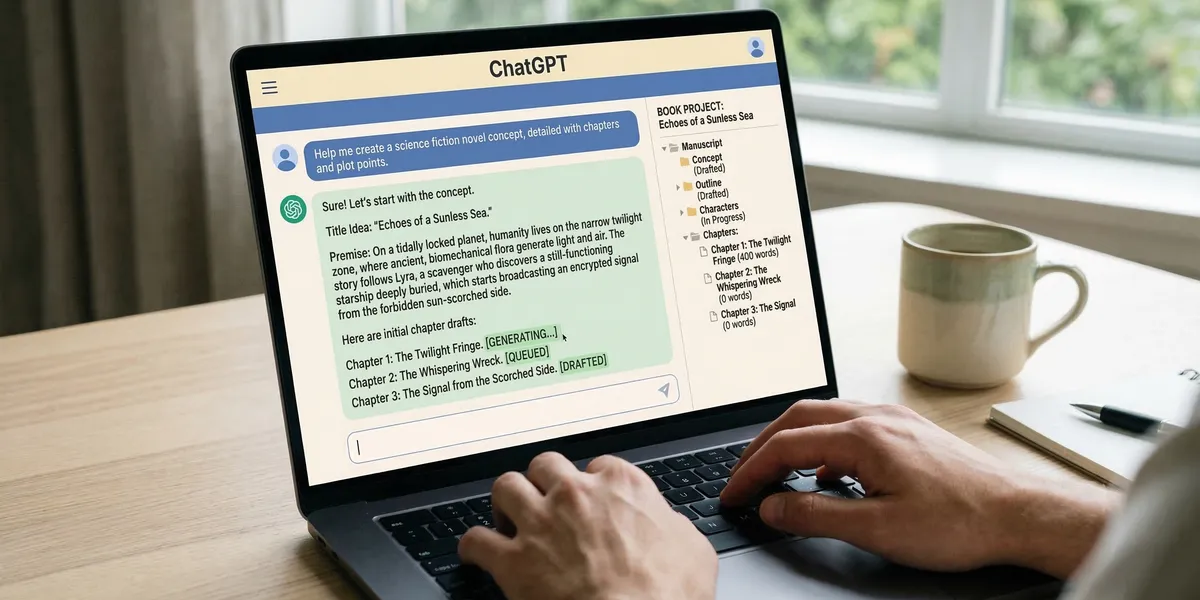
You can use ChatGPT to write a book. Thousands of authors already have. But the process requires more planning than most people expect, and ChatGPT was not built for book-length writing. This guide covers the step-by-step workflow, the real limitations you will hit, and when a dedicated book writing tool is the better choice.
What ChatGPT Can Do for Book Writing
ChatGPT is genuinely useful for several parts of the book writing process. Knowing where it works well saves you from frustration later.
Brainstorming. Ask ChatGPT for book topic ideas, chapter angles, character concepts, or plot premises. It generates dozens of options in seconds. This is one of its strongest use cases — rapid ideation without judgment.
Outlining. Give ChatGPT your book concept and ask for a chapter-by-chapter outline. It produces structured frameworks quickly. You will need to refine them, but the starting point is solid.
Drafting individual chapters. ChatGPT can write a single chapter of 1,500 to 3,000 words if you provide clear instructions about topic, tone, audience, and key points to cover. The output is competent first-draft material.
Editing and rewriting. Paste in a chapter and ask ChatGPT to tighten the prose, fix passive voice, adjust reading level, or rewrite a section in a different tone. It handles this well.
Research summaries. Ask ChatGPT to summarize a concept, explain a historical event, or provide background information for your book. Verify everything it tells you — it can produce inaccurate information — but it accelerates research.
What ChatGPT Cannot Do
This is where most authors get stuck. They expect ChatGPT to produce a complete book in one session. It cannot.
Write a full book in one conversation. ChatGPT’s context window — the amount of text it can hold in memory during a conversation — has limits. Even with GPT-4’s expanded context, it cannot hold an entire 60,000-word manuscript in working memory. By chapter fifteen, it has forgotten what happened in chapter three.
Maintain consistency across 200+ pages. Character details drift. A character described as introverted in chapter two becomes outgoing in chapter eight. Plot threads introduced early get dropped. Terminology shifts. In a single chapter, ChatGPT is consistent. Across a full book, consistency breaks down.
Remember your previous conversations. Each ChatGPT session starts fresh. If you wrote chapters one through five last Tuesday, ChatGPT does not remember them on Wednesday unless you paste them back in — which eats into your context window.
Format for publishing. ChatGPT gives you raw text. You still need to format for KDP, IngramSpark, or whichever platform you publish on. That means dealing with front matter, back matter, page layout, table of contents, and export to PDF or EPUB.
Generate images. Your book needs a cover. ChatGPT cannot produce publication-ready cover designs through its text interface alone.
Step-by-Step ChatGPT Book Writing Workflow
If you want to write a book using ChatGPT, this is the most reliable approach.
Step 1: Define Your Book Before You Touch ChatGPT
Write down these details before opening a chat:
- Book type: Nonfiction (how-to, memoir, business, self-help) or fiction (novel, short stories, novella)
- Target audience: Who is this book for? Be specific.
- Core premise: One sentence describing what the book is about.
- Desired length: How many chapters and approximate total word count.
- Tone and voice: Conversational, academic, literary, punchy, warm.
This preparation is not optional. ChatGPT produces dramatically better output when you give it specific constraints instead of vague instructions.
Step 2: Generate Your Outline
Use this prompt structure:
“Create a detailed chapter-by-chapter outline for a [word count] [genre/type] book about [topic]. The target reader is [audience]. The tone should be [tone]. Include [number] chapters with 3-5 key points per chapter.”
Review the outline carefully. Rearrange chapters, cut sections that feel weak, and add topics ChatGPT missed. This outline becomes your production plan.
Step 3: Write Chapter by Chapter
This is the core workflow. For each chapter:
- Start a new conversation (or clearly re-establish context)
- Paste your full outline so ChatGPT knows where this chapter fits
- Paste the previous chapter’s summary so it knows what came before
- Give detailed chapter instructions: key points, examples to include, target word count
- Generate the chapter
- Review and revise before moving on
Do not try to write multiple chapters in one prompt. Write one chapter at a time, review it, and move on.
Step 4: Maintain a Consistency Document
Create a separate document tracking:
- Character names, descriptions, and traits (fiction)
- Key terms and definitions (nonfiction)
- Facts you have established
- Timeline of events
- Style decisions (do you use Oxford comma? First person or third?)
Paste relevant sections from this document into each new ChatGPT session. This is your manual substitute for the long-term memory ChatGPT does not have.
Step 5: Edit the Complete Manuscript
After all chapters are drafted:
- Read the full manuscript end-to-end
- Flag inconsistencies, repetition, and tonal shifts
- Use ChatGPT to fix specific sections — paste in a chapter and ask for targeted improvements
- Run a final proofread pass
Step 6: Format and Publish
ChatGPT gives you raw text. You still need to:
- Add front matter (title page, copyright, dedication, table of contents)
- Add back matter (about the author, other books, resources)
- Format for your publishing platform
- Design or commission a cover
- Upload to Amazon KDP, IngramSpark, or your chosen distributor
The Core Problem: ChatGPT Was Not Built for Books
The workflow above works. Authors have completed books this way. But it requires significant manual effort to compensate for a fundamental limitation: ChatGPT is a general-purpose conversational AI, not a book writing tool.
You are essentially project-managing the entire process yourself — maintaining consistency documents, re-establishing context in every session, manually tracking plot threads or chapter connections, and handling all formatting and publishing preparation.
For a short ebook of 5,000 to 10,000 words, this overhead is manageable. For a full-length book of 40,000 to 80,000 words, it becomes a second job.
ChatGPT vs a Dedicated Book Writing Tool
| Feature | ChatGPT | Chapter |
|---|---|---|
| Generate full manuscript | No — chapter by chapter | Yes — 80-250 pages in ~60 min |
| Maintain consistency | Manual tracking required | Built-in across entire book |
| Story structure (fiction) | You must provide it | Built-in frameworks (Save the Cat, Three Act, Romance Beat Sheet) |
| Character consistency | Drifts over length | Character profiles maintained throughout |
| Publishing-ready output | Raw text only | KDP-ready formatting |
| Context window | Limited — forgets earlier chapters | Full manuscript awareness |
| Series support | Not built in | Continuity tracker across 9+ books |
| Cost | $20/mo (Plus) or free tier | $97 one-time |
| Learning curve | Low for basic use | Low — guided workflow |
ChatGPT is excellent for brainstorming, outlining, and editing individual sections. For producing a complete, consistent, publish-ready manuscript, a purpose-built tool eliminates the workarounds.
“I’m 58 and not techy. It was so simple.” — Linda R., Chapter user
Linda’s experience reflects what most authors want: a straightforward path from idea to published book without managing a complex multi-session ChatGPT workflow.
When to Use ChatGPT vs a Book Writing Tool
Use ChatGPT when:
- You want to brainstorm book ideas or test a concept
- You are writing a short ebook under 10,000 words
- You enjoy the hands-on process of managing each chapter individually
- You need editing help on sections you have already written
- Budget is zero and you want to use the free tier
Use a dedicated book writing tool when:
- Your book is 40,000+ words (nonfiction) or 20,000-120,000+ words (fiction)
- You need character and plot consistency across the full manuscript
- You want a finished manuscript without managing dozens of ChatGPT sessions
- You need publishing-ready output (formatted for KDP, proper front/back matter)
- You are writing a book series and need continuity tracking
Common Mistakes When Using ChatGPT for Books
- Trying to write the entire book in one prompt. The output will be a shallow 2,000-word summary, not a real book.
- Skipping the outline. Without structure, ChatGPT produces chapters that wander and repeat.
- Not tracking consistency. If you do not maintain a style guide and character/topic tracker, your book will contradict itself.
- Accepting first drafts as final. ChatGPT produces solid first drafts. They still need human editing for voice, accuracy, and flow.
- Ignoring formatting. A manuscript is not a book until it is properly formatted. Budget time for this step.
FAQ
Can ChatGPT write a full novel?
ChatGPT can help you write a novel chapter by chapter, but it cannot generate a complete novel in a single session. Context window limits mean it loses track of earlier content as the manuscript grows. For full novels, a tool built for long-form fiction like Chapter maintains consistency across 20,000 to 120,000+ words.
Is it legal to publish a book written with ChatGPT?
Yes. OpenAI’s terms of service grant you ownership of the output. You can publish and sell books written with ChatGPT commercially. Copyright law around AI-generated content is still evolving, but publishing and selling is currently permitted.
How long does it take to write a book with ChatGPT?
Plan for 20 to 40 hours of active work for a 50,000-word book — including outlining, prompting, consistency tracking, editing, and formatting. That is faster than writing from scratch, but slower than using a dedicated tool that handles the full manuscript in a single workflow.
Does ChatGPT produce good enough writing quality?
For nonfiction — particularly how-to guides, business books, and self-help — ChatGPT produces solid, clear prose that needs moderate editing. For fiction, quality varies more. Dialogue tends to be adequate, descriptions competent, but literary prose and distinctive voice require more human editing. In both cases, plan to edit the output rather than publish raw.
Which ChatGPT model should I use for book writing?
GPT-4 (available with ChatGPT Plus at $20/month) produces significantly better long-form writing than GPT-3.5. The improved reasoning, larger context window, and better instruction-following make the monthly cost worthwhile for book-length projects.