You write a biography by choosing a subject whose life reveals something worth understanding, researching that life through primary and secondary sources, and shaping the raw material into a narrative that reads like a story rather than a timeline. The process demands patience, detective work, and the ability to see patterns in someone else’s lived experience.
Biographies are one of the best-selling nonfiction categories on Amazon, and for good reason. Readers are drawn to real lives because they offer what fiction sometimes cannot: proof that extraordinary things happen to real people. Whether you are writing about a historical figure, a family member, or a living public figure, the core process is the same.
This guide walks you through every step, from picking your subject to publishing the finished book.
Choose a subject you can commit to
A biography takes months or years to write. You will spend more time with this person’s life than you spend with most of your friends. Choose carefully.
The best biography subjects share a few traits. Their lives contain conflict, transformation, or achievement that illuminates something larger than themselves. There is enough source material available to work with. And you, as the writer, have a genuine reason for telling this particular story.
Ask yourself three questions before committing:
- Why does this person’s story matter now?
- Can I access the sources I need (archives, interviews, documents)?
- Am I willing to spend a year or more inside this life?
If you cannot answer all three clearly, keep looking. A biography written out of obligation or shallow curiosity will read that way.
Example: Robert Caro chose Robert Moses as his first subject not because Moses was famous, but because Caro wanted to understand how power actually works in American cities. That clear “why” sustained him through seven years of research and produced The Power Broker, one of the greatest biographies ever written.
Understand what a biography is (and is not)
Before you start researching, get clear on what you are writing. A biography is an account of someone’s life written by another person. It is not a memoir, which is a first-person account of the author’s own experiences. It is not an autobiography, where the subject tells their own story.
| Format | Written by | Scope | Point of view |
|---|---|---|---|
| Biography | Someone other than the subject | Full life or significant portion | Third person |
| Autobiography | The subject | Full life | First person |
| Memoir | The subject | Specific theme or period | First person |
This distinction matters because it defines your responsibilities. As a biographer, you are an outsider looking in. You must earn your authority through research, not personal experience. You owe the reader accuracy and context that the subject themselves might not provide.
A biography can cover an entire life from birth to death, or it can focus on a specific period that defined the person. Both approaches are valid. What matters is that you have a clear thesis, a central argument about what this life means.
Research deeply before you write a word
Research is where biographies are won or lost. The writers behind the most acclaimed biographies, from Ron Chernow’s work on Alexander Hamilton to Walter Isaacson’s approach to his subjects, spent years gathering material before writing their first chapter.
Primary sources
Primary sources are materials created during the subject’s lifetime or by the subject themselves. These are the foundation of credible biography writing.
- Letters and correspondence. These reveal how a person actually thought and communicated, unfiltered by public image.
- Diaries and journals. Private writing captures doubts, ambitions, and emotions that never made it into public statements.
- Interviews. If your subject is living, interview them directly. If not, interview people who knew them. Record everything.
- Official documents. Birth certificates, court records, military service records, financial documents, and institutional archives fill in the factual skeleton.
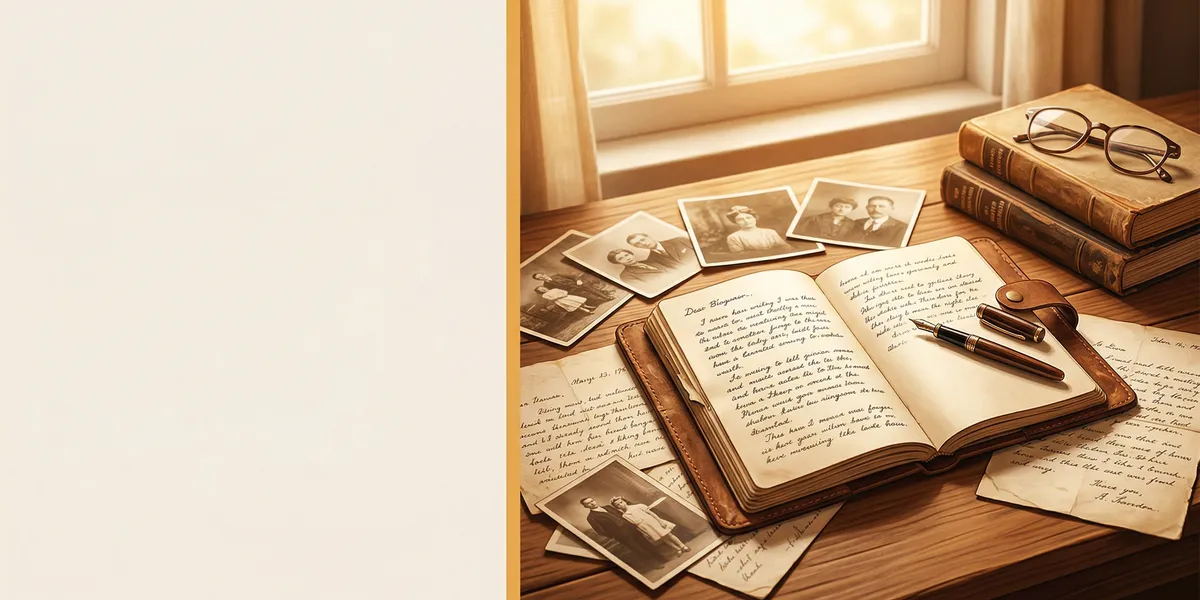
- Photographs and artifacts. Physical evidence grounds your narrative in specific times and places.
Secondary sources
Secondary sources are books, articles, and analyses written about your subject or their era. They provide context and help you see where your research confirms or contradicts existing accounts.
Read every biography and major article already written about your subject. Note where authors disagree. Those disagreements are often where the most interesting truths hide.
Organizing your research
Professional biographers like David McCullough and Doris Kearns Goodwin recommend organizing research by time period and theme simultaneously. Create folders (physical or digital) for each major life period, and cross-reference with thematic folders for recurring subjects like relationships, career, health, and conflicts.
Keep a master chronology: a simple document listing every confirmed date and event in order. This becomes your backbone when you start writing and need to check whether events overlap or which came first.
Develop your thesis and angle
A biography is not a chronological list of things that happened to someone. It is an argument about what a life meant.
Before you outline, articulate your thesis in one or two sentences. This is your answer to the question “Why does this person’s story matter?”
Strong thesis examples:
- “Despite public image as a gentle naturalist, John Muir was a ruthless political strategist whose behind-the-scenes maneuvering created the American national park system.”
- “Frida Kahlo’s art was not a product of her suffering but a deliberate, calculated act of self-invention that made suffering into a brand decades before personal branding existed.”
Your thesis will evolve as you write, and that is fine. But starting without one produces a meandering manuscript that reads like an encyclopedia entry rather than a book.
Outline the structure
Most biographies follow one of three structural approaches. Choose the one that serves your subject and thesis best.
Chronological
The most common structure. You start with birth (or ancestry) and move forward through life. This works well for subjects whose lives had a clear arc of development.
Best for: Historical figures, subjects with dramatic rises and falls, lives shaped by a sequence of escalating events.
Thematic
You organize chapters around themes rather than time periods. A chapter on relationships, a chapter on professional achievements, a chapter on the subject’s inner life.
Best for: Subjects known for multiple distinct contributions, people whose chronological story lacks dramatic shape, shorter biographical studies.
Hybrid
You follow a roughly chronological path but pause for thematic deep dives. This is the approach most modern biographers prefer because it combines narrative momentum with analytical depth.
Best for: Complex subjects, book-length biographies where both story and analysis matter, subjects whose personal and professional lives intersected in complicated ways.
Whichever structure you choose, create a chapter-by-chapter outline before you begin drafting. Each chapter should have a clear purpose, a beginning, a middle, and an end, almost like a short story within the larger narrative.
Write the first draft
With research organized and an outline in hand, start writing. The first draft is where you transform information into narrative.
Open strong
Your opening pages determine whether anyone reads page ten. The best biographies open with a scene, not a birth date. Drop the reader into a moment that captures something essential about the subject.
Example: Instead of “Abraham Lincoln was born on February 12, 1809, in a one-room log cabin in Kentucky,” consider opening with the night Lincoln secretly left Springfield for Washington, knowing half the country wanted him dead before he took office. The birth date can wait. Tension cannot.
Write in scenes
The difference between a forgettable biography and a compelling one is scenes. A scene has a specific time, place, and action. It puts the reader in the room.
Instead of summarizing, “She was nervous before her first public speech,” write the scene: the venue, what she wore, who was in the audience, what she said, and how the crowd reacted. Reconstruct moments from your research rather than glossing over them.
Handle dialogue carefully
Unless you have a direct source for a quote (a letter, interview transcript, or reliable witness account), do not invent dialogue. Fabricated dialogue is the fastest way to lose credibility as a biographer.
When you do have sourced dialogue, use it. Real words carry more weight than paraphrase. Attribute clearly: “As she wrote to her sister in June 1943…” or “According to his aide, who recorded the conversation that evening…”
Maintain third-person perspective
Biographies are written in third person. Resist the urge to insert yourself into the narrative with phrases like “I believe” or “It seems to me.” Your perspective should emerge through what you choose to emphasize, not through first-person commentary.
The rare exception is an author’s note or introduction where you briefly explain your connection to the subject or your research journey.
Balance facts with narrative
The central challenge of biography writing is telling a true story that reads like a great story. Lean too far toward facts and you produce a reference document. Lean too far toward narrative and you produce historical fiction.
Here is how to find the balance:
- Use telling details. A single well-chosen detail (what someone ate, what they kept on their desk, the condition of their shoes) says more than a paragraph of adjectives.
- Show cause and effect. Do not just report events. Connect them. Explain how one decision led to the next.
- Acknowledge gaps honestly. When you do not know something, say so. “No record survives of their conversation that evening, but within the week she had resigned” is more trustworthy than invented reconstruction.
- Quote primary sources. Let letters, diary entries, and interview transcripts carry emotional weight. Your job is to provide context, not replace the subject’s own voice.
Verify everything
Accuracy is non-negotiable in biography. A single factual error can undermine your credibility and, if your subject is living, invite legal trouble.
Professional biographers recommend cross-referencing every major claim against at least two independent sources. Dates are especially treacherous: different sources often disagree on when events happened. When sources conflict, note the discrepancy and explain which version you find more reliable and why.
Build a fact-checking pass into your revision process. Go through the manuscript chapter by chapter with your source files open. Verify names, dates, locations, quotes, and the sequence of events.
If you are writing about a living person, have a lawyer review the manuscript before publication. Defamation claims are rare but devastating, and the best defense is documented truth.
Revise with fresh eyes
First drafts of biographies are almost always too long and too detailed. Revision is where you find the story inside the research.
On the first revision pass, ask:
- Does every chapter advance the thesis?
- Are there sections where I am showing off research rather than serving the reader?
- Does the narrative have momentum, or does it stall in certain periods of the subject’s life?
- Have I included enough scenes, or am I summarizing too much?
On the second pass, focus on prose:
- Cut every sentence that does not earn its place.
- Replace passive voice with active voice.
- Vary paragraph length to maintain rhythm.
- Read dialogue passages aloud to check that they sound natural.
Consider hiring a professional editor who specializes in nonfiction. A good editor sees structural problems that you, after months inside the material, cannot.
Publish your biography
Once your manuscript is revised, you have two main paths to publication.
Traditional publishing
Query literary agents who represent biography and narrative nonfiction. Your query should lead with your thesis, explain why this subject matters now, and describe what makes your research or access unique. Include your credentials and any platform you have built.
Traditional publishing offers advances, professional editing, bookstore distribution, and marketing support. The trade-off is a longer timeline (often 18 to 24 months from acceptance to publication) and less creative control.
Self-publishing
Self-publishing gives you full control over timeline, pricing, and design. Tools like Chapter make the writing and structuring process significantly faster, especially for organizing large amounts of research into a coherent manuscript. You can go from finished draft to published book in weeks rather than years.
Our Pick — Chapter
Chapter helps nonfiction writers organize research, build outlines, and draft complete manuscripts with AI assistance. For biography writers juggling hundreds of sources across decades of a subject’s life, the ability to structure and generate content chapter by chapter is a practical advantage over starting from a blank page.
Best for: Biography writers who want to move from research to published book efficiently Pricing: $97 one-time (nonfiction) Why we built it: Because organizing a life’s worth of research into a readable narrative is one of the hardest parts of writing a biography, and the right tool makes it manageable.
Platforms like Amazon KDP make distribution straightforward once your manuscript is ready. You set your price, upload your formatted file, and your book is available worldwide within days.
Common mistakes to avoid
- Starting to write before finishing research. You will rewrite entire chapters when new information contradicts what you already drafted. Do the research first.
- Trying to include everything. A biography is not an encyclopedia. Cut material that does not serve your thesis, no matter how interesting it is on its own.
- Losing your subject in context. Historical background matters, but the reader came for the person. If three pages pass without your subject appearing, you have drifted.
- Worshipping your subject. The best biographies are honest. Show failures, contradictions, and flaws alongside achievements. Hagiography is boring.
- Neglecting the ending. Many biographies lose energy in the final chapters. Your subject’s later years (or death) should connect back to your thesis and leave the reader with a clear takeaway.
FAQ
How long does it take to write a biography?
Most book-length biographies take one to three years, depending on the scope of research required and whether the subject is living or historical. Shorter biographical essays or nonfiction books with AI assistance can be completed in a few months.
Do I need permission to write a biography about someone?
You do not need permission to write about a public figure or historical person. For private individuals, you do not legally need permission either, but you must avoid defamation (publishing false statements that damage reputation). If your subject is living, interviewing them directly strengthens both accuracy and legal standing.
How is a biography different from a memoir?
A biography is written by someone other than the subject, in third person, and typically covers the subject’s full life. A memoir is written by the subject themselves, in first person, and usually focuses on a specific theme or period. If you are writing about your own life, you are writing a memoir or autobiography, not a biography.
What makes a biography worth reading?
The best biographies combine rigorous research with compelling storytelling. They have a clear thesis about what the subject’s life means, they are built on scenes rather than summaries, and they treat the subject as a complex human being rather than a hero or villain.
Can I use AI tools to help write a biography?
Yes. AI tools can help with drafting, outlining, and organizing research. Writing a book with AI does not replace the need for original research and interviews, but it can accelerate the writing process significantly, especially for structuring large volumes of material into coherent chapters.