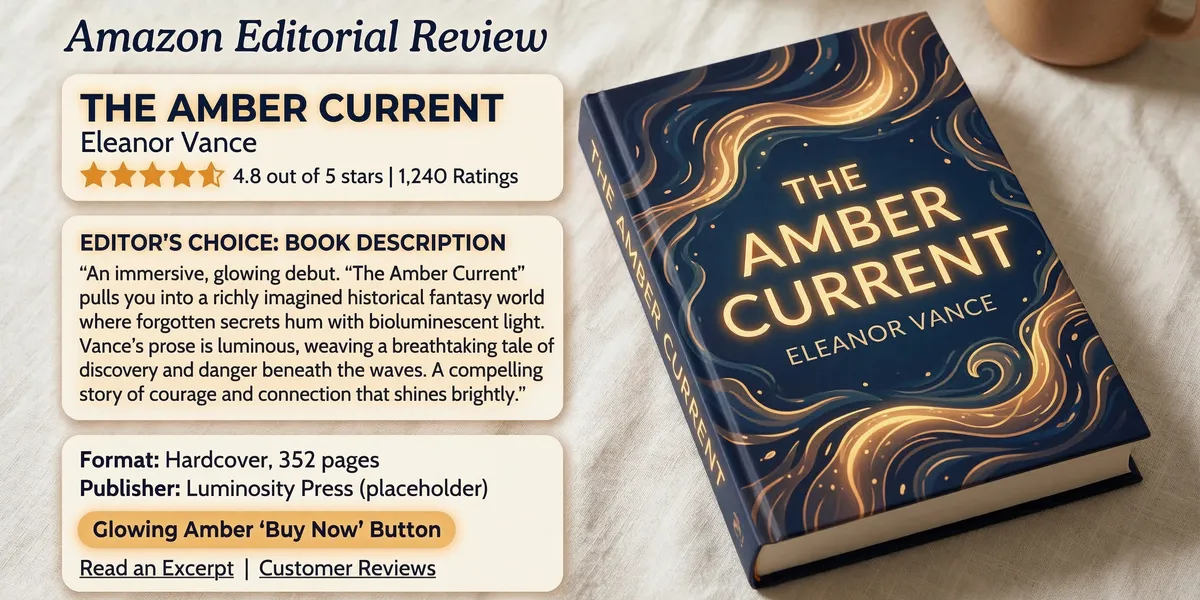
Your book description is the single most important piece of marketing copy you will ever write. It sits on your Amazon listing, right below your cover, and it is the deciding factor for most buyers. A strong book description converts browsers into buyers. A weak one sends them clicking away.
This guide gives you the exact formula for writing book descriptions that sell, with templates for both fiction and nonfiction, before-and-after examples, and the HTML formatting tricks that make your listing stand out on Amazon.
Book description vs book blurb
These terms get used interchangeably, but they serve different purposes.
A book blurb is the short teaser on the back cover of a physical book. It is typically 100 to 200 words, plain text, and designed to hook a reader who is already holding your book.
A book description is the sales copy on your Amazon product page. It can be up to 4,000 characters (roughly 600 to 700 words), supports basic HTML formatting, and needs to persuade someone who has dozens of other tabs open. The book description does heavier lifting because online buyers have shorter attention spans and more options.
| Book Blurb | Book Description | |
|---|---|---|
| Where it appears | Back cover | Amazon listing page |
| Length | 100-200 words | 150-400 words (up to 4,000 characters) |
| Formatting | Plain text | HTML (bold, italic, line breaks) |
| Purpose | Hook a browser in a bookstore | Convert an online shopper |
| Tone | Intriguing, mysterious | Persuasive, benefit-driven |
Both matter. But if you are self-publishing on Amazon, your book description is where sales are won or lost.
The book description formula
Every high-converting book description follows the same structure. Whether you are writing fiction or nonfiction, this five-part formula works.
1. The hook line
Your opening line must stop the scroll. It should create urgency, curiosity, or immediate relevance. You have about 5 seconds before the reader moves on.
Nonfiction example: “Most authors sell fewer than 250 copies. The ones who sell thousands do one thing differently.”
Fiction example: “She had forty-eight hours to find her missing daughter — and every lead pointed back to her own husband.”
2. The problem or situation
For nonfiction, state the problem your reader faces. For fiction, set up the stakes and the world. This is where the reader thinks: “This is about me” or “I need to know what happens.”
3. What they will learn or experience
Nonfiction: List the key takeaways. Use bullet points or short phrases. Fiction: Escalate the tension. Introduce the central conflict without revealing the resolution.
4. Social proof or credibility
If you have it, use it. Bestseller status, number of readers, endorsements, awards, or relevant credentials. If you are a first-time author, skip this rather than faking it.
5. The call to action
End with a line that pushes the reader to buy. “Scroll up and click Buy Now” still works on Amazon because it tells the reader exactly what to do next.
HTML formatting for Amazon
Amazon’s book description field supports basic HTML, and you should use it. Unformatted text walls get skipped. Formatted descriptions get read.
Here are the tags Amazon allows:
<b>Bold text</b>— Use for key phrases, benefits, and section headers<i>Italic text</i>— Use for book titles, emphasis, and testimonial attribution<br>— Line break. Use liberally. White space is your friend on Amazon<h2>Heading</h2>— Subheadings within your description (use sparingly)
Formatting tips that increase conversions:
- Bold the hook line to make it stand out
- Add a line break after every 2 to 3 sentences
- Use bold bullet points for nonfiction takeaways
- Keep paragraphs to 2 to 3 sentences maximum
- Put social proof in italics to distinguish it from the main copy
Amazon strips out most other HTML (no images, no links, no custom fonts). Stick to bold, italic, and line breaks.
Nonfiction book description template
<b>[Hook line — the big promise or surprising stat]</b><br><br>

[Problem statement — 2-3 sentences about the pain point your reader faces]<br><br>

<b>Inside this book, you will discover:</b><br><br>

• [Key takeaway #1]<br>
• [Key takeaway #2]<br>
• [Key takeaway #3]<br>
• [Key takeaway #4]<br>
• [Key takeaway #5]<br><br>

[1-2 sentences about the transformation — what life looks like after reading]<br><br>

<i>[Social proof if available — "Over 10,000 readers" or endorsement quote]</i><br><br>

<b>[CTA — "Scroll up and click Buy Now to start [desired outcome] today."]</b>
Fiction book description template
<b>[Hook line — a moment of tension, a question, or a vivid image]</b><br><br>

[Setup — 2-3 sentences establishing the character and their world]<br><br>

[Conflict escalation — what goes wrong, what is at stake]<br><br>

[Raise the stakes — the twist, the impossible choice, the ticking clock]<br><br>

<i>[Comp titles or genre hook — "Perfect for fans of [Author] and [Author]"]</i><br><br>

<b>[CTA — "Scroll up and click Buy Now to find out [what happens]."]</b>
Before-and-after examples
Nonfiction: Before
“This book is about how to start a business. It covers many topics including business plans, marketing, finance, and hiring. The author has over 20 years of experience in business consulting. This comprehensive guide will help you learn everything you need to know about starting and running a successful business. It is suitable for beginners and experienced entrepreneurs alike.”
Why it fails: No hook, vague promises, tells instead of sells, no formatting, no emotional pull.
Nonfiction: After
90% of new businesses fail within 5 years. Yours does not have to.
You have the idea. You have the drive. But between where you are and a profitable business is a minefield of costly mistakes — and most first-time founders walk right into them.
Inside this book, you will learn:
- The one-page business plan that replaces 40-page documents investors never read
- How to get your first 100 paying customers without spending a dollar on ads
- The cash flow mistake that kills 82% of small businesses (and how to avoid it)
- When to quit your day job — the exact financial threshold most experts get wrong
Written by a consultant who has helped launch 200+ businesses, this is the playbook they wish existed when they started.
“Finally, a business book that skips the theory and tells you what actually works.” — Reader review
Scroll up and click Buy Now to start building a business that lasts.
Why it works: Specific hook with a stat, clear takeaways, benefit-driven bullets, social proof, direct CTA, and formatted for easy scanning.
Fiction: Before
“John is a detective who investigates a murder in a small town. Along the way, he discovers secrets about the town and its residents. There are many twists and turns. Will he solve the case in time? This is a thrilling mystery novel that will keep you on the edge of your seat.”
Fiction: After
Detective John Calloway came to Millbrook to solve a murder. He did not expect to become the prime suspect.
When a beloved school teacher is found dead in the town square, every piece of evidence points to an outsider — John himself. His alibi has holes. His rental car was seen near the crime scene. And the victim’s last phone call? It was to him.
To clear his name, John has 72 hours to untangle a web of small-town secrets, old grudges, and a cover-up that stretches back three decades. But in Millbrook, everyone is watching. And someone will do anything to make sure the truth stays buried.
Perfect for fans of Tana French and Dennis Lehane.
Scroll up and click Buy Now to find out who is really guilty.
Common mistakes to avoid
- Writing a summary instead of sales copy. Your description is not a book report. It should make people feel something and want more, not explain the plot or content.
- No hook in the first line. If your opening sentence could describe any book, rewrite it. The first line must be specific and arresting.
- Listing chapter titles. “Chapter 1: Getting Started. Chapter 2: The Basics.” Nobody buys a book based on its table of contents. Sell the transformation, not the structure.
- Making it too long. Amazon shows a “Read more” link after the first few lines. Everything above that fold must hook the reader. Front-load your strongest copy.
- Skipping formatting entirely. A wall of plain text is hard to read on a screen. Use bold, line breaks, and bullet points to make your description scannable.
- Being vague about what the reader gets. “This book will change your life” means nothing. “This book shows you how to write and publish your first book in 30 days” is specific and compelling.
How to write your description faster
If crafting sales copy feels painful, Chapter can help. Write your book with Chapter’s AI-assisted tools, and use the structured output to identify your strongest selling points, key takeaways, and reader benefits. When you know exactly what your book delivers, the description almost writes itself.
FAQ
How long should a book description be on Amazon?
Amazon allows up to 4,000 characters. Most high-converting descriptions fall between 150 and 400 words. Long enough to persuade, short enough to get read. If you go over 200 words, formatting with bold text and line breaks is essential.
Should I include keywords in my book description?
Yes, but naturally. Amazon’s search algorithm indexes your description, so including relevant keywords helps discoverability. Write for humans first, then check that your primary keywords appear at least once.
How often should I update my book description?
Test a new description if your book gets clicks (impressions) but low sales (conversions). Many successful authors test two to three descriptions in the first month after launch. After you find one that converts, leave it alone until sales dip.
Can I use the same description for all retailers?
The HTML formatting only works on Amazon. For other retailers like Apple Books, Kobo, and Barnes & Noble, use the same copy but remove the HTML tags. Each platform has its own formatting rules.