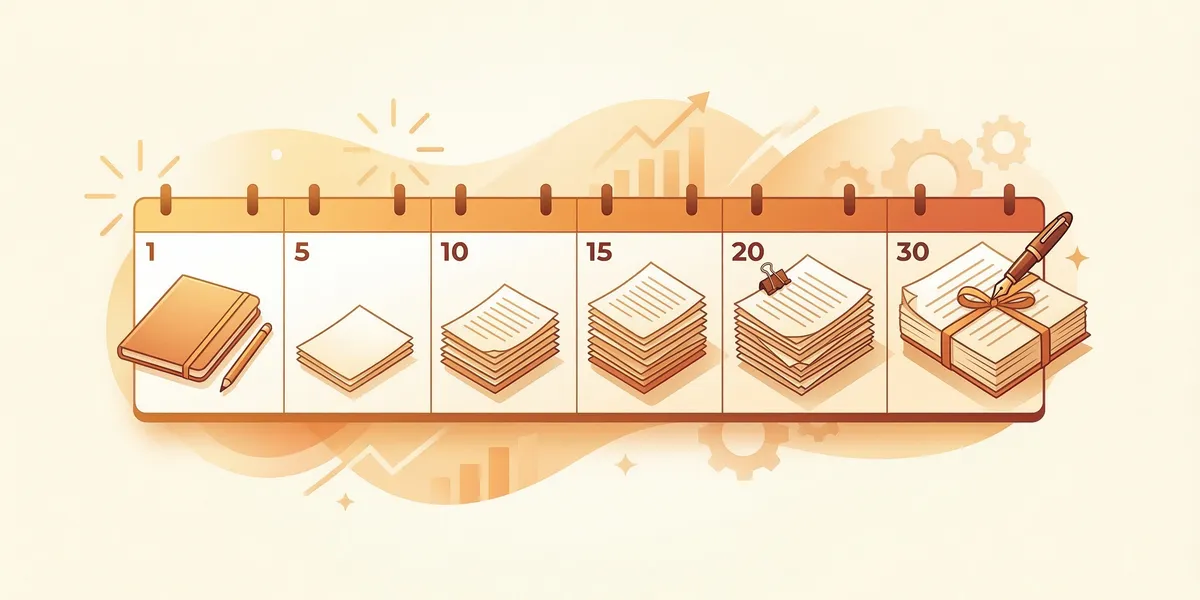
You can write a book in 30 days. The math is straightforward: 50,000 words divided by 30 days equals 1,667 words per day. Hundreds of thousands of writers have done exactly that through NaNoWriMo every November, and you do not need to wait for a special month to start.
This guide gives you a day-by-day plan, daily schedule templates, and the tools to get your first draft finished in one month — whether you write every word yourself or use AI to accelerate the process.
The math behind a 30-day book
Before you start, understand the numbers. A standard novel runs 50,000 to 80,000 words. A nonfiction book can be as short as 25,000 words for a focused authority book or as long as 60,000 for a comprehensive guide.
| Book type | Word count target | Words per day (30 days) |
|---|---|---|
| Short nonfiction | 25,000 | 834 |
| Standard novel | 50,000 | 1,667 |
| Longer nonfiction | 60,000 | 2,000 |
| Long novel | 80,000 | 2,667 |
At a typical writing speed of 500-1,000 words per hour, you are looking at roughly two to three hours of writing per day for a standard novel. That is significant but absolutely achievable — especially once you build momentum in the second and third weeks.
The key insight: you are writing a first draft, not a finished manuscript. Give yourself permission to write badly. You can fix it later. The only draft you cannot edit is the one that does not exist.
Week 1: Foundation and first chapters (Days 1-7)
The first week is about building your runway and getting into the habit.
Days 1-3: Outline your book
Do not skip this step. Writers who outline before drafting are significantly more likely to finish their manuscripts. An outline does not need to be detailed — even a list of chapter topics or a rough story arc gives your brain a map to follow.
For fiction, write a one-paragraph summary of each chapter. Include the key scene, the conflict, and how it moves the story forward. For nonfiction, list your chapters and the three to five main points each one needs to cover.
Spend days one through three outlining. You should also write your opening chapter during this time. Your outline does not need to be perfect. It needs to exist.
Days 4-7: Write chapters 1-5
Now you start drafting. Hit your daily word count target and do not look back. Resist the urge to re-read and edit what you wrote yesterday. Forward motion is the only thing that matters in week one.
By the end of day seven, you should have roughly 11,600 words if you are hitting 1,667 per day. That is five chapters and the beginning of real momentum.
Week 1 checklist:
- Complete outline (chapter-by-chapter plan)
- Write opening chapter
- Establish daily writing routine
- Hit 11,600+ words by day seven
Week 2: Push through the messy middle (Days 8-14)
Week two is where most 30-day attempts die. The excitement of starting is gone. The finish line is nowhere in sight. Your inner critic is screaming that everything you have written is garbage.
This is completely normal. Every writer who has ever finished a book has pushed through this exact feeling.
How to survive the messy middle
Lower your standards. Your only job is to get words on the page. If a scene is not working, write “[fix this later]” and move on to the next one.
Skip ahead. If chapter nine is giving you trouble, jump to chapter eleven. You can fill in the gaps later. Linear writing is not a requirement.
Use a timer. Set a 25-minute Pomodoro timer and write without stopping. When it rings, take a five-minute break. Repeat. This makes the daily word count feel less overwhelming.
By day fourteen, you should be at roughly 23,300 words. You are almost halfway there.
Week 3: Momentum builds (Days 15-21)
Something shifts around the third week. You know your characters (or your subject) deeply now. The words come faster. You can feel the end approaching.
This is the week to increase your daily output if you can. Many writers find that the 1,667-word minimum starts to feel easy by week three, and sessions that used to take three hours now take ninety minutes.
Week 3 strategies:
- Re-read your outline to make sure you are on track
- If you are ahead of schedule, take a guilt-free day off (you have earned it)
- If you are behind, use the weekend for a sprint day of 3,000-5,000 words
- Start thinking about your ending — knowing where you are headed makes the remaining chapters easier
Target by day twenty-one: 35,000 words.
Week 4: Sprint to the finish (Days 22-30)
The final stretch. You can see the finish line. This is where the excitement comes back.
Days 22-27: Write the final chapters
Push through the remaining chapters. Your ending does not need to be perfect. It needs to exist on the page. Many authors find that writing the climax and final chapters is the most satisfying part of the process because all the setup from earlier weeks pays off.
Days 28-30: Close every open loop
Use the last three days to:
- Write any chapters you skipped earlier
- Fill in the “[fix this later]” placeholder sections
- Write your opening and closing if you have not already
- Do a single read-through (resist the urge to do a full edit — that comes later)
By day thirty, you should have a complete first draft of at least 50,000 words.
Daily schedule templates
Not everyone writes at the same time. Pick the schedule that fits your life.
The morning writer
| Time | Activity |
|---|---|
| 5:30 AM | Wake up, coffee |
| 5:45 AM | Write (90 minutes) |
| 7:15 AM | Review word count, note tomorrow’s starting point |
| 7:30 AM | Start your regular day |
The evening writer
| Time | Activity |
|---|---|
| 8:00 PM | Writing session begins (after dinner, after kids’ bedtime) |
| 8:00-10:00 PM | Write (two hours, 1,667+ words) |
| 10:00 PM | Log word count, shut laptop |
The weekend warrior
If weekdays are too packed, front-load your writing on weekends:
- Saturday: 5,000 words (four to five hours with breaks)
- Sunday: 5,000 words
- Weekdays: 500 words per day (just thirty minutes)
- Weekly total: 12,500 words (ahead of the 11,667 weekly pace)
Tools that help you write faster
For tracking progress
Scrivener is the gold standard for long-form writing projects. Its project targets feature lets you set a daily word count goal and tracks your progress across the entire manuscript. The corkboard view makes it easy to rearrange chapters when your outline needs to shift.
For distraction-free writing
FocusWriter is a free, full-screen writing environment that blocks out everything except your words. Set a daily goal, pick a background that does not distract you, and write.
For AI-assisted drafting
If the idea of writing 1,667 words per day for thirty straight days feels daunting, there is a faster path. Chapter generates a full manuscript draft — 80 to 250 pages — in about sixty minutes. Instead of spending thirty days drafting, you spend thirty days editing and making the book yours.
Over 2,147 authors have used this approach to create more than 5,000 books. The AI handles the first draft; you handle the voice, nuance, and revision. It flips the traditional 30-day challenge from “can I write fast enough?” to “can I edit and refine this into something I am proud of?”
What to do when you fall behind
You will fall behind at some point. Life happens. Here is how to recover:
If you are 1-2 days behind: Add 500 extra words to each of your next four writing sessions. You will catch up in less than a week without burning out.
If you are 3-5 days behind: Use a weekend sprint day. Block off four to six hours and write 5,000-8,000 words. Bring snacks. Turn off your phone. Many writers find these marathon sessions are some of their most productive.
If you are more than a week behind: Recalculate. How many words do you have? How many do you need? Divide the remaining words by the remaining days and adjust your daily target. A 30-day book written in 35 or 40 days is still a book. A perfect schedule abandoned at day fifteen is nothing.
What “done” looks like
A finished 30-day draft is a first draft. It is messy. It has plot holes, awkward sentences, and chapters that need to be rewritten. That is exactly what it should be.
Anne Lamott calls this the “shitty first draft” and it is the most important milestone in writing a book. Every published novel, every bestselling nonfiction book, every memoir that made you cry — they all started as a rough first draft that the author then spent weeks or months revising.
Your 30-day goal is not to write a publishable book. It is to write a finishable draft. The revision, editing, and polishing come next.
The NaNoWriMo connection
National Novel Writing Month (NaNoWriMo) has been running this exact challenge every November since 1999. The goal: write 50,000 words of a novel in thirty days. Over 400,000 writers participate each year, and the program has produced multiple New York Times bestsellers, including Sara Gruen’s Water for Elephants and Erin Morgenstern’s The Night Circus.
You do not need to wait for November. The principles are the same any month of the year: set a daily word count, show up every day, and prioritize finishing over perfecting.
The AI shortcut
The traditional 30-day challenge works. But it is worth knowing that AI has changed the equation.
With Chapter, you can generate a complete manuscript draft in about an hour. That is not a gimmick — it is how thousands of authors are now approaching their first books. The AI creates a structured first draft based on your outline, your topic, and your preferences. You then spend the remaining time editing, revising, and adding your personal voice.
This turns the 30-day challenge into a 30-day editing challenge instead. For many writers — especially nonfiction authors and busy professionals — that is a much more sustainable approach. Fiction writers ($97 one-time) and nonfiction writers ($97 one-time) both have options.
Common mistakes to avoid
- Editing as you go. This is the number one killer of 30-day drafts. Write first, edit later.
- Not having an outline. Pantsing (writing without a plan) works for some writers, but it dramatically increases the odds of getting stuck in the middle.
- Setting unrealistic daily goals. If you have never written 2,000 words in a day before, do not start with a 80,000-word target. Start with 50,000 and adjust up if you are ahead of schedule.
- Skipping days without a recovery plan. Missing one day is fine. Missing three days without adjusting your schedule can spiral into quitting.
- Comparing your first draft to published books. Published books have been through dozens of revisions. Your first draft is supposed to be rough.
FAQ
Can I really write a book in 30 days with no experience?
Yes. NaNoWriMo has helped hundreds of thousands of first-time writers finish 50,000-word drafts in thirty days. The key is committing to the daily word count and accepting that your first draft will not be perfect.
How many hours per day do I need to write?
At a pace of 500-1,000 words per hour, most writers need two to three hours per day for a 50,000-word target. If you type faster or outline thoroughly, you can cut that to ninety minutes.
What if I do not finish in 30 days?
A book finished in forty-five days is still a finished book. The thirty-day timeline is a motivational framework, not a hard deadline. Adjust your daily target and keep going.
Should I write my book in order?
Not necessarily. Many successful writers skip around to whichever chapter excites them most. Writing out of order keeps your energy high and prevents you from getting stuck on a single difficult chapter.
Writing a book in thirty days is one of the most challenging and rewarding things you can do as a writer. Whether you tackle it the traditional way or use AI to fast-track your first draft, the goal is the same: get the book out of your head and onto the page. Start with day one. Everything else follows from there.
Related guides: How to Write a Book | How to Overcome Writer’s Block | Write a Book in a Week | How to Finish Writing a Book