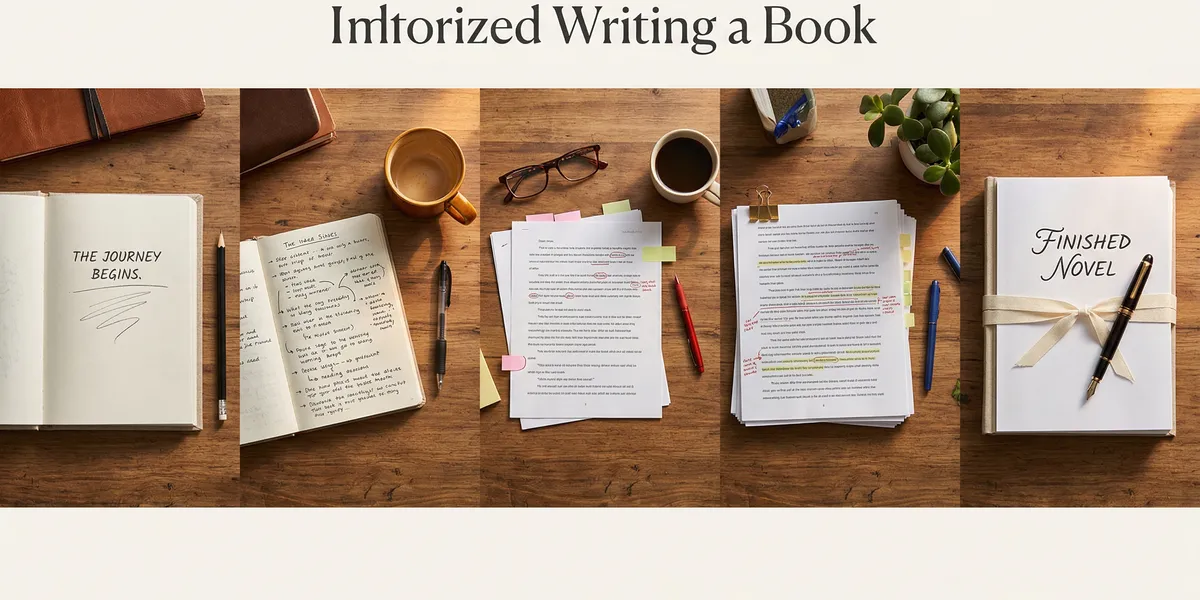
Writing a book requires ten clear steps: choose an idea, define your reader, outline your structure, set a schedule, draft it, rest, revise, gather feedback, get a professional edit, and publish. If you follow this process for how to write a book step by step, you can go from blank page to finished manuscript in 90 days or less. Here is every stage, with specific actions you can take today.
1. Choose Your Book Idea
Every book starts with a single idea, but not every idea deserves a book. The strongest book concepts sit at the intersection of three things: what you know deeply, what readers actively search for, and what you can sustain writing about for 40,000+ words.
Grab a notebook and list 10-15 topics you could teach, explain, or narrate. For each, ask one question: does someone already want this information? Check Amazon’s bestseller lists in your category, browse Reddit communities, or search Google Trends to confirm demand.
Narrow your list to three finalists. Pick the one where you have the clearest audience and the strongest point of view. If you need more inspiration, explore book ideas that are working right now.
2. Define Your Reader
A book written for everyone reaches no one. Before you type a single word, build a one-paragraph reader profile that answers four questions: Who is this person? What problem do they have? What have they already tried? What outcome do they want?
For example, if you are writing a book on personal finance for freelancers, your reader might be a 30-year-old graphic designer earning $60,000 per year who has no retirement savings and feels overwhelmed by tax season. That specificity shapes every chapter.
Write this profile and pin it above your desk or at the top of your writing document. Every time you wonder whether to include a section, ask: does my reader need this? According to Harvard Business Review, the best writers have a clear picture of their audience before they begin.
3. Create an Outline
An outline is your book’s skeleton. It keeps you moving forward on hard days and prevents the sprawling, unfocused drafts that kill first books. You do not need a detailed outline — even a simple chapter-by-chapter list works.
Start with your book’s core promise. Then break that promise into 8-15 chapters, each solving one sub-problem. Under each chapter, jot 3-5 bullet points covering the key ideas you will address.
A nonfiction book at 50,000 words with 12 chapters means roughly 4,200 words per chapter. That is about 15-17 pages. Knowing that number makes the project feel manageable instead of impossible. For a deeper walkthrough, see our book outline guide.
4. Set a Writing Schedule
Motivation fades. Schedules do not. The authors who finish their books are the ones who write on a consistent schedule, even when they do not feel inspired.
Decide on three things: how many days per week you will write, what time of day, and what your minimum word count will be. A realistic starting target is 500 words per day, five days per week. At that pace, you will have a 50,000-word draft in 20 weeks. Push to 1,000 words per day and you cut that to 10 weeks.
Block your writing time in your calendar the same way you would a meeting. Research from the American Psychological Association shows that implementation intentions — specific plans for when and where you will do something — dramatically increase follow-through.
5. Write the First Draft
This is where most aspiring authors stall. The first draft is not supposed to be good. Its only job is to exist. You cannot edit a blank page.
Write forward. Do not go back and fix yesterday’s chapter. Do not rewrite your opening paragraph six times. If you get stuck, type a placeholder like [EXPAND THIS LATER] and keep moving. The goal is momentum, not perfection.
Some writers prefer to draft linearly, chapter one through the end. Others jump to the chapter they feel most excited about. Either approach works. The only wrong method is the one where you never finish. If you are struggling to begin, read our guide on how to start writing a book.
Tools can speed up this phase significantly. Chapter.pub helps nonfiction authors generate structured first drafts using AI, giving you a solid foundation to work from instead of a blank screen. At $97 one-time, it is built specifically for authors who want to ship a real book, not just dabble.
6. Take a Break
When you type the last word of your draft, step away. Do not immediately start editing. Your brain needs distance from the text to see it clearly.
Wait at least two weeks. Stephen King recommends six weeks in his memoir on the craft of writing. During this break, read books in your genre. Exercise. Work on something else entirely.
When you return, you will see problems you were blind to during drafting. Sentences that felt brilliant at midnight will now read as bloated. Entire sections will reveal themselves as unnecessary. This clarity is exactly what you need before revising.
7. Revise and Edit
Revision is where your book transforms from a rough draft into something readers will actually enjoy. Plan for at least two full passes through the manuscript.
First pass: structure. Read the entire book in one or two sittings. Mark chapters that feel slow, sections that repeat, and gaps where the reader will have unanswered questions. Move, cut, or add material as needed. Do not fix sentences yet.
Second pass: line editing. Now tighten every paragraph. Cut filler words like “very,” “really,” and “just.” Replace passive voice with active. Read tricky sections out loud — your ear catches problems your eyes miss. The Purdue Online Writing Lab has an excellent checklist for self-revision.
Most first drafts need to lose 10-20% of their word count during revision. If your draft is 55,000 words, expect the finished book to land closer to 45,000-50,000.
8. Get Feedback
You are too close to your own book to judge it objectively. Outside readers catch blind spots, confusing passages, and assumptions that only make sense inside your head.
Share your revised manuscript with 3-5 beta readers. Ideal beta readers are people in your target audience, not your spouse or best friend (unless they happen to be your target reader). Ask them specific questions: Where did you get bored? What was confusing? What did you want more of?
Give beta readers a deadline of two to three weeks and a simple feedback form. You do not need a 10-page critique. Five focused questions will give you more actionable insight than an open-ended request.
9. Professional Editing
Beta reader feedback improves your book. A professional editor transforms it. This is the step most self-published authors skip, and it shows.
There are three types of editing, and you may need more than one:
- Developmental editing addresses structure, argument flow, and chapter organization. Cost: $0.03-$0.08 per word, or $1,500-$4,000 for a 50,000-word book.
- Copy editing fixes grammar, consistency, and sentence-level clarity. Cost: $0.02-$0.04 per word.
- Proofreading catches final typos and formatting errors. Cost: $0.01-$0.02 per word.
Find editors through the Editorial Freelancers Association or Reedsy. Always request a sample edit of 1,000-2,000 words before committing. A good editor is an investment, not an expense.
10. Publish Your Book
You have two paths: traditional publishing or self-publishing. Each has trade-offs.
Traditional publishing means querying literary agents, waiting months for responses, and giving up creative control in exchange for an advance and bookstore distribution. The timeline from finished manuscript to published book is typically 18-24 months.
Self-publishing gives you full control over cover design, pricing, and timeline. You can go from final manuscript to live on Amazon in under 30 days. You keep 35-70% of royalties instead of the 10-15% standard in traditional deals. For a complete walkthrough of this path, read our self-publishing guide.
Whichever route you choose, your book needs a professional cover, proper formatting, and metadata (title, subtitle, categories, keywords) optimized for discoverability. According to Written Word Media, cover design is the single biggest factor in a reader’s purchase decision.
Common Mistakes to Avoid
These errors derail more first-time authors than anything else:
Editing while drafting. Switching between creative and critical modes kills momentum. Draft first, edit later. They are separate phases for a reason.
Skipping the outline. Writers who skip outlining are far more likely to abandon their books at the 15,000-word mark when they run out of ideas. Spend two hours on an outline and save yourself weeks of frustration.
Waiting for perfect conditions. There is no perfect time to write a book. You will always be busy. The authors who finish are the ones who write in imperfect conditions — on lunch breaks, at 5 AM, on weekends.
Ignoring your target reader. A book that tries to help everyone gives generic advice that helps no one. Stay focused on your specific reader and their specific problem.
Publishing without professional editing. Readers notice typos, awkward sentences, and structural problems. One negative review about poor editing can tank your book’s credibility permanently.
Never finishing. This is the most common mistake of all. A finished, imperfect book is infinitely more valuable than a perfect book that exists only in your imagination. If finishing is your biggest challenge, our guide on how to finish writing a book breaks down the psychology and tactics.
Realistic Timeline for Writing a Book
Here is what a 90-day book timeline looks like at 1,000 words per day:
| Phase | Duration | Output |
|---|---|---|
| Idea + reader profile | Days 1-3 | 1-page concept doc |
| Outline | Days 4-7 | Chapter-by-chapter outline |
| First draft | Days 8-57 | 50,000-word manuscript |
| Break | Days 58-71 | Rest and distance |
| Revision (2 passes) | Days 72-85 | Tightened manuscript |
| Beta reader feedback | Days 86-100 | Reader insights |
| Final polish | Days 101-107 | Clean manuscript |
Professional editing adds 2-4 weeks after this timeline. Total time from idea to publication-ready manuscript: about four to five months.
Frequently Asked Questions
How long does it take to write a book?
Most first-time authors finish a draft in three to six months writing 500-1,000 words per day. The full process from idea to published book typically takes six to twelve months when you include editing, design, and publishing steps.
How many words should a book be?
Nonfiction books typically range from 40,000 to 70,000 words. Memoirs run 60,000-90,000. Business books are often shorter at 35,000-50,000. For a complete breakdown, see our guide on how to write a book.
Do I need to write every day?
No. Consistency matters more than daily output. Writing five days per week with weekends off is effective and sustainable. What kills books is not skipping a day — it is skipping a week, then a month, then forever.
Should I use AI tools to help write my book?
AI writing tools can accelerate your process without replacing your voice. They are especially useful for generating first-draft structures, overcoming blank-page paralysis, and organizing research. The key is treating AI output as raw material that you shape, not as a finished product.
How much does it cost to self-publish a book?
Budget $1,500-$5,000 for a professional result. That covers editing ($1,000-$3,000), cover design ($300-$800), formatting ($100-$300), and optional marketing. You can reduce costs by handling formatting yourself and using AI tools for early drafts.
Your Next Step
You now have the complete roadmap for how to write a book step by step. The biggest gap between published authors and everyone else is not talent or time — it is starting.
Pick your idea today. Write your reader profile tomorrow. Build your outline this week. Then start drafting. The process works if you work the process.