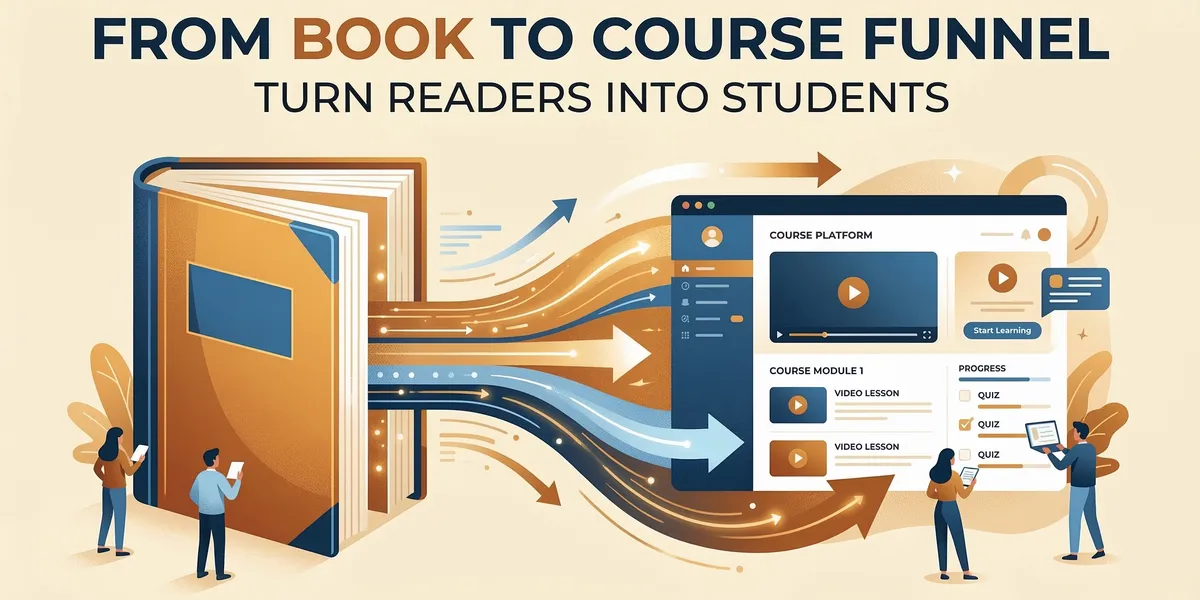
Writing a book to sell courses is the most underused marketing strategy in the online education space. A book builds trust, demonstrates your expertise, and makes your course the obvious next step — all before a reader ever visits your sales page.
The strategy is simple: teach your audience the what and the why in your book, then sell them the how and the accountability in your course. Done right, your book becomes a 24/7 sales engine that converts cold strangers into warm buyers.
This guide walks you through the exact structure, what to include (and what to hold back), and how to write it fast enough to start driving course enrollments this month.
What this guide covers
- The book-to-course funnel
- What to put in the book vs save for the course
- How to structure your book for maximum conversions
- The CTA strategy that works
- Writing your book fast
- Common mistakes to avoid
- FAQ
The book-to-course funnel: how it works
The book-to-course funnel follows a natural buyer journey that most course creators ignore. Instead of running ads directly to a sales page — where a stranger has no reason to trust you — you put a book in front of them first.
Here is how the funnel works:
| Stage | What happens | Your audience’s mindset |
|---|---|---|
| Awareness | Reader discovers your book (Amazon, social, referral) | “This looks interesting” |
| Education | Reader learns your framework and sees your expertise | ”This person really knows their stuff” |
| Trust | Reader gets a genuine transformation from the book | ”This actually worked for me” |
| Conversion | Reader wants the next level — your course | ”I need more of this” |
The reason this works better than any other funnel is simple: a book is the highest-trust lead magnet that exists. According to a 2023 Written Word Media survey, readers who finish a nonfiction book rate the author’s credibility 4x higher than readers who consume a blog post or social media content from the same person.
Your book does the selling for you. By the time someone finishes reading, they already believe you can help them. The course becomes a natural next step, not a hard sell.
Why this beats ads-to-sales-page
Running paid ads to a course sales page means you need to build trust and demonstrate expertise on a single landing page. Conversion rates for cold traffic to course sales pages average 2-5% according to Podia’s creator benchmarks. A book-first approach warms that audience before they ever see a price tag.
Course creators like Pat Flynn and Jeff Walker have used this model for years. Flynn’s book Will It Fly? feeds directly into his online course ecosystem. The book costs readers a few dollars. The courses cost hundreds or thousands. The book does the trust-building that makes the higher price feel justified.
What goes in the book vs what stays in the course
This is where most course creators get it wrong. They either give away too much (making the course redundant) or hold back too much (making the book useless and killing trust).
Here is the split that works:
Put in the book
- The complete framework. Give readers the full picture of your methodology. They need to understand the what and the why deeply enough to believe it works.
- The transformation logic. Explain why your approach produces results. Back it up with case studies, research, or your own experience.
- Quick wins. Give readers at least one thing they can implement immediately and see results from. This proves your expertise is real.
- Enough to succeed on their own. A reader who is motivated and resourceful should be able to get results from your book alone. This sounds counterintuitive, but it is what builds trust.
Save for the course
- Step-by-step implementation. The book teaches the framework. The course walks them through doing it.
- Templates, tools, and shortcuts. Your course includes the done-for-you resources that make implementation faster.
- Accountability and community. Group coaching, Q&A calls, peer feedback — things a book cannot provide.
- Advanced applications. The book covers the core method. The course goes deeper into edge cases, advanced tactics, and personalized strategies.
- Live support. The book is a one-way conversation. The course offers access to you.
The key principle
Think of it this way: the book teaches someone to fish. The course provides the fishing rod, the bait, the GPS coordinates, and a guide who stands next to them while they cast.
Your book should make readers think: “This is exactly what I needed. Now I want to go faster and have support while I do it.” That feeling is what makes them buy your course.
Structure your book for course conversions
A book designed to sell a course is not structured like a typical nonfiction book. Every chapter should move the reader closer to wanting guided implementation.
The proven structure
Chapter 1: The problem (and why it matters now) Open with the pain point your course solves. Make readers feel seen. Use specific examples of what this problem costs them — in money, time, or opportunity.
Chapters 2-3: Your framework Introduce your methodology. Explain the principles behind it. This is where you teach the what and the why. Use case studies from your course students (with permission) to prove it works.
Chapters 4-6: The core content Walk through each pillar of your framework. Give readers enough to understand and believe in each component. Include one actionable exercise or insight per chapter that they can use immediately.
Chapter 7: Results and proof Showcase transformations. Client before-and-after stories. Data if you have it. This chapter answers the question “does this actually work?” with overwhelming evidence.
Chapter 8: The gap This is the most important chapter for course sales. Acknowledge what the book covered, then clearly articulate what comes next. Be honest: “You now have the framework. Implementing it requires [specific things the course provides].”
Chapter 9: Next steps and resources Your call to action. Direct readers to your course with a specific offer — a discount, bonus module, or priority enrollment for book readers.
Internal linking strategy
Throughout the book, reference your course naturally. Not as a sales pitch, but as a resource. Examples:
- “In my [Course Name] program, students complete this step in about 3 hours using the template I provide.”
- “This is the exact exercise I walk through on Day 2 of [Course Name].”
- “If you want to see this done live, I demonstrate it in Module 4 of the course.”
These references plant seeds. By the time the reader reaches Chapter 8, the course feels familiar, not foreign.
The CTA strategy that actually converts
Putting “buy my course” at the end of every chapter kills trust. Here is what works instead.
One mid-book mention (Chapter 4 or 5). A brief, natural reference to the course as a resource. Not a pitch — an acknowledgment that it exists and how it relates to what they just learned.
One dedicated section (Chapter 8). The gap chapter. This is where you make the case honestly: here is what the book gave you, here is what you still need, and here is how the course bridges that gap.
One closing CTA (Chapter 9). Clear, direct, with a specific URL and offer. Include a QR code in print editions. Make it easy.
A resource page. At the back of the book, list all your resources — course, newsletter, free tools, community. Let readers choose their own next step.
That is it. Three mentions and a resource page. Readers respect authors who teach generously. They buy from authors they trust.
Writing your book fast
A book-to-course book does not need to be 300 pages. The sweet spot is 80 to 150 pages (20,000-40,000 words). Your course students already have the deep-dive content. The book is the bridge that gets new people into your ecosystem.
Timeline for a course-creator book
| Approach | Timeline | Best for |
|---|---|---|
| Write it yourself | 4-8 weeks | Course creators who enjoy writing |
| Hire a ghostwriter | 6-12 weeks | Busy creators who want a polished product |
| Use AI-assisted writing | 1-2 weeks | Creators who want speed without sacrificing quality |
Our Pick — Chapter
Chapter.pub lets you turn your course content, frameworks, and expertise into a complete nonfiction book in days. Since you already have the knowledge organized from building your course, Chapter helps you restructure it into book format fast.
Best for: Course creators who want to repurpose their existing material into a professional book Pricing: $97 one-time (nonfiction) — not a subscription Why we built it: Most course creators already have the content. They just need a fast way to turn it into a book that drives enrollments.
You already have the hardest part done: the expertise, the framework, the case studies. Your course content is a goldmine of material. The book is a reorganized, condensed version designed to create trust and curiosity rather than deliver the full curriculum.
Repurposing your course content
Map your course modules to book chapters. For each module, ask: “What does a reader need to understand about this topic to want guided implementation?” That understanding-level content becomes your book. The implementation-level content stays in the course.
If you have an authority book already, you can adapt it for a course-selling focus by adding the gap chapter and strengthening your CTAs.
Common mistakes to avoid
- Giving away the entire course in the book. If a reader can implement everything from the book alone, they have no reason to buy your course. Teach the framework, not the step-by-step execution.
- Making the book a 200-page sales pitch. Readers can smell a pitch from Chapter 1. If the book does not deliver genuine value, it destroys trust instead of building it.
- Skipping the gap chapter. Without explicitly stating what comes next and why, readers feel satisfied and move on. You need to create awareness of the gap between knowledge and implementation.
- Pricing the book too high. The book is a funnel entry point, not a profit center. Price it at $9.99 or less for ebook, or give it away free to maximize reach. The course is where you make money.
- Not having a clear URL or landing page. Every mention of your course in the book should point to a single, easy-to-remember URL. Make it dead simple for a reader to find your course.
FAQ
How long should a book-to-course funnel book be?
Between 80 and 150 pages (20,000-40,000 words). Long enough to establish genuine authority and deliver real value. Short enough that readers actually finish it — because the CTA is at the end.
Should I give the book away for free?
It depends on your goal. Free maximizes reach and funnel entries. Priced ($2.99-$9.99) pre-qualifies buyers — someone willing to spend money on a book is more likely to spend money on a course. Many course creators offer both: free PDF on their site, paid version on Amazon.
What if my course content changes after the book is published?
This is normal and expected. Frame your book around timeless principles and frameworks rather than specific tactics. The course delivers the current, updated implementation details. Your book stays relevant even as course content evolves.
Can I use my existing course transcripts as a starting point?
Yes, and you should. Course transcripts, slide decks, and student Q&A logs are excellent raw material. You will need to restructure them for a reading experience (people read differently than they watch), but the knowledge is already captured.
How do I track which course buyers came from the book?
Use a unique URL with tracking parameters (e.g., yourcourse.com/book-reader), a specific discount code mentioned only in the book, or ask new students how they found you. Most course platforms like Teachable and Kajabi support UTM tracking and coupon codes.
If you already have a business book or are using your book as a lead magnet, adding a course upsell is a natural next step. The infrastructure is the same — you are just extending the funnel one level deeper.