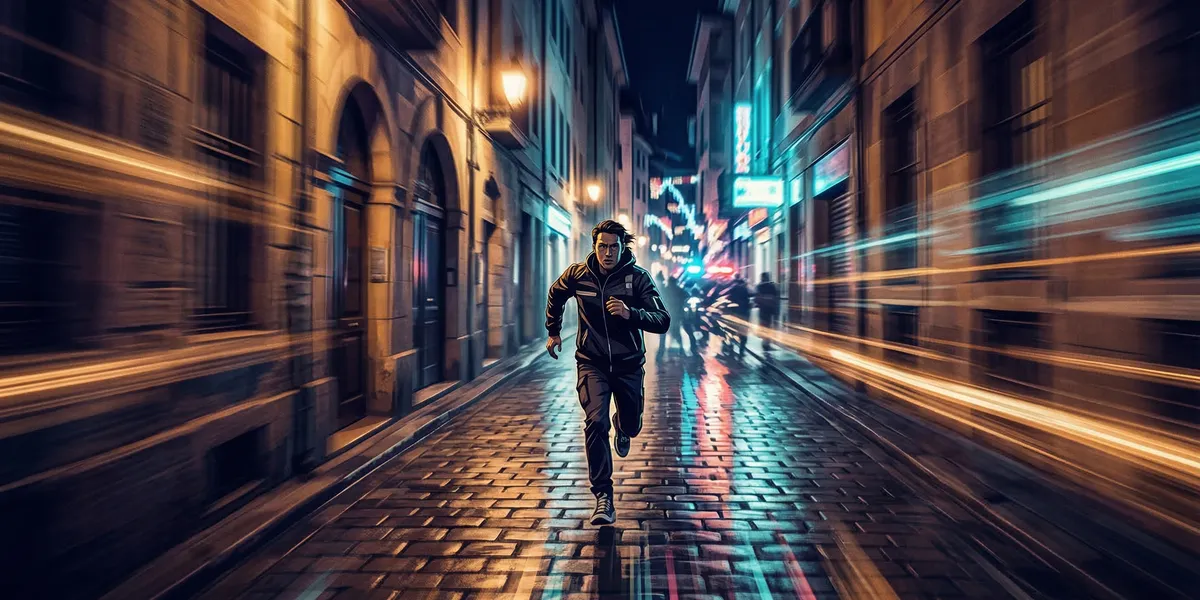
A chase scene is a sequence where one character pursues another through physical space — but on the page, it is really a ticking clock wrapped around a series of impossible decisions.
The best chases are not about running fast. They are about thinking fast, choosing between bad options, and using the environment in ways nobody expected.
Clarity of Geography
The reader must understand the space. This is the single most important rule of chase writing, and it is the one most often broken.
If the reader cannot picture where the characters are — the layout of the streets, the distance between them, the obstacles ahead — the chase becomes a blur of motion words that do not add up to anything. You are not writing “she ran and then turned and then ran some more.” You are drawing a map with words.
Before you write the chase, sketch the route. Know the geography even if the reader only gets fragments of it. A rooftop chase across a European city works because the reader can see the gaps between buildings, the slope of tile roofs, the clotheslines and satellite dishes. A chase through a subway station works because the reader knows the platform, the tunnels, the turnstiles, and the approaching train.
Give the reader landmarks:
She hit the market square and cut left, past the fountain. The alley on the other side was fifty meters away. He was forty meters behind her.
Now the reader can do the math. Now they are invested. Numbers and distances turn a chase from vague action into a problem the reader is solving alongside the character.
Short Sentences Create Speed
Your prose rhythm controls the reader’s heart rate. When the chase accelerates, your sentences compress.
Compare:
Slow: She could hear his footsteps getting closer behind her as she tried to figure out which direction to go at the intersection, and she realized the left path led to a dead end she had noticed earlier that morning.
Fast: Footsteps behind her. Closer. The intersection — left or right. Left was a dead end. She went right.
The second version is not better writing in every context. In a chase, it is better because the white space between short sentences creates urgency. The reader’s eyes move faster. Their breathing quickens. You are controlling their physiology through sentence length.
Then, when the character finds a hiding spot or a brief reprieve, let the sentences stretch back out. The contrast makes both speeds more effective.
A paragraph structure that works well for chases: three or four short, punchy sentences building speed, then one slightly longer sentence that delivers the obstacle or reversal.
He vaulted the railing. Landed hard. Kept moving. The alley forked ahead, and both paths were dark.
Obstacles and Near-Misses
A straight-line chase is boring. What makes a pursuit scene work is the series of obstacles between the runner and escape — and the creative ways the character navigates them.
Good obstacles are specific to the environment:
- Urban chase: A delivery truck blocking the alley. A chain-link fence. A crowd of pedestrians who scatter. A stairwell that goes up when the character needs to go down.
- Forest chase: A ravine too wide to jump. A river with a strong current. Fallen trees that the pursuer cannot climb over as easily.
- Interior chase (building, ship, museum): Locked doors. Security gates. A room with only one exit and someone already coming through it.
Near-misses raise the stakes more than actual contact. The pursuer’s hand closes on the runner’s jacket collar — and the runner slips out of the jacket. A bullet sparks off the railing six inches from the character’s hand. The closing elevator doors catch the pursuer’s fingers, but he yanks them out. These moments tell the reader: the gap is shrinking.
Each obstacle should force a decision. Does the character go over the fence or through the building? Do they risk the crowded street where they will be visible or the empty alley where they could be cornered? Every decision reveals character and creates branching tension.
Stakes Beyond Getting Caught
“They will catch me” is a stake, but it is a weak one unless the reader knows exactly what “caught” means.
Before writing a chase scene, make sure the reader understands the consequences. What happens if the character is caught?
- Death. The simplest and highest stake.
- Exposure. If caught, their identity is revealed and everything they have built collapses.
- Someone else gets hurt. The character is leading the pursuit away from someone vulnerable.
- The mission fails. Getting caught means the villain reaches the objective first.
- Moral compromise. To escape, the character may have to hurt an innocent bystander or abandon an ally.
The strongest chase scenes layer multiple stakes. The character is not just running from the pursuer — they are running toward something with a deadline. In The Bourne Identity, Jason Bourne is not just fleeing the agents. He is trying to reach Marie. He is trying to understand who he is. Every chase carries the weight of those larger questions.
Using the Environment Creatively
The environment should be an active participant in the chase, not just a backdrop.
Characters who interact with their surroundings in clever, specific ways feel competent and real. This is why Jackie Chan’s chase scenes are legendary — he uses ladders, chairs, window frames, and shopping carts as tools. Your characters should do the same on the page.
A character who tips a fruit cart to block the pursuer is more interesting than a character who just runs faster. A character who ducks into a restaurant kitchen and grabs a serving tray as a shield is using the world you built.
This also works for the pursuer. A pursuer who anticipates the runner’s route and takes a shortcut through a building is more threatening than one who simply runs behind. Intelligence in pursuit raises the tension because the reader realizes: the runner cannot just outrun this person. They have to outthink them.
Ian Fleming understood this. In his Bond novels, the chases involve Bond making calculated decisions about terrain, vehicles, and physics. The pursuer is not just fast — they are smart. That forces Bond to be smarter.
The Decision Moment
Every great chase builds to a moment where running is no longer an option and the character must choose: fight, hide, or try something desperate.
This is the climax of the chase, and it should feel like a trap closing. The character has been making decisions throughout the pursuit, and now the options have narrowed to two or three — all of them bad.
The decision should emerge from the geography you established. If the reader knows the character has been heading toward the river, and now they are standing at the bank with the pursuer closing in, the decision is visceral: jump into the freezing current, turn and fight, or try the bridge that is two hundred meters away with no cover.
What makes this moment powerful is that the reader has been making this calculation alongside the character. They know the space. They know the stakes. They have their own opinion about what the character should do. When the character makes a different choice — or makes the choice the reader was hoping for — the emotional payoff is enormous.
Interspersing Thought With Action
Pure action without interiority is exhausting. The reader needs moments inside the character’s head, even during a chase — but these moments must be brief and urgent.
During high-speed action, internal thought should be:
- Short. One sentence, maybe two.
- Practical. What is the character calculating? What is the next move?
- Emotional. A flash of fear, anger, or determination — not a paragraph of reflection.
The fence was eight feet high. She could make it. Probably. The sound of his boots on concrete said she had about four seconds to find out.
The thought (“she could make it, probably”) takes less than a second of reading time. But it puts the reader inside the character’s head. It transforms a physical action (climbing a fence) into a gamble. That is the difference between watching a chase and being in one.
Avoid the mistake of stopping the chase for a full paragraph of reflection. If your character is running for their life and suddenly thinks about their childhood or the meaning of trust, the chase dies. Save the reflection for after the pursuit ends. During the chase, thoughts are fragments — sharp, fast, and focused on survival.
Ending the Chase
A chase needs a definitive end — not a fade-out, not “she kept running until she was safe.” The reader has been holding tension in their body, and they need a release.
Strong endings:
- The narrow escape. The door closes just in time. The train pulls away with the character aboard. One more second and they would have been caught.
- The confrontation. The character stops running and turns to face the pursuer. The chase becomes a different kind of scene.
- The clever trick. The character doubles back, hides, or creates a diversion that sends the pursuer in the wrong direction.
- The cost. The character escapes but at a price — an injury, a lost ally, a burned bridge.
The best endings combine two of these. The character makes a clever move and escapes, but they are injured. The character confronts the pursuer and wins, but someone else was captured in the meantime.
After the chase ends, give the reader one beat of aftermath. The character catching their breath. The hands shaking. The adrenaline turning to nausea. This physical reality grounds the scene and gives the reader permission to exhale.
Chase scenes share DNA with fight scenes — both rely on clarity, stakes, and rhythm. The difference is that a fight resolves through confrontation while a chase resolves through escape or capture. If your chase ends in a confrontation, the techniques overlap. Master both and your action writing will carry readers at full speed.
For more on controlling the reader’s experience of time, see our guides on fast pacing and building suspense.