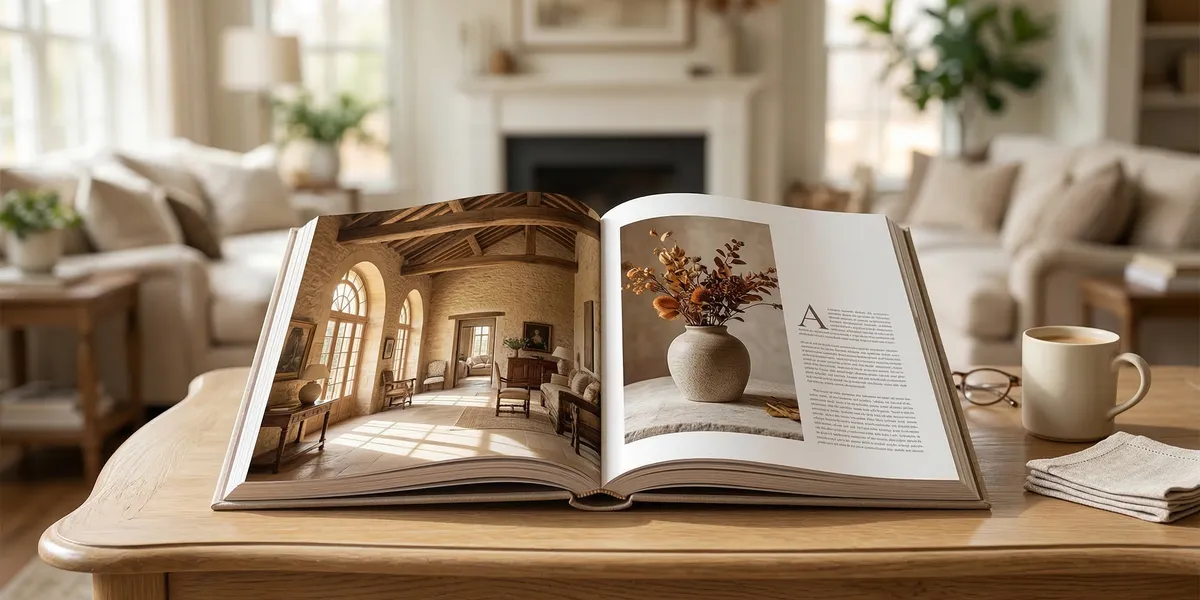
A coffee table book is a large-format, visually driven book designed to be displayed, browsed, and admired. Unlike a standard book that people read cover to cover, a coffee table book invites people to pick it up, flip to any page, and be drawn in by what they see. If you have a visual subject — photography, art, architecture, food, travel, or niche culture — this format turns it into something tangible and lasting.
This guide covers choosing your subject, working with visuals, designing layouts, navigating printing options, and pricing your finished book.
Choosing your subject
The best coffee table books are obsessively focused. They commit to a single visual subject and explore it with depth and beauty.
Strong coffee table book subjects share three qualities:
- Visual richness. The subject must photograph or illustrate beautifully. Architecture, nature, fashion, food, and travel are perennials because they are inherently photogenic.
- A clear angle. “Photography” is too broad. “Abandoned theaters of the American Midwest” is a coffee table book. Specificity creates intrigue.
- An audience willing to pay $30-75. Coffee table books are premium products. Your subject needs an audience that values it enough to display it in their home or studio.
Successful coffee table book subjects include:
- Photography collections — landscape, portrait, street, documentary
- Art and illustration — a single artist’s work, a movement, a medium
- Architecture and interiors — specific styles, regions, or eras
- Food and drink — regional cuisine, cocktail culture, restaurant documentation
- Travel and culture — a city, a country, a subculture
- Niche passions — vintage cars, sneaker culture, surfing, tattoo art, botanical gardens
The common thread is visual first. If you cannot imagine someone stopping to stare at a page, the subject may not suit this format.
Working with photography and visuals
The images are the product. Everything else — text, design, layout — supports them.
Sourcing your images
You have several options for building your visual library:
Shoot it yourself. If you are a photographer, this is the most cohesive approach. You control quality, style, and access. Plan for significantly more images than you will use — shooting 500-1,000 to select 150-200 for the final book is normal.
Commission a photographer. If your subject requires professional photography but you are not a photographer, hire one. Rates for book photography projects vary widely. Per the American Society of Media Photographers, day rates range from $1,500 to $5,000+ depending on experience and usage rights. Negotiate book-specific licensing upfront.
License existing images. For historical or archival subjects, you may license images from agencies, museums, or private collections. Getty Images, Alamy, and institutional archives are common sources. Budget $100-500 per licensed image depending on rights and usage.
Collaborate with artists. If your book features artwork, establish clear agreements about reproduction rights, credit, and royalties before production begins.
Image quality requirements
Coffee table books demand high-resolution images. For offset printing (the standard for quality coffee table books), you need:
- Minimum 300 DPI at the printed size
- CMYK color space for accurate print reproduction
- RAW files or high-quality TIFFs — not compressed JPEGs from social media
A full-page image in a 12x12 inch book needs to be at least 3,600 x 3,600 pixels. Full-bleed spreads across two pages need even more. Verify your image library meets these specs before committing to a layout.
Layout and design
Layout is where a coffee table book becomes a coffee table book. Poor layout turns stunning images into a glorified photo album.
Hire a designer (or learn the tools)
Unless you have professional design experience, hire a book designer. Coffee table book design is a specialized skill that involves typography, grid systems, pacing, and print production knowledge.
Professional book designers typically charge $3,000-$10,000+ for a complete coffee table book layout, depending on page count and complexity. Find designers through the AIGA directory or by studying the credits pages of coffee table books you admire.
If you are designing it yourself, Adobe InDesign is the industry standard. Affinity Publisher is a capable, more affordable alternative.
Design principles for visual books
Pace your spreads. Alternate between full-bleed images, white space, and grouped layouts. A book where every spread is a full-bleed photo becomes monotonous. A book with varied pacing keeps the reader turning pages.
Let images breathe. Generous margins and white space elevate the images. Cramming photos edge-to-edge without breathing room feels cheap.
Use text sparingly. The text in a coffee table book is secondary to the visuals. Captions, short essays, and introductions should complement the images without competing for attention. Most coffee table books have 5,000-15,000 words total.
Create visual chapters. Group images by theme, location, chronology, or mood. Each section should feel like a cohesive mini-story within the larger book.
Consider the physical experience. Coffee table books are handled differently than regular books. People flip from front to back, open to random pages, and show specific spreads to guests. Every spread should work as a standalone visual moment.
Typography
Choose one or two fonts and use them consistently. Serif fonts work well for captions and body text in visual books. Keep font sizes readable but not dominant — the images should always lead.
Printing: offset vs. print-on-demand
The printing decision has the biggest impact on quality, cost, and minimum quantities.
Offset printing
Offset printing produces the highest quality and is the traditional method for coffee table books.
| Factor | Details |
|---|---|
| Quality | Superior color accuracy, paper options, and finish |
| Minimum order | Typically 500-2,000 copies |
| Unit cost | $8-25 per book depending on specs and quantity |
| Lead time | 6-12 weeks from final files to delivery |
| Best for | Established audience, pre-orders in hand, gallery/retail distribution |
Get quotes from multiple printers. Asia Pacific Offset and printers in Shenzhen, China handle a large percentage of English-language coffee table books due to competitive pricing. Domestic printers like Hemlock offer shorter shipping times.
Print-on-demand (POD)
POD lets you sell without inventory risk. Each book is printed when ordered.
| Factor | Details |
|---|---|
| Quality | Good but not offset-quality; limited paper options |
| Minimum order | 1 copy |
| Unit cost | $15-40 per book depending on size and page count |
| Lead time | 3-7 business days per order |
| Best for | Testing the market, small audiences, low financial risk |
Blurb is the most popular POD platform for photo books and coffee table books, offering multiple sizes, paper stocks, and binding options. Amazon KDP supports hardcover but with limited size options for visual books.
The hybrid approach
Many authors print a small offset run (500-1,000 copies) for direct sales and events while maintaining a POD listing for ongoing orders. This balances quality with accessibility.
Pricing your coffee table book
Coffee table books command premium prices because they are premium products. Pricing depends on size, page count, print quality, and your audience.
| Book Specs | Typical Retail Price |
|---|---|
| Small format (8x8 to 9x9), softcover, 100-150 pages | $30-45 |
| Medium format (10x10 to 11x11), hardcover, 150-200 pages | $45-65 |
| Large format (12x12+), hardcover, 200+ pages | $55-85 |
| Limited edition / signed | $75-150+ |
Your pricing needs to cover production costs plus margin. If your offset-printed book costs $15 per unit and you sell direct for $55, your margin is $40 per book. If you sell through retailers (who take 40-55% of retail), your margin drops to roughly $10-15.
Direct sales through your own website, at events, and through galleries yield the highest margins. Amazon and bookstore distribution reach more buyers but at lower margins.
Publishing and distribution options
Self-publish and sell direct
The highest-margin approach. Build a website, take pre-orders, and ship from your inventory (if offset printing) or link to your POD listing. Photographers and artists with existing audiences often do this successfully.
Work with a publisher
Some publishers specialize in visual books. Rizzoli, Phaidon, Taschen, and Aperture are prestigious options that provide editing, design, printing, and distribution. Competition for spots on their lists is intense, and you will typically need an established reputation or platform.
Gallery and museum partnerships
If your subject aligns with a gallery exhibition, museum show, or cultural institution, partnership can provide funding, distribution, and credibility. Many art and photography coffee table books are produced in conjunction with exhibitions.
Writing the text
Even though a coffee table book is visual-first, the written content matters.
The introduction. 1,000-3,000 words setting the context for the visual collection. Why this subject, why now, what the reader will find inside. This is your chance to establish the emotional and intellectual framework.
Section introductions. Short essays (300-800 words) introducing each chapter or thematic section. These provide narrative structure.
Captions. Brief, informative text accompanying individual images. Location, date, context, or the story behind the shot. Good captions add a layer of meaning without cluttering the page.
Contributor essays. Many coffee table books include a foreword or essay from a recognized authority on the subject. This adds credibility and another perspective.
Common mistakes to avoid
- Prioritizing quantity over quality. Including 300 mediocre images is worse than including 150 exceptional ones. Edit ruthlessly.
- Skipping professional design. Layout makes or breaks a visual book. Amateur design undermines professional photography.
- Underestimating costs. Between photography, design, and printing, a quality coffee table book can cost $10,000-$50,000 to produce. Budget realistically.
- Choosing the wrong print method. POD for a high-end art book will disappoint. Offset printing 2,000 copies without a sales plan will bankrupt.
- Neglecting the text. The writing should be excellent even if there is not much of it. Hire a writer or editor for captions and essays if writing is not your strength.
Related Reading
- How to Write a Memoir: A Step-by-Step Guide
- Best AI Writing Tools for Authors in 2026
- Book Genres Explained: The Complete Guide for Writers
- Book Outline: How to Structure Your Book (With Templates)
FAQ
How many pages should a coffee table book have?
Most coffee table books run 120-250 pages. Under 100 feels thin for the price point. Over 300 becomes impractically heavy. The sweet spot depends on your subject — let the content dictate the length rather than targeting a specific page count.
Can I self-publish a coffee table book on Amazon?
Yes, through KDP’s hardcover option or through Blurb’s Amazon distribution. Quality will not match offset printing, but it eliminates upfront investment. Start with POD to validate demand, then consider offset for a premium edition.
Do I need to write a book proposal for a coffee table book?
If approaching a publisher, yes. A coffee table book proposal needs a visual sample (20-30 spreads showing the design concept), a written overview, your platform and audience data, and comparable titles. Publishers want to see both the visual quality and the commercial potential.
How do I protect my images from being reproduced?
Copyright protects your images automatically, but enforcement is impractical for small infringements. For high-value collections, register your copyright with the U.S. Copyright Office. Watermarking preview images and using low-resolution promotional materials reduces unauthorized reproduction.