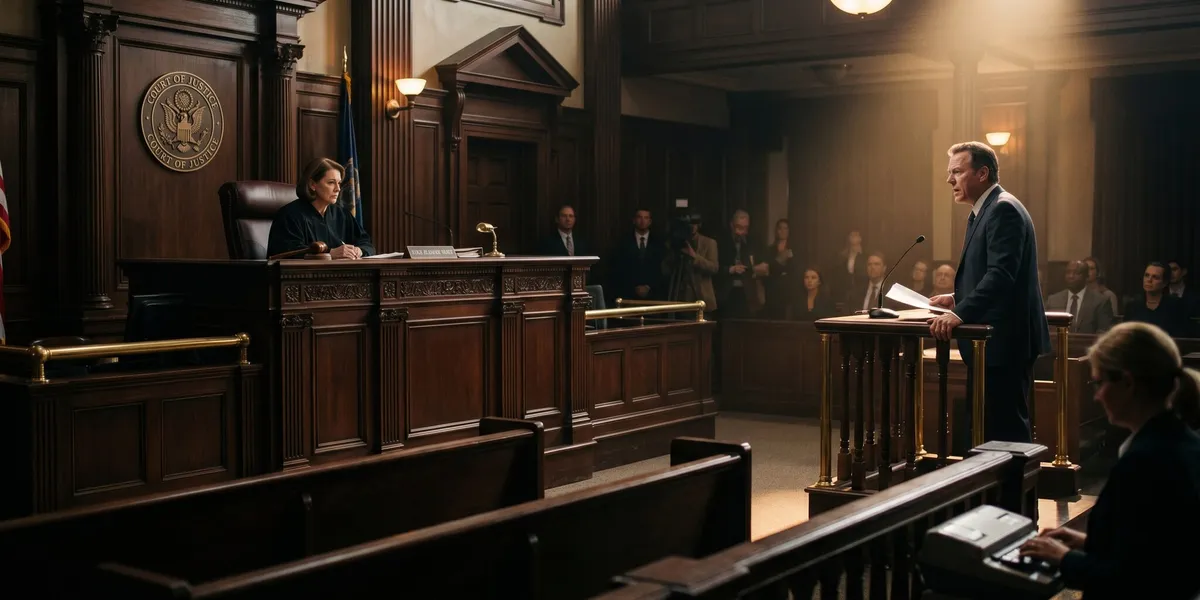
A courtroom drama centers on a legal trial as the primary source of conflict and tension, using the rigid structure of legal proceedings as a framework for revelation, confrontation, and moral reckoning. The courtroom is inherently dramatic — it’s a setting designed for opposing sides to clash under formal rules, with someone’s fate hanging on the outcome.
Why Courtroom Dramas Work
The courtroom is a controlled arena for conflict. The rules of procedure create a framework that forces confrontation: witnesses must answer questions, evidence must be presented, and the truth (or some version of it) must eventually surface.
This structure gives writers built-in tools:
- Forced confrontation — Characters who’d normally avoid each other must face each other on the stand
- Information control — Lawyers reveal evidence strategically, creating natural pacing
- Power dynamics — The judge controls the room, creating a hierarchy that characters must navigate
- Ticking clock — The trial has a finite duration, compressing tension
- Public stakes — Everything happens with an audience (jury, gallery), raising the emotional pressure
How to Structure a Courtroom Drama
The Three-Act Courtroom Structure
Act 1: The Setup
- Introduce the case, the stakes, and the key players
- Show the crime, accusation, or dispute that leads to trial
- Establish what each side wants and what they’re willing to do
- End with the trial beginning
Act 2: The Trial
- Opening statements establish each side’s narrative
- Prosecution/plaintiff presents their case through witnesses
- Cross-examinations create conflict and doubt
- Defense presents their counter-narrative
- Key evidence is introduced, challenged, or undermined
- A major twist or revelation shifts the trial’s direction
Act 3: The Resolution
- Closing arguments summarize and make emotional appeals
- Jury deliberation (can be shown or implied)
- Verdict — which may or may not align with the truth
- Aftermath — consequences for all parties
Pacing the Trial Scenes
Not every moment of a trial is dramatic. Real trials include hours of boring procedural testimony. Your job is to skip the boring parts and dramatize the moments that matter.
High-tension moments to include:
- Opening and closing arguments
- Key witness examinations (especially hostile witnesses)
- Cross-examinations that expose lies
- Surprise evidence or objections
- The verdict
Low-tension elements to skip or compress:
- Routine witness testimony that doesn’t advance the story
- Jury selection (unless it’s a plot point)
- Procedural motions and legal technicalities
- Repetitive evidence presentation
Writing Authentic Trial Scenes
Legal Procedure Basics for Writers
You don’t need a law degree, but you need to get the fundamental procedure right:
- Opening statements — Each side previews their case. Not evidence, just narrative framing.
- Prosecution/plaintiff case — Presents witnesses and evidence first
- Direct examination — The lawyer who called the witness asks questions (open-ended, no leading)
- Cross-examination — The opposing lawyer questions the witness (leading questions allowed)
- Redirect — The original lawyer can follow up on cross issues
- Defense case — Same format, defense’s witnesses
- Closing arguments — Each side summarizes and argues their interpretation
- Jury instructions — Judge tells the jury the legal standards
- Deliberation and verdict
Writing Cross-Examination Scenes
Cross-examination is the dramatic engine of courtroom fiction. The rules create natural tension: the lawyer asks leading questions designed to trap the witness, and the witness tries to avoid being trapped.
How to write effective cross-examination:
- Start with questions the witness must agree with (build a logical trap)
- Gradually narrow the witness’s options until they’re cornered
- The breakthrough question should feel inevitable in retrospect but surprising in the moment
- Let the witness fight back — one-sided domination is less interesting than a real exchange
- Use short, punchy dialogue. Courtroom exchanges should be rapid-fire during tense moments.
Writing Objections
Use objections sparingly and only when they advance the story:
- “Objection, leading” — The lawyer is putting words in the witness’s mouth
- “Objection, relevance” — The question doesn’t relate to the case
- “Objection, hearsay” — The witness is reporting what someone else said
- “Objection, calls for speculation” — The witness is being asked to guess
The judge’s rulings on objections (“Sustained” blocks the question, “Overruled” allows it) create micro-moments of tension that keep courtroom scenes dynamic.
The Jury as Audience
If your story includes a jury, they serve as an in-story audience that mirrors your reader. Show their reactions sparingly — a juror frowning, taking notes, exchanging glances — to signal how the case is landing without breaking the scene’s flow.
Key Characters in a Courtroom Drama
The Protagonist Attorney
Your main lawyer needs:
- A personal stake in the case beyond professional duty
- A moral dilemma — are they defending someone they know is guilty? Prosecuting someone they’re not sure did it?
- A flaw that affects their work (overconfidence, emotional involvement, ethical flexibility)
- A character arc that parallels the case’s resolution
The Defendant
Even if the defendant isn’t the protagonist, they need dimension:
- Guilty characters should have sympathetic qualities
- Innocent characters should have suspicious qualities
- Ambiguity about guilt keeps the reader invested until the verdict
The Witness
Key witnesses should be characters, not just evidence delivery devices:
- They have their own motivations for testifying (or resisting)
- Their credibility is itself a story — can they be trusted?
- The gap between what they know and what they’re willing to say creates tension
The Judge
The judge controls the courtroom and can be:
- Fair and procedural (the rules themselves create drama)
- Biased (creating an additional obstacle for the protagonist)
- Struggling with the case’s moral complexity
Common Mistakes in Courtroom Dramas
- Unrealistic surprise witnesses. In real trials, both sides must disclose their witnesses before trial (discovery rules). Surprise witnesses are extremely rare and usually procedurally impossible. Find other ways to create surprises.
- Lawyers making speeches during questioning. Lawyers ask questions; witnesses give answers. Long monologues during examination aren’t realistic. Save the speeches for opening and closing arguments.
- The truth always wins. In real courtrooms, truth doesn’t always prevail. A dramatically satisfying verdict doesn’t have to be the “right” one — sometimes injustice is the more powerful story.
- Ignoring the boring parts entirely. While you should compress routine testimony, acknowledging the tedium of legal procedure makes the dramatic moments hit harder by contrast.
- Getting basic procedure wrong. Readers who know legal procedure (and there are many) will lose trust if you have the defense presenting first or allow cross-examination on direct.
For more on building suspense in your courtroom scenes, see our guide on writing slow-build tension. For complex narrative structures that work well in legal fiction, explore nonlinear narratives and parallel plotlines.
FAQ
How do you write a courtroom drama?
Write a courtroom drama by structuring it around a three-act trial framework: setup (crime/accusation), trial (witness examinations, evidence reveals, twists), and resolution (verdict and aftermath). Focus on cross-examination scenes for maximum tension, get basic legal procedure correct, and give your protagonist attorney a personal stake beyond professional duty.
What makes a good courtroom scene?
A good courtroom scene has clear stakes, rapid-fire dialogue during examinations, a power dynamic between lawyer and witness, strategic use of objections, and a revelation or shift that changes the case. The best scenes feel like chess matches where each question is a calculated move building toward a devastating conclusion.
Do you need legal knowledge to write a courtroom drama?
You don’t need a law degree, but you need to understand basic trial procedure — the order of events, how direct and cross-examination differ, what objections mean, and how evidence rules work. Read trial transcripts, watch real trials, or consult a legal professional for your specific story. Getting procedure wrong breaks reader trust immediately.
What are the best courtroom drama novels to study?
Study A Time to Kill by John Grisham (emotional jury trial), Presumed Innocent by Scott Turow (unreliable protagonist), To Kill a Mockingbird by Harper Lee (moral courtroom drama), and Anatomy of a Murder by Robert Traver (procedural authenticity). Each demonstrates different strengths: emotional appeal, twist endings, moral weight, and procedural accuracy.