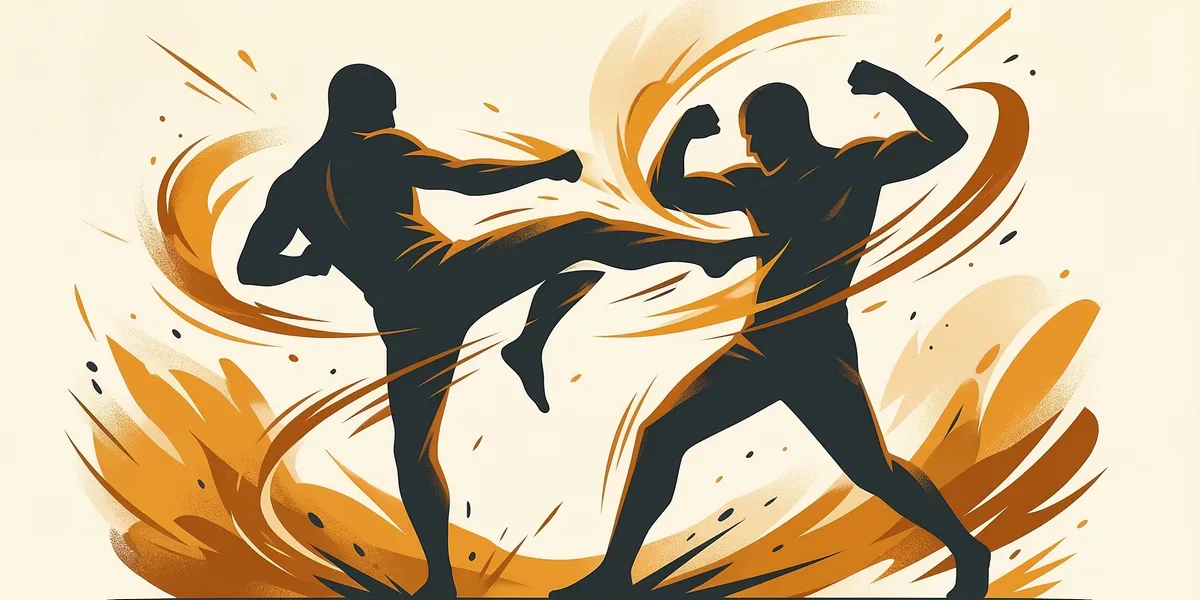
A fight scene is a moment of physical conflict between characters — but on the page, it is really a moment of decision, consequence, and change.
The best fight scenes are not about who punches whom. They are about what is at stake, what shifts, and what the violence costs. If nothing changes after the fight, the fight did not need to exist.
Clarity Beats Choreography
The most common mistake in fight writing is trying to describe every single movement. Writers who love martial arts or action movies sometimes produce paragraphs that read like a sparring manual: he blocked with his left forearm, pivoted on his back foot, then swept low with a spinning heel kick.
Readers cannot visualize that. Not at speed.
Instead, focus on the key moments — the hits that land, the decisions that matter, the turning points. You are directing a camera, not writing a transcript. Show the punch that breaks the nose. Skip the three jabs that got blocked.
Cormac McCarthy’s fight scenes in Blood Meridian are brutally effective because they give you just enough — a flash of metal, a man falling — and let your imagination fill in the rest. The violence feels enormous precisely because it is not exhaustively detailed.
Short Sentences Create Speed
Rhythm controls pace. When a fight speeds up, your sentences should get shorter.
Compare these two versions of the same moment:
Slow: She noticed that he was reaching for the knife on the counter behind him, and she realized she needed to move before he could get his hand around the handle, so she lunged forward.
Fast: He reached for the knife. She saw it. She moved first.
The second version is not better writing in every context. But in a fight, it is better because it feels urgent. The reader’s eyes move faster across the page. The white space between short sentences creates a staccato rhythm — like a heartbeat spiking.
Then, when the fight pauses, you slow the rhythm back down. Longer sentences. A moment to breathe. The contrast makes both modes more effective.
Stakes Matter More Than Moves
Before you write a single punch, answer this: what happens if the character loses?
If the answer is “nothing much,” the fight will feel hollow no matter how well-choreographed it is. In The Princess Bride, the sword fight between Inigo and the Man in Black is legendary not because of the fencing (though the fencing is excellent) but because we know Inigo has spent twenty years preparing to avenge his father. The stakes are his entire identity.
Every fight needs stakes beyond “someone gets hurt.” Those stakes can be:
- Physical survival. The simplest form. If she loses, she dies.
- Emotional. If he fights back, he becomes the violent person he swore he would never be.
- Relational. This fight will destroy their friendship regardless of who wins.
- Strategic. Losing here means the villain reaches the device first.
- Moral. She could win easily by fighting dirty. But that would make her no better than him.
The more layers of stakes you stack, the more tension the fight carries.
Use the Environment
Fights that take place in a featureless void feel generic. Fights that use their setting feel alive.
A fight in a kitchen gives you knives, hot pans, slippery tile floors, and a table to be thrown across. A fight on a rooftop gives you height, wind, loose gravel, and the edge. A fight in a library gives you heavy bookends, narrow aisles, and an unexpected silence that makes every sound amplified.
The environment should not be decoration. It should be a participant. Characters should grab what is near them, trip over what is under them, and be aware of what surrounds them.
Jackie Chan understood this better than anyone in film. His fight scenes are defined by location — a ladder, a shopping mall, a furniture warehouse. The setting is not where the fight happens. It is how the fight happens.
Every Fight Should Change Something
This is the rule that separates necessary fight scenes from filler.
After the fight ends, something should be different. Not just physically — though injuries matter and should have consequences — but in the story’s deeper architecture:
- A relationship shifts. Two allies who fight each other cannot go back to how things were.
- A power dynamic changes. The underdog wins, and now the hierarchy is upended.
- A character reveals something. Under pressure, people show who they really are. Maybe the calm leader panics. Maybe the coward stands firm.
- The plot turns. The fight’s outcome sends the story in a new direction.
If you can remove a fight scene and the story still works, remove it. Action for its own sake is just noise.
Sensory Detail Beyond the Visual
Most writers default to describing what a fight looks like. But readers experience the world through more than their eyes, and fight scenes are one of the best places to use the full sensory palette.
Pain. Not just “it hurt.” Where exactly? What kind of pain? A broken rib is a sharp, stabbing thing that screams every time you breathe. A blow to the stomach is a deep, nauseating pressure that makes the world tilt.
Sound. The wet crack of bone. The ragged breathing. The crowd roaring or the terrible silence of a fight in an empty room. A gunshot indoors is not a bang — it is a physical concussion that leaves your ears ringing.
Smell. Sweat. Blood has a copper tang. Gunpowder smells acrid. A burning building fills your nose before your eyes.
Touch. The grit of pavement under your palms when you fall. The slick warmth of blood on your hands. The way adrenaline makes your skin feel electric and numb at the same time.
One or two well-chosen sensory details per fight beat will do more than a paragraph of visual description.
Character Voice in Combat
How a character fights should reflect who they are.
A trained soldier fights differently from a scared teenager. Not just in technique — in mentality. The soldier is clinical, assessing threats, conserving energy, thinking two moves ahead. The teenager is panicking, swinging wild, running on adrenaline and terror.
Their internal monologue during a fight should sound like them, not like a generic action narrator. A character who uses humor as a defense mechanism will be cracking jokes in their head even while getting beaten. A character who overthinks everything will be analyzing the fight while it is happening, possibly to their detriment.
This is also where character development pays off. If you have built a character with specific traits, fears, and habits, the fight scene writes itself — because you know how this particular person would respond to violence.
Common Mistakes
The blow-by-blow. Describing every single movement turns a fight into a technical manual. Readers skim it. Hit the key moments and trust your reader to fill in the gaps.
No stakes. If the reader does not care who wins, the fight is just noise. Establish what is on the line before the first punch.
Too long. Most fight scenes should be shorter than you think. A real fight between untrained people lasts seconds. Even trained fighters tire quickly. A five-page fight scene needs extraordinary justification.
Every character fights the same way. If you could swap any character into the fight and nothing would change, you have not differentiated their combat styles. A fight scene is characterization — treat it that way.
No consequences. If a character takes a beating and is fine in the next chapter, you have taught the reader that violence does not matter in your story. Injuries should linger. Fights should leave marks — physical, emotional, or both.
Forgetting the emotional aftermath. The moment after a fight is as important as the fight itself. What does it feel like to have just hurt someone? To have almost died? To have won but lost something in the process? Do not cut away too quickly.
The Heart of a Good Fight Scene
A fight scene is not an interruption of the story. It is a concentrated dose of it. Every conflict your characters have been building toward can erupt in physical form — and when it does, the reader should feel every layer.
Write fights that are clear enough to follow, fast enough to feel urgent, and meaningful enough to matter. Use the setting. Engage every sense. Let each character fight like themselves, not like a generic action hero.
And when the fight ends, make sure something has changed. A fight scene that leaves the story exactly where it found it is a missed opportunity — show, do not tell your readers what this moment costs, and they will feel it long after the last page.