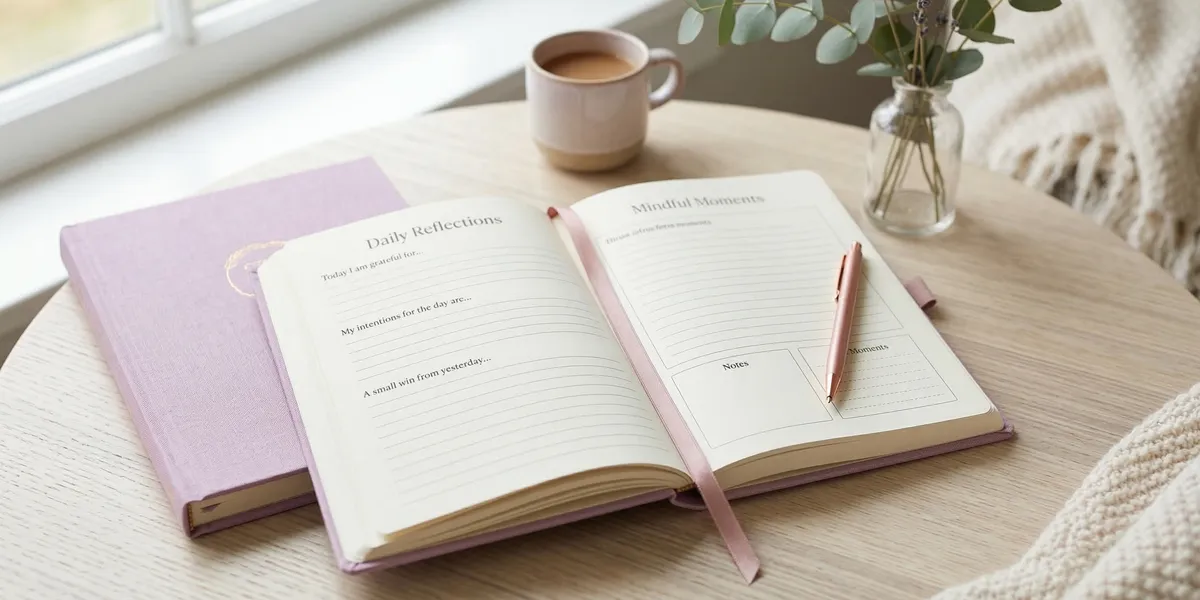
A guided journal gives readers structure for their writing practice. Instead of blank pages that can feel intimidating, guided journals provide prompts, frameworks, and reflection exercises that direct the journaling experience toward a specific outcome — gratitude, self-discovery, goal achievement, creativity, or healing.
Guided journals are one of the most approachable publishing projects you can take on, and one of the most commercially reliable. Here is how to design, write, format, and publish one.
Types of guided journals
Guided journals serve different purposes. Choose the type that aligns with your expertise and your audience’s needs.
Gratitude journals
A daily practice of recording things the reader is thankful for. Typically structured around 3-5 daily prompts that shift perspective toward appreciation.
Structure: Date field, daily prompts (“Three things I am grateful for today”), brief reflection space. Audience: Wellness-focused readers, stress reduction, mindfulness practitioners. Page count: 90-180 pages (3-6 months of daily use).
Self-discovery journals
Designed to help readers understand themselves better — their values, patterns, desires, and beliefs. These journals ask deeper questions and provide more space for extended writing.
Structure: Themed sections (identity, relationships, purpose, values), multi-paragraph prompts, reflection exercises. Audience: Personal development readers, therapy/coaching clients, people in transition. Page count: 120-200 pages.
Goal-setting journals
Guide readers through defining, planning, and tracking their goals. Often combine vision-setting prompts with daily or weekly tracking pages.
Structure: Goal-definition exercises, action planning templates, daily/weekly review pages, progress tracking. Audience: Entrepreneurs, students, productivity-focused readers. Page count: 90-150 pages.
Creative journals
Spark creativity through writing prompts, drawing exercises, brainstorming frameworks, and unconventional challenges.
Structure: Varied prompts (write, draw, list, brainstorm), creative constraints, inspiration pages. Audience: Writers, artists, creative professionals, anyone wanting to unlock creativity. Page count: 100-180 pages.
Therapeutic journals
Support specific mental health and emotional processing goals. Often aligned with therapeutic frameworks like CBT, DBT, or narrative therapy.
Structure: Structured exercises based on therapeutic principles, mood tracking, cognitive reframing prompts. Audience: Therapy clients, people processing grief or trauma, mental health-aware readers. Page count: 100-150 pages.
Important note on therapeutic journals: If your journal incorporates therapeutic techniques, be clear about your qualifications. If you are not a licensed therapist, state that the journal is not a substitute for professional help. Consider having a mental health professional review your content.
Designing the prompt structure
The prompts are the product. Every page should feel intentional, useful, and worth the reader’s time.
The prompt-space-reflection cycle
Each journal page or spread follows a cycle:
- Prompt. A specific question, exercise, or instruction that tells the reader what to write about.
- Space. Lined or blank area for the reader’s response. This is where the reader does the work.
- Reflection. A follow-up question or observation that helps the reader draw meaning from what they just wrote.
This cycle can repeat multiple times per page (for quick daily entries) or span an entire spread (for deep reflection exercises).
Writing effective prompts
Strong journal prompts share specific qualities:
They are specific, not vague.
- Weak: “Write about your feelings.”
- Strong: “Describe a moment this week when you felt genuinely at peace. Where were you? What were you doing? What made that moment different?”
They direct without dictating. A good prompt opens a door — it points the reader in a direction but does not tell them what to find there. The reader’s response should be genuinely their own.
They progress. Prompts should build on each other within a section. Early prompts might be observational (“What did you notice today?”). Later prompts push deeper (“What pattern do you see in the things you notice?”). The journal takes the reader somewhere.
They vary. Mix different types of prompts to prevent monotony:
| Prompt Type | Example | Best For |
|---|---|---|
| Open-ended question | ”What would you do if you knew you could not fail?” | Self-discovery |
| Completion prompt | ”The thing I most want to change about my daily routine is…” | Goal-setting |
| List prompt | ”List 10 things that make you feel energized” | Brainstorming |
| Observation prompt | ”Describe something beautiful you saw today in detail” | Gratitude, mindfulness |
| Contrasting prompt | ”What do you show the world? What do you keep hidden?” | Deep reflection |
| Action prompt | ”Write a letter you will never send to someone you need to forgive” | Therapeutic |
| Memory prompt | ”Describe your earliest memory of feeling brave” | Self-discovery |
How many prompts per page
This depends on your journal type:
- Daily journals (gratitude, mood tracking): 3-5 short prompts per page with 2-4 lines of space each.
- Weekly journals (reflection, review): 1-2 prompts per page with a quarter to half page of space each.
- Deep-dive journals (self-discovery, therapeutic): 1 prompt per page or spread with generous writing space.
Page count and format
How many pages
Guided journals typically range from 90-365 pages, depending on the intended use:
| Journal Type | Typical Page Count | Daily Use Duration |
|---|---|---|
| Daily gratitude | 180-365 pages | 6-12 months |
| Weekly reflection | 104-156 pages | 1-3 years |
| Goal-setting (quarterly) | 90-120 pages | 3 months |
| Self-discovery (complete once) | 120-200 pages | Use at own pace |
| Creative prompts | 100-180 pages | Use at own pace |
Page size
For journals printed through Amazon KDP, common sizes include:
- 6 x 9 inches — The standard journal size. Portable, affordable to print.
- 7 x 10 inches — More writing space while still being manageable.
- 8.5 x 11 inches — Full-page space. Good for journals with templates, grids, or drawing exercises.
- 5 x 8 inches — Compact and portable. Good for daily carry.
For KDP specifically, 6x9 and 5.5x8.5 are the most cost-effective sizes to print. Larger formats increase your print cost per unit, which reduces your royalty margin.
Formatting for KDP
Amazon KDP is the most popular platform for publishing guided journals. Here is how to format yours.
Interior design
You will need to create a print-ready interior PDF. Tools for creating journal interiors include:
- Canva — Easiest for beginners. Templates available for journal pages.
- Adobe InDesign — Professional-grade layout. Best for complex designs.
- BookBolt — Specifically designed for low-content and journal publishing on KDP.
- Affinity Publisher — Professional quality at a lower price than InDesign.
Key formatting specs for KDP:
- PDF format, flattened (no layers)
- 300 DPI resolution
- CMYK color space (or grayscale for black-and-white interiors)
- Bleed: 0.125 inches on all sides if your design extends to the page edge
- Margins: Minimum 0.25 inches (0.375 on the gutter side for perfect binding)
Cover design
Your journal cover needs to communicate the journal’s purpose at a glance. Guided journals compete with hundreds of similar products on Amazon — your cover is your primary differentiator.
What works:
- Clean, modern design with a clear title
- Color palette that reflects the journal’s tone (calming pastels for mindfulness, bold colors for goal-setting)
- Subtitle that specifies the audience or purpose
- Professional typography
What does not work:
- Cluttered designs with too many elements
- Generic stock imagery that could apply to any journal
- Small or hard-to-read text (remember, customers see the cover as a thumbnail first)
Pricing
KDP journal pricing depends on page count and trim size because Amazon calculates your print cost based on these factors.
| Page Count | Trim Size | Approx. Print Cost | Suggested Retail | Your Royalty |
|---|---|---|---|---|
| 120 pages | 6x9 | ~$2.70 | $9.99 | ~$3.30 |
| 180 pages | 6x9 | ~$3.50 | $12.99 | ~$4.30 |
| 200 pages | 7x10 | ~$4.20 | $14.99 | ~$4.80 |
| 365 pages | 6x9 | ~$5.80 | $16.99 | ~$4.40 |
Price your journal competitively by checking similar journals in your category on Amazon. Most guided journals sell for $8.99-$16.99.
Creating a series
A single guided journal can generate steady income. A series multiplies that by creating multiple entry points for customers and encouraging repeat purchases.
Series strategies
Themed volumes. A gratitude journal series with seasonal editions (Spring, Summer, Autumn, Winter). A self-discovery series with volumes focused on different life areas (Career, Relationships, Health, Purpose).
Progressive levels. A beginner journal that teaches basic reflection, followed by intermediate and advanced volumes that go deeper. This works well for therapeutic and goal-setting journals.
Audience-specific editions. The same core concept adapted for different audiences. A goal-setting journal for entrepreneurs, one for students, one for creative professionals. The structure is similar, but the prompts and examples are tailored.
Companion products. Pair your guided journal with a standard book that teaches the underlying philosophy or method. The book provides the theory; the journal provides the practice. This cross-selling approach works well on Amazon because customers who buy one often discover the other.
The low-content publishing overlap
Guided journals sit at the intersection of traditional publishing and low-content publishing. Understanding this overlap helps you position your journal correctly.
Low-content books (blank notebooks, lined journals, simple planners) compete primarily on cover design and price. They have minimal written content. The market is saturated and price-competitive.
Guided journals differentiate through their prompts and structure. The written content — your prompts, instructions, and reflection questions — is your intellectual property and your competitive advantage. A well-designed guided journal with thoughtful prompts is a fundamentally different product from a blank journal with a nice cover.
Position your journal as a guided experience, not a blank book with prompts. Your marketing, description, and cover should all signal that this journal provides structure, direction, and a specific outcome.
If you want to develop the instructional content for your guided journal before handling the layout and design, Chapter can help you draft your prompts, reflection exercises, and instructional sections. It is built for structured nonfiction content — which is exactly what the written portion of a guided journal is.
Common mistakes to avoid
- Generic prompts. “How do you feel today?” appears in thousands of journals. Your prompts need to be specific, thoughtful, and original.
- Insufficient writing space. If you give someone a deep prompt and two lines to write, they will be frustrated. Match the space to the depth of the prompt.
- No progression. A journal that asks the same type of question 200 times feels repetitive. Build variety and depth into the sequence.
- Ignoring the physical experience. Test your journal by printing a proof and actually using it. Do the pages lie flat enough to write on? Is the font readable? Is there enough margin near the spine?
- Overdesigning. Heavy graphics, decorative borders, and busy backgrounds compete with the reader’s writing. Keep the design clean and let the prompts do the work.
FAQ
Do I need to be a therapist or coach to create a guided journal?
No. Anyone with expertise in a subject — gratitude, creativity, goal-setting, self-reflection — can create a guided journal. If your journal incorporates therapeutic techniques (CBT exercises, trauma processing), consider consulting with a licensed professional to ensure your content is responsible.
Can I sell a guided journal as a digital download?
Yes. Digital guided journals (fillable PDFs) sell well on platforms like Etsy, Gumroad, and your own website. The advantage is zero print cost and instant delivery. The disadvantage is that many journal users prefer the physical experience of writing by hand.
How do I market a guided journal on Amazon?
Keywords are critical. Research what journal buyers search for using Amazon’s search suggestions and tools like Publisher Rocket. Optimize your title, subtitle, and description with relevant keywords. Choose the right category (Self-Help > Journals is the primary category for most guided journals). Encourage reviews from early buyers — social proof drives journal sales on Amazon.
Should I include an introduction in my guided journal?
A brief introduction (1-3 pages) that explains how to use the journal, what the reader will gain, and any guiding philosophy adds value. Keep it short. The reader bought a journal to write, not to read.