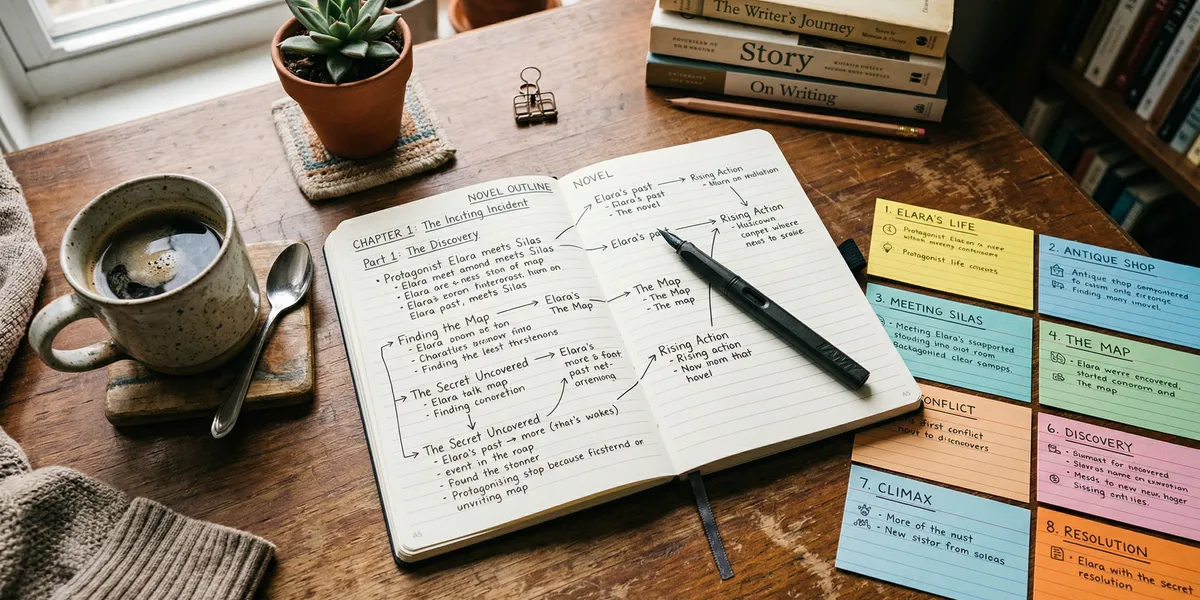
You can write a novel outline in a single afternoon. The process boils down to identifying your core story, breaking it into structural beats, and expanding those beats into a working plan you can draft from. This guide walks you through the full process, from first idea to finished outline, with three ready-to-use templates.
A 2022 survey by Written Word Media found that authors who outline before drafting are significantly more likely to finish their manuscripts. That alone makes outlining worth the investment — even if you only spend an hour on it.
Why outline your novel before writing
An outline is not a creative straitjacket. It is a decision-making tool that prevents the most common reasons novels stall out: sagging middles, wandering subplots, and characters who stop doing interesting things around chapter twelve.
Here is what a solid outline gives you:
- A clear destination. You know where your story ends, which means every scene can build toward that ending.
- Faster drafting. When you sit down to write each day, you already know what happens next. No staring at the cursor.
- Fewer structural rewrites. Discovering a plot hole in a two-page outline takes five minutes to fix. Discovering it in a 70,000-word draft takes weeks.
- Flexible working order. With an outline, you can write scenes out of sequence and still know they fit together.
If you are on the fence about whether outlining suits your style, you are likely a plantser — someone who blends plotting with discovery writing. The templates below work well for plotters and plantsers alike.
Step 1: Start with your premise and core conflict
Every novel outline starts with one question: what is this book about?
Write a single sentence that captures your premise. This is not a logline for a pitch deck — it is a working summary for you. The format that works best is: A [character] must [goal] or else [stakes].
Examples:
- A retired spy must protect her estranged daughter from the agency that trained her, or lose the only family she has left.
- A small-town baker discovers her grandmother’s recipe book contains encoded messages from a World War II resistance network.
- A teenager who can see ghosts must solve the murder of his best friend before the killer strikes again.
Your premise sentence identifies three critical elements: the protagonist, the central conflict, and the stakes. If any of those three are missing, your outline will drift. Get them down first.
Step 2: Define your protagonist’s arc
Before you plot events, clarify how your main character changes. A strong character arc gives your outline emotional direction, not just narrative sequence.
Answer these four questions:
- Who is your protagonist at the beginning? What do they believe, fear, or lack?
- What do they want? This is their external goal — the thing they are actively pursuing.
- What do they need? This is the internal lesson or growth they must achieve.
- Who are they at the end? How have they changed as a result of the story?
The gap between want and need is where story tension lives. In The Great Gatsby, Gatsby wants Daisy. What he needs is to let go of the past. That gap drives the entire novel.
Write these answers down. They become the emotional spine of your outline.
Step 3: Choose your outlining method
Different methods suit different brains. Here are three that cover the spectrum from structured to flexible. Pick the one that matches how you think, or combine elements from more than one.
Method 1: The Three Act Structure outline
The three act structure is the most widely used framework in fiction. It divides your novel into three parts with specific functions:
| Act | Portion | Purpose |
|---|---|---|
| Act I: Setup | First 25% | Introduce the world, protagonist, and inciting incident |
| Act II: Confrontation | Middle 50% | Rising conflict, complications, midpoint shift |
| Act III: Resolution | Final 25% | Climax, falling action, resolution |
Best for: Writers who want clear structural guardrails without micromanaging every scene. Works well for commercial fiction, thrillers, and romance.
Method 2: The Save the Cat beat sheet
Adapted from Blake Snyder’s screenwriting framework by Jessica Brody for novelists, Save the Cat breaks your story into 15 specific beats. Each beat has a defined purpose and approximate page position.
The key beats are:
- Opening image (1%): The snapshot of your protagonist’s world before everything changes.
- Catalyst (10%): The event that sets the story in motion.
- Break into Two (25%): The protagonist commits to the journey.
- Midpoint (50%): A false victory or false defeat that raises the stakes.
- All Is Lost (75%): The lowest point — everything falls apart.
- Finale (80-99%): The protagonist applies everything they have learned to confront the central conflict.
- Final image (100%): A mirror of the opening that shows how the protagonist has changed.
Best for: Writers who want granular, beat-by-beat guidance. Especially effective for genre fiction with tight pacing requirements.
Method 3: The Snowflake Method
The Snowflake Method, created by Randy Ingermanson, builds an outline iteratively. You start simple and expand in controlled steps:
- Write a one-sentence summary of your novel.
- Expand that sentence into a one-paragraph summary (roughly five sentences covering setup, three major plot turns, and the ending).
- Write a one-page character summary for each major character.
- Expand the paragraph summary into a full one-page synopsis.
- Write one-page character charts for each character.
- Expand the synopsis into a four-page outline.
- Continue expanding until you have a scene-by-scene plan.
Best for: Writers who feel overwhelmed by planning a full novel at once. The step-by-step expansion keeps the process manageable, especially for complex, multi-layered stories.
For a deeper comparison of these and four other methods, see our guide to novel outlining methods.
Step 4: Map your major plot points
Regardless of which method you chose, every novel outline needs the same structural anchors. These are the non-negotiable moments your story must hit.
Map these seven plot points before filling in anything else:
- Hook — The opening scene or situation that pulls readers in.
- Inciting incident — The event that disrupts the protagonist’s normal life and launches the story.
- First plot point — The moment of no return where the protagonist commits to the central conflict.
- Midpoint — A revelation, reversal, or escalation that shifts the story’s direction.
- Third plot point — The crisis moment where things look worst for the protagonist.
- Climax — The final confrontation with the central conflict.
- Resolution — The aftermath showing how the world and protagonist have changed.
Think of these seven points as tent poles. Once they are set, you can fill in the scenes between them with much more confidence.
Step 5: Build out your scenes
With your plot points locked in, expand each section into individual scenes. A scene is the smallest unit of your outline — one continuous action in one location with one purpose.
For each scene, write:
- What happens (1-2 sentences)
- Which characters are present
- What changes by the end of the scene (a character learns something, a relationship shifts, a plan fails)
That last point is the most important. If nothing changes in a scene, it does not belong in your outline.
Most novels contain between 50 and 80 scenes. A 75,000-word novel with an average scene length of 1,200 words will have roughly 60 scenes. You do not need to plan all of them in your first pass — start with the scenes you can see clearly and leave placeholder notes for the gaps.
Scene list template
Use this format for each scene entry:
Chapter [X] — Scene [Y]
POV: [Character name]
Setting: [Location, time]
What happens: [1-2 sentence summary]
Purpose: [What changes — plot, character, or reader knowledge]
Three novel outline templates
Here are three complete outline templates you can copy and customize. Each matches one of the methods described above.
Template 1: Three Act Structure outline
PREMISE: [One-sentence premise]
PROTAGONIST: [Name] — [Key trait] — [Want vs. need]
ANTAGONIST: [Name or force] — [What they want]

ACT I (Chapters 1-6, ~20,000 words)
- Ch 1-2: Normal world, introduce protagonist and their flaw
- Ch 3: Inciting incident — [what disrupts their world]
- Ch 4-5: Reaction, resistance, stakes become clear
- Ch 6: First plot point — protagonist commits to the journey

ACT II-A (Chapters 7-13, ~25,000 words)
- Ch 7-8: New world, new rules, early wins
- Ch 9-10: Subplot introduction, deepen relationships
- Ch 11-12: Complications mount, early plan fails
- Ch 13: Midpoint — [revelation or reversal that changes everything]

ACT II-B (Chapters 14-19, ~25,000 words)
- Ch 14-15: New approach after midpoint shift
- Ch 16-17: Stakes escalate, allies tested
- Ch 18: Major setback — plan falls apart
- Ch 19: Third plot point — all seems lost

ACT III (Chapters 20-25, ~15,000 words)
- Ch 20-21: Protagonist regroups with new understanding
- Ch 22-23: Final push toward climax
- Ch 24: Climax — [final confrontation]
- Ch 25: Resolution — [how the world has changed]
Template 2: Save the Cat beat sheet for novels
GENRE: [Story genre from Snyder's 10 categories]
PROTAGONIST: [Name] — [Flaw] — [Want vs. need]

1. Opening Image: [Snapshot of protagonist's world before]
2. Theme Stated: [The lesson someone voices early — protagonist ignores it]
3. Setup: [Establish world, relationships, stakes, ticking clock]
4. Catalyst: [The event that changes everything — page ~30]
5. Debate: [Protagonist hesitates, weighs options]
6. Break into Two: [Commits to the journey — end of Act I]
7. B Story: [Subplot, often a relationship that teaches the theme]
8. Fun and Games: [The "promise of the premise" — deliver what readers came for]
9. Midpoint: [False victory or false defeat — stakes rise]
10. Bad Guys Close In: [Opposition tightens, internal doubts grow]
11. All Is Lost: [Worst moment — whiff of death (literal or symbolic)]
12. Dark Night of the Soul: [Protagonist processes the loss]
13. Break into Three: [New idea or information sparks the solution]
14. Finale: [Protagonist confronts the conflict using everything learned]
15. Final Image: [Mirror of the opening — shows transformation]
Template 3: Snowflake Method worksheet
STEP 1 — One-sentence summary:
[15-25 words capturing the core story]

STEP 2 — One-paragraph expansion:
Sentence 1: [Setup and backdrop]
Sentence 2: [First quarter — inciting incident through first plot point]
Sentence 3: [Second quarter — first half of Act II]
Sentence 4: [Third quarter — midpoint through crisis]
Sentence 5: [Fourth quarter — climax and resolution]

STEP 3 — Character summaries (for each major character):
Name:
Motivation:
Goal:
Conflict:
Epiphany:
One-paragraph story summary from their POV:

STEP 4 — Expand paragraph to one-page synopsis
[Take each sentence from Step 2 and expand into a full paragraph]

STEP 5 — Scene list
[Number each scene, assign a chapter, note POV and purpose]
For more templates covering nonfiction and memoir in addition to fiction, see our book outline template collection.
Common mistakes to avoid
- Over-outlining. If your outline reads like a finished novel, you have gone too far. Leave room for discovery during drafting. The outline is a map, not the destination.
- Skipping character arcs. An outline full of plot events but no emotional development produces a manuscript that feels hollow. Always define how your protagonist changes.
- Locking yourself in. The best outlines are living documents. When you discover something better during drafting, update the outline. A rigid outline that you refuse to modify is worse than no outline at all.
- Starting with chapter one. Many writers outline chronologically and run out of steam in the middle. Start with your climax and ending, then work backward to figure out what needs to happen to earn those moments.
- Ignoring subplots. Your outline should track at least one subplot alongside the main plot. Subplots that appear out of nowhere during drafting are the leading cause of messy second acts.
How AI can help you outline faster
AI writing tools can accelerate the outlining process by generating structural options you might not consider on your own. Instead of replacing your creative decisions, they give you raw material to react to and refine.
Our Pick — Chapter
Chapter generates full novel outlines from your premise, letting you customize structure, pacing, and chapter breakdowns before you write a single scene. It is built specifically for book-length projects, not short-form content.
Best for: Authors who want a working outline fast and prefer to spend their creative energy on the writing itself. Pricing: $97 one-time (nonfiction) | Varies (fiction) Why we built it: Most AI tools are designed for blog posts and marketing copy. Chapter is designed for books — including the outlining stage.
For a full comparison of AI tools that can help with outlining, see our guide to the best AI book outline generators.
FAQ
How long should a novel outline be?
There is no universal length. A workable outline can be anywhere from two pages (a high-level beat sheet) to fifty pages (a detailed scene-by-scene plan). Most authors find that three to ten pages hits the sweet spot — enough structure to prevent getting lost, but enough flexibility to allow for creative discovery during drafting.
Should I outline every chapter?
Not necessarily. Many successful writers outline the major plot points and key turning points, then leave the connecting scenes loose. If you know your inciting incident, midpoint, and climax, you can often figure out the scenes between them as you draft.
Can I change my outline while writing?
Absolutely. An outline is a planning tool, not a contract. According to writing instructor Jerry Jenkins, your outline should evolve as you draft and discover new things about your characters and story. The goal is to prevent structural problems, not to eliminate creative flexibility.
What if I hate outlining?
You do not have to write a traditional outline. Some writers use mind maps, scene cards, or visual boards instead of linear documents. Others write a rough “zero draft” — essentially a very loose, fast version of the story — and treat that as their outline. The point is having some kind of structural plan before you commit to a full draft.
How is a novel outline different from a synopsis?
An outline is a working document for you. It can be messy, use shorthand, and include notes to yourself. A synopsis is a polished document for agents and publishers that summarizes your complete plot in one to three pages, including the ending. You write the outline first, then create the synopsis from it if needed.