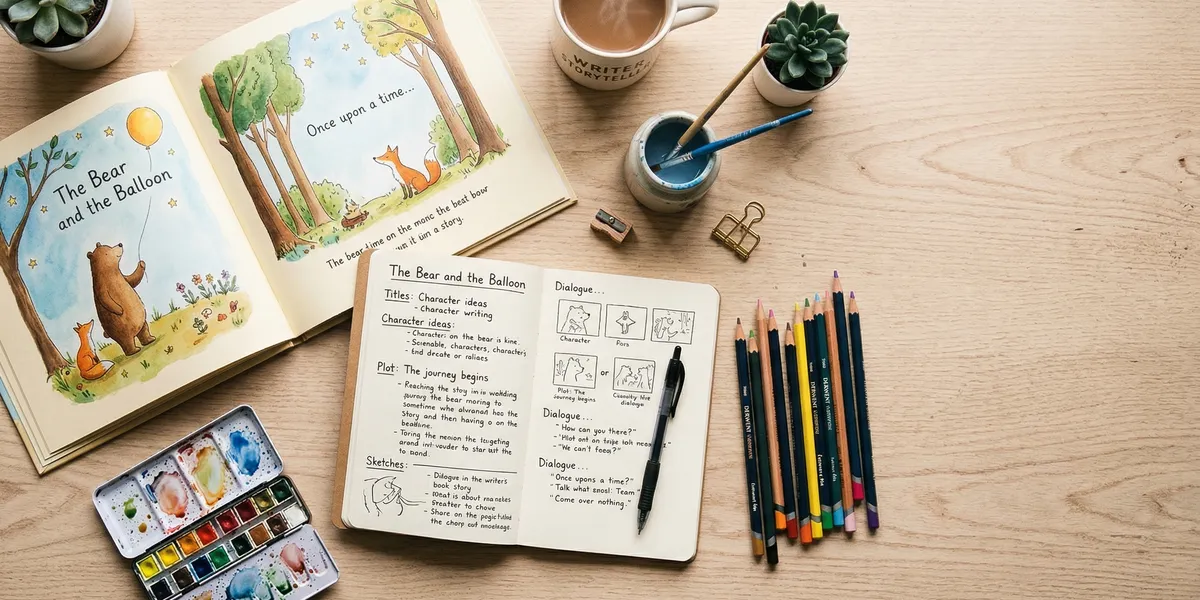
You write a picture book by crafting a tight, visual story of roughly 500 words across 32 pages, where every sentence earns its place and illustrations carry half the narrative. Yes, it is absolutely something you can learn to do, and this guide walks you through each step.
The global children’s picture book market was valued at roughly $4.7 billion in 2024, with steady growth projected through the end of the decade. Picture books remain the most popular format for children aged 3 to 7, and they are also one of the most rewarding formats to write. They are also among the hardest, because brevity demands precision.
Understand the picture book format
Before you write a single word, understand the constraints. Picture books are not short stories with pictures attached. They are a specific format with industry standards that publishers, printers, and readers all expect.
The 32-page standard. Nearly all traditionally published picture books are 32 pages long. This number comes from the printing process: sheets fold into 8-page signatures, and 32 pages print on a single sheet cost-effectively. Of those 32 pages, your story gets roughly 28 after the title page, copyright page, and dedications.
Word count: 500 words or fewer. Most picture books published today contain between 300 and 600 words. Nonfiction picture books can stretch to 1,000 words, but fiction picture books trending under 500 words have the strongest reception from agents and editors. Many successful picture books contain fewer than 200 words.
Age range. Picture books target children aged 2 to 8, though most are aimed at the 3 to 5 sweet spot. This does not mean you write simplistically. It means you write with clarity, rhythm, and economy.
Choose your concept and theme
Every strong picture book starts with a concept that works visually and emotionally. The best picture book ideas combine a clear premise with universal feelings children experience: fear of the dark, wanting to belong, learning something new, navigating friendship.
Ask yourself three questions before committing to an idea:
- Can an illustrator show this? If your story relies on internal thoughts that can’t be drawn, it may not work as a picture book.
- Does it have a clear emotional arc? Even in 500 words, readers need to feel something shift from beginning to end.
- Is it fresh? Read at least 50 recently published picture books in your category before writing. The Society of Children’s Book Writers and Illustrators (SCBWI) recommends immersing yourself in current titles to understand what’s being published now, not what you remember from childhood.
Avoid topics that are too abstract for young children, and avoid stories that only work as lessons. The best picture books entertain first and teach second.
Map your story across page spreads
Picture books are read as a series of two-page spreads. Before drafting, plan what happens on each spread. This is called a book dummy or a page map.
Grab a sheet of paper and sketch 16 rectangles, each representing one two-page spread. (Sixteen spreads multiplied by two pages equals your 32 pages.) Now thumbnail what happens in each one.
Spread 1-2: Introduce the character and their world. Spread 3-4: Introduce the problem or desire. Spread 5-12: Escalate. Raise the stakes. Add complications. Spread 13-14: Reach the climax. Spread 15-16: Resolve and close with a satisfying ending.
This structure is flexible, but the principle holds: picture books need a beginning, a middle with rising tension, and an ending. The page turn is your most powerful tool. Each spread should make the reader want to turn the page.
Write the first draft
With your page map ready, write the text for each spread. Keep these principles in mind:
Start where the story starts. Skip preamble. Your first line should drop readers into the action or the character’s world immediately.
Write for the ear. Picture books are read aloud, often dozens of times. Every sentence must sound good spoken. Read your draft aloud after every revision. If you stumble, your reader will stumble too.
Leave room for illustrations. Do not describe what an illustrator can show. If a character is sad, don’t write “she felt sad” when the illustration will show tears on her face. Write the words the illustration can’t convey: dialogue, sounds, internal decisions.
Use strong, specific verbs. “Stomped” is better than “walked angrily.” “Snatched” is better than “quickly grabbed.” Strong verbs let you cut adverbs and tighten your word count.
Create rhythm and repetition. Many beloved picture books use repeated phrases, patterns, or structures. Repetition gives young listeners something to anticipate and participate in. Think of how effective recurring phrases become in books children ask to hear again and again.
Revise ruthlessly
First drafts of picture books are almost always too long and too explanatory. Revision is where the real writing happens.
Cut your word count in half. Seriously. If your first draft is 800 words, get it to 400. Every word a picture book doesn’t need is a word that slows down the read-aloud experience.
Remove anything the illustrator can show. Go through every sentence and ask: could this be a picture instead? If yes, cut the text.
Check your page turns. Read through the manuscript spread by spread. Does every page turn create suspense, surprise, or momentum? If a spread feels flat, restructure or cut it.
Read aloud repeatedly. Read it to yourself. Read it to a child. Read it to your writing group. Listen for spots where attention drifts, where the rhythm breaks, or where the words feel clunky.
Get outside feedback. Join a critique group through SCBWI or a local writing community. Other picture book writers will catch issues you can’t see because you’re too close to the text.
Handle illustration decisions
Unless you are also an illustrator, do not include art notes in your manuscript. This is one of the most common mistakes new picture book writers make.
If you are pursuing traditional publishing: Submit text only. The publisher will pair you with an illustrator. Art direction is the publisher’s job, not the writer’s. The only exception is if a visual element is essential to understanding the story and can’t be inferred from the text.
If you are self-publishing: You will need to hire an illustrator or create illustrations yourself. Budget at least $3,000 to $10,000 for professional picture book illustration, depending on the style and the illustrator’s experience. Many self-published authors find illustrators through platforms like the SCBWI Illustrator Gallery, Reedsy, or Fiverr.
If you are using AI tools: Platforms like Chapter.pub can help you draft and structure your picture book text, letting you focus on story and language while the tool handles organization and formatting. For illustration, AI image generators are evolving quickly, though the Children’s Book Council’s 2024 guidelines recommend full disclosure of AI involvement in published works.
Format your manuscript
Picture book manuscripts follow a specific format for submission:
- Double-spaced, 12-point standard font (Times New Roman or Courier)
- Page breaks where you envision page turns (use “Page Break” or indicate with a line)
- No illustration notes unless absolutely necessary for comprehension
- Contact information on the first page, along with your word count
- Total length: Your 500-word picture book manuscript will be roughly two to three pages
If you are writing a rhyming picture book, the formatting rules are the same, but the standards are higher. Rhyme must be metrically perfect, with natural stress patterns and no forced rhymes. Most agents say that mediocre rhyme is the number one reason they reject picture book manuscripts.
Choose your publishing path
You have two main options, and both are viable for picture books.
Traditional publishing
Submit your manuscript to literary agents who represent children’s books, or submit directly to publishers that accept unsolicited manuscripts. The traditional path for picture books typically takes two to four years from accepted manuscript to bookstore shelf because of the illustration timeline.
Pros: Professional editing, illustration, design, and distribution at no cost to you. Publisher handles marketing support and bookstore placement. Cons: Long timeline, competitive gatekeeping, less creative control, lower royalty percentages.
Self-publishing
Publish independently through Amazon KDP, IngramSpark, or another platform. You control everything from text to illustration to pricing.
Pros: Full creative control, faster to market, higher royalty per unit, full ownership. Cons: All costs are yours (illustration, editing, design, marketing), and bookstore distribution is harder to achieve.
For authors who want help structuring and drafting their picture book text before either path, Chapter.pub streamlines the writing process so you can focus on getting the story right.
Common mistakes to avoid
- Writing too many words. Under 500 words. Seriously. Cut more.
- Telling instead of showing. If the illustration can carry it, let it. Your job is to write the words pictures can’t replace.
- Writing a lesson instead of a story. Children don’t want to be lectured. Embed your theme in the narrative, not in a moral tacked onto the end.
- Ignoring the page turn. Every spread needs a reason to keep going. If nothing changes or builds, you’ll lose your audience.
- Including illustration notes in your manuscript. Let the illustrator interpret the story visually. That’s their expertise.
- Rhyming badly. If you choose to rhyme, it must be flawless. Off-meter or forced rhyme is worse than no rhyme at all.
- Not reading current picture books. The market has changed. What worked in 1990 does not necessarily work in 2026. Read what’s being published now.
FAQ
How long should a picture book be?
Most picture books are 32 pages with 300 to 600 words of text. Fiction picture books trending under 500 words have the best reception from agents and editors. Nonfiction picture books can run up to 1,000 words.
Do I need to be an illustrator to write a picture book?
No. Most traditionally published picture book authors are not illustrators. The publisher matches your text with an illustrator. If you self-publish, you hire an illustrator separately.
How much does it cost to self-publish a picture book?
Budget $3,000 to $15,000 depending on illustration quality, printing method, and whether you use hardcover or softcover. Illustration is the largest expense, typically $3,000 to $10,000 for a full 32-page book.
Can I use AI to write or illustrate a picture book?
AI writing tools like Chapter.pub can help you draft, structure, and refine your picture book text. AI illustration tools exist but are still evolving in quality and consistency for the sequential visual storytelling picture books require. The Children’s Book Council recommends disclosing AI involvement in published works.
Should my picture book rhyme?
Only if you can write metrically perfect verse. Agents and editors reject more picture books for poor rhyme than almost any other reason. If you’re not confident in meter and scansion, prose is the safer and often stronger choice.