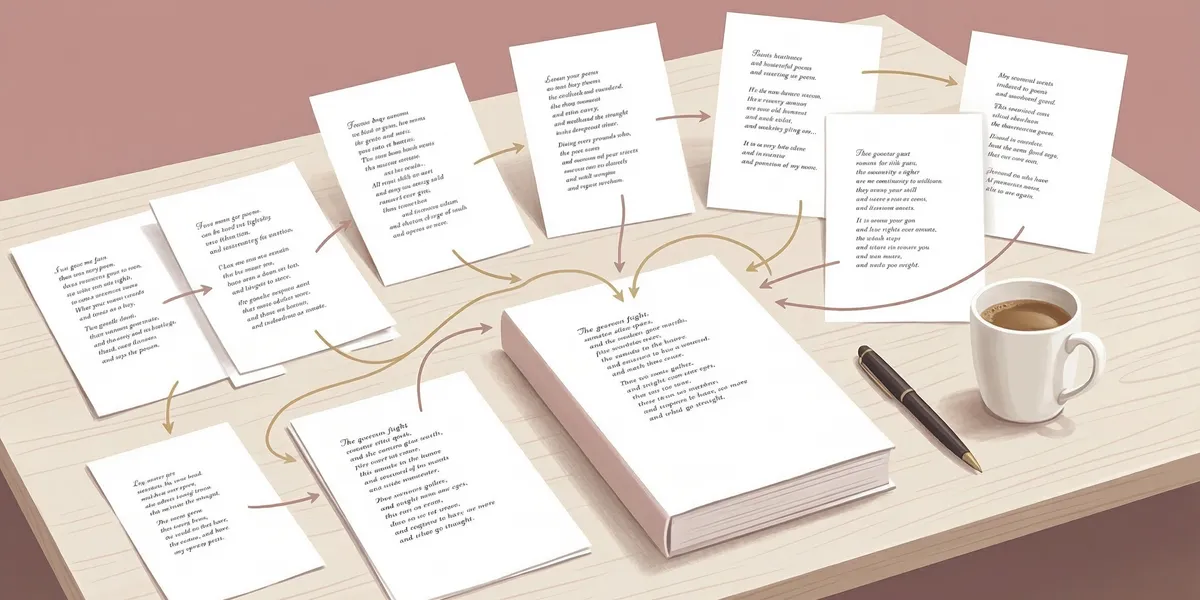
A poetry collection is more than a stack of poems between two covers. It is a curated experience — a deliberate sequence that creates a journey for the reader. The individual poems are the building blocks, but the collection itself is a work of art.
If you have poems and want to turn them into a book, here is how to organize, sequence, and publish a poetry collection that feels cohesive and intentional.
How many poems do you need?
The answer depends on whether you are building a chapbook or a full-length collection.
Chapbook
A chapbook is a short collection, typically 20-30 pages and 15-30 poems. Think of it as an EP compared to a full album. Chapbooks are the traditional entry point for poets — they are easier to complete, cheaper to produce, and many presses specialize in them.
Chapbooks work best when:
- You have a tight thematic focus
- Your poems are relatively short
- You are building a publication record toward a full collection
- You want to test an audience or a concept
Full collection
A full-length poetry collection typically runs 48-80 pages and contains 40-80 poems. This is the standard format that most poetry publishers, contests, and readers expect.
Full collections work best when:
- You have enough strong material for a substantial reading experience
- Your poems explore a subject from multiple angles
- You are ready for a significant publication milestone
The Academy of American Poets notes that most first-book contests require manuscripts of 48-80 pages, which is the industry standard for a full-length debut.
The math
Not every poem you have written belongs in your collection. Plan to select your strongest work from a larger body. If you have 120 poems, you might select 60 for a full collection. If you have 40 poems, you might select 25 for a chapbook. Quality over quantity — always.
Organizing your poems
A random arrangement of poems is not a collection. It is an anthology of yourself. The organization is what creates the reading experience.
Thematic organization
Group poems by subject matter. A collection about grief might have sections: Denial, Anger, Bargaining, Depression, Acceptance. A collection about place might organize by geography. A collection about family might group by relationship.
Thematic organization is the most intuitive for readers. It gives them a framework for understanding what they are reading and why these poems are together.
Chronological organization
Arrange poems in the order they were written or in the order of events they describe. This works particularly well for collections that document a specific period — a year of illness, a pregnancy, a war, a relationship.
Chronological organization creates a natural narrative arc. The reader experiences the passage of time alongside the poet.
Emotional arc
Regardless of your organizational strategy, every collection needs an emotional arc — a sense of movement from beginning to end. The reader should feel that the collection goes somewhere.
Think about your collection the way a musician thinks about an album. You need:
- An opening poem that sets the tone and invites the reader in. It should be accessible, compelling, and representative of what follows.
- Rising intensity through the middle sections. Build toward your strongest, most challenging, or most emotionally charged work.
- A closing poem that provides resolution, reflection, or resonance. The final poem is the last taste the reader carries away. Make it land.
Sections and dividers
Many collections divide poems into numbered or titled sections (usually 3-5 sections for a full-length collection). Sections help the reader process the material and provide natural resting points.
Section breaks can mark:
- Shifts in theme or subject
- Shifts in time period
- Shifts in tone or approach
- Different perspectives or voices
Not every collection needs sections. If your poems flow naturally from one to the next without breaks, a single continuous sequence is valid.
Sequencing: the art of arrangement
Sequencing is the most underappreciated skill in assembling a poetry collection. The order in which poems appear dramatically affects how each poem is read.
Principles of sequencing
Conversation between poems. Each poem should echo, respond to, or deepen the poem before it. A poem about loss followed by a poem about a garden creates a different experience than a poem about loss followed by another poem about loss.
Variety of pace. Alternate between longer and shorter poems. Follow a dense, complex poem with something lighter or more accessible. Follow an emotionally intense poem with something that gives the reader space to breathe.
Avoid clustering similar poems. If you have five poems about your mother, spread them throughout the collection rather than grouping them in sequence. This prevents monotony and allows each poem to stand on its own.
Strategic placement of your strongest work. Put strong poems at the openings and closings of sections. Readers pay the most attention at beginnings and endings. Bury weaker poems (if they must be included) in the middle of sections.
The pivot. Many successful collections have a pivot point — a poem or section that shifts the collection’s direction. The first half might look outward (at the world, at others) while the second half turns inward (at the self, at memory). This structural turn creates a satisfying reading experience.
A practical sequencing method
- Print each poem on a separate page.
- Spread them on a large surface — floor, table, wall.
- Group poems loosely by theme, subject, or energy.
- Within each group, experiment with order. Read poems aloud in different sequences and notice what connections emerge.
- Look for the narrative. Even if your poems are not narrative individually, the sequence can create a narrative thread.
- Test your sequence by reading the entire collection straight through. Note where your attention drifts, where transitions feel jarring, and where the pace flags.
Writing the connective tissue
Beyond the poems themselves, a collection includes several elements that shape the reading experience.
Title
Your collection’s title should be:
- Evocative and memorable
- Representative of the collection’s themes or voice
- Distinct enough to be searchable (avoid generic titles like “Poems” or “Reflections”)
Many collections take their title from one of the poems inside. This works well because the title poem becomes a kind of thesis statement for the collection.
Epigraph
An optional quotation at the beginning of the collection (or at the beginning of sections) that sets the tone or provides context. Choose epigraphs from writers, thinkers, or texts that genuinely influenced the work. Do not use epigraphs for decoration.
Dedication and acknowledgments
Standard elements. The dedication is personal. The acknowledgments section credits journals that first published individual poems (required by most publishers) and thanks people who supported the work.
Notes section
If poems reference specific events, historical figures, found texts, or require context that the reader might not have, include a brief notes section at the back. Keep notes minimal — if a poem needs extensive explanation, it may not be doing its job.
Submitting to publishers
Poetry contests
Many first poetry collections are published through contests. Presses like Graywolf, BOA Editions, Four Way Books, and Copper Canyon Press run annual contests for debut collections. Entry fees typically range from $20-35.
Contest submission involves:
- A complete manuscript (48-80 pages)
- A title page and table of contents
- An entry fee
- Submission through the press’s online portal or Submittable
The competition is intense — major contests receive 500-2,000 entries for a single publishing slot. But winning a contest comes with publication, distribution, and often a cash prize.
Open reading periods
Many small presses accept unsolicited manuscripts during designated reading periods (often 1-2 months per year). Research presses that publish work similar to yours and follow their submission guidelines exactly.
Poets & Writers maintains a comprehensive database of publishers, contests, and submission deadlines for poetry.
Literary agents
Agents are uncommon in poetry (the financial margins are too thin for most agents). Most poetry collections are sold directly from poet to publisher.
Self-publishing poetry
Self-publishing is an increasingly viable path for poetry. The stigma has diminished significantly, and poets who build their own audiences through social media, readings, and newsletters can sell collections directly.
Advantages of self-publishing poetry
- Full creative control over design, layout, and packaging
- Higher royalty percentages per copy
- No gatekeepers or contest fees
- Faster time to publication
- Ability to update or revise after publication
Practical considerations
Design matters. Poetry collections are visual objects. The typography, spacing, and page layout affect how poems are read. Hire a book designer familiar with poetry, or study well-designed collections and learn to format yours in Adobe InDesign or Vellum.
Distribution. Amazon KDP for paperback and Kindle. IngramSpark for wider bookstore and library distribution. Consider also selling directly through your website or at readings, where margins are highest.
Marketing. Poetry audiences are small but devoted. Build relationships with readers through readings, social media (Instagram poetry has a massive community), literary events, and collaborations with other poets.
Pricing. Poetry collections typically sell for $12-20 in paperback. Self-published poets should price competitively while ensuring the per-unit economics work. On KDP, a 100-page 6x9 paperback costs roughly $2.50 to print, leaving healthy margin at a $14.99 retail price.
If you have the poems written and want to organize them into a structured collection with sections and connective material, Chapter can help you draft the prose elements — introductions, section dividers, and notes — that hold a poetry collection together.
Common mistakes to avoid
- Including everything. Your collection should contain your best work, not all your work. Be willing to cut good poems that do not serve the whole.
- Weak openings and closings. The first and last poems carry disproportionate weight. Make them earn their positions.
- No organizing principle. A collection needs internal logic. If someone asked “Why are these poems together?” you should have an answer.
- Ignoring the physical object. How the book looks and feels matters. Poetry readers are often aesthetically sensitive — poor design undercuts good writing.
- Rushing to publish. A poetry collection benefits from time. Put the manuscript away for a month, come back with fresh eyes, and revise. Many published poets report their collections went through 10-20 drafts of the sequence alone.
FAQ
How long does it take to write enough poems for a collection?
Most poets accumulate poems over 2-5 years before having enough strong material for a full collection. Some write faster; many take longer. The timeline matters less than the quality of the work.
Should I publish individual poems in journals before publishing a collection?
Yes, if possible. Journal publications serve two purposes: they give individual poems an audience and feedback, and they build your publication record, which strengthens your submissions to book publishers. Most presses expect to see a list of prior publications in your acknowledgments.
Can I include previously published poems in my collection?
Absolutely. This is standard practice. Most journal publications acquire first serial rights only, meaning the rights revert to you after publication. Always check the specific journal’s rights policy, and credit them in your acknowledgments section.
Is there money in poetry publishing?
Modest amounts for most poets. Poetry collections from small presses typically sell 500-3,000 copies. Bestselling poetry (Rupi Kaur, Amanda Gorman) can sell hundreds of thousands, but that is exceptional. Most poets earn more from readings, teaching, and grants than from book sales. Self-publishing improves the per-copy economics but still relies on your ability to reach readers.