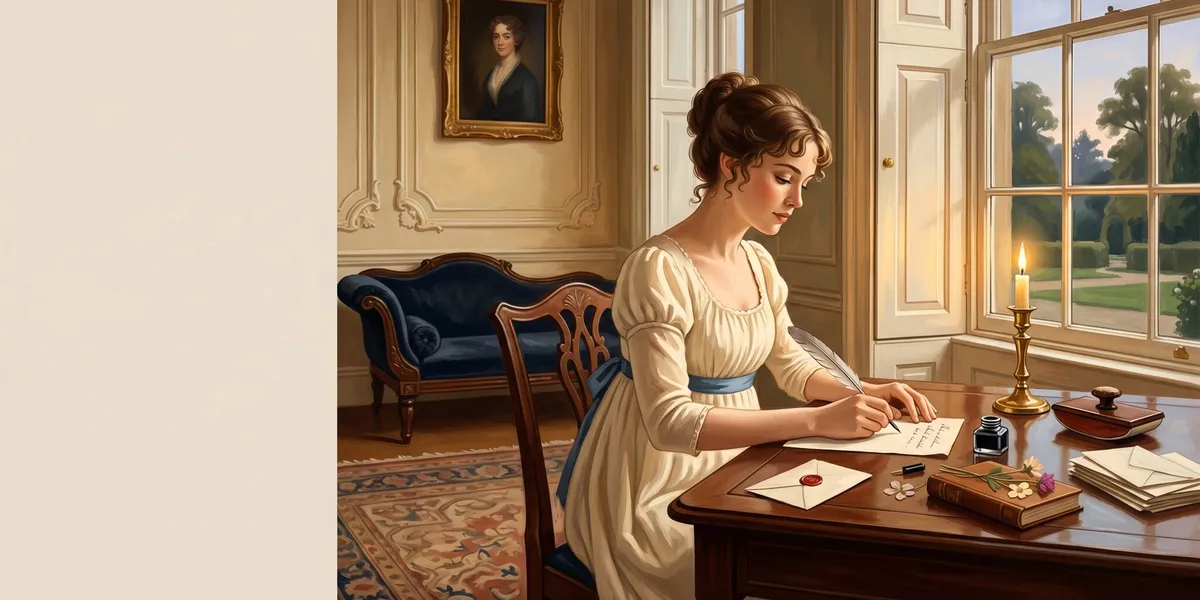
You can write a Regency romance that feels authentic, emotionally gripping, and commercially viable — even if you have never set foot in an English country house. The genre is one of the most popular romance subgenres, with Bridgerton alone driving a massive surge in reader demand since 2020.
In this guide, you’ll learn:
- How to research the Regency era without drowning in historical minutiae
- Which social rules create the best romantic tension
- The character archetypes and tropes readers expect
- How to write period-appropriate dialogue that still feels fresh
Here is the step-by-step process for writing a Regency romance that readers will love.
What Is a Regency Romance?
Regency romance — a romance subgenre set in England’s Regency era (approximately 1795-1837), where rigid social rules, class hierarchy, and the marriage market create natural romantic tension and conflict.
The official Regency period spans just nine years (1811-1820), when George, Prince of Wales, ruled as Prince Regent during his father’s incapacity. But most Regency romances draw from a broader window — roughly the late Georgian era through the early Victorian period — because the social customs and manners that define the genre existed across those decades.
What makes Regency romance distinct from other historical romance subgenres is the emphasis on wit, manners, and social maneuvering. The tension comes less from physical danger and more from social peril — a ruined reputation, a forbidden match, a family’s financial decline.
Jane Austen codified the appeal. Georgette Heyer invented the modern genre. Julia Quinn and the Netflix Bridgerton adaptation brought it to millions of new readers. If you are writing Regency romance today, you are entering one of the most passionate and knowledgeable readerships in all of fiction.
How to Research the Regency Era
You do not need a history degree to write convincing Regency romance. You need a working knowledge of the social rules that create conflict and enough period detail to make scenes feel grounded.
Essential Areas to Research
The social Season — The London Season ran roughly from January through June. This is when eligible young women were presented at court and families attended balls, assemblies, and dinners. The Season is the engine of most Regency romance plots because it forces characters into proximity.
Class and precedence — Titles matter enormously. A duke outranks a marquess, who outranks an earl, who outranks a viscount, who outranks a baron. Getting this wrong will alienate readers immediately. The order of precedence determines who enters a room first, who sits where at dinner, and who a character can reasonably marry.
Money and property — Most Regency heroes derive income from land. Estates are entailed (passed to male heirs). This creates real stakes for heroines whose fathers die without a male heir — they may lose their home entirely.
Marriage law — Before 1823, anyone under 21 needed parental consent to marry. Elopements to Gretna Green (in Scotland, where the rules differed) are a common plot device for a reason.
Research Resources That Work
Start with these and expand as needed:
- Georgette Heyer’s novels for authentic period voice and social detail
- Jane Austen’s letters for everyday Regency life
- Regency History for factual reference
- A Dictionary of the Vulgar Tongue (1811) for period slang
- Fashion plates from the V&A for clothing description accuracy
The goal is not to become a historian. The goal is to know enough that your characters feel like they belong in their world — and to know which rules you can bend for the story’s sake.
Which Social Rules Create the Best Romantic Tension?
This is where Regency romance shines. The era’s social rules function as natural obstacles between your lovers. You do not need to invent reasons why they cannot be together — society has already provided them.
The Chaperone System
Unmarried women of good family were never alone with a man who was not a relative. Ever. A stolen moment in a garden is not merely romantic in a Regency context — it is genuinely dangerous to the heroine’s reputation. This transforms every private conversation into high-stakes territory.
Reputation and Ruin
A woman’s reputation was her primary social currency. Being seen alone with a man, being caught in a compromising position, or even dancing with the same partner more than twice at a ball could trigger gossip that destroyed marriage prospects.
This gives you enormous narrative power. A single moment of indiscretion can force a marriage plot, create a scandal subplot, or raise stakes to a level that contemporary romance has to work much harder to achieve.
The Rules of Introduction
People could not simply speak to strangers. A formal introduction by a mutual acquaintance was required. This means your characters need a plausible way to meet — and it makes the enemies to lovers trope particularly delicious when characters are forced into proximity after a bad first impression.
Financial Dependence
Women had very limited options for financial independence. Marriage was not just romantic — it was economic survival. This creates inherent conflict when a heroine must choose between a financially advantageous match and the person she actually loves.
Use these constraints as story engines. The more restrictive the rule, the more satisfying it feels when your characters find ways around it.
Essential Regency Romance Tropes
Tropes are not cliches — they are reader expectations and promises. Regency readers are sophisticated and passionate about the genre, and they want fresh executions of familiar patterns.
Marriage of Convenience
Two characters wed for practical reasons (saving an estate, protecting a reputation, fulfilling a will’s terms) and slowly fall in love. The Regency setting makes this trope particularly natural because marriage was fundamentally transactional for the upper classes.
The Rake Reformed
A notorious libertine meets the one woman who sees past his reputation — or calls him on it. The Regency era’s strict morality code makes the rake’s behavior more shocking and his reformation more meaningful.
Wallflower and Duke
A shy, overlooked woman catches the attention of the most powerful man in the room. The rigid social hierarchy of the Regency makes this pairing inherently high-stakes because the class difference (or perceived difference in social value) creates immediate obstacles.
Bluestocking Heroine
An intellectual woman who values learning over social performance. In an era that valued female accomplishments (music, embroidery, watercolors) over female intellect, the bluestocking creates natural friction with society’s expectations.
The Compromising Position
An accidental or orchestrated compromising situation forces marriage. This trope works specifically because of the Regency’s reputation rules — it cannot function in a modern setting with the same stakes.
For more on romance tropes and how to execute them well, see our guides on friends to lovers, forced proximity, and fake dating.
How to Write Regency Dialogue
Dialogue is the heartbeat of Regency romance. The genre’s wit tradition — from Austen through Heyer to modern authors — means readers expect verbal sparring, double meanings, and elegant phrasing.
What Period-Appropriate Dialogue Sounds Like
You are aiming for elevated but readable. Your characters should not sound like twenty-first-century people in costumes, but they also should not sound like they swallowed a dictionary from 1812.
Do this:
- Use formal address (“Miss Bennet,” “Lord Ashworth”) until intimacy is established
- Employ slightly longer, more structured sentences than contemporary dialogue
- Include period-appropriate exclamations (“Upon my word,” “Good heavens,” “I dare say”)
- Let subtext carry emotional weight — characters of this era did not state feelings directly
Avoid this:
- Modern slang or phrasing (“I’m totally fine with that,” “No worries”)
- Overly archaic language that reads like parody (“Prithee, good sir” — that is Elizabethan, not Regency)
- Contractions debate — characters in this era did use contractions in informal speech, despite what some writing guides claim
The Wit Requirement
Regency romance readers expect banter. Not every character needs to be Oscar Wilde, but your romantic leads should have verbal chemistry. The best Regency dialogue carries a double layer — what is said publicly and what is meant privately.
A heroine saying “How kind of you to notice” to a hero who has just insulted her accomplishments is doing more emotional work than a paragraph of internal monologue. Let dialogue carry your romance.
Words to Use and Avoid
Period-appropriate: drawing room, curricle, pelisse, assemblies, the ton, Almack’s, a lady’s maid, valet, a card party Anachronistic (avoid): okay, hello (use “how do you do”), girlfriend, date (as in romantic outing), stressed out
When in doubt, check when a word entered common usage. If it post-dates 1840, cut it.
Building Your Regency Characters
The strongest Regency romances feature characters who feel of their time but resonate with modern readers. Your hero and heroine should operate within the era’s expectations while pushing against them in ways that feel authentic — not anachronistically modern.
Heroes
The classic Regency hero is a man of rank and means. Dukes dominate the genre, but you have the full peerage to work with — plus second sons (who must make their own way), military officers returning from the Napoleonic Wars, and gentlemen of independent means.
What matters more than title is competence and emotional depth. Give your hero genuine authority in his world, a flaw that the heroine uniquely challenges, and emotional barriers that the romance gradually dismantles.
Heroines
Your Regency heroine navigates a world with extremely limited female agency. Her power comes through social intelligence, wit, moral courage, and strategic thinking within the constraints of her era.
Avoid two common mistakes: making her so modern she breaks the world’s logic, or making her so passive she has no agency at all. The sweet spot is a woman who operates brilliantly within her society’s rules while quietly subverting the ones that constrain her.
Supporting Cast
No Regency romance is complete without:
- A meddling mama determined to see her daughter married well
- A best friend or sister who serves as confidante
- A rival (romantic or social) who raises stakes
- Servants who facilitate or complicate the plot (particularly lady’s maids and valets who carry messages)
How to Structure a Regency Romance Novel
Regency romance follows the same fundamental romance novel structure as any other subgenre, but the era’s social calendar provides a natural framework for pacing.
The Season as Structure
Many Regency romances use the London Season as their timeline:
- Early Season — Characters are introduced, first impressions form, initial attraction or conflict
- Mid-Season — Proximity at events forces interaction, attraction deepens, obstacles emerge
- Late Season — Stakes escalate, the dark moment arrives, a choice must be made
- Resolution — The couple overcomes the final obstacle and commits to each other
This gives you roughly five months of story time, with balls, house parties, and garden events providing natural scene settings.
Pacing Your Romance
The emotional arc must progress with every scene. Each encounter between your leads should shift the dynamic — whether toward attraction or away from it. Regency’s social constraints help here because every stolen glance, every touch of hands during a dance, every private word carries enormous weight.
Key pacing beats:
- The Meet — First encounter that establishes the dynamic (charm, conflict, or both)
- Growing awareness — Each interaction reveals new facets of the other person
- The turn — Something shifts the characters’ understanding of each other
- The dark moment — The obstacle feels insurmountable
- The grand gesture — One character risks everything for love
- HEA — The happily ever after that every romance reader requires
Choosing Your Heat Level
Regency romance spans the full spectrum from sweet (closed door) to steamy (explicit). Your choice affects pacing, tension-building, and audience.
Sweet/Clean Regency — No on-page sexual content. Tension builds through glances, dance scenes, hand touches, and near-misses. This is the traditional Georgette Heyer approach and still commands a large readership.
Warm Regency — Kissing on page, physical awareness described, but intimate scenes fade to black or are briefly handled. Most of the Bridgerton books fall here.
Steamy Regency — Explicit intimate scenes that serve the emotional arc. These books lean into the contrast between public restraint and private passion.
Each level works. The key is consistency — match your heat level to your characters’ arc and maintain it throughout. For a deep dive into heat levels across romance, see our guide on steam levels in romance writing.
Writing With AI: Using Chapter for Regency Romance
If you want to write your Regency romance faster without sacrificing quality, AI writing tools can help — particularly with research, drafting, and maintaining consistency across a full novel.
Our Pick — Chapter
Chapter’s AI fiction writing tool helps you draft, outline, and revise your Regency romance while maintaining your voice and your characters’ consistency across the full manuscript.
Best for: Fiction authors who want AI assistance with drafting and revision while keeping creative control Pricing: $97 one time, 2 books included (fiction or nonfiction), 30-day money-back guarantee Why we built it: Writing a 80,000-word historical romance requires maintaining period accuracy, character voice, and plot threads across months of work. Chapter helps you move faster without losing the thread.
Over 10,000 authors have used Chapter to write books. For Regency romance specifically, Chapter helps with:
- Generating period-appropriate dialogue variations
- Maintaining character voice consistency across chapters
- Drafting scenes you can then revise and polish
- Keeping track of historical details and character descriptions
Common Mistakes to Avoid
These errors will pull Regency romance readers out of your story immediately:
- Anachronistic language — Using words or concepts that did not exist in the era. “Okay” was not used until the 1830s. “Hello” as a greeting was not common until the telephone era.
- Wrong titles and forms of address — A duke’s daughter is “Lady [First Name],” not “Lady [Surname].” Getting this wrong signals you have not done basic research.
- Modern attitudes without consequence — A heroine who openly defies every social convention with zero repercussions breaks the world’s internal logic. Rebellion should have stakes.
- Ignoring the economics — Money drives Regency plots. If your heroine has no fortune and your hero is a second son, that creates real obstacles. Do not hand-wave financial reality.
- All dukes, all the time — There were approximately 30 dukes in Regency England. Not every hero needs to be one. Viscounts, earls, and untitled gentlemen make excellent romantic leads.
How Long Should a Regency Romance Be?
A Regency romance novel typically runs 70,000 to 90,000 words. This matches reader expectations for the subgenre and aligns with publisher guidelines. Novellas (20,000-40,000 words) work for series introductions or connected stories.
The genre rewards neither padding nor rushing. Every scene should advance the romance, reveal character, or deepen conflict. If a ball scene is just describing dresses with no romantic development, cut it.
Can You Write Regency Romance Without Being British?
Yes. Some of the most successful Regency romance authors are American, Australian, and Canadian. What matters is research quality, not nationality. Lisa Kleypas, Julia Quinn, and Courtney Milan are all American authors who write acclaimed Regency and Victorian romance.
The key is reading widely in the genre, researching diligently, and having beta readers who know the era catch any errors you miss. Your voice and emotional storytelling matter far more than your passport.
How Do You Start Writing Your First Regency Romance?
Start with three decisions:
- Choose your trope — What relationship dynamic drives the story? Marriage of convenience, enemies to lovers, rake reformed?
- Choose your setting within the era — London Season, country house party, Bath, a coastal town?
- Choose your constraint — What specific social rule or circumstance keeps your lovers apart?
Once you have those three elements, your plot will emerge from the collision between desire and obstacle. Outline if that helps you, or draft discovery-style — but always know what is keeping your characters apart and what will eventually bring them together.
Then write your first scene. A Regency romance typically opens either at a social event (a ball, a dinner, an arrival) or with a disruption (a death, a debt, a scandal) that sets the plot in motion. Start where the story gets interesting.
For more on writing romance novels generally, including structure, pacing, and the emotional beats that make romance work across all subgenres, see our complete guide.
FAQ
What is a Regency romance?
A Regency romance is a historical romance novel set in England’s Regency era (approximately 1795-1837), featuring upper-class characters navigating rigid social rules while falling in love. The genre emphasizes wit, manners, and social conflict as primary sources of romantic tension, with settings like London ballrooms, country estates, and Bath assemblies.
How is Regency romance different from other historical romance?
Regency romance differs from other historical romance through its focus on social maneuvering and verbal wit rather than physical action or adventure. While medieval romance features knights and battles, and Victorian romance explores industrialization’s effects, Regency romance centers on drawing room politics, the marriage market, and the Season as its primary dramatic framework.
Do Regency romances have to be historically accurate?
Regency romances should be historically plausible rather than perfectly accurate. Readers expect correct titles, period-appropriate language, and authentic social conventions. However, you can adjust minor details for storytelling purposes. The line is: do not break rules the reader knows about (titles, basic social customs) but you have flexibility on obscure historical minutiae.
How long does it take to write a Regency romance?
Writing a Regency romance typically takes 3 to 12 months depending on your experience, research needs, and writing pace. First-time authors in the subgenre should budget extra time for era research. Using AI writing tools like Chapter can significantly reduce drafting time while you focus on historical accuracy and emotional depth.
What are the most popular Regency romance tropes?
The most popular Regency romance tropes include marriage of convenience, enemies to lovers, the rake reformed, wallflower romances, and compromising positions that force marriage. Readers also love bluestocking heroines, second-chance romances between former sweethearts, and secret identity plots where a character hides their true rank or situation.