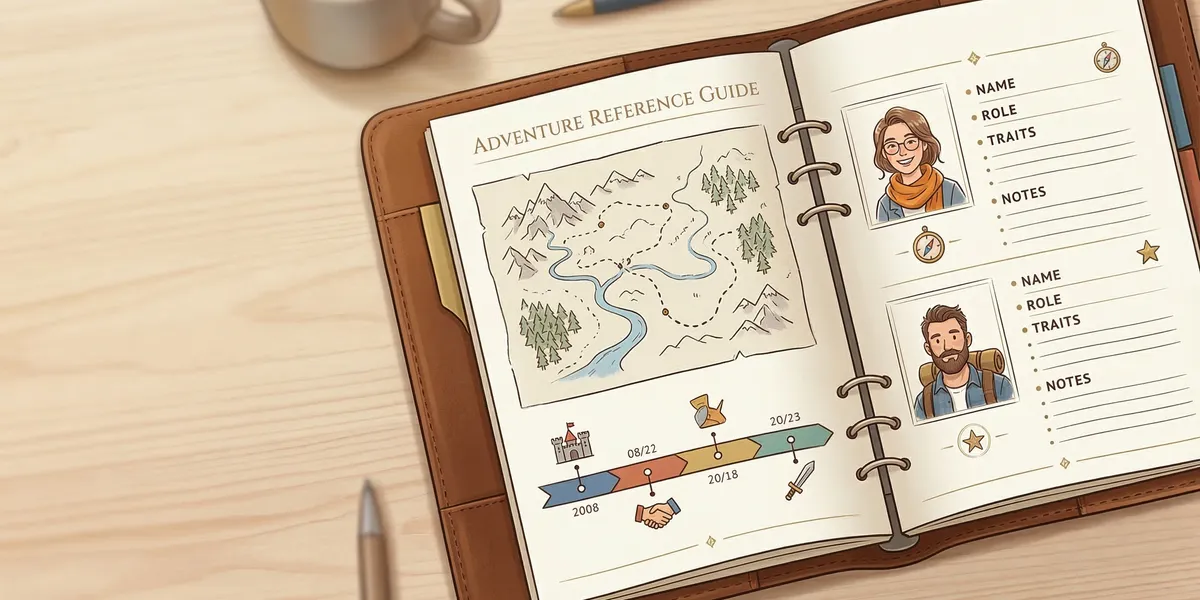
A series bible is a reference document that tracks everything in your multi-book story — characters, timeline, world rules, naming conventions, plot threads, and every detail that needs to stay consistent across thousands of pages. It is the difference between a series that feels meticulously crafted and one where the reader catches you giving a character blue eyes in book one and brown eyes in book three.
If you are writing or planning a book series, you need one. Here is how to build it.
What Goes in a Series Bible
A series bible is not a creative document. It is a reference document. You do not read it for pleasure. You consult it when you need to know whether a character has a sister, what year the Great War happened in your world, or what the rules are for your magic system.
The core sections are:
Character Profiles
For every named character in the series, track:
| Field | What to Include |
|---|---|
| Full name | Including nicknames, titles, aliases |
| Physical description | Eye color, hair, height, distinguishing marks |
| Age and birthday | Age at the start of each book |
| Personality | Key traits, speech patterns, verbal tics |
| Background | Family, education, formative events |
| Relationships | Who they know, how they feel about each other |
| Arc across series | Where they start, where they end, key turning points |
| First appearance | Book and chapter where they are introduced |
| Status | Alive, dead, missing (updated per book) |
The character profiles section will grow as your series expands. Start with the essentials and add detail as it becomes relevant.
Timeline
A chronological record of every significant event in your story’s world, from deep history to the current narrative. Include:
- World history. Wars, natural disasters, political changes, founding events. Anything a character might reference or that affects the current plot.
- Character histories. Birth dates, marriages, deaths, career milestones.
- Plot events by book. A chapter-by-chapter summary of what happens when.
- Time between books. How much time passes between the end of one book and the start of the next.
A timeline is especially critical for series that involve flashbacks, prophecies, or any form of nonlinear storytelling.
World Rules
Every fictional world has rules. Whether you are writing fantasy, science fiction, or a contemporary series set in a fictionalized town, document:
- Physics and magic. What is possible and what is not. What are the costs and limitations.
- Geography. Maps, distances between locations, travel times.
- Government and power. Who runs things, how decisions get made, what the hierarchy looks like.
- Culture. Customs, holidays, social norms, taboos.
- Technology. What exists, what does not, and what is emerging.
- Economy. Currency, trade, class structure.
Be specific. “Magic exists” is not a rule. “Magic requires physical contact and depletes the user’s body heat, leading to hypothermia in extended use” is a rule. The more specific your world rules, the fewer continuity errors you will write.
Maps and Visual References
If your world has a specific geography, draw a map. It does not need to be beautiful — a rough sketch with labeled locations and distance markers prevents you from having a character travel north to reach a city you placed to the south in book one.
Visual references also help with:
- Building layouts (the castle, the school, the spaceship)
- Character appearance (reference images for consistency)
- Clothing and style (especially in historical or fantasy settings)
Relationship Tracker
A matrix showing how every major character relates to every other major character. Update it per book as relationships evolve.
         | Elena  | Marcus | Thea   | David
---------|--------|--------|--------|-------
Elena    | --     | Sister | Enemy  | Mentor
Marcus   | Brother| --     | Ally   | Rival
Thea     | Enemy  | Ally   | --     | Unknown
David    | Student| Rival  | Unknown| --
This grid prevents the embarrassing mistake of having two characters meet for the “first time” when they already shared a scene three books ago.
Plot Threads Across Books
Track every unresolved plot thread, Chekhov’s gun, and setup that requires payoff later in the series.
| Thread | Introduced | Status | Planned Resolution |
|---|---|---|---|
| The locked room in the tower | Book 1, Ch. 4 | Open | Book 3 climax |
| Marcus’s missing father | Book 1, Ch. 1 | Partially resolved | Full reveal Book 4 |
| The prophecy fragment | Book 2, Ch. 12 | Open | Series finale |
| Elena’s scar origin | Book 1, Ch. 7 | Resolved Book 2, Ch. 15 | Complete |
This is the most important section for series writers. Readers remember promises. If you set something up, you must pay it off. The plot thread tracker makes sure nothing falls through the cracks.
Naming Conventions
Document your approach to names in the series:
- Character naming patterns. Do names in this world follow cultural naming conventions? Are there family naming traditions?
- Place names. What linguistic patterns do your locations follow?
- Invented terms. A glossary of made-up words, species names, ranks, and titles.
- Names already used. A complete list of every named character, place, and object. This prevents you from accidentally giving two characters the same name or similar-sounding names.
Tools for Building Your Series Bible
Simple Spreadsheet
A Google Sheet or Excel workbook with tabs for each section. Low-tech, free, and portable. Works well for series up to 3-4 books.
Pros: Zero learning curve, searchable, shareable. Cons: Gets unwieldy with complex series. No relationship visualization.
Notion
Notion databases with linked entries are powerful for series bibles. Create a characters database, a locations database, and a timeline database — then link them so you can see every scene a character appears in, every location they visit, and every relationship they hold.
Pros: Relational databases, multiple views, easy to reorganize. Cons: Can be over-engineered. Requires setup time.
Scrivener
Scrivener includes a research folder where you can store character sheets, images, and reference documents alongside your manuscript. The corkboard view helps with timeline management.
Pros: Lives inside your writing tool. Good for visual thinkers. Cons: Less flexible than a database for complex cross-referencing.
World Anvil
World Anvil is built specifically for world-building. It includes templates for characters, locations, species, political systems, and more. Strong community features.
Pros: Purpose-built for series bibles. Excellent templates. Cons: Learning curve. Overkill for contemporary fiction.
Chapter
Chapter’s fiction writing tools manage series of up to 9 books with built-in character and plot consistency tracking. The AI maintains your series bible data as you write, flagging potential continuity issues before they reach the page. Try Chapter for fiction series.
How to Maintain Your Series Bible
Building the bible is one challenge. Keeping it current is another.
Update during revision, not during drafting. When you are in the flow of writing, do not stop to update the bible. Instead, make a quick note — “Elena got a new scar, left forearm, Ch. 7” — and batch your updates during the revision phase.
Set a revision checkpoint. After finishing each book’s draft, spend one full session updating the series bible. Add new characters, update relationships, resolve or add plot threads, and extend the timeline.
Make it searchable. Whatever tool you use, you should be able to search for a character name and see every relevant detail in seconds. If finding information requires scrolling through pages of notes, the bible is not doing its job.
Trust the bible, not your memory. You will think you remember a character’s eye color. You will be wrong. Check the bible. Every time.
When to Start Your Series Bible
The answer is: before you start writing book one.
You do not need the bible to be complete before you begin drafting. But having the basic framework — character profiles, world rules, timeline — in place before you write the first chapter prevents retroactive continuity problems that are painful to fix later.
At minimum, start your series bible with:
- A one-page profile for each major character
- A rough timeline of your world’s history
- A list of world rules that will affect the plot
- A naming conventions document
Everything else can be built as the series develops.
Common Mistakes to Avoid
- Making it too pretty. A series bible is a functional document, not a creative project. Spending hours on formatting is procrastination disguised as productivity.
- Not updating it. A bible that reflects only book one is useless by book three. Build the update habit early.
- Including everything. Not every detail needs tracking. If a character mentions a favorite food once and it never matters again, you do not need it in the bible.
- Not backing it up. Your series bible is as important as your manuscript. Back it up in at least two locations.
- Starting too late. Retrofitting a series bible after three books means re-reading your entire backlist and hoping you catch every detail. Start with book one.
FAQ
How detailed should character profiles be? Detailed enough that you can write any scene involving that character without guessing. Physical description, personality, key relationships, and arc are the minimum. Add more as the series demands.
Do I need a series bible for a duology? Yes. Two books is enough for continuity errors. A lighter version — character sheets and a timeline — is sufficient, but you still need it.
What if I change something that contradicts the bible? Update the bible. Then check whether the change creates continuity problems in earlier books. If it does, fix the earlier books in revision. The bible is a living document, not a constraint.
Should I share my series bible with my editor? Yes. A series bible gives your editor the ability to catch continuity issues you might miss. It is one of the most useful reference documents you can provide.
How long should a series bible be? It varies enormously. A three-book contemporary romance series might have a 10-page bible. An epic fantasy series spanning 12 books might have a 200-page bible. Length follows complexity.