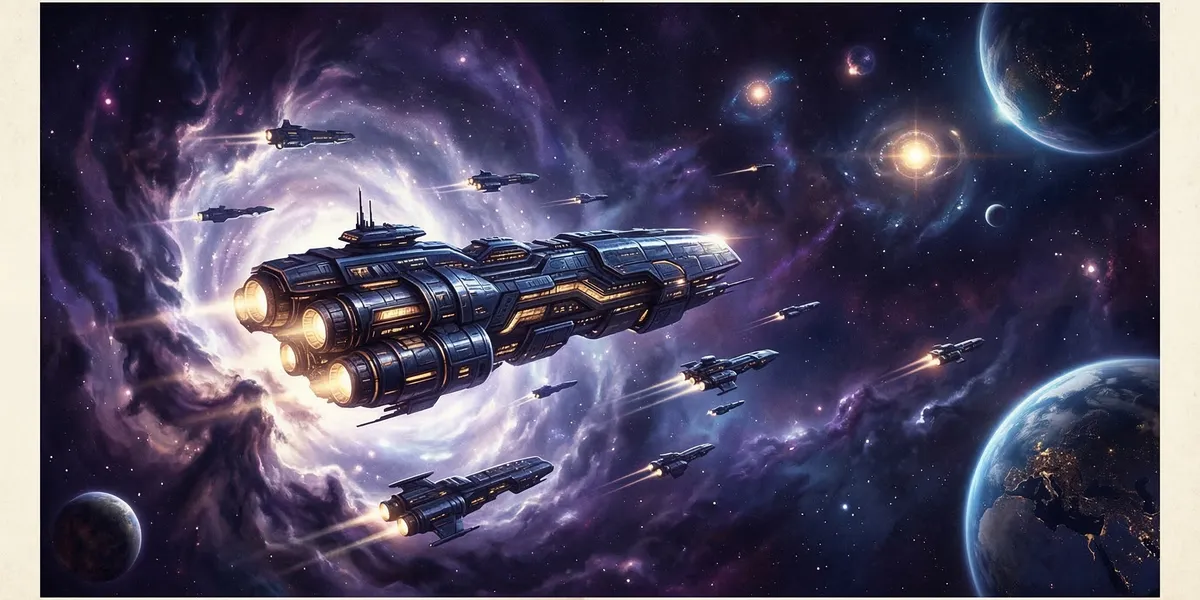
Space opera is science fiction at its largest scale — interstellar civilizations, galactic politics, space battles, and ideas big enough to reshape how readers think about humanity’s future. It is the genre of Star Wars, Dune, and The Expanse. If you want to write sci-fi that sweeps across star systems and still makes readers care about the people inside those ships, this guide covers how to do it.
What Space Opera Is (and Is Not)
Space opera is epic-scale science fiction where adventure, wonder, and large-scale conflict take priority over hard scientific accuracy. The technology serves the story, not the other way around.
Space opera IS:
- Interstellar travel, multiple worlds, galactic-scale stakes
- Character-driven stories set against vast backdrops
- Political intrigue between civilizations, factions, empires
- Space battles, alien encounters, exploration of the unknown
- Big thematic questions — what is humanity, what is power, what is justice
Space opera is NOT:
- Hard sci-fi (The Martian, where the science is the plot)
- Military sci-fi focused purely on combat logistics
- Near-future tech thrillers set on Earth
- Science fiction where the setting is incidental
The defining quality of space opera is scope combined with emotional weight. A battle between two fleets matters because of the people on those ships and what they are fighting for — not because of the technical specifications of the weapons.
The Key Ingredients
Multiple Worlds and Civilizations
Space opera needs the galaxy to feel populated. You do not need fifty detailed planets, but you need enough distinct locations that the universe feels vast.
Each world or civilization should be immediately distinguishable. A desert planet ruled by religious orders. A space station that serves as a neutral trading hub. A water world where cities float on living coral. Give each location a defining trait — visual, cultural, or political — that readers can grasp in a sentence.
The worlds should feel connected. Trade routes, political alliances, shared history, ongoing conflicts. The galaxy is not a collection of isolated planets — it is a web of relationships that drive the plot.
A Cast Across Factions
Space opera is ensemble fiction. You need characters distributed across different factions, worlds, and loyalties. A rebel pilot. A diplomat from the empire. A smuggler with no allegiance. A scientist studying something that could change everything.
The best space operas give each faction a legitimate perspective. The empire is not evil because it is an empire — it provides stability in a dangerous galaxy, even if its methods are authoritarian. The rebels are not righteous just because they resist — they may be fractured, violent, or naive. Moral complexity makes the political landscape feel real.
Galactic-Scale Stakes
The stakes in space opera are proportionally large. A war that could destroy civilizations. A discovery that could reshape the balance of power. An alien threat that forces old enemies to cooperate. A resource that every faction needs and only one can control.
But here is the key: galactic stakes only work if they are filtered through personal stakes. “The empire will conquer the galaxy” is abstract. “The empire will conquer the galaxy, and my sister is on the planet they will bomb first” is personal. Always anchor the macro in the micro.
Technology as Backdrop
Space opera is not about the technology. Faster-than-light travel, energy shields, laser weapons — these exist because the story needs them, not because the author wants to explain how they work.
Establish your technology early and keep it consistent, but do not explain the physics. “The ship jumped to hyperspace” is sufficient. “The ship activated its Alcubierre-modified warp field by compressing the spacetime manifold along the ship’s forward axis” is hard sci-fi, not space opera.
The exception: technology that is central to the plot. If a weapon can destroy a planet, readers need to understand its capabilities and limitations. If a drive system has a flaw that becomes a plot point, establish that flaw. Explain only what serves the story.
Adventure and Wonder
Space opera should make readers feel the vastness and strangeness of the universe. A ship emerging from a gas giant’s atmosphere to find a fleet waiting. The first glimpse of an alien artifact older than human civilization. A nebula that changes color in real time. A space station so large it has its own weather.
This sense of wonder is what separates space opera from political thrillers that happen to be set in space. The universe should feel awe-inspiring — a place where extraordinary things are possible and discovery waits around every jump point.
Worldbuilding at Scale
You cannot detail every planet in your galaxy. You should not try. Instead, use these strategies to create the impression of depth without drowning in exposition.
The Iceberg Principle
Build ten times more than you show. Know the history of your galaxy — the wars, the migrations, the technological breakthroughs, the extinct civilizations — but reveal only what the current story requires. References to “the Collapse” or “the Treaty of Kepler” suggest a rich history without stopping the narrative to explain it.
POV Characters as Windows
Each point-of-view character gives readers a window into one part of the galaxy. The smuggler shows readers the underworld. The diplomat shows the halls of power. The soldier shows the front lines. Together, they build a mosaic of the universe without any single character needing to explain the whole thing.
Vivid Sketches Over Detailed Maps
When you introduce a new world, give readers three specific details and move on. The red sand that gets into everything. The markets where you negotiate in silence because speaking is considered aggressive. The twin suns that create perpetual twilight at certain latitudes.
Three vivid details create a stronger sense of place than three pages of geography and political history. Trust readers to fill in the blanks.
Balancing Spectacle With Character
A space battle between a thousand ships means nothing if readers do not care about the people fighting it. This is where many space operas fail — they build spectacular set pieces and forget to build the emotional stakes that make those set pieces matter.
Before every action sequence, ask: Who is the reader afraid for? If the answer is “nobody specific,” the sequence will feel empty regardless of how well you choreograph it.
Give characters something to lose. Not just their lives — their relationships, their purpose, their identity. A pilot who dies in battle is sad. A pilot who dies in battle having never told his wingmate he loved her is devastating.
Use quiet scenes to earn the loud ones. A conversation between two characters about what they will do after the war earns the emotional impact of the battle that might prevent that future. Spectacle without setup is noise. The Expanse excels at this — every massive set piece is preceded by intimate character work.
The Politics
Space opera and politics are inseparable. Galactic-scale stories need galactic-scale power dynamics.
Build Factions With Legitimate Goals
Every faction should believe it is right. The empire wants order in a chaotic galaxy. The alliance wants freedom from centralized control. The corporation wants to exploit resources that could benefit billions. The isolationist world wants to be left alone.
When every side has a point, readers cannot simply pick the “good guys” and disengage. They have to think about which values they prioritize. This makes the political landscape compelling rather than decorative.
Make Allegiances Personal
A character’s faction loyalty should be rooted in personal history, not just ideology. She fights for the rebellion because the empire killed her parents. He serves the empire because it gave his refugee family citizenship when nobody else would. The politics become real when they are inseparable from individual lives.
Let Alliances Shift
Static political maps are boring. Let alliances form and fracture based on events in the story. An enemy becomes a reluctant ally when a greater threat appears. A trusted faction betrays another when resources become scarce. Political instability creates plot naturally.
Series Potential
Space opera works best as a series. The universe is too large and the cast too sprawling for a single book to contain. Plan for at least a trilogy from the start.
Each book needs a complete arc. Even in a series, every book should have its own beginning, middle, and end. The Expanse manages this masterfully — each book resolves its central conflict while advancing the larger story.
Expand the universe with each installment. Each new book should reveal more of the galaxy. New worlds, new factions, new threats. The universe should feel like it is growing alongside the reader’s understanding of it.
Track your continuity. With multiple worlds, factions, technologies, and characters across several books, continuity errors multiply fast. Keep a bible — a reference document with every name, location, technology, and timeline detail. Your readers will.
Famous Examples to Study
| Work | Creator | What to Learn |
|---|---|---|
| Dune | Frank Herbert | Worldbuilding as an ecosystem. Religion, politics, ecology, and personal destiny woven into one inseparable system. |
| The Expanse | James S.A. Corey | Realistic politics in space. Multiple POVs across factions, each with a legitimate perspective. Character work that earns every set piece. |
| Star Wars | George Lucas | The mythic structure in space. Proof that space opera is about emotion and archetype, not scientific accuracy. |
| Foundation | Isaac Asimov | Ideas-driven space opera. How civilizations rise and fall across millennia. |
| The Wayfarers | Becky Chambers | Character-driven, low-conflict space opera. Proof that the genre does not require war — exploration and connection are enough. |
| Ancillary Justice | Ann Leckie | How a single concept (a starship AI inhabiting human bodies) can drive political commentary and personal identity exploration. |
Common Mistakes
- Too much worldbuilding, not enough story. You can have the most detailed galaxy ever invented and still bore readers if page one is a history lesson. Start with a character in a situation. Reveal the world through their experience.
- Spectacle without emotion. A fleet of ten thousand ships exploding is meaningless if readers do not know anyone on those ships. Earn every set piece with character investment first.
- Technobabble. If you are explaining how the warp drive works for three paragraphs, you have left space opera territory. “The ship jumped” is almost always sufficient.
- One-dimensional factions. An evil empire with no redeeming qualities and noble rebels with no flaws is not political fiction — it is propaganda. Give every faction genuine strengths, real weaknesses, and internal disagreements.
- Forgetting the wonder. Space opera should inspire awe. If your characters are never awed by what they see — a new world, a cosmic phenomenon, the sheer scale of the universe — your readers will not be either. Let characters and readers experience genuine wonder together.
FAQ
How much science do I need to know? Less than you think. Space opera is not hard sci-fi. You need enough scientific literacy to avoid glaring errors (sound does not travel in a vacuum, distances between stars are enormous), but you do not need a physics degree. Internal consistency matters more than scientific accuracy.
Can space opera be small-scale? Yes. Becky Chambers’ Wayfarers series is space opera focused on a single ship and its crew, exploring themes of connection and belonging across cultures. The galaxy is the backdrop, but the stories are intimate. Scale is not about how many ships are in the battle — it is about how large the universe feels.
How do I handle alien species? Make them genuinely alien. The most common mistake is writing humans with different skin colors and calling them aliens. An alien species should think differently, perceive the world differently, and have social structures that reflect their biology and history. Even better, let alien perspectives challenge human assumptions.
Should I write space opera as a series? Almost always. The genre’s readership expects and prefers series. A standalone space opera can work, but you will need to constrain your scope significantly. Most space opera universes are too rich for a single book.
Space opera is science fiction at its most ambitious — stories that span star systems and centuries while still making readers care about the people inside them. Build a universe worth exploring, fill it with characters worth following, and do not forget that the biggest explosions mean nothing without the smallest human moments.
Writing a space opera with its sprawling cast, multiple worlds, and layered politics is the most ambitious project a fiction writer can take on. Chapter can help you build your galaxy, develop your factions, and draft your epic — from the first jump to lightspeed to the final battle.