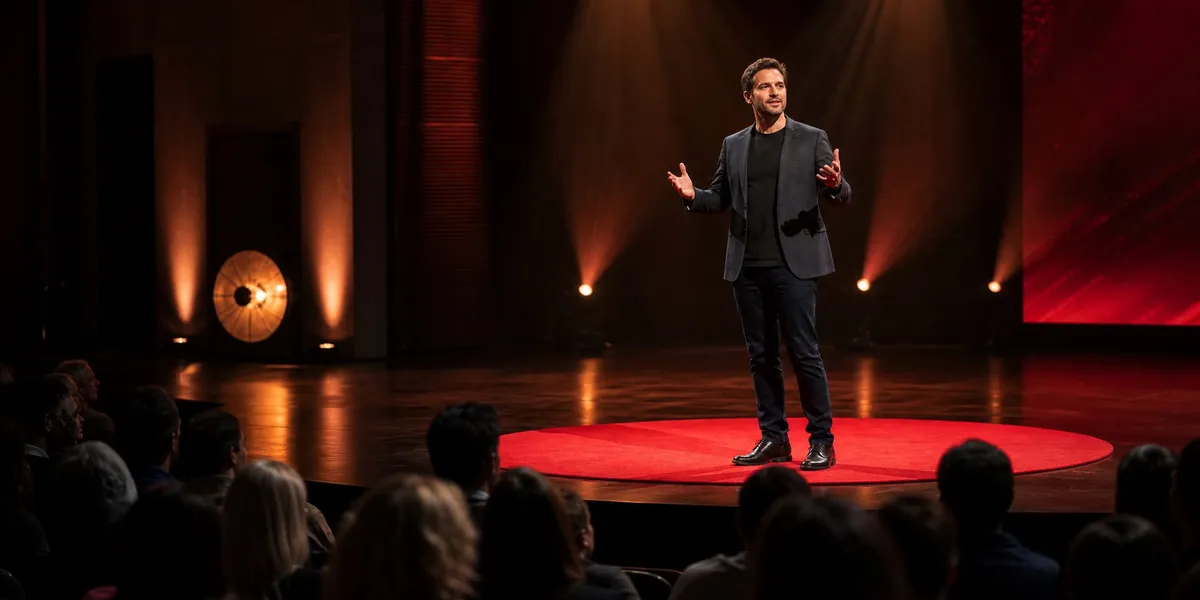
You can write a TED talk that moves an audience to tears, laughter, or action — even if you’ve never stepped on a stage before.
In this guide, you’ll learn:
- How to find and sharpen your “idea worth spreading”
- The exact structure that the best TED speakers use
- How to write a script that sounds natural, not rehearsed
- The rehearsal process that turns nerves into confidence
Here’s how to write a TED talk from scratch, step by step.
What Is a TED Talk (and How Is It Different From a Speech)?
A TED talk is a short, carefully structured presentation built around a single idea worth spreading, typically lasting 5 to 18 minutes. Unlike a traditional speech or lecture, a TED talk doesn’t try to cover everything about a topic. It makes one idea unforgettable.
The format was created by the TED organization (Technology, Entertainment, Design) and has since expanded through independently organized TEDx events worldwide. Over 100,000 TEDx events have been held in more than 170 countries.
What makes TED talks unique:
- One idea, not many. A keynote might cover five points. A TED talk covers one.
- Story-driven, not lecture-driven. The best TED talks feel like a conversation, not a classroom.
- Time-limited. The 18-minute cap forces you to cut every word that doesn’t earn its place.
- Audience-centered. You’re not showing off expertise — you’re giving the audience a gift.
If you’ve ever written a personal narrative, you already understand the core principle: one story, told well, changes how people think.
How to Find Your “Big Idea”
Every great TED talk starts with a single idea. Not a topic — an idea. There’s a difference.
A topic is broad: “education” or “artificial intelligence.” An idea is specific and arguable: “Schools should teach failure as a skill” or “AI will make human creativity more valuable, not less.”
Here’s how to find yours:
Start with what you know deeply. Think about your career, research, life experience, or obsession. What have you learned that most people don’t know? What misconception drives you crazy?
Apply the lunch test. TED’s own speaker guide recommends this: would someone naturally tell a coworker about your idea over lunch the next day? If the idea is too abstract or too obvious, the answer is no.
Write it in one sentence. If you can’t compress your idea into a single clear sentence, it’s not sharp enough yet. “I want to talk about leadership” is a topic. “The most effective leaders ask more questions than they answer” is an idea.
Ask yourself these four questions:
- Is it new? Either a genuinely new idea or a fresh angle on something familiar.
- Is it surprising? Does it challenge what people currently believe?
- Is it actionable? Can the audience do something with it after walking out?
- Do I care deeply about it? Passion isn’t optional — audiences sense it instantly.
If you’re writing a book alongside your talk, you’ll use the same process. Check out our guide on how to write a nonfiction book — the “find your core argument” step maps directly to finding your TED talk idea.
How to Structure a TED Talk
Structure is what separates a rambling story from a talk that holds 1,200 people in silence. The best TED talks follow a clear internal architecture, even when they feel spontaneous.
The Three-Act Framework
Most successful TED talks use a variation of this three-part structure:
Act 1: The Hook (first 60 seconds) Open with something that makes the audience lean forward. This can be a surprising fact, a personal story, a provocative question, or a bold statement. Never open with “Hi, my name is…” or “Today I’m going to talk about…”
Your opening does the same job as a compelling opening line in a book — it earns the audience’s attention for the next 30 seconds.
Act 2: The Journey (the middle 80%) This is where you build your case. You can structure this section in two ways:
- Argument structure: Present your idea, support it with evidence (stories, data, examples), and guide the audience to your conclusion step by step.
- Narrative structure: Tell a story that naturally reveals your idea. The audience discovers the insight through the experience, not through a lecture.
Most great TED talks blend both — a story that carries data, or an argument threaded through personal experience.
Act 3: The Landing (final 60 seconds) End with a clear, memorable conclusion. Tie back to your opening. Give the audience something to take with them — a call to action, a question to sit with, or an image they won’t forget.
The Throughline
TED coaches use the concept of a “throughline” — a single thread that connects every part of your talk. Write your throughline in 15 words or fewer. Every story, example, and data point should connect to it. If a section doesn’t serve the throughline, cut it.
Think of the throughline like the outline for a book. It keeps you from wandering and gives the audience a clear path to follow.
How to Write a TED Talk Script
Now that you have your idea and structure, it’s time to write. This is where most speakers get stuck — they either write an essay that sounds stiff when spoken aloud, or they wing it and lose coherence.
Here’s the process that works:
Step 1: Brain Dump Everything
Write down every story, statistic, example, and insight related to your idea. Don’t edit. Don’t organize. Just get it all on paper. You’ll have far more material than you need — that’s the point.
Step 2: Select Your Best Material
Go through your brain dump and highlight the three to five strongest pieces. “Strongest” means the ones that best support your throughline and create an emotional response. A good TED talk uses a mix of:
- Personal stories — These build trust and make your idea real.
- Data and research — These prove your idea isn’t just opinion.
- Examples the audience recognizes — These make your idea feel relevant.
Cut everything else. Ruthlessly.
Step 3: Write for the Ear, Not the Eye
This is the biggest mistake new TED speakers make. They write the way they’d write an article — long sentences, complex clauses, formal vocabulary. That doesn’t work when spoken.
Rules for writing a talk script:
- Use short sentences. Read every sentence aloud. If you run out of breath, it’s too long.
- Use simple words. “Use” not “utilize.” “Start” not “commence.”
- Write in first and second person. Say “I discovered” and “you might notice” — not “one might observe.”
- Use present tense when telling stories. “I walk into the room and see…” is more vivid than “I walked into the room and saw…”
- Include pauses. Write “[PAUSE]” into your script where you want the audience to absorb something.
If you’ve read our guide on how to write a hook, you know the principle: every line should make the audience want the next line.
Step 4: Read It Aloud (and Time It)
A TED talk runs roughly 130 to 150 words per minute when delivered at a natural pace. That means:
| Talk Length | Word Count |
|---|---|
| 5 minutes | 650-750 words |
| 10 minutes | 1,300-1,500 words |
| 15 minutes | 1,950-2,250 words |
| 18 minutes | 2,340-2,700 words |
Read your draft aloud with a timer. You’ll immediately hear what sounds natural and what sounds written. Mark the awkward spots and rewrite them conversationally.
How to Open a TED Talk (5 Proven Hooks)
Your opening determines whether the audience gives you their attention or reaches for their phone. Here are five opening strategies used by the most-viewed TED talks of all time:
1. The Personal Story Start with a specific moment from your life. Not a summary — a scene. “Three years ago, I sat in a hospital waiting room and got a phone call that changed everything.”
2. The Surprising Statistic Lead with a number that challenges assumptions. “Every day, 2.5 quintillion bytes of data are created — and 90% of it is never read by anyone.”
3. The Provocative Question Ask something the audience can’t answer immediately. “What if everything you believe about motivation is wrong?”
4. The Bold Statement Make a claim that demands attention. “The most important skill of the 21st century isn’t coding — it’s storytelling.”
5. The Audience Exercise Get the room physically involved. “Raise your hand if you’ve ever started a project you didn’t finish.” Instant engagement.
What never works: thanking the organizers, introducing yourself with credentials, apologizing for being nervous, or starting with a dictionary definition. Cut straight to something interesting.
How to End a TED Talk
The ending is what your audience remembers. A great talk with a weak ending fades. An average talk with a powerful ending lingers.
Strategies that work:
- Circle back to your opening. If you started with a story, finish it. If you asked a question, answer it.
- Issue a challenge. Give the audience one specific thing to do after they leave. Not “change the world” — something concrete they can start today.
- End with an image. Paint a picture of what the world looks like if people embrace your idea. Make them see it.
- Use the power of silence. After your final sentence, stop talking. Don’t say “thank you” immediately. Let your last words hang in the air for two to three seconds. The audience will start applauding.
What never works: ending with “and that’s it,” trailing off, rushing through a conclusion because you ran out of time, or adding a new idea in the final 30 seconds.
How to Design TED Talk Slides
Not every TED talk needs slides — many of the most powerful ones use none. But if visuals support your idea, follow these principles from TED’s own slide guidelines:
One idea per slide. If a slide has a bullet list, break it into separate slides.
Minimize text. If the audience is reading your slide, they’re not listening to you. Aim for six words or fewer per slide. If you need more than that, you might need to simplify your point.
Use full-bleed images. High-quality photographs that run edge to edge are more impactful than clip art or stock icons.
Make data visual. A chart is always better than a table of numbers. Use color to highlight the one data point you’re discussing.
Design for the back row. Use large fonts (30pt minimum), high contrast, and simple layouts. If someone in the last row can’t read your slide, it’s not working.
Consider your slides a backdrop, not a teleprompter. You should be able to deliver your talk without them.
How Long Should a TED Talk Be?
A TED talk can be anywhere from 3 to 18 minutes, with 18 minutes being the absolute maximum. Most TEDx organizers assign specific time slots — typically 5, 10, or 15 minutes.
The 18-minute limit exists because research on attention spans shows that audience engagement drops significantly after that point. But shorter isn’t lesser. Some of the most-viewed TED talks in history are under 10 minutes.
Choose your length based on your idea’s complexity:
- 3-5 minutes: One clear insight, one supporting story, one takeaway.
- 10-12 minutes: A more developed argument with two to three supporting points.
- 15-18 minutes: A complex idea that requires building context, presenting evidence, and offering multiple examples.
Whatever your assigned length, plan your content for two minutes under the limit. You’ll always speak slower on stage than in rehearsal, and running over time is the fastest way to lose an audience (and annoy the organizers).
How to Rehearse a TED Talk
Writing the talk is half the work. Rehearsal is what transforms words on a page into a performance that moves people.
The Four-Stage Rehearsal Process
Stage 1: Solo Read-Throughs (Week 1) Read your script aloud at least ten times. Don’t perform — just get familiar with the words. Notice where you stumble. Those spots need rewriting.
Stage 2: Memorization Through Movement (Week 2) Walk around while practicing. Your body helps your brain encode the material. Don’t try to memorize word-for-word — memorize the flow. Know your key transitions, your stories, and your opening and closing cold.
Stage 3: Test Audiences (Week 3) Deliver your talk to friends, family, and colleagues — especially people who aren’t experts in your topic. Watch their faces. Where do they lean in? Where do they check their phone? The audience always tells you what works.
Stage 4: Full Dress Rehearsal (Final Week) Practice in conditions as close to the real event as possible. Stand up. Use your slides. Time yourself. Record yourself on video and watch it back. You’ll catch habits you didn’t know you had — pacing, filler words, not making eye contact.
What to Memorize vs. What to Improvise
Memorize your opening two sentences and your closing two sentences word-for-word. These are the highest-stakes moments. The middle can be more flexible — know your stories and key points, but let the exact words vary each time. That’s what makes delivery sound natural rather than robotic.
Common Mistakes to Avoid When Writing a TED Talk
Even experienced speakers make these errors. Avoid them and you’ll be ahead of 90% of TEDx applicants:
- Trying to cover too much. One idea, deeply explored, beats five ideas mentioned briefly. Cut until it hurts, then cut a little more.
- Starting with your bio. The audience doesn’t care about your credentials yet. Earn their attention first with a compelling hook, then weave in credibility naturally.
- Reading from a script on stage. It’s fine to write a script for preparation, but you should know the material well enough to deliver it conversationally. Notes on a small card are acceptable. Reading from pages is not.
- Using jargon. Your audience is general — lawyers, teachers, students, retirees, engineers. If a 12-year-old can’t follow your language, simplify it.
- Skipping the emotional beat. Data convinces the mind. Stories convince the heart. You need both. If your talk is all facts, add a personal story. If it’s all story, add supporting evidence.
- Ending with Q&A. TED talks don’t have Q&A. Your ending should be crafted, not left to whatever someone in the audience asks.
How to Apply to Give a TEDx Talk
If you want to deliver your talk on a TEDx stage, here’s the process:
1. Find local TEDx events. Visit ted.com/tedx/events and search by city. Most cities have multiple TEDx events each year with different themes.
2. Submit an application. Each TEDx event has its own application process. You’ll typically need to describe your idea (not your topic), explain why it matters, and share any relevant background.
3. Prepare a short pitch video. Many TEDx organizers ask for a one to two minute video. This isn’t your full talk — it’s you explaining your idea with energy and clarity.
4. Build a platform. TEDx organizers look for speakers who already have some visibility — a blog, podcast, book, active social presence, or professional credibility. Writing a book about your career or area of expertise is one of the strongest credibility builders for TEDx applications.
5. Start smaller. If TEDx feels like a big leap, practice at local Toastmasters clubs, industry meetups, podcast interviews, or company all-hands meetings. Every stage rep counts.
How to Turn Your TED Talk Into a Book
Many of the most successful TED speakers have turned their talks into bestselling books — Brene Brown, Simon Sinek, and Adam Grant all followed this path. If your idea resonates on stage, it can resonate on the page.
Here’s how:
Expand, don’t repeat. A TED talk is 2,000 to 2,700 words. A book is 40,000 to 60,000. You can’t just stretch the talk — you need to deepen each section with additional research, more stories, practical frameworks, and exercises.
Use your talk structure as a book outline. Your TED talk’s three-act structure maps naturally to a book outline. Each major section of your talk becomes a chapter or section of your book.
Write the book while the talk is fresh. Audiences will search for your name after watching your talk online. Having a book ready gives them the next step.
If you’re serious about turning your expertise into a book, Chapter can help you go from idea to finished manuscript faster. The platform helps nonfiction authors structure, draft, and refine their books using AI — so you can focus on the ideas while the tool handles the heavy lifting of getting words on the page.
Our authors have created books on the platform, and many started with exactly this scenario: a speech or talk they wanted to expand into a full book.
Can You Use AI to Write a TED Talk?
You can use AI to help you prepare a TED talk — but the talk itself needs to come from you. Here’s where AI helps and where it doesn’t:
Where AI helps:
- Brainstorming and refining your core idea
- Generating multiple versions of your opening hook
- Restructuring your outline for better flow
- Cutting your script down to hit a time limit
- Practicing with AI feedback on clarity and pacing
Where AI doesn’t help:
- Your personal stories (AI can’t live your life)
- Authentic emotion and vulnerability
- Stage presence and delivery
- The genuine passion that makes audiences feel something
If you’re interested in how AI can support your writing process — whether for a talk or a full book — check out our guide on how to write a book with AI.
TED Talk Examples to Study
Want to see these principles in action? Study these talks and notice how they apply the framework:
| Talk | Speaker | Why Study It |
|---|---|---|
| Do Schools Kill Creativity? | Sir Ken Robinson | Masterclass in humor + argument structure |
| The Power of Vulnerability | Brene Brown | Perfect blend of research + personal story |
| How Great Leaders Inspire Action | Simon Sinek | Simple framework, powerfully delivered |
| Your Body Language May Shape Who You Are | Amy Cuddy | Science made personal and actionable |
| The Danger of a Single Story | Chimamanda Ngozi Adichie | Pure storytelling as argument |
Watch each one with a notebook. Write down the opening hook, the throughline, the structure, and the closing. You’ll start seeing the patterns.
How Is a TED Talk Different From a Keynote Speech?
A TED talk is a focused presentation on one idea, lasting 5-18 minutes, with no sales pitch and no Q&A. A keynote speech is typically longer (30-60 minutes), may cover multiple themes, and is often tailored to a specific event or industry audience.
Key differences:
| Element | TED Talk | Keynote Speech |
|---|---|---|
| Length | 5-18 minutes | 30-60 minutes |
| Focus | One idea | Multiple themes |
| Audience | General public | Industry-specific |
| Goal | Spread an idea | Inspire, educate, or entertain |
| Q&A | Never | Usually yes |
| Sales pitch | Not allowed | Sometimes expected |
If you’ve written a best man speech or any kind of toast, you’ve practiced a critical TED talk skill: telling a personal story under a tight time constraint.
FAQ
How Long Does It Take to Write a TED Talk?
Writing a TED talk typically takes 4 to 8 weeks from initial idea to polished script. The first week focuses on finding and refining your core idea. Weeks two and three involve outlining and drafting your script. The final weeks are dedicated to rehearsal and revision. Most TEDx coaches recommend spending at least 40 hours on preparation total.
Can Anyone Give a TED Talk?
Yes, anyone can apply to give a TEDx talk at a locally organized event. You don’t need to be famous or have formal speaking experience. TEDx organizers look for a compelling idea, genuine passion, and willingness to prepare. Over 100,000 TEDx events have been held worldwide, and speakers range from students to CEOs to stay-at-home parents.
How Many Words Is a TED Talk?
A TED talk is typically 650 to 2,700 words depending on length. At a natural speaking pace of 130-150 words per minute, a 5-minute talk is about 700 words, a 10-minute talk is about 1,400 words, and an 18-minute talk is about 2,500 words. Most speakers aim for slightly fewer words than the maximum to allow room for pauses and audience reactions.
What Makes a TED Talk Go Viral?
The most viral TED talks share three traits: a surprising or counterintuitive idea, an emotional story that makes the idea personal, and a clear takeaway the audience can share with others. Research from TED’s own data shows that talks combining humor, vulnerability, and a simple framework tend to get the most views and shares.
Do TED Speakers Get Paid?
TED speakers do not get paid to present at the main TED conference or at TEDx events. TED’s policy prohibits speaker fees to maintain the focus on ideas rather than commercial interests. However, many speakers see significant indirect benefits — book deals, consulting opportunities, media appearances, and speaking invitations to paid events often follow a well-received TED talk.