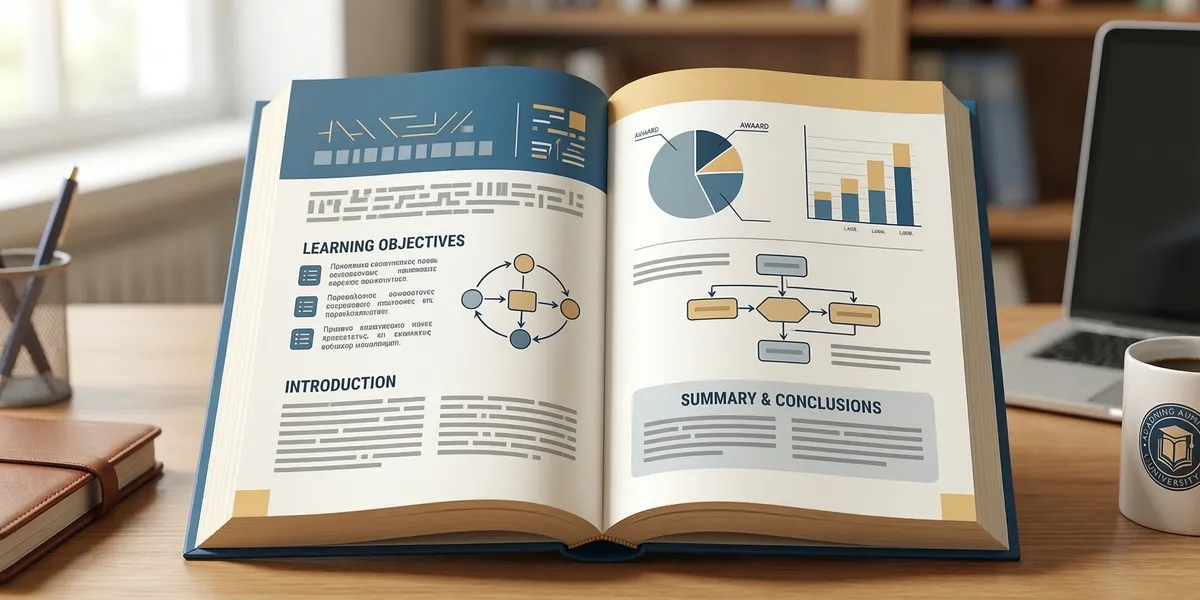
A textbook teaches a subject systematically, chapter by chapter, with the goal of bringing a student from foundational knowledge to competence. Whether you are a professor packaging decades of teaching into a book or a subject matter expert who sees a gap in existing resources, writing a textbook is one of the most impactful things you can do for your field.
This guide covers how to structure a textbook, write for learning (not just reading), navigate the publishing decision, and create the supplementary materials that make a textbook actually useful.
Academic publishing vs. self-publishing
This is the first decision, and it shapes everything that follows.
Traditional academic publishing
Publishers like Pearson, McGraw-Hill, Oxford University Press, and Springer handle editing, design, printing, and distribution. They also manage adoptions — getting your textbook onto course syllabi at universities.
The process typically involves:
- Submit a proposal. Most academic publishers have detailed proposal guidelines. You will need a chapter outline, sample chapters, a market analysis (which courses will use this book?), and your credentials.
- Peer review. Publishers send your proposal and sample chapters to experts in your field. Their feedback shapes whether the publisher moves forward and what revisions they request.
- Contract and advance. Academic advances are modest — often $5,000 to $20,000. Royalties typically range from 10-15% of net revenue, according to the Textbook & Academic Authors Association.
- Writing and revision. You write. The publisher provides developmental editing, copyediting, and design. The timeline is long — 18 to 36 months from contract to publication is standard.
- Production and marketing. The publisher handles everything from cover design to getting desk copies to professors.
The upside: credibility, distribution, and institutional infrastructure. The downside: slow timelines, loss of creative control, modest royalties, and the risk of your book going out of print.
Self-publishing
Self-publishing a textbook gives you full control over content, pricing, and updates. Platforms like Amazon KDP, IngramSpark, and direct sales through your own site make this increasingly viable.
Self-publishing works best when:
- You teach your own courses and can require the book directly
- You are writing for professional development or continuing education, not undergraduate courses
- Your subject changes rapidly and needs frequent updates
- You want higher royalties per copy
The challenge is distribution. Getting a self-published textbook adopted by other professors at other institutions is significantly harder without a publisher’s sales team.
Many authors now choose a hybrid approach: self-publish first, build adoption and reputation, then approach a traditional publisher with a proven book.
Structure your textbook for learning
A textbook is not a reference book, and it is not a monograph. It is a teaching instrument. Every structural decision should answer: “Does this help the student learn?”
The chapter framework
Each chapter in a well-designed textbook follows a consistent internal structure. Consistency matters because it sets expectations — students know where to find what they need.
| Chapter Element | Purpose | Placement |
|---|---|---|
| Learning objectives | Tell students what they will know after this chapter | Chapter opening |
| Key terms | Define vocabulary before it appears | Chapter opening or margin glossary |
| Core content | The actual instruction, broken into logical sections | Body |
| Examples and case studies | Illustrate concepts with real applications | Embedded throughout |
| Visual aids | Diagrams, charts, tables, illustrations | Where they clarify, not decorate |
| Practice exercises | Let students test their understanding | End of major sections and chapter end |
| Chapter summary | Reinforce the key takeaways | Chapter closing |
| Review questions | Deeper synthesis and critical thinking | Chapter closing |
| Further reading | Point students to primary sources and deeper material | Chapter closing |
Sequencing chapters
Textbook chapters should follow a logical progression. Each chapter builds on previous ones. There are three common approaches:
Simple to complex. Start with foundational concepts and build toward advanced topics. This is the most common structure and works for most disciplines.
Chronological. Present material in historical or developmental order. Works well for history, science, and any field where understanding the evolution of ideas matters.
Problem-centered. Each chapter addresses a specific problem or question. Works well for applied fields like business, engineering, and medicine.
Whatever sequence you choose, be explicit about prerequisites. If Chapter 7 requires knowledge from Chapter 3, say so. Students (and professors who assign chapters selectively) need to know the dependencies.
Write for learning, not for experts
The most common mistake in textbook writing is forgetting your audience. You are an expert. Your readers are not — that is why they need your textbook.
Explain before you assume
Never introduce a concept and assume the student understands it. Define terms the first time you use them. Provide context before diving into detail. Build bridges between what the student already knows and what you are teaching.
Instead of: “Applying the Navier-Stokes equations to this boundary condition yields…”
Write: “In the previous section, we established the basic equations governing fluid motion. Now we will apply those equations — specifically the Navier-Stokes equations — to a practical scenario: flow around a curved surface.”
Use examples generously
For every concept you introduce, provide at least one concrete example. Abstract principles become real when students can see them applied.
The best textbook examples follow this pattern:
- State the concept in plain language
- Show a worked example with clear steps
- Provide a similar problem for the student to attempt independently
- Include the solution (in an appendix or online supplement)
According to research published in Educational Psychology Review, worked examples significantly reduce cognitive load for novice learners, which is exactly your textbook audience.
Write with clarity, not simplicity
Clear writing is not dumbed-down writing. You can maintain rigor while being readable. Short sentences, active voice, defined terms, and logical paragraph structure make complex material accessible without diluting it.
Avoid unnecessarily complex sentence structures. If a sentence runs past three lines, break it into two. If a paragraph covers more than one idea, split it.
Working with subject matter experts
Many textbooks benefit from collaboration. Co-authors, contributors, and reviewers each play different roles.
Co-authors
A co-author shares the writing load and brings complementary expertise. This works well when a textbook spans subfields — a statistics textbook co-authored by a theoretical statistician and an applied data scientist, for example.
Establish clear agreements before writing:
- Who writes which chapters?
- How will disagreements about content be resolved?
- How will royalties be split?
- Who has final say on revisions?
Put these agreements in writing. The Authors Guild provides collaboration agreement templates.
Contributors
For edited textbooks (common in medicine, law, and social sciences), you may invite contributors to write individual chapters. As editor, you provide the structure, style guide, and chapter guidelines. Contributors provide the expertise.
Managing contributors requires project management skills. Set clear deadlines, provide detailed chapter templates, and expect at least one round of revisions.
Peer reviewers
Regardless of whether you self-publish or go traditional, have your manuscript reviewed by experts in the field and by instructors who teach the subject. Expert reviewers catch errors and gaps. Teaching reviewers tell you whether the book works in a classroom.
The review and revision process
Textbooks require more revision than most books. The stakes are higher — errors in a textbook propagate to every student who reads it.
Content review
Have at least three subject matter experts read the manuscript. Ask them specific questions:
- Is the content accurate and current?
- Are there significant omissions?
- Is the level appropriate for the intended audience?
- Do the examples and exercises test the right skills?
Classroom testing
If possible, use draft chapters in your own courses before publication. Student feedback reveals problems no expert reviewer will catch — confusing explanations, exercises that are too easy or too hard, sections that lose attention.
Technical accuracy
For STEM textbooks, verify every equation, calculation, and data point. Have someone independently work through every solved example and exercise. Errors in textbooks damage credibility and confuse students for years.
Supplementary materials
Modern textbooks are rarely standalone. Students and instructors expect supplementary materials.
| Material | Who Uses It | Effort to Create |
|---|---|---|
| Instructor’s manual | Professors | Moderate — teaching notes, suggested lesson plans |
| Solution manual | Students and professors | High — solve every exercise in the book |
| Test bank | Professors | High — hundreds of additional questions per chapter |
| Slide decks | Professors | Moderate — summarize each chapter visually |
| Online resources | Students | Variable — videos, interactive simulations, datasets |
| Study guide | Students | Moderate — chapter summaries, practice quizzes |
For self-published textbooks, even a basic solution manual and slide deck significantly increase the chance of adoption. Professors adopt textbooks that make their job easier.
Practical considerations
Length and scope
Textbook length varies enormously by field. A single-semester undergraduate textbook typically runs 300-500 pages. A comprehensive reference textbook can exceed 1,000. Let the curriculum dictate the scope — cover what a typical course needs, not everything you know about the subject.
Updating and editions
Textbooks require regular updates. In rapidly changing fields like technology, medicine, or law, plan to revise every 3-5 years. This is one area where self-publishing has a clear advantage — you can update a self-published textbook anytime without waiting for a publisher’s edition cycle.
Permissions and citations
If you use figures, data, or extended quotations from other sources, you may need permission. Copyright Clearance Center handles permissions for academic content. Budget time for this — permissions requests can take months.
Accessibility
Modern textbooks should be accessible. Use descriptive alt text for images, structure headings properly, ensure tables are screen-reader compatible, and provide text alternatives for any visual-only content. Many institutions now require accessibility compliance under WCAG guidelines.
If your textbook covers a process-driven subject and you want to move from outline to structured first draft efficiently, Chapter is designed for exactly this kind of nonfiction writing. It helps you organize complex material into clear, sequenced chapters — the structural backbone every textbook needs.
Common mistakes to avoid
- Writing for peers instead of students. Your textbook is not a journal article. Write for the learner, not the expert.
- Inconsistent chapter structure. If Chapter 3 has learning objectives and Chapter 7 does not, students lose the framework that helps them learn.
- Too few examples. One example per concept is the minimum. Two or three is better.
- Exercises without solutions. Students need to check their work. Provide solutions somewhere — in the book, in an appendix, or online.
- Ignoring visual design. Wall-of-text textbooks are hard to learn from. Use headings, white space, callout boxes, and diagrams deliberately.
FAQ
How long does it take to write a textbook?
Most textbooks take 2-4 years from start to publication when going through a traditional publisher. Self-published textbooks can move faster — 12-18 months is achievable if you are writing full-time or have extensive existing course material to draw from.
Do I need to be a professor to write a textbook?
No, but you need credible expertise. Industry professionals write textbooks in business, technology, and applied fields. The key is demonstrating that you can teach the subject effectively, whether through academic credentials, professional experience, or both.
How do I get my textbook adopted by other professors?
Offer desk copies (free review copies) to instructors who teach relevant courses. Attend academic conferences in your field. Publish in journals to build name recognition. If self-publishing, create supplementary materials that make adoption easy for other instructors.
Is writing a textbook profitable?
It depends on adoption volume. A textbook required in a popular course at multiple institutions can generate significant royalty income over many years. A niche textbook for a small field may never recoup the time invested. Most textbook authors are motivated by impact and teaching legacy as much as income.