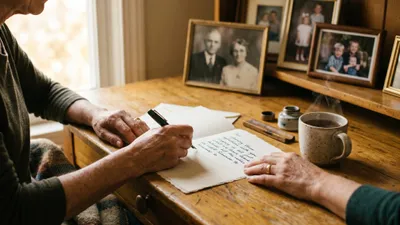
You can write a tribute book that captures someone’s life, personality, and impact — even if you’ve never written anything longer than a birthday card.
In this guide, you’ll learn:
- How to gather stories, photos, and memories from the people who knew your person best
- The step-by-step process for organizing raw material into a book people will treasure
- Which tribute book format fits your situation (memorial, retirement, milestone birthday, or living tribute)
- How to publish and share the finished book with your family
Here’s how to create something that lasts.
What Is a Tribute Book?
A tribute book is a collection of stories, photographs, letters, and memories compiled to honor a specific person. Unlike a memoir or biography, a tribute book is written about someone — often by multiple contributors — and focuses on how that person affected the people around them.
Tribute books are not just for funerals or memorials. You can create one for a retirement, a milestone birthday, a wedding anniversary, or simply because someone in your life deserves to see the impact they’ve had while they’re still here.
The best tribute books feel personal. They read like a conversation between people who loved the same person, not like a polished biography.
Who Writes a Tribute Book?
Anyone who wants to honor someone writes a tribute book. You don’t need writing experience or a publishing background.
Common reasons people create tribute books include:
- Memorial or bereavement — preserving the memory of someone who has passed
- Retirement celebrations — collecting stories from colleagues and friends
- Milestone birthdays — a 50th, 60th, 70th, or 80th birthday gift
- Living tributes — honoring a parent, grandparent, or mentor while they can still read it
- Wedding or anniversary — celebrating a couple’s journey through the eyes of people who love them
A living tribute — writing the book while your person is alive — is one of the most powerful gifts you can give. They get to read how they changed people’s lives.
Step 1: Decide on Your Tribute Book Format
Before you collect a single story, decide what kind of tribute book you’re making. Your format shapes everything that follows — what you ask contributors, how you organize the material, and what the final product looks like.
Common tribute book formats:
| Format | Best For | What It Includes |
|---|---|---|
| Memory collection | Memorials, retirements | Short stories and messages from multiple people |
| Photo tribute | Milestone birthdays, anniversaries | Photos organized chronologically with captions and stories |
| Life story narrative | Parents, grandparents | A cohesive narrative built from interviews and research |
| Letter book | Living tributes, weddings | Individual letters from family and friends |
| Recipe and memory book | Food-loving families | Favorite recipes paired with stories about the person |
| Scrapbook-style | Children, creative tributes | Mixed media — photos, drawings, handwritten notes, mementos |
You can combine formats. A photo tribute can include letters. A memory collection can include recipes. The categories above are starting points, not strict rules.
Step 2: Gather Stories and Contributions
The heart of any tribute book is what other people share. Your job as the book’s creator is to make it easy for contributors to say yes and give you something meaningful.
How to ask people to contribute
Send a clear, specific request. Vague asks (“write something about Dad”) produce vague responses. Specific prompts produce stories worth reading.
Here’s what works:
Give a deadline. Two to three weeks is enough time for thoughtful responses without letting people procrastinate indefinitely.
Offer prompts. Not everyone knows where to start. Give them 3-5 specific questions to choose from:
- What’s your favorite memory with [person’s name]?
- What’s something [person’s name] taught you that you still carry with you?
- Describe a time [person’s name] made you laugh.
- What would you want [person’s name] to know about how they affected your life?
- If you could describe [person’s name] in one story, what would it be?
Set a word range. Ask for 200-500 words. This gives people a target without overwhelming them. Some will write more, and that’s fine.
Accept voice recordings. Some people find talking easier than writing. Let them record a voice memo and transcribe it yourself. You’ll often get more vivid, natural stories this way.
What to collect beyond stories
- Photographs — from different stages of life, group shots, candid moments
- Handwritten notes or letters — scan originals to preserve the handwriting
- Recipes — if food was important to your person
- Artwork or drawings — especially from grandchildren
- Quotes or sayings — things your person always said
- Documents — military records, newspaper clippings, awards
Cast a wide net. You’ll curate later. Right now, collect everything.
Step 3: Interview Key People
Written contributions give you breadth. Interviews give you depth. Sit down (in person, by phone, or on video) with 3-5 people who knew your person best and have a real conversation.
Record the interview with permission. A 30-minute conversation will give you material you’d never get from a written prompt.
Interview questions that produce great stories:
- How did you first meet [person’s name]?
- What was [person’s name] like when no one else was watching?
- What’s a story about [person’s name] that always makes you smile?
- What’s something most people didn’t know about them?
- How did they handle hard times?
- What did they value most?
- What do you want their grandchildren to know about them?
The best interview moments come from follow-up questions. When someone says “Oh, they were always so generous,” ask: “Can you give me a specific example?” Specifics are what make tribute books come alive.
Step 4: Organize Your Material
Once you have everything — stories, photos, interviews, documents — spread it all out (physically or digitally) and look for natural groupings.
Three ways to organize a tribute book:
Chronological
Follow the person’s life from beginning to the present (or end). This works well for life story narratives and photo tributes. Chapters might be: childhood, school years, career, marriage, parenthood, retirement.
Thematic
Group material by themes rather than time periods. This works well for memory collections where contributions come from different eras. Themes might be: humor, generosity, faith, adventure, family, friendship, work ethic.
By contributor
Each person gets their own section. This works well for letter books and retirement tributes. It gives every voice its own space and feels like a series of personal testimonials.
Most tribute books use a combination. You might organize chronologically overall but group memories thematically within each life stage.
Step 5: Write the Connecting Narrative
Even if your tribute book is mostly other people’s contributions, it needs connective tissue. You provide the transitions, context, and framing that turn a pile of stories into a cohesive book.
What to write yourself:
- An introduction — explain why you created this book and who it’s for
- Section introductions — brief context before each chapter or theme (2-3 sentences is enough)
- Photo captions — identify who’s in the photo, when and where it was taken, and why the moment mattered
- Timeline elements — key dates, milestones, and historical context
- A closing reflection — your personal note about what this person means to you
Keep your narrative voice warm and straightforward. You’re not writing a literary masterpiece. You’re stitching together the voices of people who loved someone.
If you need help drafting these connecting sections, AI writing tools can help you find the right words. Chapter works well for nonfiction projects like tribute books — you can outline your sections, draft connecting narrative, and organize the full manuscript in one place.
Step 6: Choose Photos Carefully
Photos are the emotional backbone of most tribute books. Selecting the right ones matters more than including every photo you have.
Photo selection tips:
- Show different life stages. Childhood, young adulthood, middle age, later years. The progression tells its own story.
- Prioritize candid shots over posed portraits. A photo of someone laughing at a barbecue says more than a studio headshot.
- Include group photos. Your person existed in relationships. Show them with the people they loved.
- Match photos to stories. When a contributor mentions a specific trip, holiday, or event, pair their story with a photo from that moment.
- Scan and restore old photos. If originals are faded or damaged, a quick digital scan and basic editing can make them look sharp in print.
Don’t overcrowd pages. Give significant photos room to breathe. One powerful image per page with a story or caption has more impact than a collage of six small thumbnails.
Step 7: Design and Format Your Book
You have three main paths for designing your tribute book:
DIY with book writing software
Use tools like Chapter to write and organize your manuscript, then format it for print. This gives you full control over the content and structure. Chapter’s AI-assisted writing can help you draft connecting sections, organize chapters, and polish the narrative. For a nonfiction project like a tribute book, it handles the heavy lifting of turning scattered material into a structured manuscript.
Our Pick — Chapter
Chapter helps you organize stories, interviews, and narrative sections into a structured manuscript. Its AI writing assistant can draft connecting passages, suggest chapter organization, and help you polish contributor stories without losing their authentic voice.
Best for: Writing and organizing the manuscript content Pricing: $97 one-time (nonfiction) Why we built it: Every book starts as a messy collection of ideas — Chapter turns that into a finished manuscript.
Photo book platforms
Services like Blurb, Shutterfly, or Mixbook offer drag-and-drop templates specifically for photo-heavy books. These work best when images are the primary content and text is secondary.
Professional book designers
For a high-end, heirloom-quality tribute book, hire a book designer. Expect to pay $500-2,000 depending on page count and complexity. This makes sense for milestone projects you want to last generations.
Step 8: Edit and Review
Before you finalize, get at least two other people to review the book. Fresh eyes catch what you’ll miss after staring at the same material for weeks.
Your editing checklist:
- Every contributor’s name is spelled correctly
- Dates and facts are accurate (cross-reference with multiple sources)
- Photos are properly captioned and credited
- The book flows logically from section to section
- No one is accidentally left out (check your original contributor list)
- Grammar and spelling are clean throughout
- The tone is consistent — warm and personal, not clinical
If your tribute book covers someone who has passed, be sensitive about how you handle difficult periods. You don’t need to sanitize their life, but you should be thoughtful about what serves the book’s purpose and what doesn’t.
For guidance on handling emotional material, see our guide on writing a grief book.
Step 9: Print and Share Your Tribute Book
You have several printing options depending on your budget and how many copies you need.
| Option | Best For | Cost Per Copy | Minimum Order |
|---|---|---|---|
| Print-on-demand (Amazon KDP, IngramSpark) | Large families, ongoing availability | $5-15 | 1 copy |
| Local print shop (Staples, FedEx) | Small runs, fast turnaround | $20-50 | 1 copy |
| Online photo book service (Blurb, Shutterfly) | Photo-heavy tributes | $30-80 | 1 copy |
| Offset printing | 50+ copies, premium quality | $8-20 | 50-100 copies |
Print-on-demand is the most practical choice for most tribute books. You upload your files once, and anyone in the family can order a copy at any time. Services like Amazon KDP make your book available indefinitely with no upfront cost.
If you’re creating the book for a specific event — a funeral, retirement party, or birthday celebration — order copies in advance and hand them out. Having a physical book in someone’s hands at the right moment is powerful.
How Long Does It Take to Write a Tribute Book?
Most tribute books take 4-8 weeks from start to finished copies. The timeline breaks down roughly like this:
- Week 1: Plan the format, make your contributor list, send requests
- Weeks 2-3: Collect contributions, conduct interviews, gather photos
- Week 4-5: Organize material, write connecting narrative, design layout
- Week 6: Edit and review
- Week 7-8: Print and distribute
You can compress this timeline to 2-3 weeks if you’re working under a deadline (such as a memorial service). In that case, simplify: collect shorter contributions, use fewer photos, and choose a straightforward layout.
If you’re making a living tribute with no deadline, take your time. Extra weeks of collecting stories only makes the book richer.
What to Write in a Tribute Book When You’re Stuck
Writer’s block hits tribute book creators just like any other writer. If you’re struggling with what to write, try these approaches:
Start with a single memory. Don’t try to capture an entire life. Write about one afternoon, one conversation, one moment. Then write another. The book builds one scene at a time.
Use the senses. What did their house smell like? What song did they always play? What did their handshake feel like? Sensory details make flat descriptions vivid.
Write it as a letter. Address your writing directly to the person. “Dear Mom, I want to tell you about the day I realized…” This removes the pressure of writing for an audience and lets you write honestly.
Borrow from others. If a contributor’s story reminds you of something, write your version of the same moment. Different perspectives on the same event reveal character in ways a single account can’t.
For more prompts and techniques for writing about someone’s life, check out our guide on writing a family history book.
Tribute Book Ideas for Different Occasions
Memorial tribute book
Focus on celebrating the person’s life rather than dwelling on their death. Include stories that capture who they were at their best. Ask contributors: “What do you want people to remember about [name]?”
Retirement tribute book
Gather stories from colleagues, direct reports, clients, and friends. Include professional achievements alongside personal moments. A timeline of their career milestones works well as a structural backbone.
Birthday tribute book
This is a living tribute — the person reads it on their birthday. Make it joyful. Include funny stories, inside jokes, and messages of gratitude. Photos from every decade of their life create a visual timeline they’ll love.
Anniversary tribute book
Collect stories from people who witnessed the couple’s relationship over the years. Include photos from the wedding and every year since. Ask contributors to describe a moment when they saw the couple’s love in action.
Parent or grandparent tribute
Record their stories before they’re gone. Use the interview questions from Step 3 to capture their voice, their wisdom, and their memories. A legacy book and a tribute book can overlap here — the key is preserving their words alongside your tributes.
Common Mistakes to Avoid
- Waiting too long to start collecting stories. Memories fade. If you’re making a memorial tribute, reach out to people within the first few weeks when emotions and memories are fresh.
- Making it too long. A 40-page tribute book that people actually read beats a 200-page book that sits on a shelf. Quality over quantity.
- Forgetting to include yourself. As the organizer, you might focus so much on others’ contributions that you forget to add your own voice. Your story matters too.
- Over-editing contributors. Clean up spelling and grammar, but don’t rewrite people’s voices. The charm of a tribute book is hearing different people speak in their own way.
- Only including happy memories. The most moving tributes acknowledge complexity. Your person wasn’t perfect, and a tribute that pretends they were feels less honest than one that loves them fully.
Tribute Book vs. Memoir vs. Biography: What’s the Difference?
Understanding the differences helps you choose the right format for your project.
| Feature | Tribute Book | Memoir | Biography |
|---|---|---|---|
| Written by | Multiple contributors | The subject (or ghostwriter) | A single author |
| Perspective | Many voices | First person | Third person |
| Scope | Highlights and stories | One theme or period | Full life story |
| Purpose | Honor and celebrate | Explore and reflect | Document and analyze |
| Typical length | 30-100 pages | 200-300 pages | 250-400+ pages |
A tribute book is shorter, more personal, and more collaborative than either a memoir or biography. That’s its strength. It captures how someone made other people feel — something a single-author book often misses.
For a deeper look at the differences, see our post on memoir vs. autobiography and our guide to writing about your life.
Can You Write a Tribute Book With AI?
You can use AI writing tools to help with specific parts of a tribute book — drafting connecting narrative, organizing chapters, polishing grammar, and suggesting structure. AI won’t replace the personal stories and memories that make a tribute book meaningful, but it can handle the structural work that many non-writers find intimidating.
Chapter is built for exactly this kind of project. You input your stories, interviews, and notes, and the AI helps you organize them into chapters, draft transitions between sections, and create a polished manuscript. Over 10,000 authors have used Chapter to write nonfiction books, and tribute books are one of the most common projects on the platform.
AI is especially helpful when you have 20 contributor stories of varying length and quality and need to weave them into something cohesive. It can suggest book outlines, help you write introductions, and draft dedications — all while keeping your authentic voice at the center.
FAQ
What is a tribute book?
A tribute book is a collection of stories, photos, letters, and memories compiled to honor a specific person. Multiple contributors typically share their personal experiences with the subject. Tribute books celebrate someone’s life and impact for occasions like memorials, retirements, milestone birthdays, and living tributes.
How many pages should a tribute book be?
A tribute book should be 30-100 pages, depending on the number of contributors and photos included. Most effective tribute books land between 40-60 pages. Shorter books with meaningful content have more impact than long books padded with filler. Focus on quality stories and well-chosen photographs over page count.
How much does it cost to make a tribute book?
Making a tribute book costs $5-80 per copy depending on your printing method. Print-on-demand services like Amazon KDP cost $5-15 per copy with no upfront fees. Photo book services like Blurb or Shutterfly run $30-80 per copy. DIY writing and organizing is free with tools like Chapter.
Can I make a tribute book for someone who is still alive?
You can absolutely make a tribute book for someone who is still alive — and it’s one of the most meaningful gifts you can give. Living tribute books let the honoree read firsthand how they’ve impacted the people around them. Common occasions include milestone birthdays, retirements, and anniversaries.
How do I get people to contribute to a tribute book?
Get people to contribute to a tribute book by sending specific prompts with a clear deadline. Give contributors 3-5 questions to choose from, set a 200-500 word target, and allow 2-3 weeks for responses. Offer the option to record voice memos for people who find writing difficult. Follow up once after the halfway point.