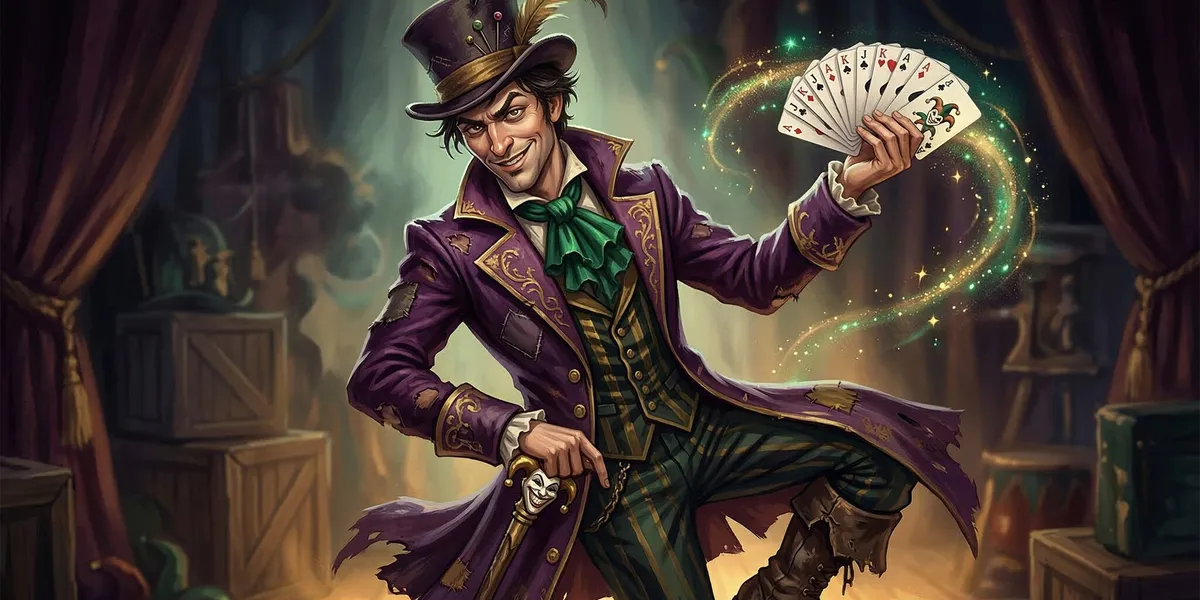
A trickster is a character who operates by cleverness rather than force — bending rules, exploiting loopholes, and turning situations upside down through wit and audacity. They are one of the oldest character archetypes in storytelling, appearing in myths, folklore, and modern fiction across every culture.
What makes tricksters compelling is their moral ambiguity. They are not heroes and not villains. They are agents of disruption who serve the story’s deeper themes while being the most entertaining character in the room.
The Trickster Archetype
The trickster sits outside the normal social order. While the hero follows the rules (or at least respects them) and the villain breaks the rules for power, the trickster breaks the rules because the rules are absurd — and they want everyone to see it.
Core trickster traits:
Cleverness over strength. The trickster wins not by being the strongest or bravest but by being the smartest person in the room. They outthink their opponents, set traps, and manipulate situations so that others do the heavy lifting.
Rule-breaking. Not for its own sake, but because the trickster sees structures — laws, hierarchies, traditions, etiquette — as systems to be exploited rather than respected. They find the loophole in every contract and the weakness in every plan.
Moral ambiguity. Tricksters are not reliably good or evil. They help the hero when it suits them and hinder the hero when that suits them too. Their loyalty is to their own code, which may not align with anyone else’s.
Charm. Despite everything, people like them. Tricksters are magnetic. They are funny, confident, and oddly honest — they will lie to your face and then tell you they are lying, and somehow you trust them more for it.
Shape-shifting. Sometimes literally (Loki is a shapeshifter), but more often socially. Tricksters adapt to any environment. They can talk to kings and beggars with equal ease. They wear masks — and they are aware they are wearing them.
The Trickster’s Role in the Story
Tricksters serve specific narrative functions that other character types cannot fill.
Disrupting the status quo. The story’s world has an established order, and the trickster throws a wrench into it. This creates plot movement. In Pirates of the Caribbean, Captain Jack Sparrow enters a structured naval world and immediately destabilizes everything through sheer unpredictability. Plans fall apart around him. New opportunities emerge from the chaos.
Revealing hypocrisy. Tricksters have a talent for exposing the gap between what people say and what they do. They puncture authority, mock self-importance, and force “respectable” characters to confront their own contradictions. Shakespeare’s fools serve this function — they tell the truth that no one else is allowed to say.
Creating opportunities through cleverness. When the straightforward path is blocked, the trickster finds the side door. They solve problems through unconventional means — a con, a performance, a ridiculous plan that should not work but does because nobody expected it.
Testing the hero. The trickster often serves as a test of the hero’s judgment. Can the hero work with someone unreliable? Can they tell when the trickster is being honest versus performing? The hero’s ability to navigate the trickster reveals their own intelligence and adaptability.
Providing comic relief with substance. Tricksters are often the funniest characters in the story, but their humor is not decorative. It serves the plot, reveals character, and frequently delivers the story’s sharpest observations about human nature.
Trickster vs. Villain
This distinction is crucial. Both tricksters and villains break rules, but their relationship to the story’s themes is fundamentally different.
A villain opposes the hero’s goals and threatens what the hero values. They represent the force the hero must overcome.
A trickster complicates the hero’s path but does not necessarily oppose their goals. They represent chaos, unpredictability, and the limits of control. The hero does not need to defeat the trickster — they need to navigate them.
Loki in Norse mythology is a trickster, not a villain. He causes problems, certainly — but he also solves them, sometimes in the same scene. He is the god who gives the gods their greatest treasures and also causes Ragnarok. He serves the story’s themes about the limits of order and the necessity of change.
When a trickster becomes a true villain — as the Marvel Cinematic Universe initially tried with Loki — they often lose what made them interesting. The most compelling version of Loki is the one who stands between sides, serving his own inscrutable agenda.
A well-written trickster makes the reader uncertain. They might help. They might hinder. They might do both at once. That uncertainty is what makes every scene with a trickster feel electric.
Famous Tricksters Worth Studying
Captain Jack Sparrow (Pirates of the Caribbean). Jack appears incompetent — stumbling, slurring, making terrible decisions — but his bumbling is a mask. Beneath it, he is calculating every angle. His trickster nature means that other characters (and the audience) can never be sure whether he is failing or executing a plan nobody else can see.
Tyrion Lannister (A Song of Ice and Fire). In a world of warriors and kings, Tyrion survives through wit. He reads people better than anyone, finds leverage in every situation, and uses humor as both shield and weapon. His trickster qualities are sharpened by the prejudice he faces — cleverness is his only option in a society that dismisses him.
Puck (A Midsummer Night’s Dream). The original literary trickster. Puck manipulates the lovers in the forest not from malice but from amusement. He sees human love as absurd and entertaining, and he is not wrong. His meddling creates the play’s central chaos, but it also drives every character toward their eventual resolution.
Fred and George Weasley (Harry Potter). Comic tricksters whose rule-breaking has a moral dimension. They disrupt Umbridge’s authoritarian regime not through direct confrontation but through jokes, pranks, and spectacle. Their departure from Hogwarts — a fireworks display of defiance — is one of the most satisfying moments in the series.
Coyote (Native American folklore). Perhaps the oldest trickster in the Americas. Coyote is greedy, lustful, foolish, and wise — sometimes in the same story. He creates rivers, steals fire for humanity, and trips over his own schemes. He represents the chaotic, contradictory nature of creation itself.
Tips for Writing Your Trickster
Give them a code. Moral ambiguity does not mean moral emptiness. The best tricksters have principles — they are just unusual principles. Jack Sparrow values freedom above all. Tyrion values fairness for the marginalized. A trickster with a code is unpredictable in their methods but consistent in their values.
Make them genuinely clever. The biggest failure in trickster writing is telling the reader a character is clever without showing it. Your trickster needs to do things the reader did not anticipate — set up cons the reader does not see coming, make connections other characters miss, turn apparent defeats into victories.
This means you need to be clever in the plotting. A trickster is only as smart as the writer allows them to be. Plan their schemes carefully. Plant the elements they will use before they use them. The reader should be able to look back and see how the trick was assembled.
Let them fail. A trickster who always succeeds becomes boring and smug. The best tricksters overreach. Their cleverness gets them into trouble as often as it gets them out. Coyote’s schemes blow up in his face constantly. Jack Sparrow spends half his screen time in situations his own plans created. Failure humanizes the trickster and keeps the reader from resenting their competence.
Give them genuine stakes. Behind the mask of cleverness and charm, what does the trickster actually care about? What are they afraid of losing? A trickster who cares about nothing is a plot device. A trickster who uses humor and manipulation to protect something vulnerable — that is a person.
Use their perspective to illuminate the world. Tricksters see the world differently than other characters. Let that perspective do narrative work. When the trickster observes a political negotiation, they see the lies. When they attend a religious ceremony, they see the performance. Their outsider perspective can reveal truths the other characters are too embedded to notice.
Control their screen time. Tricksters are rich spice — a little goes a long way. If the trickster is in every scene, their disruptions become the new normal and lose their impact. The most effective tricksters appear, create chaos, and vanish — leaving the other characters to deal with the aftermath.
The trickster is one of several powerful character archetypes worth mastering. If the trickster sits between hero and villain, the antihero occupies similar territory — a protagonist who operates outside conventional morality. And if your trickster relies on humor, our guide on writing humor covers the mechanics of comedic timing and wit on the page.
The trickster archetype endures because it represents something true about human nature: our love of cleverness, our suspicion of authority, and our secret delight when someone gets away with something they should not have. Write a trickster well, and they will steal the story. That is, after all, what tricksters do.