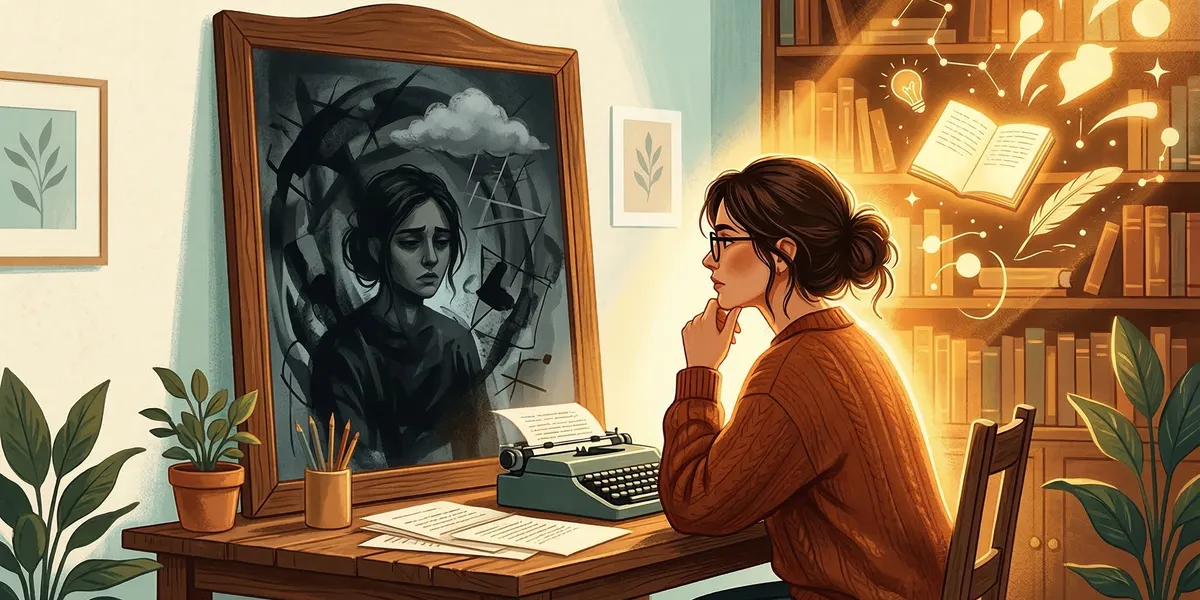
Imposter syndrome is the persistent feeling that you are not a real writer, that your work is not good enough, and that sooner or later someone will figure out you have no idea what you are doing. If you have ever felt this way, you are in the company of nearly every writer who has ever published anything.
It is real, it is common, and it is beatable. Here is why writers are especially vulnerable to it, how to recognize it in yourself, and seven practical ways to write through it.
What Imposter Syndrome Looks Like for Writers
For writers, imposter syndrome takes specific shapes that are easy to mistake for rational self-assessment.
“I’m not a real writer.” You have written thousands of words. You may have finished a manuscript. You may have published a book. But you still feel like calling yourself a writer is somehow fraudulent — as if there is an invisible threshold you have not crossed.
“Someone will find out I don’t know what I’m doing.” You read a craft book, attend a workshop, or see another author discuss story structure with confidence, and you feel exposed. Surely everyone else learned the rules properly while you have been faking it.
“My work isn’t good enough.” Not the productive self-awareness that drives revision, but the paralyzing conviction that nothing you write will ever meet some undefined standard of quality. This version of imposter syndrome does not make you revise — it makes you stop writing entirely.
“I don’t deserve this.” You finish a draft, get a positive review, make a sale — and instead of satisfaction, you feel anxiety. A mistake was made. Someone was being nice. The success was a fluke.
If any of these sound familiar, you are experiencing imposter syndrome. It is not a character flaw. It is a well-documented psychological phenomenon that affects high-achievers in creative fields at disproportionate rates.
Why Writers Are Especially Vulnerable
Writing creates perfect conditions for imposter syndrome. Here is why.
No Credential Required
Doctors have medical degrees. Lawyers pass the bar. Writers have no equivalent credential. Nobody hands you a certificate that says “you are now officially a writer.” This absence of formal validation means the question of whether you are “really” a writer never gets definitively answered — so self-doubt fills the gap.
Subjective Art, Public Judgment
A bridge either holds weight or it does not. A book’s quality is a matter of opinion. You can write something you believe is good and have someone tell you, publicly, that it is terrible. The subjectivity of creative work means there is no objective proof that you are doing it right, and your brain interprets that ambiguity as evidence that you are doing it wrong.
Comparison Culture
Social media shows you writers who seem more productive, more confident, more successful. They are posting their highlights while you are sitting with a blank page and a full cup of self-doubt. The comparison trap is especially destructive for writers because writing progress is invisible — nobody sees the hours of thinking, outlining, and revising that produce a finished page.
The Solitary Nature of the Work
When you work alone, you have no colleagues to normalize your experience. In an office, you can see that other people also struggle, also procrastinate, also feel unsure. When you write alone, your struggles feel uniquely yours. You assume everyone else is gliding through their manuscripts while you grind through every paragraph.
Visibility of “Better” Writers
You read published books — polished, edited, refined through multiple drafts — and compare them to your messy first draft. You are comparing your behind-the-scenes to their final product. That comparison is inherently unfair, but your brain makes it anyway.
7 Ways to Fight Imposter Syndrome
1. Name It
The single most effective first step is recognizing imposter syndrome for what it is. When you catch yourself thinking “I’m not a real writer” or “this isn’t good enough,” pause and label it: “That’s imposter syndrome.”
Naming it creates distance between you and the thought. It transforms a vague, overwhelming feeling into a specific, recognizable pattern. Patterns can be managed. Unnamed anxiety cannot.
Research from the American Psychological Association shows that simply understanding imposter syndrome — knowing its name, its characteristics, and its prevalence — reduces its power significantly.
2. Know That Every Famous Author Felt This
You are not the first writer to feel like a fraud. You are not even the thousandth.
Neil Gaiman has told the story of attending a gathering of artists, scientists, and writers and feeling he did not belong — until he met another Neil (Neil Armstrong) who confessed to feeling the same way. If the first man on the moon can feel like an imposter, so can you.
Maya Angelou, after publishing eleven books and receiving dozens of honors, said: “I have written eleven books, but each time I think, ‘uh oh, they’re going to find out now. I’ve run a game on everybody, and they’re going to find me out.’”
John Steinbeck wrote in his journal while working on The Grapes of Wrath: “I am not a writer. I’ve been fooling myself and other people.”
These are not marginally successful authors. These are the writers whose names define literary history. They all felt exactly what you are feeling.
3. You Do Not Need Permission to Write
There is no gatekeeper. No committee decides who qualifies as a “real” writer. No test you must pass, no minimum word count you must hit, no publication threshold you must clear.
If you write, you are a writer. The definition is that simple. You do not need an MFA, a publishing contract, or a bestseller list appearance. You need a pen, a page, and the intention to put words on it.
The gatekeeping impulse — the feeling that you must earn the title — is a leftover from an era when traditional publishing was the only path. Self-publishing has eliminated the permission barrier. You can write a book and publish it on your own terms. The only person whose permission you need is yourself.
4. Stop Comparing
Comparison is the fastest way to kill your motivation and amplify imposter syndrome. Social media makes it worse because it curates the highlight reel.
What you see: “I finished my third novel this year!” What you do not see: The two years of therapy that followed a burnout. The ghostwriter who helped with book two. The three abandoned manuscripts before the first one worked.
Practical actions to reduce comparison:
- Unfollow or mute authors whose posts make you feel bad about your own progress
- Set specific time limits for social media, especially writing-related communities
- Track your own progress against your own past output, not anyone else’s
- Remember that writing speed, publication volume, and commercial success are not measures of creative worth
5. Write Badly on Purpose
Perfectionism is imposter syndrome’s best friend. The fear that your writing is not good enough feeds the fear that you are not good enough. Break the cycle by deliberately writing badly.
Set a timer for 20 minutes. Write the worst possible version of your scene, chapter, or essay. Use cliches. Write flat dialogue. Make your descriptions boring. Give yourself full permission to produce garbage.
Two things happen. First, the pressure evaporates — you cannot fail at writing badly. Second, within the garbage, you will find usable material. Ideas appear when the internal editor is silenced. Sentences emerge that are better than you expected. The act of writing, even writing badly, generates momentum that perfectionism blocks.
This is the philosophy behind the famous advice to write a terrible first draft. Nobody writes well in the first pass. Everyone’s first draft is bad. The writers who finish books are the ones who write through the bad parts instead of stopping to doubt themselves.
6. Celebrate Small Wins
Imposter syndrome dismisses your accomplishments. Fight back by making your accomplishments visible.
Finished a chapter? That is an achievement. Millions of people say they want to write a book. You are actually doing it.
Wrote 500 words today? That is 500 words more than yesterday’s blank page. At 500 words a day, you will have a full manuscript in four to six months.
Got one positive comment from a reader? Save it. Screenshot it. Put it in a file. That comment is evidence — evidence that your writing reached someone and mattered to them.
The imposter syndrome voice says none of this counts. The evidence says it does. Build the evidence file and let it speak louder than the doubt.
7. Join a Community of Writers
The fastest cure for feeling like the only writer who struggles is discovering that every writer struggles.
A writing group — online or in person — shows you that other people also stare at blank pages, also doubt their work, also wonder if they are “real” writers. This normalization is powerful. It does not eliminate imposter syndrome, but it reframes it from a personal failing to a shared human experience.
Writing communities also provide external validation that is harder to dismiss than self-reassurance. When a fellow writer whose opinion you respect says your chapter is strong, it carries more weight than telling yourself the same thing.
If you do not have a writing community, find one. Scribophile, local library groups, NaNoWriMo communities, and genre-specific Discord servers are all starting points.
The Evidence File Technique
This is the single most practical tool for long-term imposter syndrome management.
Create a document, folder, or notebook. Call it whatever you want — “Evidence,” “Proof,” “The File.” In it, collect:
- Positive reviews and reader feedback
- Completed word counts and milestones
- Finished drafts, even if unpublished
- Compliments from beta readers, editors, or writing group members
- Screenshots of sales, downloads, or any metric that shows people engaging with your work
- Personal reflections on moments when writing felt right
When imposter syndrome hits — and it will — open the file. Read through it. Let the accumulated evidence push back against the voice that says you are not good enough.
This works because imposter syndrome relies on selective memory. It remembers every criticism and forgets every success. The evidence file corrects the imbalance by making your successes tangible and accessible.
When to Seek Professional Help
Imposter syndrome exists on a spectrum. For most writers, it is an occasional nuisance — a voice that flares up at certain moments and fades with time and practice. For some, it becomes debilitating.
Consider talking to a therapist if:
- Imposter syndrome prevents you from writing for extended periods
- The anxiety extends beyond writing into other areas of your life
- You experience physical symptoms (insomnia, loss of appetite, panic attacks) related to creative self-doubt
- You have stopped submitting, publishing, or sharing your work entirely due to fear of being “found out”
Cognitive behavioral therapy (CBT) is particularly effective for imposter syndrome because it targets the thought patterns that sustain it. A good therapist can help you identify and reframe the automatic thoughts that fuel self-doubt.
Seeking help is not a sign that you are weak or broken. It is a sign that you take your creative life seriously enough to invest in maintaining it.
You Belong Here
The feeling that you do not belong in the world of writers is a lie. It is a convincing lie, told by a part of your brain that is trying to protect you from judgment and failure. But it is still a lie.
You belong here because you write. Not because you write well, or often, or for money. Because you write. That is the only qualification, and you already have it.
The doubt will not disappear entirely. Even after your tenth book, your hundredth positive review, your first bestseller list appearance — some version of the voice will still whisper that you got lucky, that the next book will expose you, that you are not the writer people think you are.
Let it whisper. Then sit down and write anyway.
That is what real writers do. And you are one of them.
“Start writing, no matter what. The water does not flow until the faucet is turned on.” — Louis L’Amour
Now go finish your book.