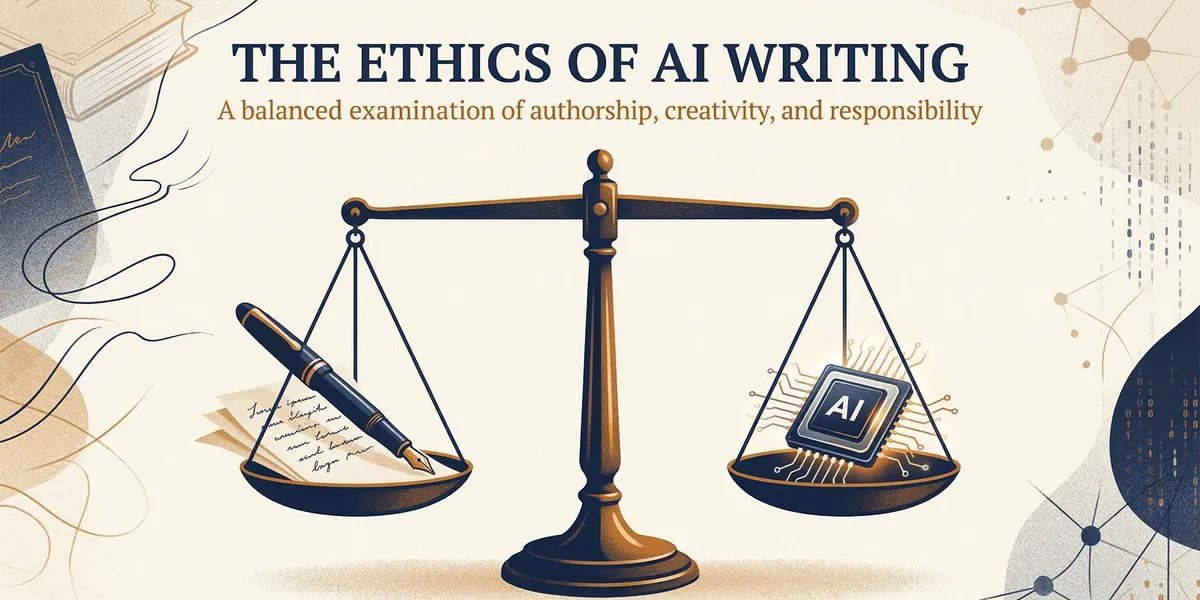
Is AI writing cheating? The honest answer: it depends on what you are doing with it and whether you are honest about it. That is not a dodge — it is the only intellectually honest position in a debate where both sides have legitimate points.
Over 2,147 authors have used AI to write and publish more than 5,000 books. Some made real money — $60,000 in 48 hours, $13,200 from a single client, a #12 Amazon bestseller in five days. Others published authority books, memoirs, and how-to guides that helped their careers and businesses.
Were they cheating? Let us examine the arguments.
The Case That AI Writing Is Cheating
These arguments have merit. Dismissing them makes the conversation less honest, not more.
The words are not yours
When a human writes a book, every sentence reflects their choices — word selection, rhythm, metaphor, structure. When AI generates the prose, those choices come from a statistical model trained on existing text. The argument: if you did not choose the words, calling yourself the author is misleading.
This is the strongest argument against AI writing. A traditionally written book is an expression of the author’s mind. An AI-generated book is an expression of the author’s inputs processed through a model. Those are different things, and pretending they are identical is dishonest.
Misrepresentation concerns
When you publish a book under your name, readers assume you wrote it. If the prose was generated by AI and you do not disclose that, some readers will feel deceived when they find out — and in 2026, they often do find out.
This matters more in some contexts than others. A literary novel where readers care about the author’s craft has different expectations than a business how-to guide where readers care about the information. But the misrepresentation concern applies broadly.
Devaluing human craft
Writing is hard. Authors spend years developing their voice, understanding narrative structure, learning to convey emotion through language. When AI generates a 60,000-word novel in hours, it can feel like those years of craft development are being rendered irrelevant.
Writers who have dedicated decades to their craft have a right to feel uneasy about technology that produces superficially similar output overnight. The concern is not irrational — it is a legitimate response to technological disruption of a skill they worked hard to build.
The Case That AI Writing Is Not Cheating
These arguments also have merit. Embracing new tools is not inherently dishonest.
All writing tools augment human ability
The printing press did not make writing cheating. Typewriters did not make handwriting the only “real” writing. Word processors with spell-check, grammar correction, and auto-formatting did not make authors frauds. Each tool made writing more accessible and efficient.
AI is the next step in that progression. The human still decides what to write, who to write it for, what structure to use, what expertise to include, and how the final product should read. The tool handles execution — the same role every writing tool has played, just at a larger scale.
Ghostwriters have existed for centuries
An estimated 50% of nonfiction bestsellers are ghostwritten. Celebrity memoirs, business books by executives, political autobiographies — many of the most respected nonfiction books were not written by the person whose name appears on the cover.
If hiring a human to write your book is not cheating, it is difficult to argue that using an AI tool is. The expertise, ideas, and authority behind the book are still yours. The writing labor is outsourced — whether to a ghostwriter charging $25,000 or an AI tool charging $97.
The expertise is still yours
An AI cannot generate a valuable business book if you have no business expertise. It cannot produce a useful how-to guide if you do not know how to do the thing. It cannot write a compelling memoir if you have not lived the life.
The knowledge, frameworks, case studies, stories, and insights that make a nonfiction book worth reading come from the author. The AI converts that expertise into structured prose — a labor task, not an intellectual one.
For fiction, the author provides the characters, world, themes, plot, and emotional core. The AI generates prose from those inputs. The creative vision remains human.
Calculators did not make math cheating
When calculators appeared, critics argued they would destroy mathematical understanding. Instead, they freed mathematicians and engineers to focus on higher-level problem solving. Students still learn math. Professionals still understand what they are calculating. The tool accelerated the mechanical parts of the work.
AI writing follows the same pattern. Authors who use AI still understand storytelling, structure, audience, and purpose. The tool accelerates the mechanical part — converting ideas into sentences. The thinking behind the book remains human.
The Nuance: It Depends on Context
Neither the “always cheating” nor “never cheating” position survives contact with specific scenarios. Context determines the ethics.
When AI writing is ethically clear
Expert using AI to write a business book. A consultant with 20 years of experience uses AI to write a book sharing their frameworks. The expertise is genuine. The book accurately represents their knowledge. The AI handled writing labor the same way a ghostwriter would have. Readers benefit from knowledge they would not have accessed otherwise, because the expert would never have found time to write 200 pages manually.
This is the use case behind most of the 5,000+ books published through Chapter. Jim T.’s book earned him a $13,200 client — not because the AI-generated prose was beautiful, but because the consulting expertise in it was real and valuable.
Author using AI to draft and then extensively editing. Many authors use AI for a first draft, then rewrite substantially — adjusting voice, adding personal anecdotes, refining arguments, cutting weak sections. The final product is a genuine collaboration between human and machine. The author’s judgment shapes every page.
Clear disclosure. When an author is transparent about AI assistance — whether in the foreword, the about page, or publicly — the misrepresentation concern disappears. Readers can make informed choices.
When AI writing is ethically questionable
Submitting AI fiction to a literary contest as original work. Most literary contests explicitly evaluate craft — the author’s skill with language, structure, and storytelling. Submitting AI-generated work without disclosure misrepresents what is being judged. Several major literary organizations have updated their rules to require disclosure.
Academic submissions without disclosure. Submitting an AI-written thesis, dissertation, or academic paper as your own work violates the fundamental purpose of academic writing — demonstrating that you understand the material. This is cheating in the same way using a calculator on a no-calculator exam is cheating.
Flooding a market with low-quality AI content. Generating hundreds of thin, unedited AI books to exploit Amazon’s recommendation algorithm is not necessarily cheating, but it is a quality problem that hurts readers and legitimate authors. Amazon’s content guidelines have been updated to address this.
Claiming AI-written work as a display of personal craft. If the value proposition of your book is “look at how well I write,” and the writing was done by AI, that is a misrepresentation of personal skill.
Our Position: AI Is a Tool. Ethics Depend on Use.
We build AI book writing software. We have a financial stake in this question. That bias should be transparent.
With that disclosure, here is what we believe after watching 2,147 authors use AI to publish books:
AI writing is a tool, like every writing tool before it. The ethics do not live in the tool. They live in how you use it and what you represent to your readers.
The value of most nonfiction books is the expertise, not the prose. When a consultant, coach, or expert uses AI to write a book, readers are buying the knowledge — not the sentence construction. The writing labor was always separable from the intellectual contribution. Ghostwriters proved this decades ago.
Fiction is more nuanced. The craft of prose matters more in fiction. Readers of literary fiction value how something is written as much as what is written. Using AI for genre fiction where readers prioritize story is different from using AI for literary fiction where readers prioritize craft. Authors should be honest about their process, and readers should be empowered to make informed choices.
Disclosure solves most ethical concerns. When an author is transparent about using AI — “I wrote this book with AI assistance” — readers can decide for themselves whether they care. Most nonfiction readers do not. Many fiction readers do not either, as long as the story delivers. The ones who do care deserve the information.
Quality is the real test. A well-researched, genuinely useful AI-written business book is more valuable than a poorly written, self-indulgent traditionally written book. A compelling AI-generated thriller that keeps readers up all night delivers more reader value than a mediocre human-written one. The method matters less than the result.
What This Means Practically
If you are considering using AI to write a book, here are guidelines that keep you on solid ethical ground:
-
Bring real expertise or a genuine story. AI is a writing tool, not a knowledge tool. If you do not have something worth saying, AI cannot give it to you.
-
Edit meaningfully. Treat AI output as a first draft. Add your voice, your examples, your judgment. The more of yourself you put into the final product, the more genuinely yours it is.
-
Be honest about your process. You do not need a disclaimer on every page, but do not actively lie about writing every word yourself if you did not.
-
Judge by output quality, not production method. A book that helps readers, entertains them, or provides genuine value is a good book. How it was produced is a separate question from whether it was worth producing.
-
Respect the contexts that demand original work. Academic submissions, literary contests, and any context where the craft itself is being evaluated — use AI cautiously and disclose fully.
FAQ
Do I have to tell readers I used AI?
No legal requirement exists in most jurisdictions as of 2026. Amazon KDP requires disclosure of AI-generated content. Beyond platform requirements, disclosure is an ethical choice. We recommend honesty — most readers care less than you expect, and transparency builds trust.
Can I copyright an AI-written book?
Copyright law around AI-generated content is evolving. In the United States, the Copyright Office has indicated that purely AI-generated content without human creative input may not be copyrightable, while works with substantial human involvement (editing, structuring, directing) likely are. Most AI-assisted books involve enough human input to qualify for protection.
Is it ethical to sell an AI-written book?
Selling a product is ethical when it delivers the value it promises. A nonfiction book that genuinely teaches what it claims to teach is worth the price regardless of how the prose was generated. A fiction book that delivers an engaging story delivers value regardless of method. The ethics are in the value delivered and the honesty of the representation.
How do publishers and agents view AI-written books?
Traditional publishers and literary agents generally require disclosure of AI use and may reject fully AI-generated manuscripts. The self-publishing market is more open — Amazon KDP accepts AI-assisted books with proper disclosure. Most of the 5,000+ books published through Chapter are self-published, where the author controls the process and the disclosure.
Will AI writing replace human authors?
AI will not replace authors who bring unique voice, lived experience, and creative vision. It will replace the mechanical labor of converting ideas into prose — the same labor that ghostwriters, transcriptionists, and copy editors have always handled. The authors who thrive will be those who use AI to amplify their unique contributions rather than trying to produce generic content at scale.