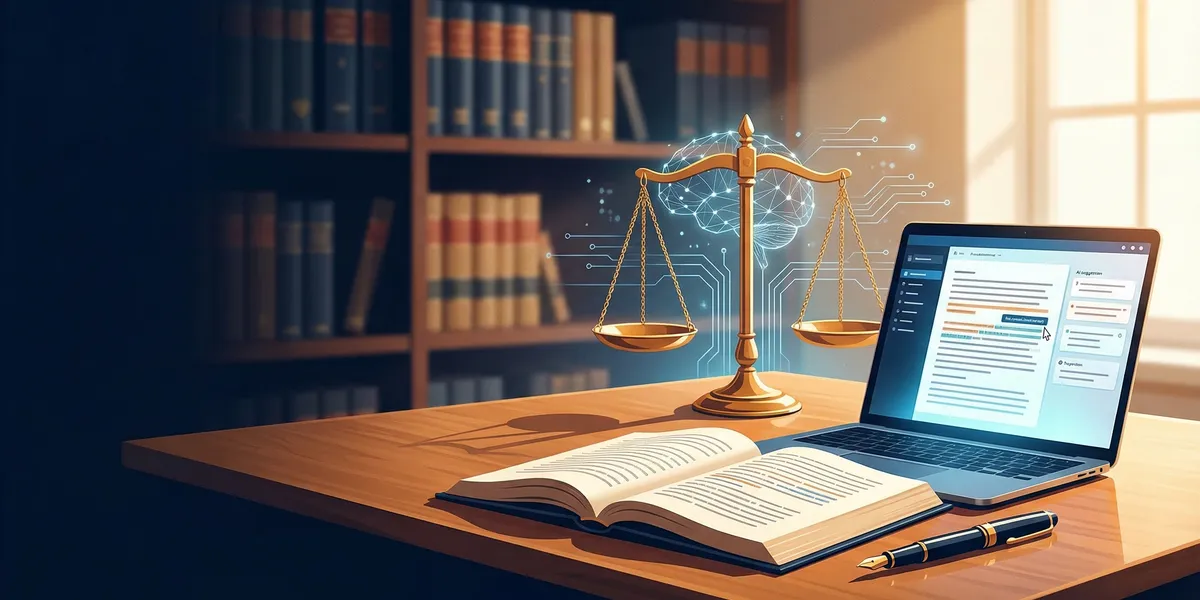
Yes, it is legal to use ChatGPT to write a book. No law in the United States or any major jurisdiction prohibits using AI tools to create written content, including full-length books. You can write it, publish it, and sell it.
The real question is not legality but copyright protection. Whether your AI-assisted book qualifies for copyright depends entirely on how much human creative work you put into it. This guide covers the current legal landscape, the copyright rules you need to follow, and how to make sure your AI-written book is fully protected.
The U.S. Copyright Office position on AI-generated works
The U.S. Copyright Office released its landmark report on AI and copyrightability in January 2025. The position is clear: copyright protects only works created by human authors.
This does not mean AI-assisted books are unprotectable. It means the office draws a sharp line between two categories:
| Category | Copyright status | Example |
|---|---|---|
| Fully AI-generated | Not copyrightable | Paste a prompt, publish raw output |
| AI-assisted with human authorship | Copyrightable (human portions) | Use AI to draft, then substantially rewrite, edit, restructure |
| Human-authored with AI editing | Fully copyrightable | Write the manuscript yourself, use AI for grammar and polish |
The Copyright Office stated explicitly that “copyright can protect only material that is the product of human creativity” and that the term “author” in both the Constitution and the Copyright Act “excludes non-humans.”
But the office also confirmed that using AI as a tool does not disqualify a work from protection. If you use AI to generate ideas, then write original content based on those ideas, the resulting work is copyrightable. The key is that perceptible human expression must exist in the final product.
The human authorship requirement explained
The January 2025 copyrightability report established several principles that every AI-assisted author needs to understand.
Prompts alone are not enough. Typing a prompt into ChatGPT and publishing the output does not make you an author. The Copyright Office found that the variation of outputs in response to identical prompts demonstrates a lack of human control over expressive elements. Selecting one output from several options is also insufficient.
Human modifications can establish authorship. If you take AI-generated text and substantially rewrite, restructure, or transform it, you can claim copyright over those human-authored elements. The more creative work you contribute, the stronger your copyright claim.
Case-by-case analysis applies. There is no bright-line rule for how much human involvement is “enough.” The Copyright Office evaluates each work individually, looking at whether human authors contributed creative expression that is perceptible in the final product.
In March 2026, the Supreme Court reinforced this framework by denying certiorari in Thaler v. Perlmutter, the landmark case where an AI developer tried to register a work listing an AI system as the sole author. The Court’s refusal to hear the case leaves the human authorship requirement firmly in place.
How to ensure your AI-assisted book qualifies for copyright
The legal framework is actually straightforward once you understand it. Your goal is to ensure sufficient human creative input at every stage.
1. Provide the creative direction
You decide the topic, the structure, the argument, the audience, and the angle. These creative decisions are yours, and they form the foundation of your authorship claim.
2. Write or substantially rewrite the content
Using AI to generate a first draft is fine. Publishing that draft without meaningful revision is not. Go through every chapter and rewrite sections in your voice. Add your own examples, anecdotes, and expertise. Remove generic AI patterns and replace them with specific, original content.
For practical techniques on this step, see our guide on how to edit AI-generated text.
3. Apply creative selection and arrangement
Even if individual sections contain AI-generated language, your creative decisions about what to include, what to cut, and how to arrange the material can establish copyrightable authorship. The Copyright Office recognizes creative “selection, coordination, and arrangement” as a basis for protection.
4. Document your process
Keep records of your creative contributions. Save your outlines, revision history, notes on structural decisions, and drafts showing how the work evolved. If a copyright question ever arises, this documentation proves your human involvement.
5. Disclose AI content when registering
When you register copyright with the U.S. Copyright Office, you must disclose AI-generated content that is more than minimal. Use the “Limitation of the Claim” section to exclude AI-generated portions, and describe your human contributions in the “Author Created” field.
For a complete walkthrough of the registration process, see our guide on how to copyright a book.
What OpenAI’s terms of service say about ownership
OpenAI’s Terms of Use address ownership directly: “As between you and OpenAI, and to the extent permitted by applicable law, you retain your ownership rights in Input and own the Output. We hereby assign to you all our right, title, and interest, if any, in and to Output.”
In plain language: OpenAI does not claim ownership of what ChatGPT writes for you. They assign whatever rights they might have in the output to you.
The critical phrase is “to the extent permitted by applicable law.” OpenAI can only assign rights that exist. If copyright law does not protect purely AI-generated text (which it currently does not), then there are no rights to assign. This is another reason your human creative contribution matters so much.
One practical caveat: ChatGPT outputs are not unique. Other users can receive similar or identical text from similar prompts. This makes heavy reliance on raw AI output a poor strategy for both legal and quality reasons.
Amazon KDP’s AI disclosure policy
Amazon is the largest self-publishing platform, and their policy on AI content is more permissive than many authors expect.
Amazon KDP requires you to disclose AI-generated content during the publishing process. They distinguish between two categories:
AI-generated (disclosure required): Text, images, or translations created by an AI tool, even if you edited the output substantially afterward. If ChatGPT drafted chapters that appear in your final book, you must select “Yes” for AI-generated content.
AI-assisted (no disclosure required): Content you wrote yourself where AI was used only for brainstorming, grammar checking, or proofreading. If you wrote every word and ChatGPT just fixed your typos, no disclosure is needed.
Amazon does not display your AI disclosure to readers. The information is for their internal records and compliance monitoring.
The consequences of failing to disclose are serious: book removal, account suspension, royalty withholding, and republishing restrictions. Amazon has increased enforcement significantly throughout 2025 and 2026, using both automated detection and human review.
The good news: Amazon does not reject books for containing AI content. They reject books that fail to disclose AI usage or violate quality standards. Properly disclosed, well-edited AI-assisted books are published and sold on KDP every day.
For a full guide on the publishing process, see how to publish a book on Amazon.
Is it ethical to use ChatGPT to write a book?
The legal question has a clear answer. The ethical question is more nuanced, but the writing industry has largely settled on a practical consensus.
The industry standard: transparency and human value
A Gotham Ghostwriters survey of 1,481 professional writers found that 61% now use AI tools, reporting an average 31% productivity increase. AI-assisted writing has moved from controversial to commonplace among professionals.
The ethical standard that has emerged is straightforward:
- Be transparent about AI involvement when platforms require it
- Contribute genuine human value through your expertise, voice, and editorial judgment
- Do not mislead readers about the nature of your content
- Do not use AI to mass-produce low-quality content that degrades the market
The backlash against AI books targets a specific pattern: zero-effort, no-expertise “authors” who prompt ChatGPT and publish raw output at scale. That practice is legal but harms readers, dilutes search results, and undermines the credibility of legitimate AI-assisted authors.
Where the line is
Using AI as a writing tool is no different in principle from using a ghostwriter, a developmental editor, or speech-to-text software. The author provides the ideas, the expertise, and the creative direction. The tool accelerates execution.
The ethical issues arise when AI replaces the author’s contribution entirely. If you have no expertise on a topic but use ChatGPT to generate a book about it, the result will be generic, potentially inaccurate, and offers nothing readers cannot get from ChatGPT directly.
If this question concerns you, our deeper exploration of whether AI writing is cheating covers the full philosophical and practical debate.
International perspectives on AI and copyright
Copyright law varies by country, and the global landscape for AI-generated works is still developing.
United Kingdom
The UK has an existing provision in the Copyright, Designs and Patents Act 1988 (Section 9(3)) that grants copyright in computer-generated works to “the person by whom the arrangements necessary for the creation of the work are undertaken.” This provision, written decades before generative AI existed, could theoretically apply to AI-assisted books, making the UK more permissive than the US.
The UK government is currently developing a comprehensive AI and copyright framework, with an economic impact assessment due by the end of March 2026.
European Union
The European Parliament is actively legislating on AI and copyright. Their 2025-2026 proposals focus primarily on training data and transparency rather than output copyrightability. The EU AI Act’s transparency rules for AI-generated content will become applicable on August 2, 2026, requiring providers to mark AI-generated content in machine-readable formats.
China
Chinese courts have shown more openness than U.S. courts to assigning copyright to human operators of generative AI systems. China’s 2023 Interim Measures for the Management of Generative AI Services require developers to use lawful data and respect intellectual property, while offering relatively straightforward paths to copyright for AI-assisted works.
The common thread
Despite their differences, no major jurisdiction recognizes AI as an independent author. Every system requires some form of human involvement. The practical takeaway for authors: regardless of where you publish, contributing meaningful human creative work to your AI-assisted book protects you in every market.
How Chapter ensures your book qualifies for copyright
The copyright risk with AI-written books comes from a specific workflow: prompt, generate, publish. When the human contribution is limited to typing a prompt, the resulting book has a weak or nonexistent copyright claim.
Our Pick — Chapter
Chapter is built around a workflow that ensures meaningful human authorship at every stage — from ideation through final manuscript.
Best for: Authors who want to write AI-assisted books with full copyright protection Pricing: $97 one-time (nonfiction) | Varies (fiction) Why we built it: To make AI book writing fast without sacrificing the human authorship that copyright law requires.
Here is how the platform addresses each legal requirement:
Creative direction is yours. Chapter interviews you about your expertise, target audience, and goals before generating anything. The AI builds around your knowledge, not around generic prompts. For nonfiction, this means your subject matter expertise drives the content. For fiction, you provide the characters, themes, and story direction.
Structured human involvement. The platform uses proven frameworks (Save the Cat for fiction, expertise-based structuring for nonfiction) that require your input at every decision point. You are not hitting “generate” once and walking away. You are making creative choices throughout.
Built for editing. Every chapter comes through as a draft you are expected to review and revise. The workflow assumes editing is part of the process, not an afterthought.
Over 2,147 authors have used Chapter to create more than 5,000 books. The platform has been featured in USA Today and The New York Times. That track record exists because the workflow produces books with genuine human authorship baked in.
For a detailed comparison of AI writing tools, see our guide on the best AI writing tools.
Common mistakes to avoid
- Publishing raw ChatGPT output. This gives you no copyright protection and produces a book readers can identify as AI-generated in seconds. Always revise substantially.
- Failing to disclose AI usage on Amazon. KDP enforcement is real. Disclose honestly and you face zero penalties. Hide it and risk losing your account.
- Listing AI as the author. Do not credit ChatGPT as the author or co-author. The AI is a tool, not a collaborator. You are the author.
- Assuming AI output is factually accurate. ChatGPT generates plausible text, not verified facts. Every claim in your book needs human fact-checking, especially in nonfiction.
- Ignoring copyright registration. While your book is copyrighted the moment you write it, formal registration with the Copyright Office provides legal advantages you cannot get otherwise, including the ability to sue for statutory damages.
FAQ
Is it illegal to use ChatGPT to write a book?
No. There is no law prohibiting the use of ChatGPT or any AI tool to write a book. You can legally use AI for any stage of the writing process. The legal considerations involve copyright protection (which requires human authorship) and platform compliance (Amazon KDP requires AI disclosure), not criminal or civil liability for using the tool.
Can I copyright a book written with ChatGPT?
Yes, if you contributed sufficient human creative work. The U.S. Copyright Office protects works where a human author made creative decisions about selection, arrangement, and expression. If you used ChatGPT to draft content but then substantially rewrote, restructured, and added original material, the human-authored elements are copyrightable. Purely AI-generated text without meaningful human revision is not.
Do I have to tell Amazon my book was written with AI?
Yes, if AI generated the text, images, or translations. Amazon KDP requires disclosure during the publishing process. If you only used AI for brainstorming or grammar checking, no disclosure is needed. The disclosure is not shown to readers — it is for Amazon’s internal records.
Can someone copy my AI-written book if I do not have copyright?
If your book contains purely AI-generated content without sufficient human authorship, those portions may not be copyrightable, meaning others could potentially reproduce them without infringement. This is the strongest practical reason to invest real human creative effort in your manuscript. The portions you wrote, arranged, and edited are protected.
Will the law change in the future?
Almost certainly. Congress, the Copyright Office, and courts are actively evaluating AI and copyright. The European Union is legislating on AI content transparency. The UK is developing its own framework. As AI tools become more sophisticated and more authors use them, legal standards will continue evolving. The safest strategy is to always maintain strong human involvement in your work — that protects you under current law and any foreseeable future law.