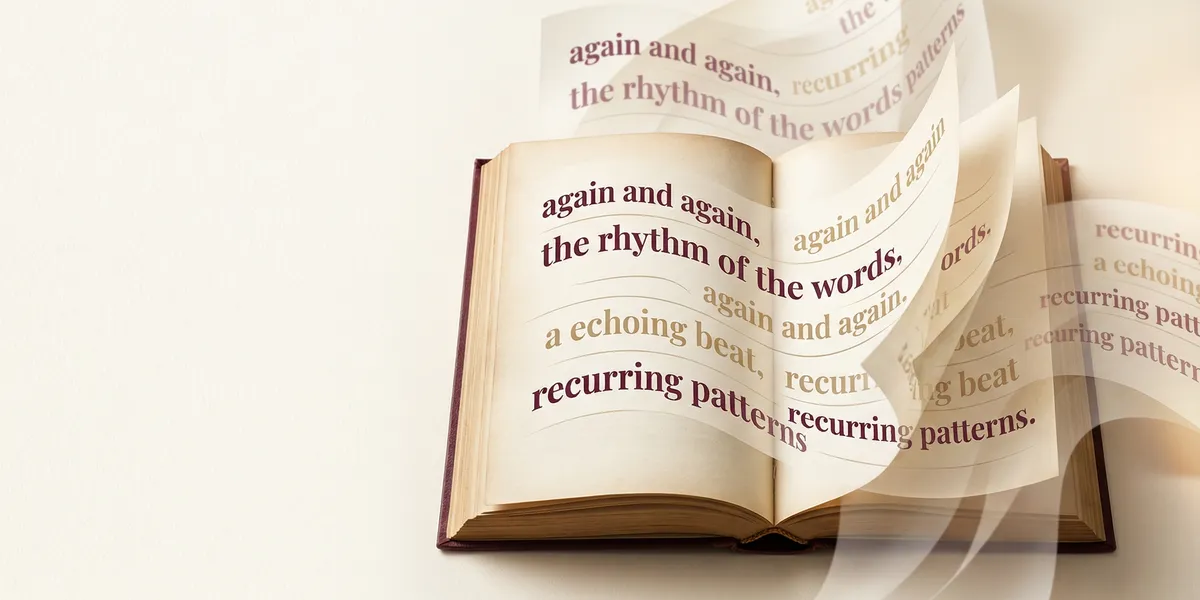
Yes, repetition is a literary device. It involves deliberately reusing words, phrases, sounds, or structures to create emphasis, rhythm, or emotional impact in writing. Repetition is one of the oldest and most versatile tools in a writer’s arsenal, appearing in everything from Shakespeare’s plays to modern bestsellers.
In this guide, you’ll learn:
- The 12 most common types of repetition (with examples)
- Why repetition works so well in both poetry and prose
- How to use repetition in your own writing without overdoing it
Here’s everything you need to know.
What Is Repetition in Literature?
Repetition is a literary device where a writer intentionally repeats words, phrases, sentences, or structural patterns for effect. It’s not accidental reuse or sloppy editing. It’s a deliberate choice.
You’ll find repetition across every genre and form of writing. Poets use it to build rhythm and musicality. Novelists use it to hammer home themes. Speechwriters use it to make ideas stick in the audience’s memory.
What makes repetition special is its range. It’s not a single technique but an entire family of related devices, each with a different name and purpose.
12 Types of Repetition in Literature
Repetition comes in many forms. Here are the 12 most important types you should know, organized by where and how the repetition occurs.
1. Anaphora (Repeating the Beginning)
Anaphora repeats the same word or phrase at the beginning of consecutive clauses or sentences.
Martin Luther King Jr.’s “I Have a Dream” speech is the most famous example. The phrase “I have a dream” begins eight consecutive sentences, building emotional intensity with each repetition.
In fiction, Charles Dickens opens A Tale of Two Cities with anaphora: “It was the best of times, it was the worst of times, it was the age of wisdom, it was the age of foolishness…“
2. Epistrophe (Repeating the End)
Epistrophe is the opposite of anaphora. It repeats words at the end of consecutive clauses.
Abraham Lincoln used epistrophe in the Gettysburg Address: “…government of the people, by the people, for the people.” The repeated “the people” drives home who government should serve.
3. Epizeuxis (Immediate Repetition)
Epizeuxis repeats a word or phrase immediately, with no words in between.
Edgar Allan Poe’s raven croaking “Nevermore, nevermore” is a classic example. In Shakespeare’s King Lear, the devastating line “Never, never, never, never, never” uses epizeuxis to convey absolute despair.
4. Diacope (Repetition With Words Between)
Diacope repeats a word or phrase with a small number of intervening words.
Shakespeare’s “To be, or not to be” is diacope. So is the Star Wars line: “Do, or do not. There is no try.” The interruption between the repeated words creates contrast and emphasis.
5. Anadiplosis (End-to-Beginning Chain)
Anadiplosis takes the last word of one clause and makes it the first word of the next.
Yoda’s dialogue often uses this pattern. A literary example: “Fear leads to anger. Anger leads to hate. Hate leads to suffering.” Each repetition links ideas into an unbreakable chain of cause and effect.
6. Antanaclasis (Same Word, Different Meaning)
Antanaclasis repeats a word but shifts its meaning each time.
Benjamin Franklin’s famous line demonstrates this: “Your argument is sound, nothing but sound.” The first “sound” means solid or valid. The second means noise — empty air. It’s repetition as wordplay.
7. Polyptoton (Same Root, Different Form)
Polyptoton repeats words that share the same root but appear in different grammatical forms.
Shakespeare used this constantly. “Let me not to the marriage of true minds / Admit impediments” — where related forms of words echo throughout the sonnets. Another example: “The Greeks destroyed the destroyer of their peace.”
8. Alliteration (Repeated Initial Sounds)
Alliteration repeats the same consonant sound at the beginning of nearby words.
“Peter Piper picked a peck of pickled peppers” is the textbook example. In literature, you’ll find it in everything from Beowulf to modern novels. It creates a musical quality that makes prose more memorable.
9. Assonance (Repeated Vowel Sounds)
Assonance repeats vowel sounds within nearby words, regardless of where those sounds appear.
Edgar Allan Poe was a master of assonance. In “The Bells,” the repeated long “e” sounds in “hear the mellow wedding bells” create a ringing, musical effect that mirrors the subject.
10. Consonance (Repeated Consonant Sounds)
Consonance repeats consonant sounds anywhere within nearby words, not just at the beginning.
Emily Dickinson used consonance extensively. The repeated “s” and “t” sounds in her poetry create a hushed, whispering quality. Consonance works more subtly than alliteration, shaping mood without calling attention to itself.
11. Refrain (Repeated Lines in Poetry or Song)
A refrain is a line or group of lines repeated at regular intervals, usually at the end of a stanza.
Poe’s “The Raven” uses “Nevermore” as a refrain. In songs, the chorus functions as a refrain. In literature, refrains create a sense of inevitability — the reader knows the line is coming, and that anticipation builds emotional weight.
12. Polysyndeton (Repeated Conjunctions)
Polysyndeton deliberately repeats conjunctions (and, or, but) more than grammar requires.
Ernest Hemingway favored this technique: “He ate and drank and talked and laughed.” The repeated “and” slows the pace and gives each action equal weight. It creates a breathless, accumulating effect.
Why Do Writers Use Repetition?
Repetition isn’t filler. When used intentionally, it serves four core purposes in writing.
Emphasis. Repeating a word or phrase tells your reader: “This matters.” When King repeats “I have a dream,” you don’t forget the central vision of his speech. Repetition is the literary equivalent of underlining.
Rhythm and musicality. Poetry and prose both benefit from patterns of sound. Repetition creates a beat that pulls readers forward. It transforms ordinary sentences into something closer to music.
Emotional intensification. Each repetition adds weight. The first time you read a phrase, you notice it. The second time, you feel it. By the third, it’s embedded in your emotional response. This is why repetition appears so often in speeches, prayers, and love poetry.
Unity and cohesion. Repetition ties sections of a work together. A motif — a recurring image, phrase, or idea — uses repetition to build thematic connections across an entire novel or poem.
How to Use Repetition in Your Writing
Repetition is powerful, but it’s easy to misuse. Here’s how to deploy it effectively.
Be intentional. Every repetition should serve a purpose. Ask yourself: am I repeating this for emphasis, rhythm, or emotional effect? If you can’t answer that question, cut the repetition.
Vary the type. Don’t rely on just one form. Mix anaphora with imagery, pair diacope with consonance. The richest writing layers multiple types of repetition.
Follow the rule of three. Three repetitions hit the sweet spot. One is a statement. Two is a coincidence. Three is a pattern. More than three risks losing your reader’s attention.
Use it at key moments. Reserve repetition for your most important ideas, turning points, and emotional climaxes. If you repeat everything, nothing stands out.
Read it aloud. Repetition lives in the ear as much as on the page. If a passage sounds musical when you read it out loud, your repetition is working. If it sounds clunky or redundant, revise.
Repetition vs. Redundancy: What’s the Difference?
Writers often confuse repetition with redundancy. They’re not the same thing.
Repetition is a deliberate choice that adds meaning, emphasis, or rhythm. Each repeated element serves the writing.
Redundancy is accidental reuse that adds nothing. Saying “She nodded her head” is redundant because nodding already means moving your head. Saying “free gift” is redundant because gifts are, by definition, free.
The test is simple: does the repetition add something the reader wouldn’t get without it? If yes, it’s rhetoric. If no, it’s a draft that needs editing.
Repetition in Poetry vs. Prose
Repetition works differently depending on the form.
In poetry, repetition is structural. Refrains, rhyme schemes, and metrical patterns all rely on repetition. Poets use sound repetition (alliteration, assonance, consonance) to create musicality. They use anaphora and epistrophe to build cadence across stanzas. Repetition in poetry is expected and celebrated.
In prose, repetition is more surgical. Novelists use it sparingly for key moments — a character’s catchphrase, a thematic motif, or a structurally parallel sentence at a turning point. Too much repetition in prose feels amateurish. The right amount feels deliberate and powerful.
The key difference is density. Poetry tolerates (and rewards) far more repetition per line than prose does.
Repetition in Speeches and Rhetoric
Some of the most famous lines in history rely on repetition as a rhetorical device.
Winston Churchill’s “We shall fight on the beaches” speech uses anaphora relentlessly. The repeated “we shall fight” creates an unbreakable rhythm of defiance. By the time he reaches the final clause, the audience feels the resolve in their bones.
In persuasive writing, repetition works because of a cognitive principle called the illusory truth effect. Research in psychology shows that people are more likely to believe statements they’ve encountered multiple times. Repeating your key message doesn’t just emphasize it — it makes it feel true.
This is why advertisers use slogans, teachers repeat key concepts, and politicians hammer talking points. Repetition changes how your brain processes information.
Common Mistakes to Avoid
- Accidental repetition. Reusing the same word because you can’t think of a synonym isn’t a literary device — it’s a first draft. Always distinguish between intentional repetition and lazy writing.
- Overusing the same type. If every paragraph starts with the same word (anaphora everywhere), the effect dulls quickly. Vary your techniques.
- Repeating weak words. Repeating “very” or “really” adds nothing. Repeat vivid, meaningful words that deserve the emphasis.
- Ignoring context. Repetition in a speech works differently than repetition in a novel. Match your technique to the form and audience.
- Missing the rhythm. Repetition should create a pattern your reader can feel. If the spacing or structure is off, the repetition falls flat instead of building momentum.
Is Repetition the Same as a Motif?
A motif is a specific type of repetition — a recurring element (image, phrase, idea, or symbol) that appears throughout an entire work to reinforce a theme.
Repetition is the broader technique. A motif is repetition applied at the structural level of a full story or poem. The green light in The Great Gatsby is a motif. Repeating “so it goes” in Slaughterhouse-Five is both a motif and a refrain.
Think of it this way: all motifs use repetition, but not all repetition is a motif.
What Is the Difference Between Repetition and Parallelism?
Repetition reuses the same words or sounds. Parallelism reuses the same grammatical structure, even with different words.
“I came, I saw, I conquered” uses both. The repeated “I” is anaphora (repetition). The repeated subject-verb structure is parallelism. The two devices often work together, but they’re not the same thing.
You can have parallelism without repetition: “She loved the mountain, he preferred the sea.” The structure is parallel, but no words repeat.
FAQ
Is repetition a figurative language technique?
Repetition is a literary and rhetorical device, but it is not technically figurative language. Figurative language uses words in non-literal ways (like metaphors and similes). Repetition uses literal words — it just uses them more than once for effect. However, many figurative language lists include repetition because the categories overlap in practice.
What is the most common type of repetition in literature?
The most common type of repetition in literature is anaphora — repeating a word or phrase at the beginning of consecutive lines or sentences. Anaphora appears in poetry, prose, speeches, and religious texts across every culture and time period. It’s the most recognizable and widely taught form of repetition.
Can you use too much repetition in writing?
Yes, you can absolutely use too much repetition. Excessive repetition becomes monotonous and signals weak writing rather than deliberate craft. The key is intentionality — every repeated element should serve a clear purpose like emphasis, rhythm, or emotional effect. If a repetition doesn’t add something the reader needs, cut it.
What is the effect of repetition on the reader?
Repetition creates emphasis, rhythm, and emotional resonance for the reader. Psychologically, repeated exposure to a phrase increases its memorability and perceived importance. In poetry, repetition produces a musical quality. In persuasive writing, it reinforces key arguments. The cumulative effect is that repeated words and phrases feel more significant and true than words used only once.