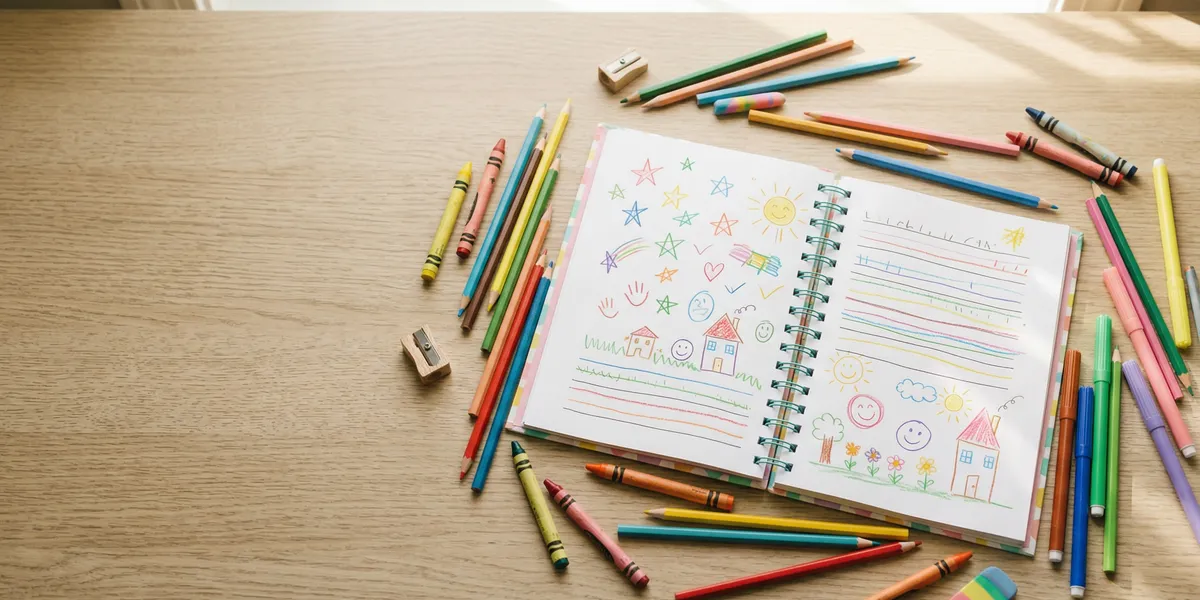
Yes, kids can journal — and they should. Journal prompts for kids build writing confidence, sharpen emotional awareness, and give children a safe space to explore their thoughts. This guide gives you 75 age-appropriate prompts organized by group, plus practical tips for making journaling stick.
Research from Scholastic shows that journaling helps children ages 4 through 14 develop stronger writing skills, process emotions, and build self-awareness. A study on journal writing in classrooms found that it serves as a reliable outlet for assessing, reflecting, and processing emotions — benefits that matter even more for younger writers still learning to name what they feel.
Why Journaling Matters for Kids
Before jumping into the prompts, here is what the research says about why this habit is worth building early.
Writing skills grow faster with low-stakes practice. Edutopia reports that ungraded journal writing builds language fluency, increases writing stamina, and helps children develop their own voice. Unlike school assignments with rubrics and red marks, a journal is a pressure-free zone where kids can experiment.
Emotional intelligence develops on the page. When children write about their feelings, they learn to identify and label emotions rather than just reacting to them. Let’s Grow Pediatrics notes that journaling gives kids a structured way to express thoughts and feelings, which builds the self-regulation skills they need as they grow.
Creativity gets a workout. Imaginative prompts push kids to think beyond the obvious. Writing a story about a talking animal or inventing a new holiday exercises the same creative muscles they will use in problem-solving, art, and storytelling later in life.
You do not need a special notebook or a set schedule to start. Five minutes with one good prompt is enough.
Journal Prompts for Early Writers (Ages 5–7)
At this age, journaling might mean a sentence and a drawing — and that counts. Keep prompts short, concrete, and connected to their world.
- Draw your favorite animal. Write one sentence about why you like it.
- What did you eat for breakfast? Was it yummy or yucky?
- If you could have any superpower, what would it be?
- Draw a picture of your family. Write everyone’s name.
- What is your favorite thing to do outside?
- If your stuffed animal could talk, what would it say?
- What makes you feel happy?
- Draw your dream bedroom. What is in it?
- What is your favorite color? Name three things that are that color.
- If you could be any animal for a day, which one would you pick?
- What is the best thing that happened today?
- Draw a monster. Is it friendly or scary? Give it a name.
- What is your favorite book? What do you like about it?
- If you could eat only one food forever, what would you choose?
- What do you want to be when you grow up? Draw a picture of yourself doing that job.
Tip for parents: At this age, let kids draw first and write after. Drawing lowers the barrier to entry. If they can only write a few words, that is a win — have them dictate the rest while you write it down.
Journal Prompts for Growing Writers (Ages 8–9)
Eight and nine year olds are ready for slightly more complex prompts. They can write a few sentences and are starting to form opinions about the world.
- Describe your best friend without saying their name. Could someone guess who it is?
- If you found a treasure chest in your backyard, what would be inside?
- Write about a time you felt really proud of yourself.
- What is the most interesting thing you learned this week?
- If you could invent a new holiday, what would it celebrate and how?
- What is something you are good at that most people do not know about?
- Write a letter to your future self. What do you want 20-year-old you to know?
- If you could visit any place in the world, where would you go and why?
- Describe your perfect day from morning to night.
- What is the bravest thing you have ever done?
- If animals could go to school, what subjects would they study?
- What would you do if you were invisible for a day?
- Write about someone who is kind to you. What do they do that makes you feel good?
- If you could make one rule that everyone in the world had to follow, what would it be?
- What is something that scares you? What helps you feel less afraid?
Tip for parents: Do not correct spelling or grammar in journal entries. The point is expression, not perfection. You can work on mechanics during schoolwork — the journal stays judgment-free.
Journal Prompts for Confident Writers (Ages 10–12)
Preteens are developing self-awareness and abstract thinking. These prompts tap into that by asking them to reflect, analyze, and imagine at a deeper level.
Self-Reflection Prompts
- What three words would your friends use to describe you? Do you agree with them?
- Write about a mistake you made and what you learned from it.
- What is something you have changed your mind about recently?
- If you could give advice to a younger kid starting at your school, what would you say?
- What is one thing about yourself you would never want to change?
- Describe a moment when you felt like you did not fit in. How did you handle it?
- What does “being brave” mean to you? Give an example from your own life.
- Write about a time you had to make a hard choice. What did you decide and why?
- What are you most grateful for right now? Be specific.
- If you could have a conversation with anyone — alive, historical, or fictional — who would it be and what would you ask?
Creative and Imaginative Prompts
- You wake up and discover you are the main character in your favorite book. What happens next?
- Write the opening paragraph of a mystery story set in your school.
- Invent a new sport. Explain the rules, equipment, and how to win.
- You find a door in your house that was never there before. Where does it lead?
- Write a story where the villain turns out to be the hero.
- Describe a world where kids are in charge and adults go to school.
- If you could design a robot to help with one part of your life, what would it do?
- Write a news report from the year 2100. What is the headline?
- You receive a mysterious package with no return address. What is inside? What do you do with it?
- Create a character who has a completely useless superpower. Write a short story about their day.
Opinion and Critical Thinking Prompts
- Should kids have homework? Make your case with at least three reasons.
- What is one thing you wish adults understood about being a kid?
- If you could change one thing about your school, what would it be and why?
- Is it better to be really good at one thing or pretty good at many things? Explain your answer.
- What makes a good leader? Think of someone you consider a leader and explain why.
- Should every kid learn to code? Why or why not?
- What is the difference between being nice and being kind? Are they the same thing?
- If you had $1,000 to donate to any cause, where would the money go?
- Do you think social media is good or bad for kids your age? Give your honest opinion.
- Write a persuasive paragraph convincing your parent to let you do something they have said no to.
Themed Journal Prompts for Any Age
These work across age groups. Adjust the complexity of your expectations based on the child’s age.
Gratitude Prompts
- Name three things you are thankful for that do not cost money.
- Write about a person who made your day better this week.
- What is one thing about your home that you love?
- Describe a meal you are grateful for. Who made it?
- What is something in nature that you appreciate?
Seasonal and Holiday Prompts
- What is your favorite thing about the current season? What do you wish you could change about it?
- If you could create a new tradition for your family, what would it be?
- Write about your favorite holiday memory.
- Design your perfect snow day (or summer day). What do you do from start to finish?
- If you could celebrate your birthday anywhere in the world, where would it be?
Feelings and Emotions Prompts
- Draw or describe what anger looks like to you. What about calm?
- Write about a time you felt really nervous. What happened?
- What do you do when you feel sad? Does it help?
- Describe your happiest memory in as much detail as you can.
- If your feelings had colors, what color would you feel right now and why?
How to Make Journaling a Habit for Kids
Having prompts is only half the equation. Here is how to help kids actually stick with journaling.
Start small. Five minutes is plenty. A single sentence counts for younger children. The goal is consistency, not volume.
Let them choose. Offer two or three prompts and let the child pick. Autonomy increases engagement — nobody wants to be told exactly what to write about every single time.
Write alongside them. Kids mirror what they see. If you journal for five minutes while they journal, the habit feels normal rather than like an assignment. Good2Know Network’s research on classroom journaling confirms that modeling the behavior is one of the most effective ways to get kids writing.
Never grade or critique entries. The journal is not a school assignment. Do not correct spelling. Do not ask them to rewrite a sentence. The moment journaling feels like work, kids stop doing it.
Try different formats. Some kids prefer writing. Others prefer drawing with captions, bullet-point lists, or even comic strips. Brightwheel’s early childhood research shows that even scribbling and drawing in a journal builds literacy foundations for very young children. Let the format flex to match the child.
Celebrate the habit, not the content. Praise showing up, not writing quality. “You’ve journaled five days in a row” matters more than “That was a great sentence.”
Common Mistakes to Avoid
- Forcing a daily schedule too early. Start with two or three times per week. Daily journaling is a goal, not a starting point.
- Reading their journal without permission. Trust is everything. If kids think someone is reading their private thoughts, they will either stop writing or start censoring themselves.
- Correcting grammar and spelling. Save the editing lessons for schoolwork. Journal time is creative time.
- Choosing prompts that are too abstract for the age. A five year old cannot write about “the meaning of courage.” Match the prompt to the developmental stage.
- Making it competitive. Avoid comparing siblings’ journals or praising one child’s writing over another’s.
Turning Journal Entries Into Bigger Projects
Once a child is journaling regularly, those entries can become the raw material for something bigger.
A collection of short stories, a personal essay, or even a self-published book can grow from journal pages. Kids who journal regularly already have dozens of story seeds, character ideas, and personal reflections to draw from.
If your child has been journaling consistently and wants to take their writing further, tools like Chapter can help them organize their ideas into a structured book project. It is designed to guide writers through the process from outline to finished manuscript — and it works just as well for a twelve year old with a folder full of journal stories as it does for an adult author.
For more creative writing starters, check out our 300 writing prompts collection or explore fun journal prompts for all ages. If your child is interested in writing stories, our guide on how to come up with story ideas walks through techniques that work for writers of any age. And if they are ready to take the leap into a bigger project, how to write a children’s book breaks down the full process.
FAQ
What age should kids start journaling?
Kids can start journaling as early as age four or five. At that stage, journaling looks like drawing pictures with a few words or dictated sentences. By age seven or eight, most children can write short entries independently. There is no wrong age to start — adapt the format to match their skills.
How long should a child journal each day?
Five to ten minutes is the sweet spot for most kids. Younger children (ages 5-7) may only last three to five minutes, which is perfectly fine. The goal is building a regular habit, not hitting a word count. According to Mental Health Center Kids, even brief daily journaling sessions support emotional development and self-reflection.
Should parents read their child’s journal?
Generally, no. Respecting a child’s privacy builds trust and encourages honest writing. If you are concerned about your child’s wellbeing, have a direct conversation rather than reading their journal behind their back. For younger children, shared journaling sessions where you write together work better than reviewing entries later.
What if my child says they hate writing?
Start with drawing prompts, comic strips, or bullet-point lists. Not all journaling has to be traditional prose. Some kids respond better to structured formats like “three things I liked today” rather than open-ended writing. The key is removing pressure and making the experience feel like play rather than homework.
Can journaling help with anxiety in children?
Research supports this. Scholastic’s parent resources highlight that journaling gives children a tool for processing worry and stress. Writing about fears and anxieties helps kids externalize those feelings rather than ruminating on them. Gratitude prompts in particular can shift focus toward positive experiences.