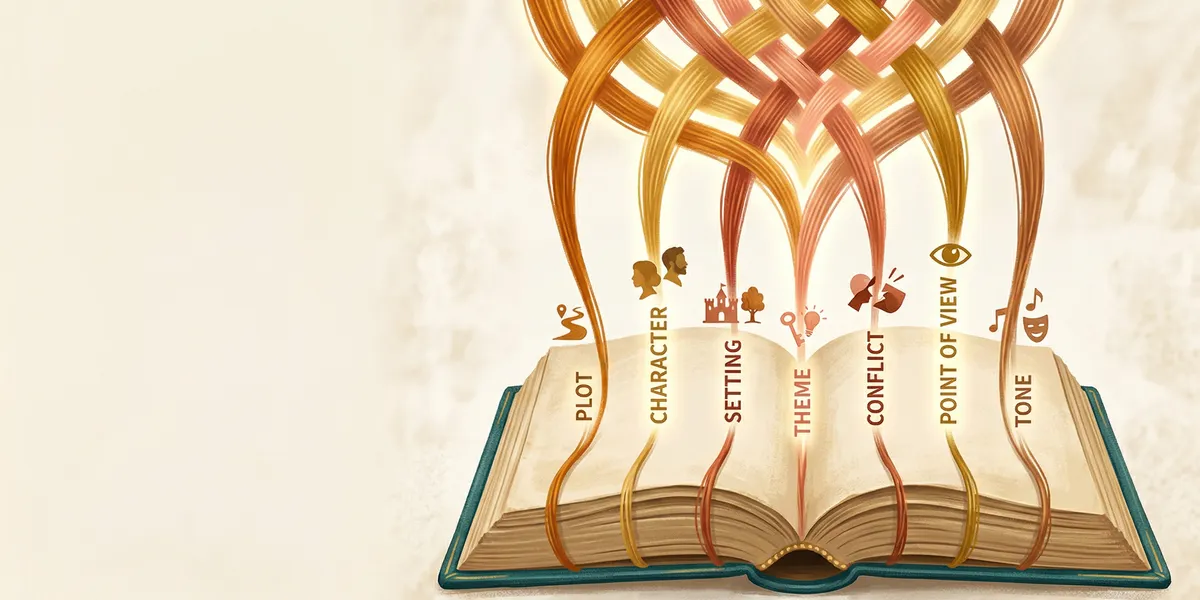
A literary element is a structural building block that every story must contain. Plot, character, setting, theme, conflict, point of view, and tone are not optional techniques you choose to add. They are the foundation of narrative itself.
In this guide, you’ll learn:
- What each of the 7 core literary elements actually does in a story
- How to strengthen each element in your own writing
- The difference between literary elements and literary devices
- A practical framework for diagnosing weak spots in your draft
Here is how to use every literary element with intention.
What Is a Literary Element?
A literary element is a required structural component that exists in every work of narrative fiction or nonfiction. Remove any one of them and the story stops functioning.
Think of it this way: if your story were a house, literary elements would be the walls, roof, and foundation. Literary devices — metaphor, foreshadowing, irony — are the paint, furniture, and decorations. You can strip those out and still have a house. Remove the walls, and the building collapses.
Every novel, short story, memoir, and screenplay contains the same seven core elements. What separates a good story from a forgettable one is not which elements it uses, but how well you use them.
The 7 Core Literary Elements
Here is a quick reference before we dig into each one.
| Literary Element | What It Does | Key Question It Answers |
|---|---|---|
| Plot | Structures the sequence of events | What happens? |
| Character | Provides the people driving the story | Who is this about? |
| Setting | Establishes time, place, and atmosphere | Where and when does this take place? |
| Theme | Communicates the deeper meaning | What is this story really about? |
| Conflict | Creates tension and stakes | What stands in the way? |
| Point of View | Determines who tells the story | Whose perspective are you in? |
| Tone | Sets the emotional register | How does this story feel? |
How to Use Plot Effectively
Plot is the sequence of events that moves your story from beginning to end. It is the backbone of your narrative — the thing that keeps your reader turning pages.
Most plots follow a five-part structure: exposition, rising action, climax, falling action, and resolution (also called denouement).
Practical tips for stronger plot
Start with a disruption. Your reader does not need three pages of “normal life” before something happens. Open with the moment things change.
Give every scene a purpose. Ask yourself: does this scene move the plot forward, reveal character, or raise stakes? If the answer is none of those, cut it.
Plant and pay off. The best plots weave setups early that pay off later. A gun mentioned in chapter two should matter by chapter ten. This is Chekhov’s Gun in practice.
If you are writing a book and your middle feels sluggish, the problem is almost always plot. Your character needs a clearer obstacle, a tighter deadline, or higher stakes.
How to Build Compelling Characters
A character is any person, creature, or entity that participates in the story’s action. Strong characters are the single biggest factor in whether a reader stays engaged.
The three-question framework
Before writing any character, answer three questions:
- Who is this person? — their background, personality, and role
- What do they want? — their external goal (a specific, concrete desire)
- What do they need? — their internal need (often something they do not realize yet)
The gap between want and need is where character arcs live. A detective wants to solve the case. They need to forgive themselves for a past failure. That tension makes the character human.
Character depth checklist
- Does your character have at least one flaw that affects the plot?
- Can you describe their voice in one sentence? (If everyone sounds the same, you have a voice problem.)
- Do they change by the end of the story? Static characters work in supporting roles, but your protagonist needs an arc.
- What is their motivation in every scene?
The fastest way to tell if your characters are working: cover up the dialogue tags. If you cannot tell who is speaking, your characters are not distinct enough.
How to Use Setting as More Than a Backdrop
Setting is the time, place, and environment where your story unfolds. But the best writers treat setting as an active element — not just a stage.
Three layers of setting
Setting operates on three interconnected levels:
- Temporal — When does the story take place? Historical period, season, time of day. These affect everything from dialogue to social norms.
- Environmental — Where does the story happen? A cramped apartment feels different from an open prairie. Geography shapes behavior.
- Individual — How does your character relate to this place? The same city can feel like home to one character and a prison to another.
Make setting do double duty
Your setting should reinforce your theme or conflict, not just provide decoration. A story about isolation hits harder when set in a remote farmhouse than in a bustling city. A story about social pressure gains tension from a claustrophobic small town.
Ask yourself: if I moved this scene to a completely different location, would anything change? If the answer is no, your setting is not working hard enough.
How to Develop Theme Without Preaching
Theme is the central idea or message your story explores. It is the answer to the question every reader subconsciously asks: what is this really about?
Theme is not a moral lesson or a bumper sticker. “Revenge is bad” is not a theme. “The cost of pursuing revenge on the people you love” is closer — because it invites exploration rather than demanding agreement.
How to find your theme
Many writers — including Neil Gaiman — recommend discovering theme through writing rather than imposing it. Write your first draft, then ask: what keeps coming up? What are my characters arguing about? What question does this story keep circling?
Your theme will emerge from the collision between your character’s desire, their obstacle, and the choices they make.
How to weave theme into your story
- Through character choices. Every major decision your protagonist makes should connect to the thematic question.
- Through motif. Recurring images, phrases, or symbols that reinforce the central idea.
- Through contrast. Put characters with opposing views of the theme into direct conflict.
The mistake most writers make with theme: stating it directly. If a character delivers a speech that summarizes the moral of your story, you have stopped showing and started telling. Trust your reader to understand what the story means.
How to Create Conflict That Drives the Story
Conflict is the central problem or tension that prevents your character from getting what they want. Without conflict, there is no story. A character who wants something and immediately gets it is not a narrative — it is a wish fulfillment.
The four types of conflict
| Conflict Type | Description | Example |
|---|---|---|
| Character vs. Character | Direct opposition between two people | A detective pursuing a criminal |
| Character vs. Self | Internal struggle | An addict fighting their own impulses |
| Character vs. Society | Fighting against systems or norms | A whistleblower challenging a corporation |
| Character vs. Nature | Battling the environment | Surviving a shipwreck |
Most strong novels layer multiple types of conflict. Your protagonist fights an external antagonist (character vs. character) while battling their own doubt (character vs. self). The external conflict tests them physically. The internal conflict forces them to grow.
Conflict escalation
Your conflict should escalate throughout the story, not stay at the same intensity. Each attempt your character makes to solve the problem should make things worse before they get better. This is what creates page-turning momentum.
If your draft feels flat, ask: where does my conflict level off? That is where you need to raise the stakes.
How to Choose the Right Point of View
Point of view determines who tells the story and how much the reader knows. This single choice shapes everything — from intimacy to information control.
Your main options
- First person (“I walked into the room”) — Maximum intimacy. You are inside one character’s head. The reader only knows what this character knows.
- Third person limited (“She walked into the room”) — Close but flexible. You follow one character’s perspective per scene but can switch between chapters.
- Third person omniscient (“They both walked into the room, each hiding a secret”) — The narrator knows everything. Useful for epic stories with large casts.
- Second person (“You walk into the room”) — Rare in fiction. Creates an unusual, immersive effect.
How to decide
Ask yourself two questions:
- How many characters’ thoughts does the reader need access to? If the answer is one, use first person or third limited. If it is many, use third omniscient.
- Is there information the reader should not know yet? First person and third limited let you control reveals naturally. Omniscient makes it harder to hide secrets without feeling manipulative.
The most common mistake: switching point of view mid-scene without a clear break. This is called head-hopping, and it disorients readers. Pick a perspective and commit to it within each scene.
How to Set the Right Tone
Tone is the emotional attitude your writing conveys. It is not what happens in the story — it is how the story feels to read. A dark comedy and a grim thriller can cover the same events with completely different tones.
Tone lives in your word choices, sentence rhythms, and narrative distance. Compare these two sentences describing the same event:
“The building collapsed at 3:47 PM, killing fourteen people.” — Detached, journalistic.
“The ground shuddered. Then the screaming started.” — Visceral, immediate.
Same event. Completely different tone and mood.
How to control tone
- Word choice. “Residence” feels formal. “Home” feels warm. “Dump” feels contemptuous. Choose words that match the feeling you want.
- Sentence length. Short sentences create tension and urgency. Longer, flowing sentences create contemplation or ease.
- Detail selection. What you choose to describe (and what you leave out) signals tone. Describing a character’s chipped nail polish tells a different story than describing their diamond bracelet.
Read your draft aloud. If the tone shifts unexpectedly — a comedic scene suddenly turns grim without narrative justification — you have a tone consistency problem.
Literary Elements vs. Literary Devices: What Is the Difference?
This is where many writers get confused. Literary elements are the structural components every story needs. Literary devices are optional techniques you use to enhance your storytelling.
| Category | Examples | Required? |
|---|---|---|
| Literary elements | Plot, character, setting, theme, conflict, POV, tone | Yes — every story has them |
| Literary devices | Metaphor, foreshadowing, symbolism, dramatic irony, allegory | No — optional techniques |
A story without foreshadowing can still work. A story without plot cannot. That is the difference.
Think of literary elements as the ingredients in a recipe (flour, eggs, butter — you need all of them) and literary devices as the spices (cinnamon, vanilla, cardamom — they enhance the flavor but the cake exists without them).
How to Diagnose Weak Literary Elements in Your Draft
If your story is not working and you cannot figure out why, run through this diagnostic checklist.
- Plot feels aimless? Your character’s goal is unclear, or there is no escalating conflict. Define what they want in one sentence.
- Characters feel flat? Check the three-question framework above. If you cannot answer all three questions for your protagonist, dig deeper.
- Setting feels generic? You are describing a place instead of evoking one. Add sensory details. Make the setting interact with the character.
- Theme feels preachy? You are telling instead of showing. Cut any passage where a character explicitly states the moral.
- Conflict feels low-stakes? Raise the consequences. What does your character lose if they fail?
- POV feels inconsistent? You are head-hopping. Lock into one perspective per scene.
- Tone feels off? Read it aloud. Circle any words or phrases that clash with the emotional register you want.
This checklist works whether you are writing your first short story or your tenth novel. The fundamentals do not change. Only your skill at executing them improves.
How Many Literary Elements Are There?
The number of literary elements depends on which framework you use. Most writing educators agree on seven core elements: plot, character, setting, theme, conflict, point of view, and tone. Some frameworks expand this to eight or nine by adding narrator as a separate element from point of view, or by including mood and style.
The exact count matters less than understanding what each element does. If your story has strong plot, vivid characters, grounded setting, resonant theme, compelling conflict, clear point of view, and consistent tone — you have covered the fundamentals.
Can You Have a Story Without One Literary Element?
Technically, experimental fiction has pushed against every convention. Some stories strip away plot (stream-of-consciousness narratives). Some eliminate setting (abstract dialogues). But these are deliberate artistic choices by writers who understand the rules before breaking them.
For most writers, all seven elements need to be present and working together. A story missing conflict is an anecdote. A story missing characters is a description. A story missing theme is entertainment without resonance.
What Is the Most Important Literary Element?
Character is the most important literary element for most readers. Research into reading psychology shows that readers engage with stories primarily through character identification. You can have a simple plot, a minimal setting, and a subtle theme — but if the reader cares about the character, they will keep reading.
That said, different genres weight elements differently. Thriller readers prioritize plot. Literary fiction readers prioritize theme and voice. Romance readers prioritize character relationships. Know your genre and lean into the element your readers value most.
FAQ
What is a literary element in simple terms?
A literary element is a fundamental building block of storytelling that every narrative must contain. The seven core literary elements are plot, character, setting, theme, conflict, point of view, and tone. Unlike literary devices (which are optional techniques), literary elements are required — remove one and the story stops functioning.
What is the difference between a literary element and a literary device?
The difference between a literary element and a literary device is that elements are required structural components (plot, character, setting) while devices are optional techniques (metaphor, foreshadowing, irony). Every story has literary elements. Not every story uses every literary device.
What are the 7 literary elements?
The 7 literary elements are plot (sequence of events), character (the people in the story), setting (time and place), theme (central message), conflict (the central problem), point of view (who tells the story), and tone (the emotional attitude of the writing). Together, they form the complete structural foundation of any narrative.
How do you identify literary elements in a text?
To identify literary elements in a text, ask seven questions: What happens? (plot), Who is it about? (character), Where and when? (setting), What is it really about? (theme), What stands in the way? (conflict), Who is telling the story? (point of view), and How does it feel? (tone). Every text contains answers to all seven.
Why are literary elements important for writers?
Literary elements are important because they give you a diagnostic framework for your own writing. When a story is not working, the problem is always traceable to one or more weak elements. Understanding them lets you pinpoint exactly what needs fixing — whether that is flat characters, unclear conflict, or inconsistent tone — instead of rewriting blindly.