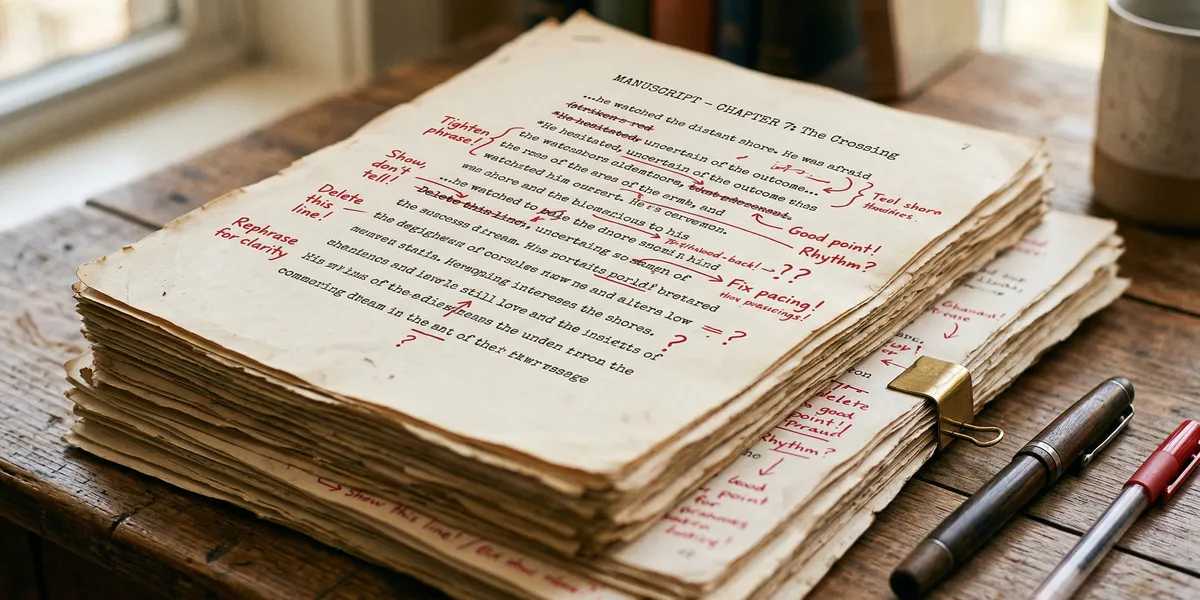
The manuscripts meaning in publishing is straightforward: a manuscript is the author’s original text before it becomes a finished, published book. It is the raw work — the draft that gets edited, formatted, designed, and eventually transformed into the product readers hold in their hands or download to their devices.
The word “manuscript” comes from the Latin manu scriptus, meaning “written by hand.” Centuries ago, that was literal. Monks copied texts by hand onto parchment. Today, the term applies to any unpublished work an author submits to an agent, publisher, or editor — regardless of whether it was typed in Word, written in Scrivener, or drafted with an AI writing tool.
Manuscript vs. published book
A manuscript is not a book. This distinction matters because authors — especially first-time authors — sometimes confuse the two.
| Feature | Manuscript | Published Book |
|---|---|---|
| Formatting | Double-spaced, standard font | Typeset with professional layout |
| Design | Plain text, no graphics | Cover, interior design, images |
| Status | In progress or submitted | Final product |
| Audience | Editors, agents, beta readers | General public |
| File format | .docx, .rtf, or .pdf | Print, ePub, MOBI, PDF |
| Page count | Higher (due to double-spacing) | Lower (typeset and trimmed) |
A 300-page manuscript typically becomes a 200-250 page published book after professional typesetting. The content is the same; the presentation changes completely.
Standard manuscript formatting
If you are submitting a manuscript to an agent or publisher, they expect a specific format. This convention exists so editors can estimate word count, make margin notes, and read comfortably.
The standard format includes:
- 12-point Times New Roman or Courier font
- Double-spaced lines throughout
- 1-inch margins on all sides
- Left-aligned text (not justified)
- Indented first line of each paragraph (0.5 inches)
- Page numbers in the header with author’s last name
- Title page with title, author name, word count, and contact information
These conventions come from the era of typewritten submissions, but publishers and literary agencies still expect them. The Shunn manuscript format is the most widely referenced standard for fiction submissions.
Nonfiction proposals follow a different structure: a proposal document (overview, chapter summaries, market analysis, author platform) plus two or three sample chapters in standard manuscript format.
Types of manuscripts
The term covers several categories depending on context.
Unsolicited manuscripts are submissions an author sends to a publisher or agent without being asked. Most publishers do not accept unsolicited manuscripts — they require submissions through literary agents.
Solicited manuscripts are specifically requested by a publisher, usually after reviewing a query letter or book proposal.
Complete manuscripts contain the full text of the work. Fiction submissions almost always require a complete manuscript before an agent will consider representation.
Partial manuscripts include the first few chapters (typically 50-100 pages) plus a synopsis. Some agents request partials for initial evaluation before asking for the full manuscript.
Revised manuscripts have been through at least one round of editing based on feedback from an editor, agent, or beta readers.
Digital manuscripts today
Modern manuscripts are almost entirely digital. Authors write in word processors, specialized writing software, or cloud-based tools and submit electronically.
Common manuscript tools:
- Microsoft Word — The industry standard for submissions. Agents and editors expect .docx files.
- Google Docs — Useful for collaboration but typically exported to .docx for submission.
- Scrivener — Popular with authors for organizing long works, then exporting to standard format.
- Chapter — AI-assisted writing platform that handles manuscript creation through publication, including formatting and export to all major publishing platforms.
The shift to digital manuscripts has changed the publishing workflow significantly. Track changes, commenting, and cloud storage make collaboration between authors and editors faster than the old system of mailing physical pages back and forth.
When people say “manuscript”
In everyday publishing conversation, “manuscript” usually refers to the book-length work an author is writing or has completed but not yet published. When someone says “I am working on my manuscript,” they mean they are writing a book.
In academic and historical contexts, “manuscript” can also refer to handwritten documents of historical significance — illuminated manuscripts from medieval Europe, the Dead Sea Scrolls, original drafts of literary works held in archives.
For modern authors, the practical meaning is simple: your manuscript is your book before it becomes a book. It is the working document that carries your ideas from first draft to finished product.