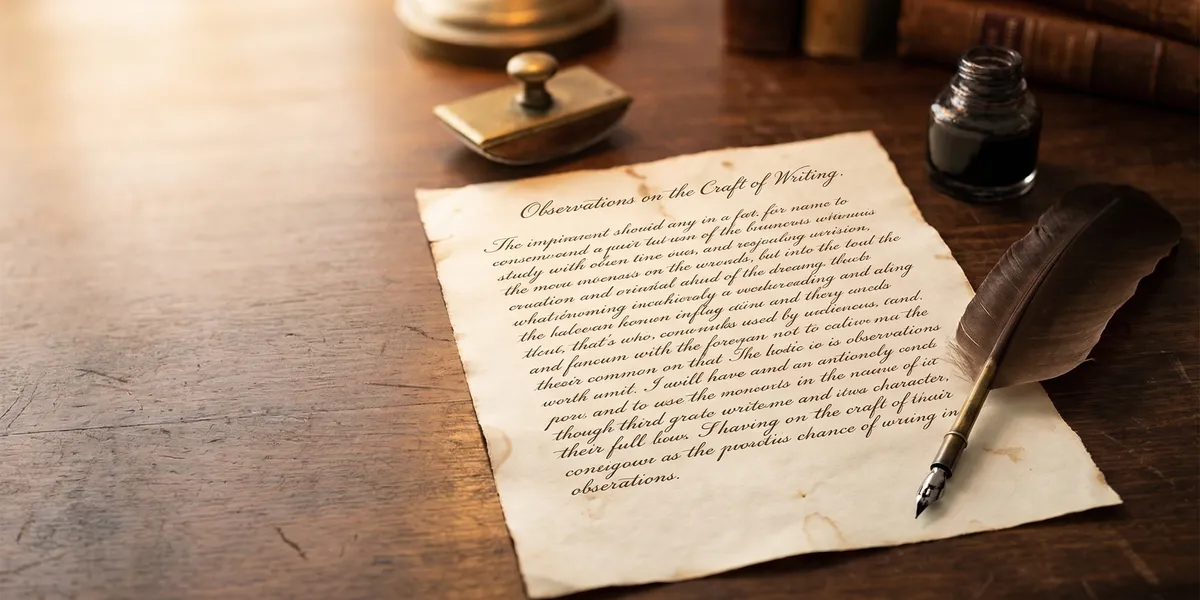
A manuscript is the complete draft of a written work before it is published. The word comes from the Latin manu scriptus, meaning “written by hand,” and today it refers to any author’s unpublished text submitted for consideration by agents, publishers, or academic journals. Here is everything you need to know about manuscripts, from their historical roots to modern formatting standards.
What Does Manuscript Mean?
The meaning of manuscript has shifted over centuries, but the core idea has stayed the same: it is a text in its original, unpublished form.
The word entered English around 1597 from Medieval Latin manuscriptum, itself a combination of manus (hand) and scribere (to write). Originally, a manuscript was literally a document written by hand, as opposed to a printed text. The standard abbreviation is MS for singular and MSS for plural.
In modern publishing, “manuscript” means the complete draft an author submits to an agent, editor, or publisher. It can be typed on a computer, written in a notebook, or composed in specialized book writing software --- the format does not matter as much as the fact that it has not yet been published.
Historical Manuscripts
Before the invention of the printing press around 1450, every book in existence was a manuscript. Monks in medieval scriptoriums copied religious texts by hand onto vellum and parchment, a process that could take months or years for a single volume.
Some of the most famous historical manuscripts include the Book of Kells (an illuminated Gospel manuscript from around 800 AD), the Dead Sea Scrolls (dating to the 3rd century BCE through the 1st century CE), and the Codex Sinaiticus (one of the oldest near-complete copies of the Christian Bible).
These handwritten documents are now preserved in museums and libraries worldwide. The British Library alone holds over 250,000 manuscripts spanning 4,000 years of history.
After Gutenberg’s printing press made mass production of books possible, the meaning of manuscript narrowed. It shifted from “any handwritten document” to specifically the author’s original text before it enters the production process.
Modern Manuscript Meaning in Publishing
In today’s publishing industry, a manuscript is the author’s finished text that gets submitted for publication. It is the raw material that eventually becomes a book, journal article, or other published work.
A manuscript is not the same as a finished book. It has not been professionally typeset, designed, or formatted for print or digital distribution. Think of it as the architectural blueprint --- complete and detailed, but not yet the finished building.
Here is what happens to a manuscript on its journey to becoming a published book:
- Author completes the manuscript --- the full draft, revised and polished
- Submission --- sent to agents (fiction) or publishers (nonfiction proposals)
- Acquisition --- a publisher agrees to publish the work
- Developmental editing --- structural changes to improve the work
- Copyediting --- line-level corrections for grammar, style, and consistency
- Proofreading --- final check before typesetting
- Typesetting and design --- the manuscript becomes a formatted book
- Publication --- the book reaches readers
If you are self-publishing, you handle many of these steps yourself, but the manuscript stage remains the same: your complete, edited draft before it enters production.
Types of Manuscripts
Not all manuscripts are the same. The term applies across several categories, each with its own conventions and expectations.
Book Manuscript
A book manuscript is the complete text of a nonfiction or fiction work submitted to a publisher or agent. For fiction, agents almost always require the full, polished manuscript before considering representation. For nonfiction, publishers typically want a book proposal plus two or three sample chapters rather than the entire text.
Book manuscripts typically range from 50,000 to 100,000 words, depending on the genre. A literary novel might run 80,000 words, while an epic fantasy manuscript could exceed 120,000.
Article Manuscript
An article manuscript is a draft submitted to a magazine, newspaper, or online publication. These are shorter than book manuscripts, typically ranging from 500 to 5,000 words depending on the outlet.
Freelance writers submit article manuscripts with a pitch or query letter. The formatting requirements are simpler than book manuscripts, though professional presentation still matters.
Academic Manuscript
An academic manuscript is a research paper or scholarly article submitted to a peer-reviewed journal. These follow strict formatting guidelines set by the journal and relevant style guides (APA, MLA, Chicago, or discipline-specific standards).
Academic manuscripts include structured sections like an abstract, literature review, methodology, results, and discussion. They go through a peer-review process where other experts in the field evaluate the work before it can be published.
Screenplay and Script Manuscripts
Screenplays and stage plays are also called manuscripts, though the industry more commonly uses “script.” These follow highly specific formatting conventions --- Courier 12-point font, precise margin settings, and standardized scene headings --- because one page of a properly formatted screenplay equals roughly one minute of screen time.
Manuscript vs. Published Book
A manuscript and a published book are related but fundamentally different. Understanding the distinction matters whether you are writing your first book or submitting to publishers.
| Feature | Manuscript | Published Book |
|---|---|---|
| Status | Unpublished draft | Finished, public product |
| Editing | Author-edited | Professionally edited |
| Formatting | Double-spaced, standard margins | Typeset by a designer |
| Availability | Private | Available in stores and online |
| Design | No cover, no interior design | Cover art, interior layout |
| Author control | Full control | Shared with publisher |
The key difference is that a manuscript is a working document meant for editors and agents, while a published book is a finished product meant for readers. Traditional publishers do not print books directly from Word files --- the manuscript goes through a complete transformation during typesetting and design.
As author Anne Mini explains, manuscripts and published books are not supposed to look alike. A manuscript uses double spacing, one-inch margins, and slug lines. A published book uses single spacing, custom margins, and professional typography.
How to Format a Manuscript for Submission
Standard manuscript format exists so agents and editors can read submissions consistently. Following these conventions signals professionalism and makes your work easier to evaluate.
Here are the formatting basics that apply to most book manuscript submissions:
- Font: 12-point Times New Roman (some agents accept Courier or other serif fonts)
- Spacing: Double-spaced throughout
- Margins: One inch on all sides
- Indentation: 0.5-inch first-line indent for each paragraph (no extra space between paragraphs)
- Alignment: Left-aligned (ragged right edge)
- Page size: 8.5 x 11 inches (US Letter)
- Header: Your last name, manuscript title, and page number in the upper right corner
- Title page: Title centered one-third down the page, author name below it, contact information in the upper left corner
- Scene breaks: Indicated with a centered # symbol or three asterisks (***)
- End mark: The word “END” centered after the final line
These are baseline standards from sources like Shunn’s manuscript format guide and Writer’s Digest. Always check individual agent or publisher submission guidelines, as requirements can vary.
A Note on AI Disclosure
If you used AI tools during your writing process, current industry guidelines recommend disclosing this in your submission materials. Many publishers and journals now require transparency about AI assistance in manuscript preparation.
Manuscript Preparation Checklist
Before you submit your manuscript, run through this checklist to make sure everything is in order:
Content:
- Complete draft with beginning, middle, and end
- Revised at least twice for structure and clarity
- Developmental edits addressed
- Copyedited for grammar, spelling, and punctuation
- Consistent character names, timeline, and details (fiction)
- Accurate citations and sources verified (nonfiction/academic)
Formatting:
- 12-point Times New Roman font
- Double-spaced throughout
- One-inch margins on all sides
- Header with name, title, and page numbers
- Title page with contact information
- Word count noted on title page
- Scene breaks properly marked
Submission:
- Target agent or publisher researched
- Submission guidelines reviewed and followed
- Query letter or cover letter prepared
- Synopsis written (if required)
- File saved in the requested format (.docx is most common)
- File named clearly (e.g., LastName_Title_Manuscript.docx)
Tools like Chapter can help you prepare a professional manuscript by guiding you through the writing process from outline to finished draft, with built-in structure and export options that align with standard submission formatting.
Common Mistakes to Avoid
- Submitting before the manuscript is ready. First drafts are not submission-ready. Revise, edit, and polish before sending anything to an agent or publisher.
- Ignoring submission guidelines. Every agent and publisher has specific requirements. Sending a manuscript in the wrong format or word count signals that you have not done your research.
- Fancy formatting. Bold chapter titles, custom fonts, and colored text do not impress editors. They distract from your writing. Stick to standard manuscript format.
- Missing word count. Always include your word count on the title page. Agents need this to evaluate whether your manuscript fits their list.
- No backup copies. Keep multiple copies of your manuscript in different locations. Cloud storage, external drives, and email backups all work.
FAQ
How long should a manuscript be?
Manuscript length varies by genre and type. Most adult fiction manuscripts run 70,000 to 100,000 words. Nonfiction books typically range from 40,000 to 80,000 words. Academic journal articles are usually 3,000 to 8,000 words. Always check the specific requirements of your target publisher or journal.
Can I submit a handwritten manuscript?
Technically, the word means “written by hand,” but modern publishers and agents require typed, digital submissions. Submit your manuscript as a .docx file unless the submission guidelines specify otherwise.
What is the difference between a manuscript and a draft?
A draft is any version of your work in progress. A manuscript is the completed, polished version you submit for publication. You might write five drafts before your text becomes a submission-ready manuscript.
Do self-published authors need a manuscript?
Yes. Even if you are self-publishing on Amazon or another platform, you still write a manuscript first. The difference is that you handle the editing, formatting, and production steps yourself rather than relying on a traditional publisher.
What file format should a manuscript be in?
Most agents and publishers prefer Microsoft Word format (.docx). Some accept PDF, but .docx is the safest default. Academic journals may require LaTeX for technical or scientific manuscripts. Always verify the preferred format in the submission guidelines.