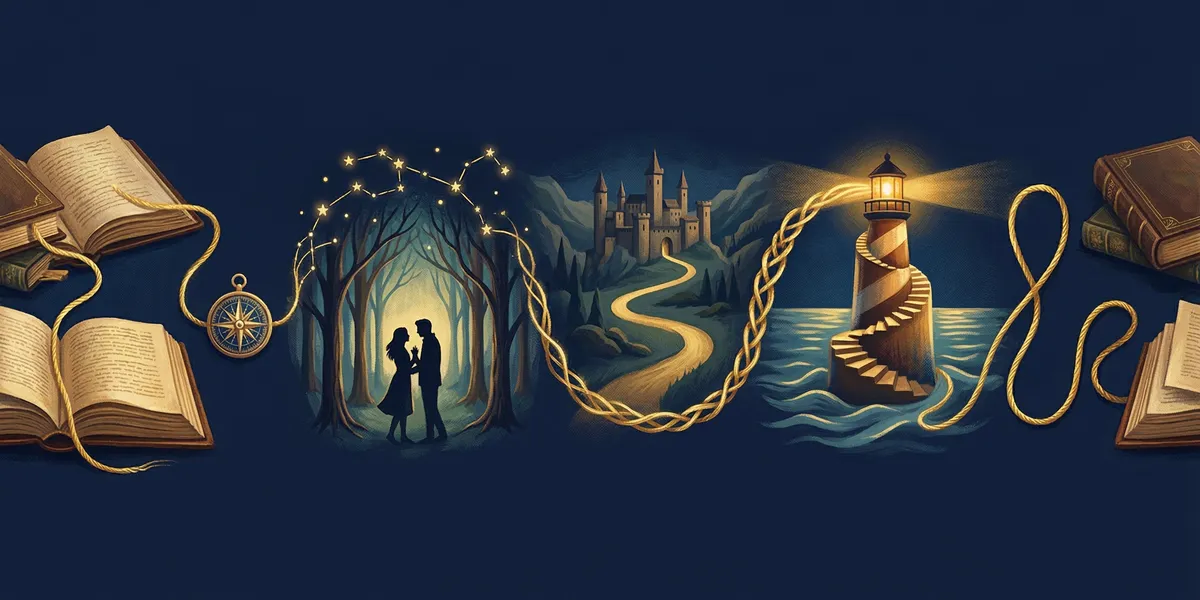
A motif is a recurring element in a story — an image, phrase, situation, or idea — that appears multiple times and reinforces the work’s theme. It is the pattern beneath the surface, the thread you follow through the tapestry of a novel or play until its repetition reveals meaning.
A motif is not the same as a symbol. A motif is not the same as a theme. It is the bridge between them — the recurring concrete element that connects individual moments to the story’s larger meaning.
Motif vs. symbol vs. theme
These three terms describe different layers of meaning, and they work together rather than independently.
Theme is the abstract idea. It is what the story means — the argument it makes about human experience. Example: guilt is inescapable.
Motif is the recurring element. It appears again and again throughout the narrative, each appearance building on the last. Example: blood that cannot be washed away.
Symbol is a single element that carries meaning in a specific moment. A symbol may appear once or many times. When a symbol recurs, it becomes a motif. Example: the blood on Lady Macbeth’s hands.
| Theme | Motif | Symbol | |
|---|---|---|---|
| What it is | An abstract idea | A recurring element | A meaningful object/image |
| How it works | Argued through plot/character | Built through repetition | Created through context |
| Example (Macbeth) | Guilt destroys the guilty | Blood appears throughout | The bloody dagger before Duncan’s murder |
A theme can be supported by multiple motifs. A motif can involve multiple symbols. They are nested layers, not interchangeable terms.
Examples of motifs in literature
Blood in Macbeth — Shakespeare
Blood appears more than forty times in Macbeth. It begins as literal blood — the blood of battle, then the blood of murder. It evolves into figurative blood — guilt that cannot be washed clean.
Macbeth says: “Will all great Neptune’s ocean wash this blood clean from my hand? No, this my hand will rather the multitudinous seas incarnadine, making the green one red.”
Lady Macbeth says: “Out, damned spot! Out, I say!”
The same motif, the same inability to remove blood, but the progression shows the theme deepening. Macbeth recognizes his guilt immediately and sees it as oceanic. Lady Macbeth, who initially dismissed the blood as something a little water would clear away, is eventually driven mad by it. The motif of blood tracks the theme of guilt across both characters’ arcs.
Eyes and sight in The Great Gatsby — Fitzgerald
The eyes of Doctor T.J. Eckleburg — a faded billboard — watch over the Valley of Ashes. Owl Eyes, the man who examines Gatsby’s books, sees through the illusion to the real. Nick Carraway is an observer, always watching. Gatsby watches the green light. Daisy’s eyes are described repeatedly.
The motif of eyes and seeing reinforces the theme of perception versus reality. Everyone in the novel is either watching, being watched, or failing to see clearly. The faded eyes on the billboard — commercial, empty, all-seeing and unseeing — become the novel’s visual signature because they distill the motif into a single, recurring image.
Water in Beloved — Toni Morrison
Water runs through Beloved in multiple forms. Sethe’s water breaks when Beloved arrives. The river separates slavery from freedom. Beloved emerges from water. Denver is born during a river crossing.
The motif of water connects birth, death, memory, and freedom — all central themes. Water is the boundary between states of being, and every time it appears, it marks a transformation.
Light and dark in Heart of Darkness — Joseph Conrad
The title itself announces the motif. But Conrad inverts expectations. The “dark” continent is not Africa — it is the darkness inside Kurtz, inside the colonial enterprise, inside civilization’s polished surface.
Light, supposedly representing civilization and progress, is repeatedly associated with deception and violence. Darkness, supposedly representing savagery, is associated with truth. The motif subverts its own conventional meaning, which is the novel’s central argument: what we call “light” is often the real darkness.
Doubles and mirrors in Strange Case of Dr Jekyll and Mr Hyde — Stevenson
The entire novel is built on doubling. Jekyll and Hyde are one person split in two. But the motif extends beyond the central pair. The story is told through multiple narrators, each providing a partial view. Doors have two sides. Faces show one expression while hiding another.
The recurring motif of duality reinforces the theme that the respectable self and the violent self are not opposites — they are aspects of the same person that Victorian society demanded be kept separate.
Seasons and decay in The Waste Land — T.S. Eliot
Eliot opens with “April is the cruellest month” — inverting the conventional association of spring with renewal. Throughout the poem, seasons fail to fulfill their promises. Spring does not bring rebirth. Water does not bring cleansing. The motif of failed seasonal cycles reinforces the theme of spiritual barrenness in the modern world.
How to use motifs in your writing
Identify your motifs after the first draft. Most motifs emerge organically. You will find that certain images, objects, or situations keep appearing without your conscious planning. The first draft reveals your instincts. The revision is where you sharpen them.
Go through your draft and mark every recurring element. Some will be accidents. Others will be motifs you were building without knowing it.
Vary the form of each appearance. A motif should evolve, not merely repeat. If your motif is water, let it appear as rain in one scene, a river in another, tears in a third, a glass of water in a fourth. Each form should carry a slightly different shade of the same meaning. Repetition with variation is the key — identical repetition becomes monotony.
Increase intensity over the arc. The first appearance of a motif can be subtle, almost invisible. The second should be noticeable. By the climax, it should be unmistakable. Blood in Macbeth begins on a battlefield (normal), moves to a king’s chamber (shocking), and ends in a sleepwalking scene (haunting). The escalation mirrors the story’s emotional arc.
Connect motifs to turning points. Plant your motif’s appearances at structurally important moments — at the inciting incident, the midpoint, the climax. When a motif appears at a turning point, it signals to the reader that this moment matters. It is a form of emphasis that does not require the writer to say “this is important.”
Do not overload. One or two strong motifs are more effective than five competing ones. Each motif requires screen time to build meaning through repetition. Too many motifs dilute each other. Choose the ones that most naturally reinforce your theme and commit to developing them fully.
Trust the reader. Do not explain your motif. If you write a scene where your character notices birds at every emotional turning point, you do not need a line that says “she realized the birds had been there at every important moment.” The reader is already tracking the pattern. Let them feel the satisfaction of recognizing it themselves.
For how individual moments of symbolism work, see symbolism in literature. For the abstract ideas that motifs reinforce, see theme in fiction. For a technique closely related to motif — planting elements that pay off later — see foreshadowing.