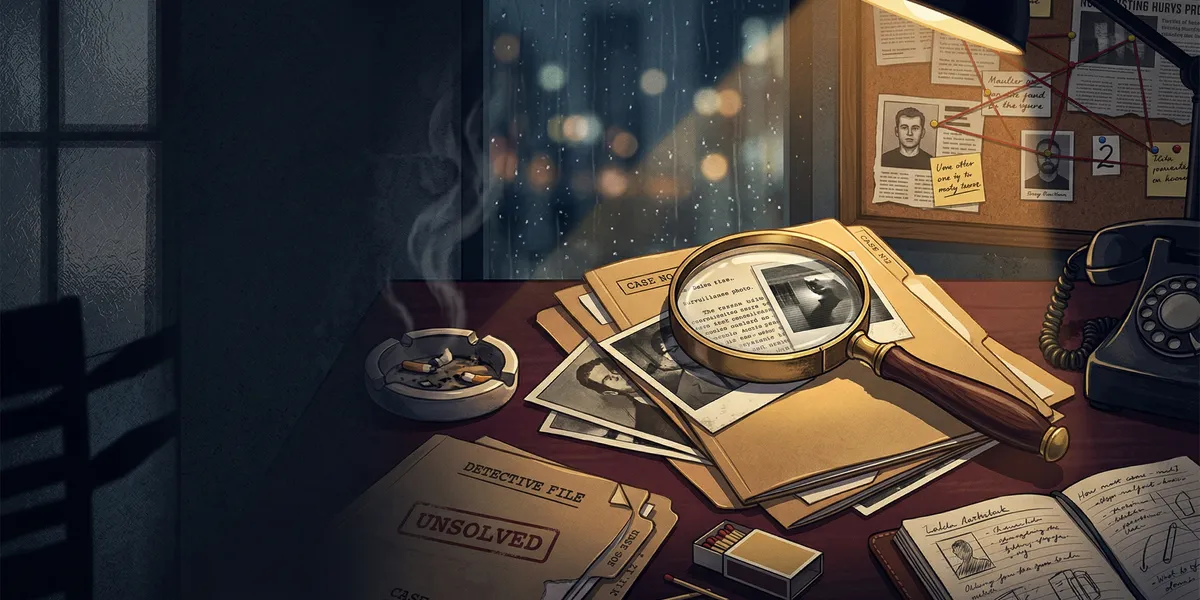
The mystery genre is fiction built around an unsolved crime — usually murder — where a protagonist investigates clues, interviews suspects, and pieces together the truth before the final reveal. It’s one of the oldest and most popular genres in publishing, commanding roughly 20% of all adult fiction sales in the United States.
In this guide, you’ll learn:
- Every major mystery subgenre and how they differ
- The essential elements that make a mystery work
- How to write your own mystery novel, step by step
- Which famous authors define the genre today
Here’s everything you need to know about the mystery genre.
What Is the Mystery Genre?
The mystery genre centers on a crime, a question, and a resolution. A crime occurs (or a puzzle surfaces), a detective figure investigates, and the truth is revealed by the end.
What separates mystery from other genres like thriller or suspense is the emphasis on solving. The reader becomes an active participant, sifting through clues alongside the protagonist. The satisfaction comes from the reveal — the moment all the pieces click.
Mystery fiction traces its roots to Edgar Allan Poe’s 1841 story “The Murders in the Rue Morgue,” widely considered the first modern detective story. Since then, the genre has exploded into dozens of subgenres, each with its own conventions and devoted readership.
The mystery book market was valued at $23.8 billion globally in 2024, with projected growth to $32.2 billion by 2030. If you’re choosing a genre to write in, mystery is one of the most commercially viable options available.
Mystery Subgenres: Every Type Explained
Not all mysteries are the same. The subgenre you choose shapes your tone, pacing, character types, and reader expectations. Here’s every major category.
Cozy Mystery
Cozy mysteries feature an amateur sleuth solving crimes in a small, close-knit community. Violence happens offstage. There’s no graphic content, minimal profanity, and plenty of warmth — think cats, bookshops, bakeries, and small-town charm.
Famous examples: Agatha Christie’s Miss Marple series, Alexander McCall Smith’s No. 1 Ladies’ Detective Agency
Best for writers who: Love character-driven stories with a warm, inviting tone
Hardboiled Mystery
Hardboiled mysteries feature a tough, cynical detective navigating a corrupt world. The tone is gritty, the prose is lean, and the stakes are personal. These novels don’t shy away from violence or moral ambiguity.
Famous examples: Raymond Chandler’s Philip Marlowe novels, Dashiell Hammett’s The Maltese Falcon
Best for writers who: Want to explore dark themes with sharp, muscular prose
Police Procedural
Police procedurals follow law enforcement officers solving crimes through official channels — forensic evidence, interrogations, autopsies, and departmental politics. Accuracy and research matter here.
Famous examples: Michael Connelly’s Harry Bosch series, Tana French’s Dublin Murder Squad series
Best for writers who: Enjoy research-heavy writing and realistic investigative detail
Whodunit
The classic whodunit presents a puzzle: a crime, a closed set of suspects, and clues scattered throughout. The reader is invited to solve the mystery alongside (or ahead of) the detective. Fair play is the central rule — all clues must be available to the reader.
Famous examples: Agatha Christie’s And Then There Were None, Anthony Horowitz’s The Word Is Murder
Best for writers who: Love constructing intricate puzzles and planting clever clues and red herrings
Psychological Thriller/Mystery
Psychological mysteries focus on the mind — unreliable narrators, shifting perspectives, and plot twists that reframe everything you thought you knew. The crime matters less than the characters’ mental states.
Famous examples: Gillian Flynn’s Gone Girl, Paula Hawkins’ The Girl on the Train
Best for writers who: Want to explore complex characters and morally ambiguous situations
Historical Mystery
Historical mysteries are set in a past time period, blending detective fiction with historical research. The setting becomes a character, and period-accurate details create immersive atmosphere.
Famous examples: Umberto Eco’s The Name of the Rose, C.J. Sansom’s Shardlake series
Best for writers who: Love history and want to combine research with storytelling
Legal/Courtroom Mystery
Legal mysteries center on lawyers, trials, and the justice system. Much of the tension plays out in courtrooms, with procedural drama and ethical dilemmas driving the plot.
Famous examples: John Grisham’s A Time to Kill, Scott Turow’s Presumed Innocent
Best for writers who: Find legal procedure fascinating and want high-stakes courtroom drama
Locked-Room Mystery
The locked-room mystery presents a seemingly impossible crime — usually committed in a sealed space with no apparent way in or out. The detective must explain the “how” as much as the “who.”
Famous examples: John Dickson Carr’s The Hollow Man, Pierre Boileau and Thomas Narcejac’s works
Best for writers who: Enjoy engineering complex mechanical puzzles
Noir
Noir is darker and more fatalistic than hardboiled. The protagonist is often flawed, morally compromised, or doomed. Justice doesn’t always prevail. The tone is bleak, atmospheric, and deeply cynical.
Famous examples: James Ellroy’s L.A. Confidential, Jim Thompson’s The Killer Inside Me
Best for writers who: Want to write morally complex stories where nobody is truly innocent
Amateur Sleuth
Similar to cozies but broader in scope, amateur sleuth mysteries feature a non-professional detective — a journalist, teacher, librarian, or anyone whose curiosity pulls them into an investigation. The sleuth’s profession or expertise typically provides their investigative edge.
Famous examples: Janet Evanovich’s Stephanie Plum series, Sue Grafton’s Kinsey Millhone alphabet series
Best for writers who: Want a relatable protagonist readers can identify with
Mystery Subgenre Comparison Table
| Subgenre | Tone | Violence Level | Protagonist | Typical Length |
|---|---|---|---|---|
| Cozy Mystery | Warm, lighthearted | Minimal (offstage) | Amateur sleuth | 60,000-80,000 words |
| Hardboiled | Gritty, cynical | Moderate to high | Private detective | 70,000-90,000 words |
| Police Procedural | Realistic, methodical | Moderate | Law enforcement | 80,000-100,000 words |
| Whodunit | Cerebral, puzzle-like | Low to moderate | Detective (any type) | 70,000-90,000 words |
| Psychological | Tense, unsettling | Varies | Unreliable narrator | 75,000-95,000 words |
| Historical | Atmospheric, immersive | Varies by era | Period-appropriate sleuth | 80,000-100,000 words |
| Legal | High-stakes, procedural | Low | Lawyer/legal professional | 80,000-100,000 words |
| Noir | Dark, fatalistic | High | Flawed/morally gray | 60,000-80,000 words |
Essential Elements of the Mystery Genre
Every strong mystery shares these core elements, regardless of subgenre. Miss one, and your story falls apart.
The Crime (or Central Puzzle)
Something must go wrong. Usually it’s murder, but mysteries can revolve around theft, disappearance, fraud, or any unexplained event. The crime should appear in your first chapter — or better, your opening scene.
The crime creates the central question that drives everything forward: Who did it? Why? How?
The Sleuth
Your detective doesn’t need a badge. They need a reason to investigate and the skills (or stubbornness) to follow through. The best sleuths have a personal stake in the outcome — not just professional obligation.
Give your sleuth a distinctive trait, method, or worldview that shapes how they investigate. Sherlock Holmes had deductive reasoning. Miss Marple had her understanding of human nature through village life.
Clues and Red Herrings
Clues are the breadcrumbs that lead to the solution. Red herrings are the false trails that keep readers guessing. A good mystery balances both — enough real clues that the solution feels fair, enough misdirection that it isn’t obvious.
Plant your clues in plain sight. The best clues are ones the reader notices but doesn’t recognize as important until the reveal.
Suspects
You need a cast of characters who each had motive, means, and opportunity. Three to five strong suspects is the sweet spot for most mysteries. Each suspect should have a credible reason to have committed the crime — and a credible reason to be innocent.
Rising Tension and Pacing
The investigation should escalate. Each new discovery raises the stakes, introduces complications, or eliminates possibilities. If your middle sags, your reader puts the book down.
Use cliffhangers at chapter endings. Introduce time pressure. Put your sleuth in danger. Make the consequences of failure personal.
The Reveal
The climax of a mystery is the reveal — the moment the detective explains who did it, how, and why. This must feel both surprising and inevitable.
Test your reveal with this question: can a reader go back through the book and find every clue that pointed to the solution? If yes, you’ve played fair. If no, you’ve cheated your reader.
Resolution
After the reveal, tie up loose ends quickly. Show the consequences. Restore (or fail to restore) order. In a series, plant a thread for the next book. The denouement should be brief and satisfying.
How to Write a Mystery Novel
Ready to write your own? Here’s the process, step by step.
Step 1: Start With the Crime
Work backward. Decide who committed the crime, why, and how before you write a single word. You need to know the answer before you can plant clues and misdirection.
Ask yourself: What’s the crime? Who did it? What’s their motive? How did they do it? What evidence did they leave behind?
Step 2: Build Your Sleuth
Create a protagonist readers want to follow for 300 pages. Give them a personal connection to the case — or a character flaw that makes solving it harder.
Your sleuth’s background determines their investigative style. A forensic accountant approaches clues differently than a retired police officer or a nosy librarian.
Step 3: Create Your Suspect Pool
Design three to five suspects, each with a believable motive. Give every suspect a secret — not all secrets relate to the crime, but they all create tension and misdirection.
Map out each suspect’s timeline during the crime. Know where they were, what they were doing, and what they have to hide.
Step 4: Plant Clues Using the Rule of Three
For every critical clue, present it three times: once where it’s easy to miss, once where it’s noticeable but seems unimportant, and once where it becomes the key to solving the case.
This technique ensures fair play without making the solution obvious. The reader has the information — they just didn’t recognize its significance.
Step 5: Outline Your Rising Action
Structure your investigation in three phases:
- Discovery (Act 1): The crime occurs, initial clues emerge, suspects are introduced
- Complication (Act 2): False leads, new evidence, the case gets harder before it gets easier
- Convergence (Act 3): The pieces come together, the final confrontation, the reveal
Each chapter should end with a question, a discovery, or a complication that pulls the reader into the next one.
Step 6: Write the First Draft
Write fast. Don’t edit as you go. Mystery first drafts are messy because you’ll discover new clue placements and plot connections as you write. That’s normal.
Our Pick — Chapter
Chapter helps you draft your mystery novel faster with AI-assisted writing that keeps your plot threads organized. Generate scene drafts, explore character motivations, and maintain consistency across your clue timeline.
Best for: Mystery writers who want to accelerate their first draft without losing creative control Why we built it: Writing mysteries requires juggling more moving parts than almost any other genre — Chapter keeps everything connected.
Step 7: Revise for Fairness
Your revision pass is where a mystery becomes great or falls apart. Check every clue. Verify every timeline. Make sure the solution is both surprising and logical.
Read through as if you’re a first-time reader. Can you follow the clue trail? Are any red herrings too obvious — or too obscure? Does the reveal land?
Mystery Genre vs. Thriller: What’s the Difference?
People confuse mystery and thriller constantly. Here’s the distinction.
Mystery asks “who did it?” The crime has already happened, and the protagonist investigates backward. The satisfaction comes from solving the puzzle.
Thriller asks “will they stop it?” The crime is usually in progress or about to happen, and the protagonist races forward to prevent disaster. The satisfaction comes from the adrenaline.
A mystery is a chess match. A thriller is a car chase. Some books blend both, but understanding the core difference helps you meet reader expectations.
| Feature | Mystery | Thriller |
|---|---|---|
| Central question | Who did it? | Will they survive/stop it? |
| Timeline | Looks backward | Races forward |
| Pacing | Methodical, escalating | Fast, relentless |
| Protagonist role | Investigator | Target or pursuer |
| Reader experience | Puzzle-solving | Adrenaline |
Famous Mystery Authors You Should Read
Studying the masters teaches you more about mystery craft than any writing guide. Here are authors who define the genre.
- Agatha Christie — The queen of mystery. Her puzzle construction is still unmatched. Start with And Then There Were None or The Murder of Roger Ackroyd.
- Arthur Conan Doyle — Created Sherlock Holmes, the archetype for every fictional detective since. A Study in Scarlet launched the template.
- Raymond Chandler — Defined the hardboiled style with Philip Marlowe. His prose is as influential as his plots.
- Tana French — Modern literary mystery at its best. The Dublin Murder Squad series blends psychological depth with classic investigation.
- Louise Penny — Cozy mystery elevated to literary fiction. The Gamache series proves “cozy” doesn’t mean “simple.”
- Michael Connelly — The gold standard for police procedurals. The Harry Bosch series is a masterclass in sustained series writing.
- Gillian Flynn — Brought psychological mystery to mainstream audiences. Gone Girl changed how publishers marketed the genre.
Can You Write a Mystery Novel With AI?
Yes — and mystery is one of the genres where AI assistance makes the most practical sense. Mysteries require tracking multiple plot threads, character timelines, suspect motivations, and clue placements simultaneously. That’s exactly the kind of structural complexity where AI tools shine.
You can use AI to brainstorm motives for suspects, generate plot twists you hadn’t considered, draft dialogue for interrogation scenes, and check your timeline for consistency. The creative decisions — who did it, why, and how the reveal lands — remain entirely yours.
Over 2,147 authors have used Chapter to write and publish books across every genre, with 5,000+ books created on the platform. Mystery writers specifically benefit from Chapter’s ability to maintain plot consistency across complex narratives.
Common Mistakes Mystery Writers Make
Avoid these pitfalls that trip up even experienced writers:
- Withholding clues from the reader — If the detective has information the reader doesn’t, the reveal feels like cheating. Play fair.
- Making the solution too obvious — If your reader solves it by chapter three, there’s no reason to keep reading. Test your manuscript with beta readers.
- Forgetting character motivation — Every suspect needs a real, believable reason to have committed the crime. “They’re just evil” isn’t a motive.
- Sagging middle — The investigation must escalate, not plateau. If nothing changes for three chapters, you’ve lost your reader.
- Deus ex machina reveals — The solution can’t depend on evidence introduced in the final chapter. Plant everything early.
How Long Should a Mystery Novel Be?
A mystery novel typically runs 70,000 to 90,000 words, though this varies by subgenre. Cozy mysteries tend to be shorter (60,000-80,000 words), while police procedurals and historical mysteries often run longer (80,000-100,000 words).
For your first mystery, aim for 75,000 words. That gives you enough space to develop your suspects, plant your clues, and build tension without padding. Publishers and agents expect manuscripts in this range.
Is the Mystery Genre Hard to Write?
Mystery is one of the more structurally demanding genres because you’re essentially writing two stories simultaneously — the story of the investigation (what the reader sees) and the story of the crime (what actually happened). Everything in story A must connect to story B in ways that are fair but not obvious.
That said, the structure is also what makes mysteries satisfying to write. You have a clear framework: crime, investigation, reveal. You know where you’re going. The challenge is making the journey surprising.
If you can outline a plot, track details, and think like both a criminal and a detective, you can write a mystery.
FAQ
What is the mystery genre in simple terms?
The mystery genre is fiction where a crime or puzzle drives the plot and a protagonist investigates to uncover the truth. The reader follows along, piecing together clues and red herrings until the solution is revealed. Mysteries range from cozy amateur-sleuth stories to gritty hardboiled detective novels.
What are the main types of mystery books?
The main types of mystery books include cozy mysteries, hardboiled mysteries, police procedurals, whodunits, psychological mysteries, historical mysteries, legal thrillers, locked-room mysteries, and noir. Each subgenre has distinct conventions for tone, violence level, and protagonist type that shape the reading experience.
What is the difference between mystery and thriller?
The difference between mystery and thriller is the central question and timeline. A mystery asks “who did it?” and investigates a past crime. A thriller asks “will they stop it?” and races to prevent a future crime. Mysteries are cerebral and puzzle-driven, while thrillers prioritize adrenaline and pacing.
How do you start writing a mystery novel?
You start writing a mystery novel by working backward from the solution. First decide who committed the crime, their motive, and their method. Then create your suspects, plant your clues, and build your investigation around the reveal. Knowing the ending first lets you hide clues in plain sight throughout.
What makes a good mystery?
A good mystery has a fair puzzle, compelling characters, and a satisfying reveal. The clues must be available to the reader throughout the story. The solution should feel both surprising and inevitable — shocking in the moment, but obvious in hindsight. Strong mysteries also feature a sleuth readers genuinely want to spend time with.