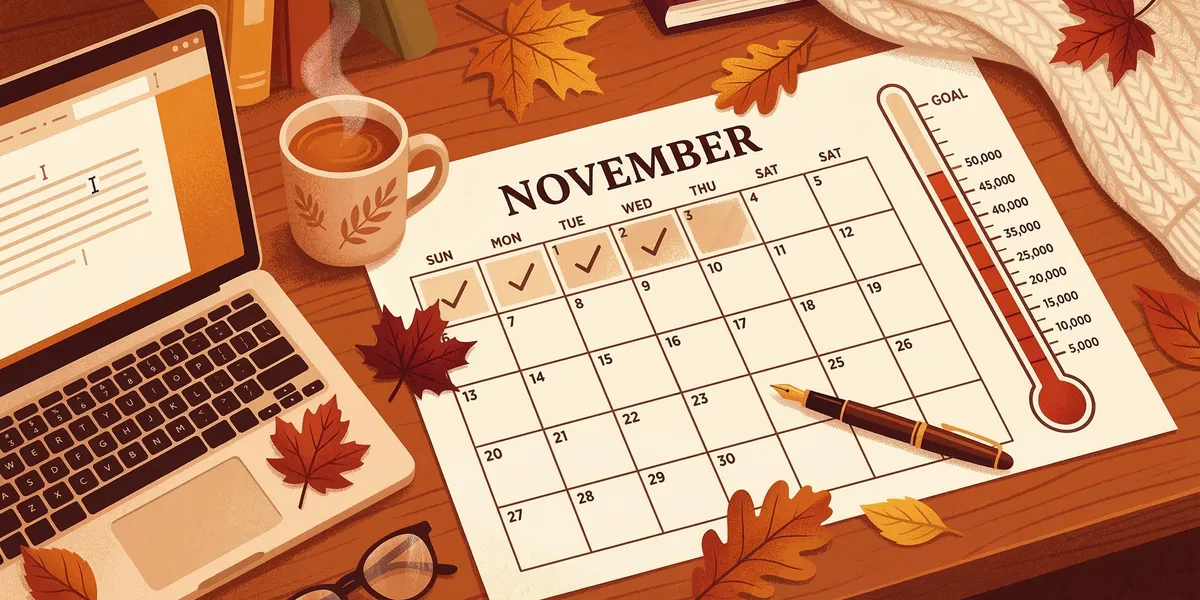
NaNoWriMo — National Novel Writing Month — challenges writers to produce 50,000 words of a novel in thirty days. That is 1,667 words per day, every day, from November 1 to November 30.
It sounds extreme. It is. And every year, hundreds of thousands of writers attempt it because the deadline does something that good intentions never will: it forces you to actually write.
What NaNoWriMo Actually Is
NaNoWriMo started in 1999 with 21 participants in San Francisco. It has since grown into a global writing event with hundreds of thousands of participants each year. The goal is simple: write a 50,000-word manuscript in one month.
The point is not perfection. The point is completion. NaNoWriMo’s philosophy is that you cannot edit a blank page, so the first priority is getting words down — messy, imperfect, sometimes terrible words — that you can revise later.
Fifty thousand words is roughly the length of The Great Gatsby or Fahrenheit 451. It is on the shorter side for a modern novel, but it is enough to have a complete narrative with a beginning, middle, and end. Many participants continue writing after November to bring their manuscript to full novel length.
Notable novels that began as NaNoWriMo projects include Water for Elephants by Sara Gruen, Fangirl by Rainbow Rowell, and The Night Circus by Erin Morgenstern.
How to Prepare in October
November success is built in October. The writers who finish are the ones who start the month with a plan.
Outline your novel. You do not need a detailed scene-by-scene outline, but you should know your beginning, your ending, and the major turning points in between. At minimum, answer these questions: Who is the protagonist? What do they want? What stands in their way? How does it end?
Writers who start November with no outline tend to stall around week two when the initial burst of inspiration fades and they do not know what happens next.
Clear your schedule. Look at November on a calendar. Identify the days you will not be able to write — Thanksgiving, travel, family obligations, work deadlines. Count the days you actually have available. If it is twenty instead of thirty, your daily target is 2,500 words, not 1,667.
Build a buffer zone. Plan to write more than 1,667 words on your strong days so you have margin for the days that do not go well. If you can write 2,500 words on the first three days, you buy yourself an extra day of rest later in the month.
Set up your writing environment. Whatever you use to write — laptop, desktop, notebook, phone — have it ready. Install your writing software. Create the file. Set up your workspace. Remove friction so that when November 1 arrives, you can sit down and start immediately.
Tell people. Let your family, friends, and roommates know that November is your writing month. You will be less available. You may be distracted. You will need them to give you space at certain hours. This is not selfish — it is planning.
The Daily Word Count Strategy
The magic number is 1,667. Every day. That is roughly six to eight double-spaced pages, or about sixty to ninety minutes of writing for most people.
Here is how to think about it:
Write first, edit never. During November, do not go back and revise. Do not rewrite yesterday’s chapter. Do not fix the plot hole you noticed in chapter three. Write forward only. Revision is for December.
This is the hardest habit to build and the most important. Every minute spent revising is a minute not spent adding new words to your count. The internal editor will scream. Ignore it.
Track your daily count. NaNoWriMo’s website provides tracking tools, but a simple spreadsheet works too. Record your word count every day. Watching the number climb is motivating. Watching it stall is motivating in a different way.
Write at the same time each day. Routine defeats resistance. If you write from 6 to 7:30 AM every day, your brain learns that this is writing time. It stops fighting. The words come easier because you have trained the habit.
Have a minimum and a stretch goal. Your minimum is 1,667. Your stretch is 2,500. On good days, hit the stretch. On bad days, hit the minimum. On terrible days, write 500 words and call it progress — because it is.
What to Do When You Fall Behind
You will fall behind. Almost everyone does. The writers who finish NaNoWriMo are not the ones who never fall behind — they are the ones who catch up.
Do not panic at a one-day deficit. Missing one day puts you 1,667 words behind. That is an extra thirty minutes tomorrow. It is recoverable.
Do the math. If it is November 15 and you have 20,000 words instead of 25,000, you need 30,000 words in fifteen days — 2,000 per day. That is challenging but doable.
Schedule a writing sprint marathon. Set aside a Saturday or Sunday and write for four to six hours with breaks. Aim for 5,000 to 8,000 words. One marathon day can erase a week of deficits.
Lower your quality bar. When you are behind, this is not the time for careful prose. Write dialogue without description. Write action without subtext. Write the scene that is in your head without worrying about how it connects to what came before. You can fix everything later. Right now, you need words.
Skip ahead. If you are stuck on a scene, skip it. Write the next scene. Write the climax. Write the scene you have been excited about for weeks. NaNoWriMo is not about writing in order — it is about writing 50,000 words.
Week-by-Week Guide
Week 1 (Days 1-7): The Sprint. Target: 11,669 words (staying on pace).
This is the honeymoon week. Motivation is high. The story is fresh. You are excited. Write as much as you can. Build a buffer here because you will need it later.
Do not spend week one making decisions about your story. Make those decisions in October. Week one is for writing the scenes you already know.
Week 2 (Days 8-14): The Wall. Target: 23,338 words cumulative.
This is where most people quit. The initial excitement fades. The story feels messy. You realize your outline has holes. The internal critic wakes up and starts whispering that everything you have written is garbage.
This is normal. Push through it. The wall is not a sign that your story is bad — it is a sign that you are in the difficult middle, where every novel lives for a while. Write through the doubt. The words do not need to be good. They need to exist.
Week 3 (Days 15-21): The Grind. Target: 35,007 words cumulative.
You are past the wall. The story has momentum again, even if the prose is rough. This is the week to introduce complications, escalate conflict, and push your characters toward their crises.
If you are behind, this is the week to schedule your marathon writing sessions. Thanksgiving week is coming, and you need to be as close to 40,000 as possible before the holiday disrupts your schedule.
Week 4 (Days 22-30): The Finish. Target: 50,000 words.
The end is visible. This is where the story starts coming together — or at least, where you can see the shape it will eventually take. Write the climax. Write the resolution. If you need to, write scenes out of order to hit the count.
The final days of November have a manic energy. Embrace it. The finish line is not about quality. It is about proving to yourself that you can write a novel-length manuscript.
Writing Sprints and Community
Writing sprints are timed sessions — usually fifteen to thirty minutes — where you write as fast as possible without stopping. Set a timer, put your head down, and go. Many writers find they can produce 500 to 1,000 words in a thirty-minute sprint.
Sprints work because they are short enough to feel manageable and competitive enough (with yourself or others) to create urgency.
Community is one of NaNoWriMo’s greatest strengths. The event runs both online and in local groups. Writing with other people — even remotely — creates accountability. When you know someone else is also struggling through week two, the struggle feels less isolating.
Find your NaNoWriMo community through the official forums, local library events, writing groups, or social media. Having someone to celebrate milestones with (and commiserate with during the hard days) makes the difference between quitting and finishing.
Editing After November, Not During
This rule cannot be overstated: do not edit in November.
Your NaNoWriMo manuscript will be messy. It will have plot holes, inconsistent character names, scenes that go nowhere, and prose that makes you cringe. This is expected. This is the plan.
December is for resting. January is for reading through the manuscript with fresh eyes. February is for revising. The NaNoWriMo draft is raw material — it is the clay, not the sculpture. But you cannot sculpt air. You need the clay first.
Writers who try to edit while writing in November almost never finish. They get trapped in an endless loop of revision on the first three chapters while the rest of the book never gets written.
Using AI Tools to Get Unstuck
When you hit a wall — a scene you cannot figure out, dialogue that will not flow, a plot problem that has you staring at a blank screen — AI writing tools can help you push through without losing momentum.
Chapter can generate scene drafts, dialogue, and narrative sections based on your characters and plot. When you are stuck at 11 PM with 800 words left to hit your daily count, feeding the tool your scene context and getting a draft you can revise is faster than staring at the cursor.
This is not about replacing your writing. It is about eliminating the blank-page paralysis that kills NaNoWriMo attempts. Generate a rough version of the scene you are stuck on, then rewrite it in your voice. The result is yours — the AI just helped you find the starting point.
Other uses during NaNoWriMo:
- Generating character backstory when you need to understand a character’s motivation
- Drafting transitions between scenes when you know what happens but not how to get there
- Producing alternative versions of a scene so you can pick the direction that works
- Writing through the “boring but necessary” scenes that connect the exciting parts
The goal is 50,000 words. Whatever gets you to that number — caffeine, writing sprints, AI tools, sheer stubbornness — is a valid strategy.
After You Finish
Hitting 50,000 words is an achievement. Take a moment to feel it.
Then step away from the manuscript. Give it at least two weeks — ideally a month — before you read it again. Distance gives you perspective. The scenes you thought were terrible may surprise you. The scenes you loved may need more work than you expected.
When you are ready to revise, read the entire manuscript without making changes first. Just read. Note what works, what does not, and what is missing. Then build a revision plan and work through it systematically.
If you want a more detailed guide on the full writing process, see our posts on how to write a book in 30 days and how to finish writing a book. And if the blank page is your biggest obstacle, our guide on overcoming writer’s block covers the mental strategies that keep words flowing.
Many NaNoWriMo novels need significant revision before they are publishable. That is not failure — it is the normal process. The manuscript exists because you wrote it in thirty days. Now you have all the time you need to make it good.