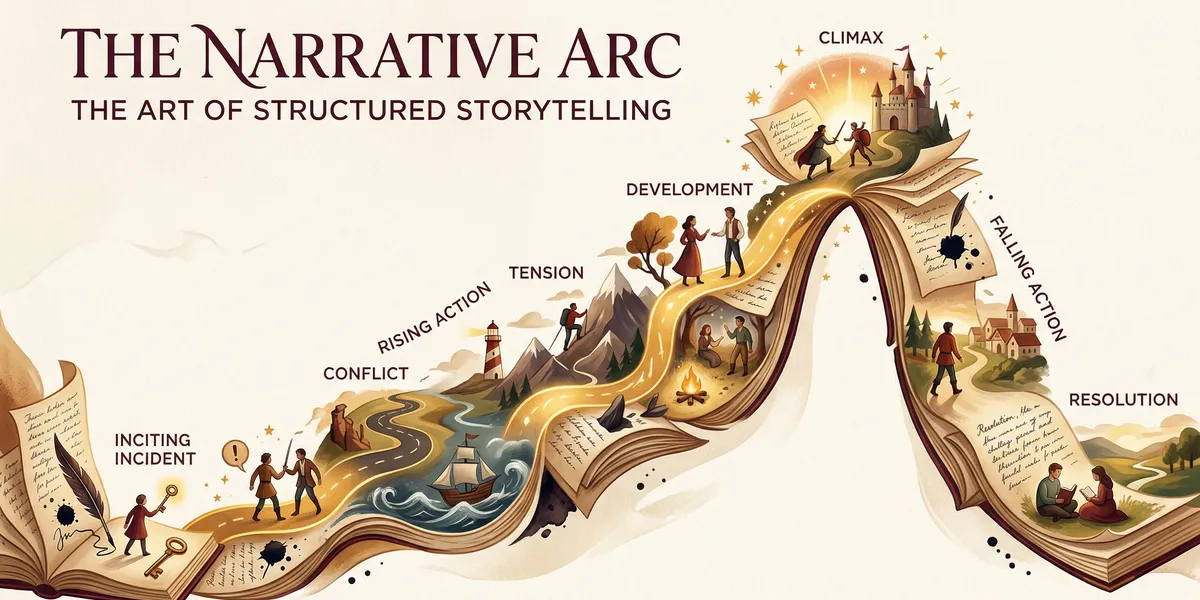
Narrative structure is the blueprint that organizes your story’s events, characters, and themes into a coherent whole. It determines how information reaches the reader, when tension builds, and where emotional payoffs land. Whether you’re writing a novel, memoir, or short story, choosing the right narrative structure separates published authors from those stuck in revision limbo.
Every story has structure, even if the writer never consciously chose one. The question is whether that structure works for your story or against it. The seven frameworks below give you tested patterns that readers instinctively recognize and respond to, each suited to different genres, themes, and storytelling goals.
What Narrative Structure Actually Does
Narrative structure is not the same as plot structure, though the two overlap. Plot structure describes what happens. Narrative structure describes how and when the reader experiences what happens.
Think of it this way: the plot of a murder mystery is always “someone dies, someone investigates, someone gets caught.” But the narrative structure could present that chronologically, start with the arrest and work backward, or weave between the killer’s and detective’s perspectives.
Structure controls pacing, suspense, and emotional impact. It tells you where to place your inciting incident, how to handle rising action, and when to deliver your climax. The frameworks below each handle those decisions differently.
1. Three-Act Structure
Three-act structure is the most widely used narrative framework in Western storytelling. It divides your story into setup, confrontation, and resolution, with turning points connecting each act.
How it works:
- Act 1 (Setup, ~25%): Introduce the protagonist, their world, and the status quo. End with an inciting incident that forces them into the main conflict.
- Act 2 (Confrontation, ~50%): The protagonist pursues their goal against escalating obstacles. A midpoint shift raises the stakes. The act ends when all seems lost.
- Act 3 (Resolution, ~25%): The protagonist faces the final confrontation, wins or loses, and the new normal is established.
Example: In The Hunger Games, Act 1 establishes Katniss’s life in District 12 and ends with her volunteering as tribute. Act 2 covers the training, alliances, and arena survival. Act 3 is the final confrontation and the rule change that forces the ending.
Best for: Novels, screenplays, and any story with a clear protagonist pursuing a concrete goal. This is the safest default if you’re writing your first book.
2. Freytag’s Pyramid
Developed by German novelist Gustav Freytag in 1863, this five-part structure maps the dramatic arc of classical tragedy. It works well for stories where the protagonist’s downfall is the point.
The five stages:
- Exposition: The world and characters are introduced.
- Rising Action: Complications and conflicts build momentum.
- Climax: The turning point where the protagonist’s fate is sealed.
- Falling Action: Consequences unfold from the climactic decision.
- Denouement: The final resolution and new equilibrium.
The critical difference from three-act structure is placement. Freytag puts the climax in the middle, not near the end. Everything after the climax shows the consequences cascading outward.
Example: Shakespeare’s Macbeth follows Freytag’s Pyramid precisely. The exposition introduces Macbeth as a loyal general. Rising action covers the witches’ prophecy and Duncan’s murder. The climax is Macbeth’s coronation, the moment of highest power and deepest corruption. Falling action brings paranoia and more killings. The denouement is his defeat and death.
Best for: Tragedies, literary fiction, and stories where a character’s peak moment is also the beginning of their undoing. The Purdue Online Writing Lab maintains useful resources on classical dramatic structure.
3. The Hero’s Journey (Monomyth)
Joseph Campbell identified this 12-stage pattern across world mythology in The Hero with a Thousand Faces (1949). It maps a protagonist’s transformation through departure, initiation, and return.
The 12 stages, simplified:
- Ordinary World — The hero’s normal life.
- Call to Adventure — Something disrupts the status quo.
- Refusal of the Call — The hero hesitates.
- Meeting the Mentor — A guide provides tools or wisdom.
- Crossing the Threshold — The hero enters the unfamiliar world.
- Tests, Allies, Enemies — The hero faces challenges and builds relationships.
- Approach to the Inmost Cave — The hero nears the central ordeal.
- The Ordeal — The hero faces their greatest challenge.
- Reward — The hero gains what they sought.
- The Road Back — The return journey begins, often with new danger.
- Resurrection — A final test transforms the hero.
- Return with the Elixir — The hero brings change back to the ordinary world.
Example: The Lord of the Rings maps almost perfectly. Frodo’s ordinary world is the Shire. Gandalf delivers the call. The Council of Elrond is the crossing. Mount Doom is the ordeal. The Scouring of the Shire is the return.
Best for: Fantasy, adventure, coming-of-age stories, and any narrative about personal transformation. Christopher Vogler’s The Writer’s Journey adapted Campbell’s framework specifically for fiction writers and screenwriters.
4. Save the Cat! Beat Sheet
Blake Snyder’s Save the Cat! framework breaks a story into 15 specific beats with suggested page counts. Originally designed for screenwriting, it has become one of the most popular plotting tools for novelists.
The 15 beats:
- Opening Image — A snapshot of the protagonist’s world before change.
- Theme Stated — Someone hints at the story’s lesson (often unrecognized by the protagonist).
- Setup — The protagonist’s life, flaws, and stakes are established.
- Catalyst — The event that starts the story engine.
- Debate — The protagonist wrestles with the new situation.
- Break into Two — The protagonist commits to the new path.
- B Story — A secondary relationship that carries the theme.
- Fun and Games — The “promise of the premise” delivered.
- Midpoint — A false victory or false defeat that raises stakes.
- Bad Guys Close In — External pressure and internal doubts escalate.
- All Is Lost — The lowest point, often with a “whiff of death.”
- Dark Night of the Soul — The protagonist processes the loss.
- Break into Three — A new insight provides the path forward.
- Finale — The protagonist applies lessons learned and wins.
- Final Image — A mirror of the opening, showing transformation.
Example: In Finding Nemo, the opening image shows Marlin as an overprotective father. The catalyst is Nemo’s capture. Fun and games is Marlin’s ocean journey with Dory. The midpoint is the whale. All is lost is the jellyfish scene. The finale proves Marlin has learned to let go.
Best for: Commercial fiction, genre novels, and any writer who wants extremely detailed structural guidance. The beat sheet removes guesswork about what should happen when.
5. Dan Harmon’s Story Circle
Dan Harmon (creator of Community and Rick and Morty) distilled the Hero’s Journey into eight simpler steps arranged in a circle. It strips away mythology-specific language and focuses on the core psychological pattern.
The eight steps:
- You — A character in their comfort zone.
- Need — They want something.
- Go — They enter an unfamiliar situation.
- Search — They adapt to the new situation.
- Find — They get what they wanted.
- Take — They pay the price.
- Return — They go back to the familiar.
- Change — They have transformed.
The top half of the circle (steps 1-4) represents order and the known world. The bottom half (steps 5-8) represents chaos and transformation. The character crosses between these worlds twice.
Example: In a single episode of Breaking Bad, Walter White starts comfortable (1), needs money for cancer treatment (2), enters the drug trade (3), learns to cook meth (4), makes his first big sale (5), faces violent consequences (6), returns home (7), and is permanently changed (8).
Best for: Episode structure, short stories, individual chapters, and writers who find the Hero’s Journey too complex. Its simplicity makes it useful for developing characters across a series.
6. Kishotenketsu
This four-act structure from East Asian storytelling (used in Japanese, Chinese, and Korean narrative traditions) is unique because it contains no central conflict. Instead, it builds meaning through juxtaposition and surprise.
The four acts:
- Ki (Introduction): Present the characters and setting.
- Sho (Development): Deepen what was introduced without adding conflict.
- Ten (Twist): Introduce a surprising element that recontextualizes everything.
- Ketsu (Conclusion): Reconcile the twist with the established elements.
The “Ten” is the heart of this structure. It is not a complication or obstacle. It is an unexpected perspective, event, or revelation that changes how the reader understands what came before.
Example: Many of Hayao Miyazaki’s films use Kishotenketsu. My Neighbor Totoro introduces two sisters in a new home (Ki), shows them exploring the countryside (Sho), reveals the existence of Totoro and the spirit world (Ten), and brings those elements together when the spirits help find the lost sister (Ketsu). There is no villain. No combat. No traditional conflict.
Best for: Literary fiction, slice-of-life narratives, children’s stories, and any writer who wants to move beyond conflict-driven plots. The University of Chicago’s narrative theory resources explore non-Western structural traditions in depth.
7. In Medias Res
Latin for “into the middle of things,” In Medias Res is not a complete structural framework but a powerful opening technique that pairs with any of the structures above. It drops the reader into the story mid-action and fills in the backstory later.
How to use it:
- Open with a scene of high tension or dramatic action.
- Orient the reader with minimal context — just enough to understand the immediate stakes.
- Use flashbacks, dialogue, or narrative exposition to fill in the backstory throughout the first act.
- Rejoin the chronological timeline once the reader has enough context.
Example: Homer’s Iliad opens in the ninth year of the Trojan War, not the beginning. Gone Girl opens with Nick’s wife already missing. The Bourne Identity opens with the protagonist pulled from the ocean with no memory.
Best for: Thrillers, mysteries, literary fiction, and any story where the backstory is more interesting when the reader already cares about the outcome. It works especially well when learning how to write a story that hooks readers from the first page.
How to Choose the Right Structure
The framework you pick depends on your story’s needs, not your personal preference. Ask these questions:
What is the emotional arc? If your protagonist transforms through a clear challenge-and-growth pattern, the Hero’s Journey or Story Circle fits. If they rise and then fall, Freytag’s Pyramid is designed for that shape.
How important is pacing? Save the Cat gives you the most granular pacing control. Three-act structure gives moderate control. Kishotenketsu prioritizes meaning over momentum.
What genre are you writing? Thrillers and mysteries benefit from In Medias Res openings. Fantasy and adventure align naturally with the Hero’s Journey. Literary fiction has more freedom to use Kishotenketsu or modified structures.
How experienced are you? If you’re writing your first novel, start with three-act structure or Save the Cat. Their prescriptive nature prevents common structural problems before they develop.
You can also combine frameworks. Open with In Medias Res, structure the overall plot with three-act structure, and use the Story Circle for individual chapters. Experienced authors mix and modify constantly.
If you want to test different structures quickly, tools like Chapter.pub let you outline and restructure your book before committing to a full draft, so you can see how different frameworks shape your story.
Common Mistakes to Avoid
Skipping the setup. Writers eager to reach the action often compress Act 1 or eliminate the ordinary world. Without setup, readers have no baseline to measure change against. The payoff of transformation requires knowing what the character was before.
Sagging middles. The middle 50% of your story carries the most structural weight, and it is where most novels fail. If your Act 2 feels aimless, you likely skipped the midpoint reversal. Every framework includes a mid-story shift for a reason.
Mistaking structure for formula. Structure is a skeleton, not a straitjacket. The three-act structure does not mean every story needs identical proportions. Bend the framework to fit your story, not the other way around.
Forcing conflict where it does not belong. Western writing advice insists every scene needs conflict. Kishotenketsu proves otherwise. If your story is about discovery, connection, or wonder rather than opposition, consider whether conflict-driven frameworks are limiting you.
Ignoring the ending. Many writers plan elaborate beginnings and improvisational endings. Structure exists specifically to prevent this. If you know your framework, you know what shape your ending needs before you write the first chapter.
Using structure as a crutch for weak characters. No framework saves a story with flat characters. Structure organizes events. Strong character development gives those events meaning. Build both.
Putting Structure Into Practice
Reading about narrative structure is useful. Applying it is where the learning happens.
Pick one framework from this guide and outline a story using it. Do not write prose yet. Map out the major structural beats, identify where each act begins and ends, and note where your protagonist changes. If the outline reveals gaps — a missing midpoint, a weak climax, a rushed resolution — you have found the exact problems structure is designed to solve.
Then write a short scene from the climactic moment. If you can feel the weight of everything that came before in that scene, your structure is working.
FAQ
What is the difference between narrative structure and plot structure?
Plot structure describes the sequence of events in a story (what happens). Narrative structure describes how those events are organized and presented to the reader (the order, pacing, and perspective). A story’s plot might be chronological, but its narrative structure could present events out of order using flashbacks or In Medias Res.
Which narrative structure is best for beginners?
Three-act structure is the most accessible starting point. Its three clear divisions (setup, confrontation, resolution) are intuitive and flexible enough to accommodate most genres. Save the Cat is the next step up if you want more detailed guidance on what should happen at each stage.
Can I combine multiple narrative structures?
Yes, and experienced writers do it constantly. You might use three-act structure for overall plot organization, the Hero’s Journey for your protagonist’s emotional arc, and In Medias Res for your opening. The frameworks are tools, not rules. Use whichever combination serves your story.
Do all stories need conflict?
Not necessarily. Western storytelling traditions emphasize conflict as essential, but Kishotenketsu demonstrates that stories can work through juxtaposition and surprise instead. Literary fiction and slice-of-life narratives often succeed with minimal or no traditional conflict. The key is that something must change — but change does not require opposition.
How do I fix a story with structural problems?
First, identify which structural framework your story most closely follows. Then compare your manuscript against that framework’s beats. Structural problems almost always fall into a few categories: missing or weak inciting incidents, sagging middles without a midpoint shift, or rushed third acts. Once you identify the gap, you know exactly what scene or sequence to add, move, or revise.