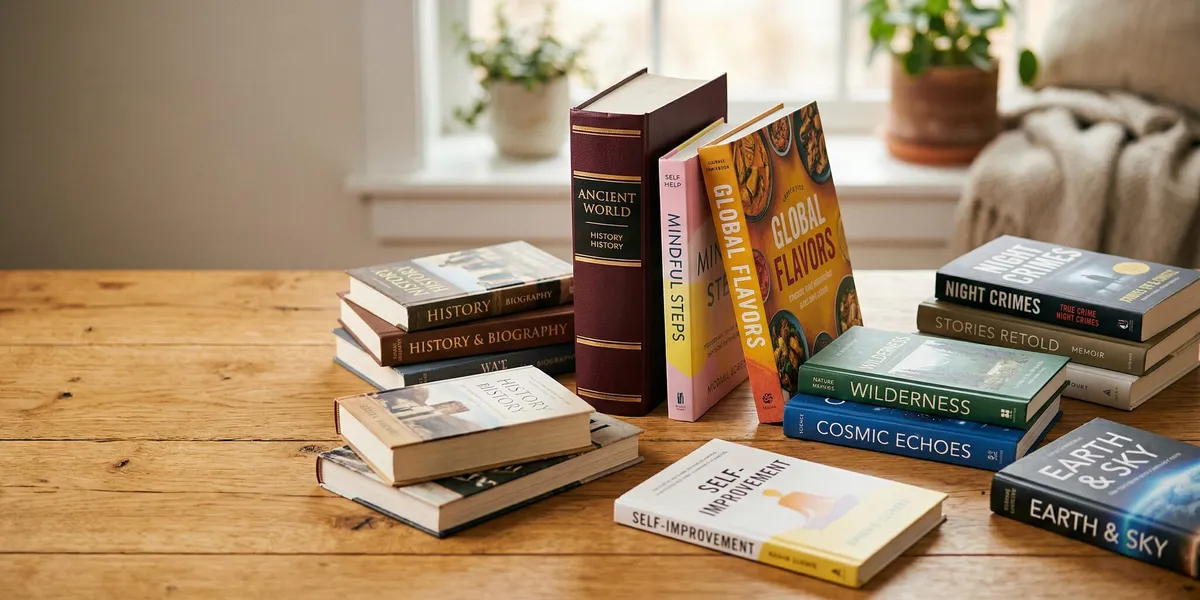
Nonfiction book genres are categories that classify fact-based books by subject matter, structure, and reader expectations. There are over 20 major nonfiction genres — from memoir to self-help to true crime — and picking the right one determines how you write, market, and sell your book.
In this guide, you’ll learn:
- Every major nonfiction genre with clear definitions and examples
- How to pick the right genre for your book idea
- The difference between narrative and expository nonfiction
- Which nonfiction genres sell best right now
Here’s the full breakdown.
What Is Nonfiction?
Nonfiction is any book based on real events, real people, or factual information. Unlike fiction, nonfiction doesn’t invent characters or fabricate plotlines. Every claim should be verifiable, and every story should be rooted in truth.
That said, nonfiction isn’t limited to dry textbooks. Narrative nonfiction reads like a novel. Memoir explores deeply personal stories. Science writing makes complex ideas accessible. The genre is enormous — and growing.
The two broadest categories are narrative nonfiction (story-driven) and expository nonfiction (information-driven). Most genres fall clearly into one camp, though some blend both approaches.
Narrative Nonfiction Genres
Narrative nonfiction tells true stories using literary techniques — character development, scene-setting, dialogue, and dramatic arcs. You’re reading facts, but the experience feels like reading a novel.
Memoir
A memoir focuses on a specific theme, time period, or experience from the author’s life. Unlike autobiography, memoir doesn’t try to cover everything. It zooms in on one thread and explores it deeply.
Memoirs are one of the most popular nonfiction genres because they combine personal storytelling with universal themes. You don’t need to be famous to write one — you need a compelling angle.
Examples: Educated by Tara Westover, When Breath Becomes Air by Paul Kalanithi
Best for: Writers with a powerful personal story tied to a broader theme.
If you’re considering writing one, check out our guide on how to write a memoir.
Biography and Autobiography
A biography tells the story of another person’s life, usually from birth to death (or present day). An autobiography does the same, but written by the subject themselves.
Biographies require extensive research — interviews, archival documents, and fact-checking. Autobiographies rely on the author’s own memory and perspective, often supplemented by records and conversations with others.
Examples: Steve Jobs by Walter Isaacson (biography), The Autobiography of Malcolm X (autobiography)
Best for: Writers fascinated by a specific person’s life and impact. Learn more in our how to write a biography guide.
True Crime
True crime investigates real criminal cases — murders, frauds, heists, disappearances. The best true crime books go beyond the crime itself to explore psychology, systemic failures, and social context.
This genre has exploded in popularity thanks to podcasts and streaming documentaries. Readers expect meticulous research, a compelling narrative structure, and ethical treatment of victims.
Examples: In Cold Blood by Truman Capote, I’ll Be Gone in the Dark by Michelle McNamara
Best for: Writers who enjoy deep investigative research and can handle dark subject matter responsibly. See our true crime writing guide for a step-by-step process.
Travel Writing
Travel writing documents the author’s experiences in specific places. The best travel books aren’t just itineraries — they explore culture, history, and personal transformation through the lens of a journey.
Travel writing ranges from practical guidebooks to deeply literary narratives. The key is a distinctive voice and genuine insight into the places you visit.
Examples: A Walk in the Woods by Bill Bryson, Eat, Pray, Love by Elizabeth Gilbert
Best for: Writers who travel with curiosity and can turn observations into storytelling.
Creative Nonfiction and Essays
Creative nonfiction is the broadest narrative category. It uses literary techniques to explore true subjects — personal essays, longform journalism, nature writing, and cultural criticism all fall here.
Essay collections have gained renewed popularity, especially among online writers building audiences. The form rewards a strong voice and original perspective more than any other nonfiction genre.
Examples: The Year of Magical Thinking by Joan Didion, Between the World and Me by Ta-Nehisi Coates
Best for: Writers with a distinctive voice who want flexibility in subject and structure. Explore our creative nonfiction guide for more.
Journalism and Investigative Reporting
Journalism books take deep-dive reporting and expand it into long-form narratives. These are the stories too big for a magazine article — multi-year investigations, systemic exposés, and untold histories.
The research bar is extremely high. You need primary sources, on-the-record interviews, and ironclad fact-checking. But the payoff is significant — journalism books regularly win major awards and drive real-world change.
Examples: Bad Blood by John Carreyrou, Catch and Kill by Ronan Farrow
Best for: Reporters, journalists, and researchers with access to original sources.
Expository Nonfiction Genres
Expository nonfiction prioritizes information delivery over storytelling. The goal is to teach, explain, or reference — not to narratively immerse. These books are structured around clarity, not plot.
Self-Help and Personal Development
Self-help books help readers improve a specific area of their life — productivity, relationships, mental health, finances, habits. This is one of the bestselling nonfiction genres worldwide.
The best self-help books combine a clear framework with actionable advice. Readers want a system they can implement, not just inspiration. Original research or a proprietary methodology makes your book stand out.
Examples: Atomic Habits by James Clear, The 7 Habits of Highly Effective People by Stephen Covey
Best for: Coaches, therapists, consultants, and anyone with a proven framework. Our how to write a self-help book guide walks through the full process.
Business and Economics
Business books teach strategies for entrepreneurship, management, marketing, leadership, or economics. The audience is professionals looking for an edge.
The most successful business books distill complex ideas into memorable frameworks. Think of them as self-help books for your career or company.
Examples: Good to Great by Jim Collins, Zero to One by Peter Thiel
Best for: Entrepreneurs, executives, and consultants who want to establish authority. Writing a book as a business card is one of the most powerful marketing moves you can make.
History
History books explore past events, eras, movements, or civilizations. They range from academic scholarship to popular history written for general readers.
Popular history is a thriving genre. Readers want the rigor of academic research presented with the accessibility of a good story. The best history books reframe familiar events through fresh evidence or overlooked perspectives.
Examples: Sapiens by Yuval Noah Harari, The Warmth of Other Suns by Isabel Wilkerson
Best for: Historians, researchers, and writers passionate about a specific period or event.
Science and Popular Science
Science books explain scientific concepts, discoveries, or theories for a general audience. Popular science bridges the gap between academic journals and everyday understanding.
You don’t need a PhD to write popular science — you need the ability to explain complex ideas clearly. Strong analogies, real-world applications, and a narrative thread through the science make these books work.
Examples: A Brief History of Time by Stephen Hawking, The Immortal Life of Henrietta Lacks by Rebecca Skloot
Best for: Scientists, science journalists, and curious writers who can translate complexity into clarity.
Philosophy
Philosophy books explore fundamental questions about existence, morality, knowledge, and meaning. Modern philosophy writing has moved toward accessible, applied approaches rather than dense academic texts.
Popular philosophy books often connect ancient wisdom to modern problems. The audience ranges from academic philosophers to general readers searching for meaning.
Examples: Meditations by Marcus Aurelius, The Daily Stoic by Ryan Holiday
Best for: Thinkers with a framework for examining life’s big questions.
Religion and Spirituality
Religion and spirituality books explore faith, spiritual practice, theology, and the search for meaning. This is a diverse genre spanning devotional guides, theological scholarship, interfaith dialogue, and personal spiritual journeys.
The audience is vast and highly engaged. Religious and spiritual readers are among the most loyal book buyers.
Examples: Mere Christianity by C.S. Lewis, The Power of Now by Eckhart Tolle
Best for: Religious leaders, spiritual teachers, and writers exploring faith.
Health, Fitness, and Wellness
Health and wellness books cover physical fitness, nutrition, mental health, medical conditions, and holistic approaches to wellbeing. Readers want evidence-based advice they can act on immediately.
Credentialing matters here more than in most genres. Readers (and publishers) want authors with relevant expertise — doctors, nutritionists, therapists, certified trainers.
Examples: Why We Sleep by Matthew Walker, The Body Keeps the Score by Bessel van der Kolk
Best for: Health professionals, certified practitioners, and researchers.
Cookbooks and Food Writing
Cookbooks compile recipes around a theme — a cuisine, dietary approach, skill level, or lifestyle. Food writing explores the culture, history, and personal stories behind what we eat.
Modern cookbooks have evolved beyond recipe collections. The most successful ones combine beautiful photography, personal storytelling, and tested recipes with clear instructions.
Examples: Salt, Fat, Acid, Heat by Samin Nosrat, The Food Lab by J. Kenji Lopez-Alt
Best for: Chefs, food bloggers, nutritionists, and home cooks with a distinctive approach.
Parenting and Family
Parenting books guide parents through child-rearing challenges — from pregnancy to the teenage years. The best ones combine research-backed advice with practical strategies.
This genre evolves quickly as new research emerges and cultural norms shift. Books addressing specific challenges (ADHD parenting, single parenting, blended families) often outperform general guides.
Examples: The Whole-Brain Child by Daniel J. Siegel, How to Talk So Kids Will Listen by Adele Faber
Best for: Pediatricians, child psychologists, educators, and experienced parents.
Education and Textbooks
Education books range from classroom teaching guides to academic textbooks to educational philosophy. Textbooks serve specific courses and follow established curricula.
Self-published educational materials have grown rapidly, especially workbooks, study guides, and supplementary learning resources. These can be highly profitable in niche subjects.
Examples: Mindset by Carol Dweck, Make It Stick by Peter Brown
Best for: Teachers, professors, and educational researchers.
Humor
Humor books make readers laugh through essays, observations, parody, or satirical takes on culture and life. This is a difficult genre to break into because humor is subjective — but when it works, it works big.
Humor writing often crosses into memoir territory. The most successful humor books combine genuine comedic talent with relatable storytelling.
Examples: Bossypants by Tina Fey, Me Talk Pretty One Day by David Sedaris
Best for: Comedians, humorists, and writers with a proven ability to make people laugh.
How-To and DIY
How-to books teach a specific skill, craft, or process through step-by-step instructions. Topics range from woodworking to gardening to coding to home repair.
The how-to genre thrives on specificity. Broad topics face heavy competition — narrow topics (container gardening for apartments, knitting for beginners) find loyal audiences faster.
Examples: The Life-Changing Magic of Tidying Up by Marie Kondo, Bird by Bird by Anne Lamott
Best for: Experts in any practical skill or craft.
Politics and Social Sciences
Political books analyze government, policy, social movements, and civic issues. Social science books explore psychology, sociology, anthropology, and related fields.
These books often ride current events. Timing matters — a book about election integrity hits differently during an election year. But the best political writing transcends the news cycle.
Examples: Thinking, Fast and Slow by Daniel Kahneman, Just Mercy by Bryan Stevenson
Best for: Policy experts, academics, activists, and political journalists.
Art and Photography
Art books showcase visual work, explore art history, or teach artistic techniques. Photography books range from instructional guides to curated collections of a photographer’s work.
Production quality matters enormously in this genre. Readers expect high-resolution images, quality paper, and thoughtful design. Self-publishing art books requires careful attention to printing specifications.
Examples: Ways of Seeing by John Berger, Humans of New York by Brandon Stanton
Best for: Artists, photographers, art historians, and curators.
Nonfiction Genres Comparison Table
| Genre | Avg. Word Count | Research Level | Narrative Style | Market Size |
|---|---|---|---|---|
| Memoir | 60K-80K | Personal | Story-driven | Large |
| Biography | 80K-120K | Very high | Story-driven | Medium |
| True Crime | 70K-90K | Very high | Story-driven | Large |
| Self-Help | 40K-60K | Moderate | Instructional | Very large |
| Business | 40K-60K | Moderate | Framework-based | Large |
| History | 80K-120K | Very high | Varies | Medium |
| Science | 60K-90K | High | Explanatory | Medium |
| Health/Wellness | 50K-70K | High | Instructional | Large |
| Cookbooks | 30K-50K | Practical | Recipe-based | Large |
| How-To/DIY | 30K-50K | Practical | Step-by-step | Medium |
| Humor | 50K-70K | Low | Essay-based | Medium |
| Religion | 40K-70K | Varies | Varies | Large |
How to Choose the Right Nonfiction Genre
Picking your genre isn’t just a creative decision — it determines your audience, your marketing strategy, and your book’s discoverability. Here’s how to narrow it down.
Start with your expertise
Write about what you genuinely know. Self-help requires a proven framework. Science writing requires deep understanding. Memoir requires lived experience. Your credibility as an author starts with genuine expertise in your subject.
Match your strengths to the genre’s demands
If you’re a natural storyteller, lean toward narrative nonfiction — memoir, creative nonfiction, or travel writing. If you’re an organizer and explainer, expository genres like self-help, how-to, or reference books will suit you better.
Research the market
Check Amazon’s bestseller lists in your target genre. Look at the top 20 books. What topics are saturated? Where are the gaps? A niche angle in a popular genre often outperforms a broad approach.
Consider your goals
Are you writing to build authority in your field? Business books and self-help work best. Want to process a personal experience? Memoir. Passionate about a topic and want to share knowledge? Science, history, or how-to.
Our Pick — Chapter
If you’re ready to write your nonfiction book, Chapter helps you go from idea to finished manuscript using AI-assisted writing. It handles outlining, drafting, and editing — so you can focus on your expertise, not the blank page.
Best for: First-time nonfiction authors who want structure and speed. Pricing: $97 one-time Why we built it: Most nonfiction authors have the knowledge but struggle with the writing process. Chapter bridges that gap.
Which Nonfiction Genres Sell Best?
Based on industry data from major publishers and Amazon bestseller trends, here are the top-performing nonfiction genres by sales volume:
- Self-help and personal development — consistently the #1 nonfiction category
- Business and economics — strong year-round, spikes during New Year goal-setting
- Health and wellness — growing rapidly, especially mental health titles
- Memoir — perennial strong seller, especially celebrity and trauma recovery memoirs
- True crime — surging demand driven by podcast and streaming interest
- Cookbooks — steady performer with seasonal spikes
- Religion and spirituality — loyal, repeat-buying audience
- History — consistent mid-range performer with occasional breakout hits
The pattern is clear: genres that promise personal transformation (self-help, business, health) outsell genres that provide information or entertainment (history, science, humor). But a great book in any genre can break through.
How Many Nonfiction Genres Are There?
There are 20+ major nonfiction genres and dozens of sub-genres. The exact number depends on how granularly you categorize — some publishers list 15 broad categories, while Amazon uses over 40 nonfiction sub-categories.
The genres listed in this guide cover every major category you’ll encounter when publishing. Most books fit primarily into one genre, with elements that touch others. A business memoir, for example, blends business and memoir. A science book about the psychology of habits blends science, self-help, and psychology.
When categorizing your book, pick the primary genre that best matches reader expectations. You can use secondary categories and keywords to capture cross-genre interest.
Can You Blend Nonfiction Genres?
Yes — and some of the most successful nonfiction books do exactly that. Genre blending works when the combination serves the reader rather than confusing them.
Successful blends include:
- Memoir + self-help: Personal story that teaches lessons (Becoming by Michelle Obama)
- Science + narrative: Research findings told through stories (The Immortal Life of Henrietta Lacks)
- Business + memoir: Entrepreneurial journey with takeaways (Shoe Dog by Phil Knight)
- History + true crime: Historical criminal cases (The Devil in the White City by Erik Larson)
The key is having one dominant genre that sets reader expectations. Your cover, description, and category placement should match the primary genre. Let the blending happen organically within the text.
How to Write a Nonfiction Book in Your Chosen Genre
Once you’ve picked your genre, the writing process follows a similar path regardless of category:
- Research your topic thoroughly — even for memoir, you need to verify dates, names, and facts
- Create a detailed outline — nonfiction books live or die by their structure. Use our book outline template to get started
- Write the first draft quickly — perfectionism kills nonfiction projects. Get your ideas on the page first
- Revise for clarity and flow — cut ruthlessly. Every paragraph should earn its place
- Get feedback — beta readers catch blind spots you can’t see
For a complete walkthrough, read our how to write a nonfiction book guide.
FAQ
What are the main nonfiction book genres?
The main nonfiction book genres include memoir, biography, self-help, business, history, science, true crime, health and wellness, cookbooks, religion and spirituality, travel writing, how-to, humor, and creative nonfiction. Each genre has distinct conventions, audience expectations, and market dynamics.
What is the difference between narrative and expository nonfiction?
Narrative nonfiction tells true stories using literary techniques like scene-setting, dialogue, and character development. Expository nonfiction prioritizes information delivery through explanation, instruction, or reference. Memoir and true crime are narrative; self-help and how-to books are expository.
What is the most popular nonfiction genre?
The most popular nonfiction genre by sales volume is self-help and personal development. Books about habits, productivity, relationships, and mental health consistently top bestseller lists. Business books and health/wellness titles are the next largest categories.
How do I know which nonfiction genre to write in?
Choose your nonfiction genre based on three factors: your expertise (what you genuinely know), your writing style (storyteller vs. explainer), and market demand (what readers are actively searching for). Start with what you know best, then validate the market before writing.
Can a nonfiction book fit into multiple genres?
Yes, many successful nonfiction books blend genres. A business memoir combines business and memoir. A narrative science book blends science with storytelling. The key is choosing one primary genre for marketing and categorization while letting secondary genre elements enrich the content naturally.