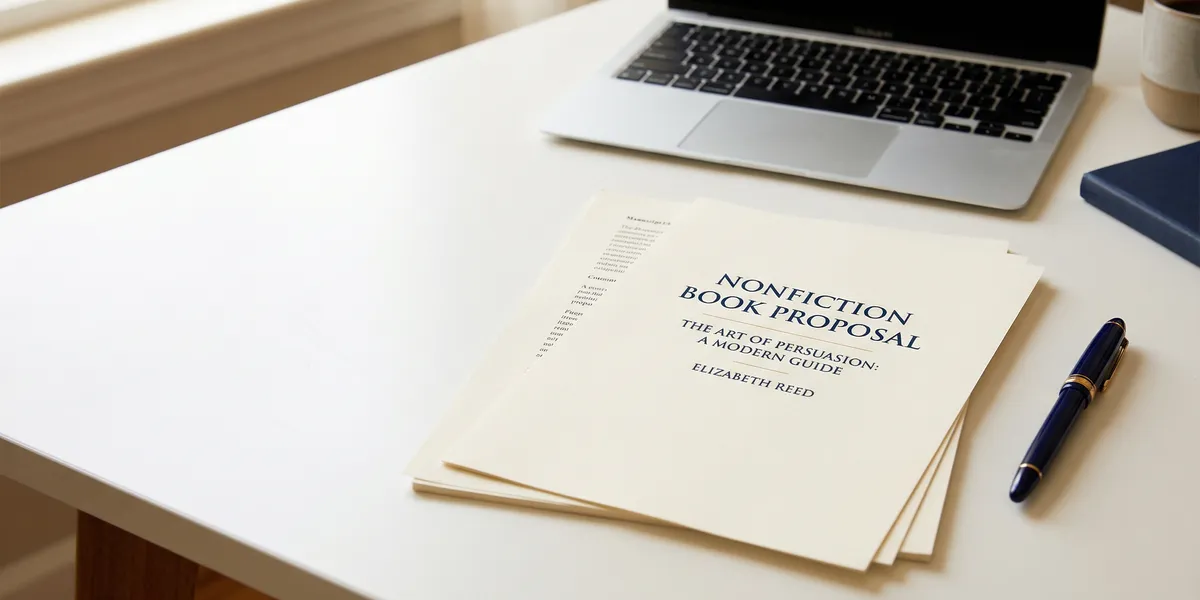
A nonfiction book proposal sample PDF gives you a proven blueprint to follow when pitching your book to agents and publishers. Instead of guessing at structure and formatting, you can study real proposals that landed six-figure deals.
In this guide, you’ll find:
- Free nonfiction book proposal sample PDFs you can download right now
- A section-by-section breakdown of what every proposal needs
- A fill-in template you can customize for your own book
- Common mistakes that get proposals rejected instantly
Here are the best samples, templates, and examples to model your proposal after.
Best Free Nonfiction Book Proposal Sample PDFs
You don’t need to pay for a book proposal template. Several literary agencies, writing organizations, and publishing professionals offer high-quality samples for free. Here are the most useful ones.
Jane Friedman’s Nonfiction Book Proposal Guide
Jane Friedman is one of the most respected voices in publishing. Her book proposal guide includes a downloadable Word template formatted to industry standards. It covers every section with tips and common mistakes for each.
Best for: Authors who want a structured, fill-in-the-blank approach with expert guidance at every step.
CMA Literary Agents Proposal Guide (PDF)
The CMA Literary nonfiction proposal guide is a direct PDF download from a working literary agency. It shows you exactly what agents look for when evaluating proposals.
Best for: Understanding the agent’s perspective on what makes a proposal stand out.
Sastrugi Press Proposal Outline (PDF)
The Sastrugi Press nonfiction book proposal outline is a clean, minimal template that lists every required section with formatting notes.
Best for: Authors who prefer a simple outline they can fill in without extra commentary.
Rebecca Campbell’s Sample Proposal Structure (PDF)
Rebecca Campbell’s sample proposal template walks through the structure of an actual nonfiction book proposal. It includes guidance on addressing publishers, introducing yourself, and presenting your book concept.
Best for: First-time authors who need a full structural example to follow.
Writers’ Federation of Nova Scotia Guide (PDF)
The Writers’ Federation of Nova Scotia proposal resource includes recommended guides and opening pages from real example proposals. It provides a more editorial perspective on proposal craft.
Best for: Authors writing narrative nonfiction or memoir proposals.
Reedsy’s Free Book Proposal Template
Reedsy’s book proposal template is a free downloadable resource paired with a detailed 9-step writing guide. The template covers all standard sections.
Best for: Authors who want a step-by-step walkthrough alongside a template.
What Should a Nonfiction Book Proposal Include?
Every nonfiction book proposal follows a standard structure. Publishers and agents expect specific sections in a specific order. Miss one and your proposal goes to the bottom of the pile.
Here is the complete section-by-section breakdown.
| Section | Purpose | Typical Length |
|---|---|---|
| Title page | First impression, contact info | 1 page |
| Overview | The pitch for your book | 1-3 pages |
| Target audience | Who will buy this book | 1-2 pages |
| Competitive title analysis | What exists and how yours differs | 1-2 pages |
| About the author | Your credentials and platform | 1-2 pages |
| Marketing and promotion plan | How you’ll help sell the book | 1-3 pages |
| Chapter outline | Detailed summary of each chapter | 3-10 pages |
| Sample chapters | 1-2 polished chapters | 15-30 pages |
The Overview
Your overview is the single most important section. It answers three questions in 1-3 pages: What is this book about? Why does it matter right now? Why will people buy it?
Start with a hook that frames the problem your book solves. Then explain your unique angle. End with a brief description of the book’s scope and structure.
The overview is your elevator pitch on paper. Many agents read only this section before deciding whether to continue.
Target Audience
Define your reader with specifics. Don’t write “anyone interested in self-improvement.” Instead, write something like “first-time managers aged 28-40 who’ve been promoted in the last 12 months and feel unprepared.”
Include audience size data when possible. Reference relevant industry stats, subreddit membership counts, podcast download numbers, or conference attendance figures. Numbers prove demand.
Competitive Title Analysis
List 5-7 books that occupy similar shelf space. For each one, briefly describe what it covers and then explain how your book differs or improves on it.
This section shows you understand the market. It also demonstrates there’s proven reader demand for your topic (other books sell well) while establishing what gap your book fills.
Do not trash competitors. Agents represent those authors too. Frame your analysis as “this excellent book covers X, while mine focuses on Y.”
About the Author
This isn’t a biography. It’s a credentials section. Answer one question: Why are you the right person to write this book?
Include relevant expertise, professional experience, degrees, speaking engagements, media appearances, and any existing audience (email list, social following, podcast). If you have previous publishing credits, list them.
If you don’t have a massive platform, emphasize depth of expertise and unique access to your subject matter.
Marketing and Promotion Plan
Publishers want to know how you’ll actively help sell the book. This section outlines your platform and your planned promotional activities.
Include your current audience numbers, planned launch activities, media connections, speaking calendar, partnerships, and any pre-existing email list. Be specific and realistic — agents can spot inflated numbers.
According to Scribe Media, the marketing plan is one of the most important sections in any nonfiction proposal. Publishers increasingly expect authors to bring an audience.
Chapter Outline
Provide a detailed summary of every chapter in your book. Each chapter entry should include the chapter title, a 2-3 paragraph summary of its content, and the key takeaway for the reader.
This section can run 3-10 pages depending on the book’s length. It shows the agent and publisher that you have a clear vision for the entire book — not just a vague idea.
Sample Chapters
Include 1-2 fully written, polished chapters. Most agents recommend including your first chapter plus one chapter from the middle of the book.
These chapters prove you can execute the concept. They demonstrate your writing voice, your ability to structure information, and your expertise on the topic.
Format sample chapters in 12-point Times New Roman, double-spaced, with 1-inch margins. Save as PDF unless an agent specifies otherwise.
Nonfiction Book Proposal Template (Fill-In Format)
Use this template as your starting framework. Copy each section and replace the bracketed text with your own content.
Title Page:
[Book Title]: [Subtitle] A Book Proposal by [Your Name] [Your Email] | [Your Website] [Date] Word Count: [Estimated final word count]
Overview (1-3 pages):
[Opening hook — the problem your book addresses]
[Your unique angle or thesis]
[Brief description of scope and structure]
[Why this book matters now — timeliness hook]
Target Audience:
Primary audience: [Specific demographic + psychographic description]
Audience size indicators: [Stats, community sizes, market data]
Secondary audience: [Broader group who may also buy]
Competitive Titles:
- [Title] by [Author] — [Brief description]. My book differs because [specific differentiation].
- [Title] by [Author] — [Brief description]. My book differs because [specific differentiation]. [Continue for 5-7 titles]
About the Author:
[Your relevant credentials and expertise]
[Your platform: audience size, media appearances, speaking]
[Previous publications if applicable]
Marketing Plan:
[Current platform metrics]
[Planned launch activities]
[Media and partnership opportunities]
Chapter Outline:
Chapter 1: [Title] [2-3 paragraph summary of content and key takeaway]
Chapter 2: [Title] [2-3 paragraph summary]
[Continue for all chapters]
Sample Chapters:
[Include 1-2 fully polished chapters]
How to Format Your Proposal as a PDF
Once you’ve written your proposal, formatting it professionally matters. Sloppy formatting signals an amateur author. Here’s what agents expect.
Font and spacing: Use 12-point Times New Roman or Garamond. Double-space the body text. Single-space the chapter outline summaries.
Margins: 1-inch margins on all sides.
Headers: Include your name, book title, and page number in the header of every page.
File format: Save as PDF unless the agent’s submission guidelines specify Word (.docx). PDFs preserve your formatting across devices.
File naming: Name your file professionally. Use LastName_BookTitle_Proposal.pdf — not bookidea_final_v3_FINAL.pdf.
Length: Most nonfiction proposals run 15-50 pages total, including sample chapters. The proposal itself (without sample chapters) is typically 10-20 pages.
How to Write Your Proposal Faster With AI
Writing a book proposal from scratch takes most authors 4-8 weeks. You need to research competitive titles, draft and polish each section, and write sample chapters. AI tools can compress this timeline significantly.
Our Pick — Chapter
Chapter helps you draft, structure, and polish your nonfiction book — including the proposal sections. Use it to generate your chapter outline, write sample chapters, and refine your overview until it’s pitch-ready.
Best for: Nonfiction authors who want to move from idea to polished proposal in days instead of months. Pricing: $97 one-time (nonfiction) Why we built it: Over 2,147 authors have used Chapter to create 5,000+ books. The same AI-assisted workflow that helps you write your book also helps you write the proposal that sells it.
You can use Chapter to draft each proposal section individually. Feed it your book concept and target audience, then refine the output until it matches your voice. The AI handles structure and pacing while you focus on the expertise and insights that only you can provide.
Common Mistakes That Get Proposals Rejected
Agents read hundreds of proposals every month. Avoid these mistakes that trigger instant rejection.
- No competitive title analysis. Skipping this section tells agents you haven’t researched your market. Every proposal needs 5-7 comp titles.
- Vague target audience. Writing “everyone” or “anyone who likes business books” shows a lack of market understanding. Get specific.
- Weak or missing platform. If you have no audience, acknowledge it honestly and explain your plan to build one before publication.
- Unpolished sample chapters. Your sample chapters represent your best writing. Typos, passive voice, and weak structure kill proposals.
- Too long or too short. A 5-page proposal looks thin. A 75-page proposal looks unfocused. Aim for 15-50 pages total.
- Pitching a completed manuscript. For nonfiction, publishers want to shape the book with you. Don’t present a finished product — present a compelling concept with a clear plan.
Do You Need a Book Proposal for Self-Publishing?
You don’t technically need a formal proposal if you’re self-publishing your book. No agent or publisher requires one.
But writing a proposal anyway is one of the smartest things you can do. Here’s why.
A proposal forces you to clarify your book’s purpose, audience, and competitive positioning before you start writing. Authors who skip this step often end up with a book that doesn’t have a clear reader or market fit.
Even if you plan to self-publish on Amazon KDP, going through the proposal process helps you write a stronger book. It’s a planning tool, not just a sales document.
How Long Does It Take to Write a Book Proposal?
A nonfiction book proposal typically takes 4-8 weeks to write if you’re starting from scratch. The competitive title analysis and marketing plan sections require the most research time. Sample chapters can take an additional 2-4 weeks depending on your writing speed.
With AI writing tools like Chapter, you can cut this timeline to 1-2 weeks. The AI helps you draft sections quickly while you focus on the strategic elements — market positioning, unique angle, and credentials — that require your expertise.
Can You Submit the Same Proposal to Multiple Agents?
Yes. Unlike some academic journals, the publishing industry allows simultaneous submissions. You can — and should — send your proposal to multiple agents at the same time.
Most agents expect this. Just follow each agent’s specific submission guidelines. Some want the full proposal. Others want a query letter first, then request the proposal if interested.
Keep a spreadsheet tracking which agents you’ve queried, their response times, and any specific requirements they mentioned.
What Happens After You Submit Your Proposal?
After submitting, expect to wait 4-12 weeks for a response. If an agent is interested, they’ll typically request a phone call to discuss the project. If the conversation goes well, they’ll offer representation.
Your agent then submits the proposal to editors at publishing houses. This round takes another 4-12 weeks. If an editor wants your book, they present it at an editorial board meeting. If approved, you receive an offer.
The entire process from proposal submission to book deal can take 3-12 months. Having a polished, professional proposal — especially one modeled after successful samples — dramatically improves your odds.
For a complete walkthrough of writing each section, see our guide to writing a nonfiction book proposal. If you’re still deciding between traditional and self-publishing, our book publishing guide covers both paths.
FAQ
What Is a Nonfiction Book Proposal?
A nonfiction book proposal is a 15-to-50-page document that pitches your book concept to literary agents and publishers. It includes an overview, target audience analysis, competitive titles, author bio, marketing plan, chapter outline, and 1-2 sample chapters. Publishers use proposals to decide whether to offer a book deal.
How Long Should a Nonfiction Book Proposal Be?
A nonfiction book proposal should be 15-50 pages total, including sample chapters. The proposal sections themselves (overview through chapter outline) typically run 10-20 pages. Sample chapters add another 15-30 pages. Aim for comprehensive but concise — every sentence should earn its place.
Do I Need to Finish My Book Before Writing a Proposal?
No. For nonfiction, you do not need a finished manuscript before writing a proposal. Publishers expect to buy nonfiction based on the proposal alone. You only need 1-2 polished sample chapters. This is the opposite of fiction, where agents want a completed manuscript before they’ll consider representation.
Where Can I Find Free Book Proposal Templates?
Free nonfiction book proposal templates are available from Jane Friedman, Reedsy, and Scribe Media. Literary agencies like CMA Literary and Sastrugi Press also offer free PDF downloads.
How Do I Find a Literary Agent for My Nonfiction Book?
Start by identifying agents who represent books similar to yours. Use resources like QueryTracker, Publishers Marketplace, and the acknowledgments pages of comp titles. Then follow each agent’s submission guidelines precisely. Our guide to finding a literary agent covers the full process step by step.