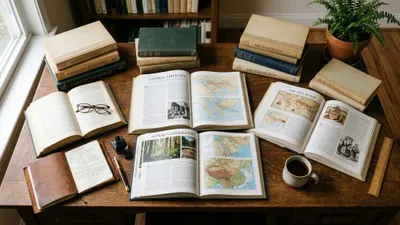
The best nonfiction book recommendations for 2026 span memoir, self-help, business, history, science, and narrative journalism — and you don’t need a literary critic on speed dial to find them.
In this guide, you’ll discover:
- 25 must-read nonfiction books across 8 categories (with honest verdicts)
- How to pick the right nonfiction book for your goals (career, growth, curiosity)
- Where to find new releases before everyone else does
- How to actually finish the nonfiction books you buy
- How to turn your own expertise into a published nonfiction book in 2026
Here are the picks, the categories, and the system that makes nonfiction reading actually pay off.
What Counts as a “Must-Read” Nonfiction Book?
A must-read nonfiction book is one that changes how you think, what you do, or both — and stays relevant beyond its publication year. The strongest picks combine a fresh angle, rigorous research or lived experience, and prose that respects your time. These criteria filter out trend-chasing titles that fade in six months.
Every recommendation below has been pressure-tested against three questions:
- Does it teach something you can’t get from a 10-minute summary?
- Will it still be cited five years from now?
- Would you actually finish it?
If the answer to all three is yes, it earned a spot.
How We Curated These Picks
You’re swimming in nonfiction recommendations from podcasts, newsletters, BookTok, and your friend who reads 100 books a year. Most of those lists copy each other.
This list pulls from a different mix. We weighed prize lists (the Pulitzer, Baillie Gifford, Andrew Carnegie Medal), critic roundups from The Washington Post, NPR, and Kirkus Reviews, and titles that working writers cite repeatedly when asked about influence. Then we cross-checked with reader scores on Goodreads and StoryGraph.
The result is a list that won’t embarrass you in front of a librarian.
Best Memoirs
Memoir is having a moment in 2026, with established literary voices and surprising debuts pushing the genre into bolder territory.
1. Strangers by Belle Burden
Best for: Readers drawn to raw, intimate accounts of grief and reinvention.
Burden’s debut chronicles her husband’s sudden departure from their marriage during the early pandemic, examining intimacy, abandonment, and the strange clarity that follows devastation. The prose is lean and unsparing.
It earns the top memoir slot because it refuses easy resolution — a rarity in the genre.
2. Famesick by Lena Dunham
Best for: Anyone curious about the cost of early fame.
Dunham returns to memoir territory with a sharper, older voice, asking whether her rise to cultural infamy was worth what it took from her. Funnier and more self-implicating than her first memoir.
3. Memorial Days by Geraldine Brooks
Best for: Readers facing loss themselves.
Brooks, the Pulitzer-winning novelist, retreats to a remote Australian island to confront her husband’s sudden death. The result is a meditation on grief that earns comparisons to Joan Didion’s The Year of Magical Thinking.
4. The Liza Minnelli Memoir
Best for: Showbiz biography fans and old-Hollywood obsessives.
Minnelli’s long-awaited memoir spans her childhood as the daughter of Judy Garland, her cabaret reign, her health battles, and the activism most people didn’t know about. Surprisingly literary.
Best Self-Help and Personal Growth
The genre is glutted with recycled advice, but a few 2025-2026 releases push past the usual frameworks.
5. Talk by Alison Wood Brooks
Best for: Anyone who freezes in conversations or wants to lead better meetings.
Harvard Business School professor Wood Brooks distills decades of dialogue research into a practical playbook. Unlike most communication books, it’s grounded in actual studies — not anecdotes from boardrooms.
6. The Book of Alchemy by Suleika Jaouad
Best for: Writers, journalers, and anyone navigating a hard chapter.
Jaouad turns her wildly popular Isolation Journals project into a guide to journaling as creative practice and therapy. Contributions from Salman Rushdie, George Saunders, and dozens of others.
7. Atomic Habits by James Clear
Best for: Anyone who’s tried and failed to build a routine.
Yes, it’s still on the list. Clear’s habit-stacking framework has held up because it’s actually testable — and the four-laws structure makes it easier to apply than most behavior-change books.
8. The Body Keeps the Score by Bessel van der Kolk
Best for: Trauma survivors and the people who love them.
Van der Kolk’s groundbreaking work on how trauma lives in the body has become foundational reading for therapists, parents, and anyone trying to understand their own reactions. Dense in places, but worth it.
Best Business and Career Books
Business nonfiction can feel like LinkedIn slop in book form. These don’t.
9. The Patagonia Story (Various Authors)
Best for: Founders who want to build something that outlives them.
A New York Times investigation into how Patagonia built a billion-dollar brand on principles most companies treat as PR. Less hagiography, more case study.
10. The Long Game by Dorie Clark
Best for: Knowledge workers stuck in short-term thinking.
Clark argues for compounding — in skills, relationships, and reputation — over the chase for quick wins. A useful antidote to hustle culture.
11. Trader Joe’s by Joe Coulombe
Best for: Retail nerds and contrarian builders.
The founder’s posthumous memoir explains how he turned a failing convenience store into a cult grocery chain by ignoring nearly every conventional rule. Surprisingly funny.
12. Working Backwards by Colin Bryar and Bill Carr
Best for: Operators inside scaling companies.
Two former Amazon executives explain the six-page memo, the working-backwards process, and the mechanisms that turned an online bookstore into the everything store.
Best History and Narrative Nonfiction
These are the books you give people who say “I don’t read nonfiction.”
13. A Flower Traveled in My Blood by Haley Cohen Gilliland
Best for: Readers who want history that reads like a thriller.
Cohen Gilliland investigates the Argentine grandmothers who tracked down children stolen during the Dirty War. Equal parts investigation, family memoir, and reckoning.
14. Empire of Pain by Patrick Radden Keefe
Best for: Anyone who wants to understand the opioid crisis.
Keefe’s investigation into the Sackler family is the gold standard of investigative narrative nonfiction. His new untitled 2026 release continues the same form.
15. Say Nothing by Patrick Radden Keefe
Best for: History readers who want literary prose.
Keefe again — because he’s that good. Say Nothing unravels a single Belfast murder into the entire story of the Troubles. If you only read one history book this year, make it this one.
16. The Wager by David Grann
Best for: Adventure-history fans.
Grann’s account of an 18th-century shipwreck and mutiny reads like fiction but is meticulously sourced. The audiobook is exceptional.
Best Science and Nature Writing
Science nonfiction has gotten dramatically better in the last decade. These represent the best of where it’s headed.
17. The Edge of Space-Time by Chanda Prescod-Weinstein
Best for: Curious non-physicists.
Prescod-Weinstein argues physics belongs to everyone — not just the people with PhDs. Lyrical, political, and accessible.
18. When the Forest Breathes
Best for: Anyone tired of doomscrolling about climate.
A reminder that the natural world has things to teach you about resilience, patience, and community. Less polemic, more meditation.
19. The Book of Birds
Best for: Casual nature readers and gift-givers.
A coffee-table-quality dive into bird habitats, songs, flight patterns, and intelligence. Beautiful enough to read with a child, dense enough for an adult.
20. An Immense World by Ed Yong
Best for: Anyone who’s ever wondered what their dog is sensing.
Yong explores how animals perceive the world — through echolocation, electric fields, magnetic sensing, and senses humans don’t even have words for. A genuine perspective-shifter.
Best Cultural and Social Commentary
These are the books that shape dinner-party conversations for the next year.
21. The Elements of Power by Nicolas Niarchos
Best for: Tech-curious readers and supply-chain nerds.
Niarchos travels the global battery supply chain to document how the green transition runs on the backs of artisanal miners in toxic conditions. Uncomfortable and necessary.
22. The Black Single Mother by Jamilah Lemieux
Best for: Anyone interested in cultural criticism done well.
Lemieux turns one of America’s most disparaged figures into the subject of careful, sympathetic, fierce examination. Personal essays interwoven with historical analysis.
Best Writing Craft and Creativity Books
Yes, this category is on the list because the best writing books are also among the best nonfiction books, period.
23. Bird by Bird by Anne Lamott
Best for: Writers stuck in self-doubt.
Lamott’s classic on writing and life remains the most quoted writing book for a reason. Funny, generous, and quietly devastating about perfectionism.
24. On Writing by Stephen King
Best for: Anyone who wants writing advice from a working pro.
Half memoir, half craft manual. King’s practical advice holds up because he tells you what he actually does, not what gurus say to do.
25. Save the Cat! Writes a Novel by Jessica Brody
Best for: Writers who feel lost in their own outlines.
Brody adapts the screenwriting beat sheet into a novel-writing framework. Hugely popular among working novelists for a reason — it’s actionable.
Quick Comparison Table: Top 10 Picks
| Book | Category | Best For | Year |
|---|---|---|---|
| Strangers | Memoir | Grief & reinvention | 2026 |
| Talk | Self-Help | Better conversations | 2025 |
| The Patagonia Story | Business | Mission-driven founders | 2025 |
| A Flower Traveled in My Blood | History | Investigative narrative | 2025 |
| Say Nothing | History | Literary history | 2018 |
| The Edge of Space-Time | Science | Accessible physics | 2026 |
| An Immense World | Science | Animal perception | 2022 |
| Atomic Habits | Self-Help | Behavior change | 2018 |
| Bird by Bird | Craft | Stuck writers | 1994 |
| Memorial Days | Memoir | Loss & recovery | 2025 |
How to Choose the Right Nonfiction Book for You
You can’t read all 25. Here’s how to narrow it down based on what you actually want.
If you want to think differently
Start with science writing or cultural commentary. An Immense World, The Edge of Space-Time, or The Elements of Power will rewire how you see something you took for granted.
If you want to do something differently
Self-help and business work best — but only the rigorous picks. Talk, Atomic Habits, and The Long Game give you frameworks, not platitudes.
If you want to feel less alone
Memoir is your category. Strangers, Memorial Days, and The Book of Alchemy sit with hard things instead of skipping past them.
If you want a great story
History and narrative nonfiction. Say Nothing, The Wager, and anything by Patrick Radden Keefe read like the best novels — except they’re true.
How to Actually Finish the Nonfiction Books You Buy
Most people buy more nonfiction than they read. The dropout rate on a typical nonfiction book is above 70% according to reading trackers like StoryGraph. Here’s how to beat the average.
Pick one at a time. You don’t read three novels simultaneously, and you shouldn’t try to read three nonfiction books either. Pick one. Finish it. Then pick the next.
Read 25 pages, then decide. If a nonfiction book hasn’t earned your trust in 25 pages, abandon it. Life is short. The good ones make their case fast.
Take messy notes. Underline. Dog-ear. Write in margins. Books you mark up are books you remember. Books you keep pristine are books you forget.
Talk about what you’re reading. Mentioning a book to one friend within a week of reading it triples retention. This is why book clubs work even when the books are mediocre.
Common Mistakes Nonfiction Readers Make
- Buying based on the cover or hype, not the table of contents. The TOC tells you whether a book is dense or padded. Read it before buying.
- Treating every book as equal. A 600-page biography deserves a different reading speed than a 200-page self-help book. Adjust accordingly.
- Skipping the introduction. The intro usually contains the author’s core argument. Skipping it is like watching a movie from the second act.
- Reading only books you already agree with. Confirmation bias is the enemy of growth. Once a quarter, read something you’ll probably argue with.
- Never returning to highlights. Marking up a book is useless if you never reread the marks. Skim your highlights once a year.
Where to Find New Nonfiction Releases
Most readers rely on the same three sources. You can do better.
Critic-driven sources: The New York Times Book Review, The Washington Post Book World, The Atlantic’s books section, and Kirkus Reviews cover serious nonfiction with depth.
Curator newsletters: Five Books, The Browser, and Brain Pickings consistently surface nonfiction picks that haven’t hit the bestseller list yet.
Prize lists: Watch the Pulitzer Prize for General Nonfiction, the Baillie Gifford Prize, and the Andrew Carnegie Medal. Prize-list books skew older and harder, but they last.
Booksellers: Independent bookstore staff picks (especially at Powell’s, The Strand, and Books Are Magic) tend to outperform algorithmic recommendations.
How Long Does It Take to Read a Nonfiction Book?
The average nonfiction book takes 8 to 14 hours to read at a normal pace — about 250-300 pages at 30 pages per hour. Dense academic or technical books can take 20+ hours, while accessible self-help and memoir often clock in under 6 hours. If you read 30 minutes a day, you’ll finish a typical nonfiction book in 3 to 4 weeks.
That works out to roughly 12-15 nonfiction books a year on a casual schedule. Doubling your reading time doubles your output. The math is friendly.
Are Audiobooks “Real” Reading for Nonfiction?
Yes. Audiobooks count as real reading for nonfiction, and research from cognitive scientists at the University of California shows comprehension is roughly equal between audio and print. The exception is dense, jargon-heavy material — for those, print wins because you can re-read passages and study diagrams.
For memoir, narrative history, and most self-help, audio is often the better experience. Author-narrated memoirs especially.
Can You Write Your Own Nonfiction Book in 2026?
Absolutely yes — and this is where Chapter comes in.
Most people who finish 25 nonfiction books a year secretly want to write one. The barrier has never been ideas. The barrier has been the time and structure required to turn expertise into a draft.
Our Pick — Chapter
Chapter is the AI book writing platform we built specifically for nonfiction authors who have something to say but no months free to draft a manuscript. You give Chapter your topic, expertise, and audience — it builds your outline, expands your chapters, and helps you edit toward something publishable.
Best for: Coaches, consultants, founders, and experts who want to turn their knowledge into a real, professional nonfiction book. Pricing: one-time (no subscription) Why we built it: Because the world’s best ideas were stuck inside the heads of people who didn’t have six months to write a book. Chapter unlocks them.
Trust signals: Chapter has helped 2,147+ authors create 5,000+ books, including clients who landed ,200 from a single book, banked K in 48 hours, and secured a speaking gig for an audience of 20,000 people. Featured in USA Today and The New York Times.
If you’re serious about turning your expertise into a published book, start with Chapter.
FAQ
What is the most popular nonfiction genre right now?
Memoir and narrative nonfiction are the most popular nonfiction genres in 2026, followed by self-help, business, and history. Memoir leads because it combines emotional intimacy with the credibility of true stories — and because audiobook adoption has supercharged the format.
How many nonfiction books should I read per year?
There’s no universal number, but most committed readers finish 12 to 24 nonfiction books per year, or roughly one to two per month. Depth beats volume — finishing 12 books and acting on three is better than skimming 50 and acting on none.
Are nonfiction books better than fiction for self-improvement?
Not necessarily. Fiction builds empathy, perspective-taking, and emotional intelligence, while nonfiction transfers explicit knowledge and frameworks. The strongest readers mix both. A diet of only nonfiction tends to produce people who know a lot but feel little.
What’s the difference between memoir and autobiography?
A memoir focuses on a specific theme, period, or experience in the author’s life, while an autobiography covers the entire arc from birth to present. Memoir is shorter, more literary, and selective. Autobiography is comprehensive and chronological. Strangers is a memoir. Benjamin Franklin’s life story is an autobiography.
How do I write my own nonfiction book?
The fastest path is to outline first, then draft chapter-by-chapter using your existing expertise as the source material. Tools like Chapter.pub can compress months of drafting into weeks by helping you outline, expand, and edit. The hardest part for most people isn’t writing — it’s structure. Solve structure first.
Where can I find nonfiction book recommendations beyond bestseller lists?
The best non-obvious sources are Five Books (expert-curated by topic), prize lists like the Pulitzer and Baillie Gifford, independent bookstore staff picks, and Substack newsletters from working authors and editors. Avoid relying solely on Amazon’s algorithm — it pushes whatever’s selling, not what’s best.
Sources: