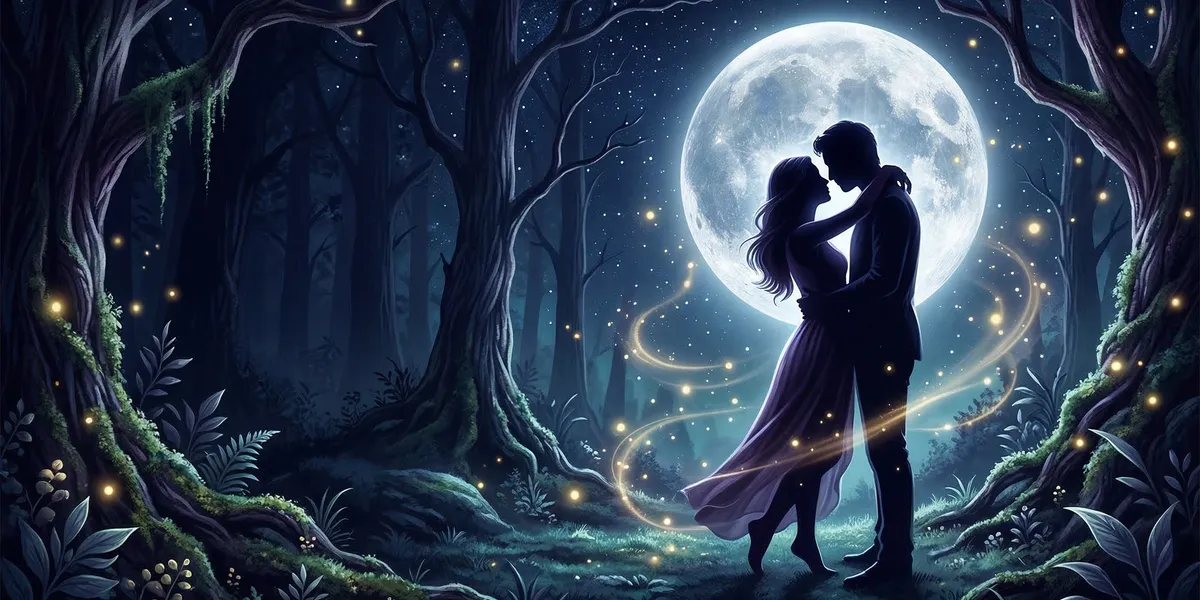
Paranormal romance places a love story inside a world where supernatural elements are real. Vampires, shifters, witches, fae, demons, angels — the specific creature matters less than what it does to the romance. Supernatural elements raise the stakes, intensify the chemistry, and give the love story obstacles that don’t exist in the real world.
The subgenre commands a devoted readership that consumes series by the dozen. Get the balance right between romance and worldbuilding, and readers will follow you for twenty books.
Types of Paranormal Romance
Vampire Romance
The original paranormal romance archetype. Vampires bring immortality (love that spans centuries), predatory desire (hunger as metaphor for passion), and the darkness/light dynamic (the dangerous lover who is drawn to someone who represents what they’ve lost).
The key tension: the vampire’s nature threatens the person they love. Whether that’s literal bloodlust or the existential weight of an immortal loving a mortal, the supernatural condition creates a built-in obstacle that mirrors real relationship fears — can someone dangerous love you without destroying you?
Tone range: From gothic and dark (Anne Rice, Kresley Cole) to romantic and brooding (Twilight) to steamy and action-packed (J.R. Ward’s Black Dagger Brotherhood).
Shifter Romance
Werewolves, bear shifters, dragon shifters, and everything else that transforms. Shifter romance leans into primal instinct — the animal side that recognizes its mate before the human side catches up. The body knows what the mind resists.
The key tension: control. A shifter who could lose control during an emotional moment (anger, passion, protectiveness) creates tension every time emotions run high. The human who loves a shifter must trust them to maintain that control — or accept the wildness.
Tone range: From dark and territorial (Kresley Cole) to cozy small-town shifter communities (T.S. Joyce) to comedic (Molly Harper).
Witch/Warlock Romance
Magic users bring power dynamics that operate differently from wealth or social status. A witch who can literally enchant someone raises questions about consent and free will that give the romance philosophical weight.
The key tension: trust. How does a non-magical partner trust that their feelings are genuine? How does a magical partner prove their love isn’t a spell? And when magic can solve most problems, what problems remain that only love can fix?
Fae Romance
Courts, bargains, beautiful cruelty, and ancient power. Fae romance (popularized explosively by Sarah J. Maas’s ACOTAR series) uses the fae’s alien morality and otherworldly beauty to create love interests who are genuinely other — not humans with powers, but beings who think differently, value differently, and love differently.
The key tension: the fae world has rules that human morality doesn’t apply to. Bargains that bind. Courts that demand loyalty over love. Beauty that conceals danger. The human (or human-adjacent) protagonist must navigate a world where the rules of romance are literally different.
Angel/Demon Romance
The forbidden love dynamic at maximum intensity. An angel who falls for a demon (or a mortal). A demon who develops a conscience through love. The theological framework — good vs. evil, salvation vs. damnation — gives the romance cosmic stakes.
The key tension: the relationship itself is the transgression. Being together defies the fundamental order of their world. This makes it the most high-stakes version of the “forbidden love” trope.
Building Your Paranormal World
The worldbuilding in paranormal romance serves the romance. Every supernatural element should create romantic tension, enable emotional moments, or raise the stakes of the love story. Worldbuilding that exists only for its own sake pulls focus from the relationship.
Rules That Matter to the Romance
Establish the supernatural rules that directly affect the love story. If your vampires can’t be in sunlight, that limits when and where the couple can be together. If your shifters lose control during the full moon, that creates a monthly crisis. If your witches must sacrifice something to use magic, what would they sacrifice for love?
The rules don’t need to be exhaustive — readers of paranormal romance are generally experienced with the genre’s conventions and will fill in gaps. Focus on the rules that create romantic tension.
The Human World Relationship
How does the supernatural world relate to the human one? Is it hidden (masquerade/secret world), integrated (everyone knows about the supernatural), or separate (the supernatural world exists in its own realm)?
This choice shapes the romance’s external conflict. A hidden supernatural world means the relationship involves secrets, cover stories, and the risk of exposure. An integrated world means the couple faces prejudice or political complications. A separate world means one character is pulled between two realities.
Power Levels and Balance
The supernatural character is almost always more physically powerful than the human or less-powerful supernatural character. This power imbalance is part of the appeal (the protector dynamic, the dangerous lover) but needs balancing.
Give the less-powerful character their own form of strength. Emotional intelligence the supernatural character lacks. A unique ability that the powerful character needs. The courage to stand up to someone who could destroy them. The power imbalance should create tension, not make one character a passive object of protection.
The Mate Bond Convention
The “fated mates” or “mate bond” is paranormal romance’s most distinctive convention. A supernatural recognition that this person is your destined partner. It’s simultaneously the genre’s most beloved element and its biggest craft challenge.
Why readers love it: The certainty is the fantasy. In a world of dating apps and situationships, the idea that the universe itself has declared “this is your person” is powerfully appealing. The mate bond removes ambiguity about whether the relationship will work — the question becomes how and when, not if.
The craft challenge: If the characters are destined to be together, where does the conflict come from? The answer is that the bond creates the attraction but doesn’t create the relationship. Two people who are supernaturally drawn to each other still need to learn to communicate, trust, compromise, and build a life together. The body recognizes the mate. The heart has to catch up.
Variations that add conflict:
- Rejected mate bond. One character rejects the bond, creating an agonizing push-pull.
- Enemies who are fated. The bond connects characters from opposing factions.
- Delayed recognition. One character feels the bond; the other doesn’t (yet).
- Broken bond. A previous bond was severed, and the character must learn to trust the new one.
Balancing Romance With Worldbuilding
This is the central craft challenge of paranormal romance. Too much worldbuilding and the romance drowns in exposition. Too little and the paranormal elements feel like a veneer over a contemporary romance.
The 70/30 principle. In paranormal romance (as opposed to romantic fantasy, which inverts this), approximately 70% of the story should serve the romance arc and 30% should serve the world/plot arc. The romance is the primary story. The supernatural world creates the conditions for that story.
Worldbuild through the romance. Instead of exposition dumps, reveal the supernatural world through romantic moments. The vampire explains their history during a vulnerable late-night conversation. The shifter’s transformation is first witnessed by the love interest in a moment of trust. The fae court’s rules are learned as the couple navigates them together.
Front-load less than you think. Readers of paranormal romance are genre-savvy. They know how vampires work. They understand mate bonds. You don’t need to explain everything before the story starts — you need to explain what’s different about your version, and you can do that gradually.
Heat Expectations
Paranormal romance tends to run hotter than many other romance subgenres. The supernatural elements — heightened senses, supernatural stamina, predatory instinct, the mate bond’s physical pull — naturally escalate physical intensity.
Sweet/clean paranormal romance exists and has a readership, but it’s the exception. Most paranormal romance readers expect at least warm-to-steamy heat levels, and many of the subgenre’s bestselling series (Black Dagger Brotherhood, Dark-Hunter, Immortals After Dark) are explicitly steamy.
The supernatural element should affect intimacy. A vampire’s heightened senses make every touch more intense. A shifter’s instinct adds urgency and protectiveness. A witch might literally feel their partner’s pleasure through magic. If the supernatural nature doesn’t influence the intimate scenes, you’re missing an opportunity.
Series Structure
Paranormal romance is overwhelmingly a series genre. Single-title paranormal romances exist but are far less common than interconnected series.
The group model. A coven, pack, court, or brotherhood provides the series framework. Each book features a different member finding their mate while advancing an overarching plot that spans the series. J.R. Ward’s Black Dagger Brotherhood and Kresley Cole’s Immortals After Dark are the templates.
The couple-focused series. One couple across multiple books, with the supernatural world providing escalating threats. Twilight follows this model. It works but requires stronger external plot to sustain multiple books with the same couple.
The world-expansion model. Each book explores a different corner of the paranormal world. Book one is vampires, book two shifts to the shifter pack in the same world, book three introduces the witch council. This approach builds a rich world while keeping each romance fresh.
Famous Examples
Twilight by Stephenie Meyer. Regardless of literary opinion, Twilight redefined paranormal romance for a generation and proved the commercial ceiling of the subgenre. The human-vampire dynamic, the love triangle, and the mate bond (imprinting) became cultural touchstones.
A Court of Thorns and Roses by Sarah J. Maas. The series that launched the modern fae romance explosion. Maas blends fantasy worldbuilding with intense romance, demonstrating how to balance world-scale plot with deeply personal love stories.
Black Dagger Brotherhood by J.R. Ward. The template for steamy, action-packed paranormal romance series. Each book focuses on a different warrior vampire finding his mate while the overarching conflict with the enemy escalates.
Immortals After Dark by Kresley Cole. A sprawling paranormal world where vampires, Valkyries, shifters, and demons intersect. Cole’s series demonstrates how to create a rich paranormal ecosystem where every creature type gets representation and every book expands the world.
Moon Called by Patricia Briggs (Mercy Thompson series). Urban fantasy with strong romance elements, featuring a mechanic who is also a coyote shifter navigating werewolf pack politics. The slower romance build across the series shows how paranormal romance can develop over multiple books.
Writing Paranormal Romance With Chapter
Paranormal romance demands both consistent worldbuilding and romance pacing — the supernatural rules need to stay consistent while the emotional arc builds naturally. Chapter’s fiction software handles this with its romance beat sheet mapped to your supernatural world, tracking how the mate bond, magical conflicts, and romantic milestones intersect across the full manuscript. The series management feature is critical for paranormal romance writers — it maintains your world’s rules, character abilities, and relationship dynamics across up to nine books. And the heat-level control keeps your intimate scenes consistent with the supernatural intensity your readers expect. Sarah M. hit #12 in Romance Contemporary in five days — Chapter’s structure works across every romance subgenre.