Plot structure is the sequence of events that forms the backbone of a story. It determines when tension builds, when secrets are revealed, and when the whole thing comes crashing down in the best possible way.
Every novel you have ever loved follows a plot structure — whether the author chose it deliberately or stumbled into it by instinct.
What Is Plot Structure
Plot structure is the architectural blueprint of a narrative. It organizes the events of a story into a pattern that creates rising tension, emotional engagement, and satisfying resolution.
Think of it like the frame of a house. Readers never see the frame directly, but without it, the walls collapse. A well-chosen structure gives your story momentum. A missing or broken one is why drafts feel like they are “going nowhere” around the midpoint.
Several models exist for mapping plot structure. The most widely used are the Three-Act Structure, Freytag’s Pyramid, the Hero’s Journey, and the Save the Cat Beat Sheet. Each describes the same fundamental shape — tension rises, peaks, and resolves — but slices it differently.
The Major Plot Structure Models
Three-Act Structure
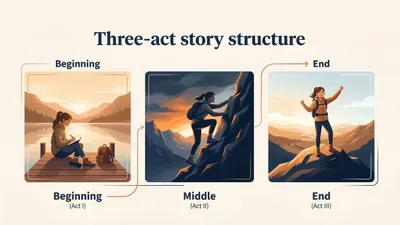
The simplest and most universal framework. Nearly every Hollywood screenplay and most commercial novels follow it.
| Act | Purpose | Roughly |
|---|---|---|
| Act I — Setup | Introduce the character, world, and central conflict | First 25% |
| Act II — Confrontation | The character pursues their goal and faces escalating obstacles | Middle 50% |
| Act III — Resolution | The climax and its aftermath | Final 25% |
In practice: In The Hunger Games, Act I ends when Katniss volunteers and arrives at the Capitol. Act II is the training, alliance-building, and the Games themselves. Act III is the final confrontation and the rule-breaking decision to eat the berries.
The Three-Act Structure is a starting point, not a straitjacket. Most other models are just more granular versions of this same shape.
Freytag’s Pyramid
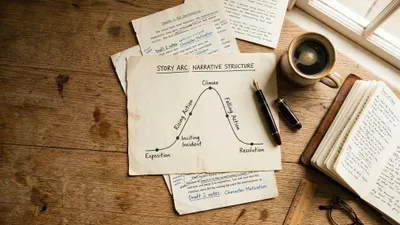
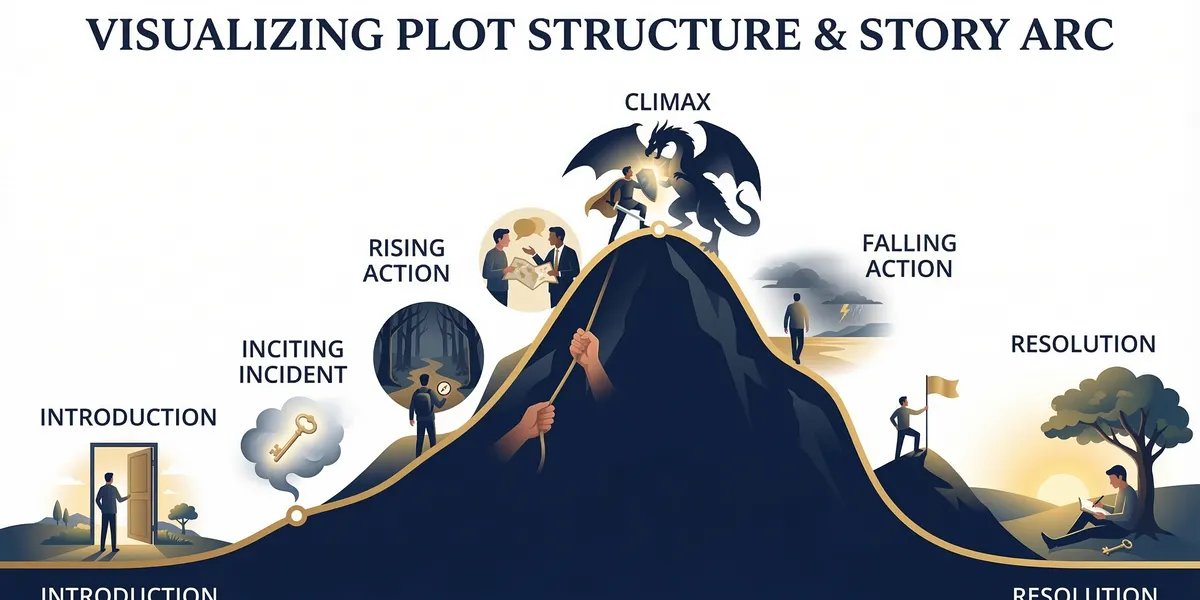
Developed by Gustav Freytag in 1863, this model breaks plot into five stages and maps them as a pyramid — action rises to a peak and then falls.
- Exposition — The status quo. Characters, setting, and stakes are established.
- Rising Action — Complications pile up. Each scene raises the tension higher than the last.
- Climax — The turning point. The highest moment of tension where the central conflict reaches its peak.
- Falling Action — Consequences of the climax play out. Loose threads begin to resolve.
- Denouement — The new normal. The story settles into its ending.
In practice: In Pride and Prejudice, the exposition establishes the Bennet family and their need for advantageous marriages. Rising action builds through Darcy and Elizabeth’s misunderstandings. The climax is Darcy’s letter after Elizabeth’s rejection. Falling action traces their gradual reconciliation. The denouement is their engagement and the resolution of the Lydia-Wickham subplot.
Freytag originally designed this for classical tragedy, but the model adapts well to any genre. The key insight is that falling action matters as much as rising action — readers need time to process the climax before the story ends.
The Hero’s Journey
Joseph Campbell identified this pattern across world mythology, and Christopher Vogler adapted it for modern storytelling. It maps a character’s transformation through twelve stages, grouped into three movements.
Departure: The hero lives in their ordinary world, receives a call to adventure, resists it, meets a mentor, and crosses the threshold into the unknown.
Initiation: The hero faces tests, allies, and enemies. They approach the central ordeal, survive it, and seize the reward.
Return: The hero heads home, faces a final test, and returns transformed with the “elixir” — whatever they gained from the journey.
In practice: Harry Potter and the Philosopher’s Stone follows this almost beat for beat. Ordinary world (Privet Drive), call to adventure (Hogwarts letter), mentor (Hagrid, then Dumbledore), threshold (Platform 9 3/4), ordeal (the trials guarding the Stone), and return (back to Privet Drive, transformed).
The Hero’s Journey works best for adventure, fantasy, and coming-of-age stories. It can feel forced in literary fiction or romance, where the transformation is internal rather than quest-driven.
Save the Cat Beat Sheet
Blake Snyder’s model, originally for screenwriters, has been adopted by commercial fiction authors who want precise pacing. It prescribes fifteen specific beats with suggested page counts.
The key beats include:
- Opening Image — A snapshot of the “before” state
- Catalyst — The event that sets everything in motion (around the 10% mark)
- Midpoint — A false victory or false defeat that raises the stakes (50% mark)
- All Is Lost — The lowest point, often paired with a “whiff of death” (75% mark)
- Finale — The hero applies everything they have learned to defeat the antagonist
In practice: Many bestselling thrillers and romance novels follow the Beat Sheet closely. The precision makes it especially useful for writers who struggle with sagging middles — the Midpoint beat forces a major event at the halfway mark instead of letting the story drift.
Examples of Plot Structure in Published Novels
Seeing structure in books you have already read makes the concept stick.
The Great Gatsby (Three-Act Structure) Act I introduces Nick, the world of West Egg, and the mystery of Gatsby. Act II is the escalating tension of the affair, the confrontation at the Plaza Hotel, and Daisy’s hit-and-run. Act III is the aftermath — Gatsby’s murder, the empty funeral, and Nick’s disillusionment.
To Kill a Mockingbird (Freytag’s Pyramid) Exposition builds the world of Maycomb and the children’s fascination with Boo Radley. Rising action layers in the Tom Robinson trial. The climax is the guilty verdict. Falling action follows Bob Ewell’s threat. The denouement is Boo Radley saving the children — tying both plotlines together.
The Lord of the Rings (Hero’s Journey) Frodo’s ordinary world is the Shire. The call is Gandalf’s revelation about the Ring. The threshold is leaving the Shire. Tests and allies fill the middle volumes. The ordeal is Mount Doom. The return — and the bittersweet cost of the journey — is the Scouring of the Shire and the Grey Havens.
How to Choose a Plot Structure for Your Story
You do not need to pick one model and follow it rigidly. Most experienced writers internalize several and blend them. Here is how to decide where to start.
Start with Three-Act if you are new to structure. It is flexible enough to accommodate any genre and simple enough that it will not overwhelm your creative process. Once you have a working draft, you can overlay more detailed models to diagnose pacing issues.
Use Freytag’s Pyramid if your story is character-driven. The explicit falling action stage reminds you to give emotional consequences room to breathe. Literary fiction and tragedies benefit from this model.
Use the Hero’s Journey if your protagonist goes on a literal or figurative quest. Fantasy, sci-fi, adventure, and coming-of-age stories map naturally to its stages. If your character does not transform, this model will fight you.
Use Save the Cat if you want precise pacing. Commercial fiction — thrillers, romance, YA — benefits from its specific beat targets. If your drafts tend to sag in the middle, the Midpoint beat alone is worth the framework.
Combine models freely. You might use Three-Act as your macro structure while hitting Save the Cat beats within each act. Or use the Hero’s Journey for your protagonist’s arc while structuring subplots with Freytag’s Pyramid.
Plot Structure vs. Story Structure
These terms are often used interchangeably, but a useful distinction exists.
Plot structure refers specifically to the sequence of events — what happens and when. It is about external action and pacing.
Story structure is broader. It includes plot structure but also encompasses character arcs, thematic development, and the emotional journey the reader experiences.
A story can have strong plot structure (events are well-paced and causally connected) but weak story structure (the character does not change, or the theme goes nowhere). The reverse is rarer but possible — a deeply felt character transformation in a meandering plot.
When writers say a draft “has no structure,” they usually mean plot structure. When they say it “feels hollow,” they often mean story structure. Both matter. Plot structure is the easier one to learn and fix.
If you are looking for tools to help you map out your plot, an AI plot generator can be a useful brainstorming partner — especially for testing how different structures fit your premise before committing to a full draft.