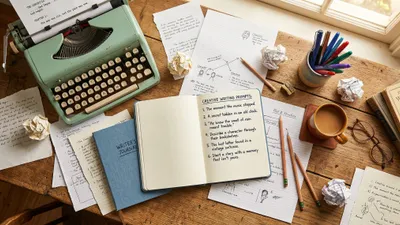
These poetry prompts are for anyone staring at a blank page, waiting for the right words to arrive. Pick one, set a timer, and write without stopping.
Nature & Seasons
- Write about the exact moment a rainstorm stops and the world goes silent.
- Describe a tree you climbed as a child — from the tree’s perspective.
- A river is carrying something it shouldn’t. What is it, and where did it come from?
- Write about the color green without ever using the word “green.”
- The last firefly of summer blinks out. What happens next?
- Describe frost forming on a window at 4 a.m., one crystal at a time.
- A wildflower grows through a crack in a highway median. Give it a voice.
- Write about the smell of earth after the first rain of spring.
- The moon is full and something in the woods is awake that shouldn’t be.
- Describe autumn as if it were a person arriving uninvited to a party.
- Write about a body of water you’ve stood beside — focus only on the sound it made.
- A single leaf falls from a branch. Track its entire journey to the ground.
- The sun sets in a color you’ve never seen before. Name it.
- Write about winter from the perspective of a hibernating animal waking too early.
Love & Relationships
- Describe love using only objects found in a kitchen.
- Write about the last normal moment before you knew you were in love.
- Two people sit in a car in silence. One of them is about to say something that changes everything. Write what comes before.
- Describe the space between two people holding hands on a park bench.
- Write a love poem where the word “love” never appears.
- A voicemail you never deleted. What does it say?
- Write about someone you loved who spoke a different language — focus on what was understood without words.
- Describe the exact way a specific person laughs.
- Write about a relationship that only existed in letters.
- The last dance at a wedding where nobody is watching anymore.
- Write about learning to sleep alone again after sharing a bed for years.
- A couple argues about something small that is really about something enormous. Write only the small thing.
Loss & Memory
- Write about a room you can no longer enter.
- Describe the weight of a phone call you knew was coming.
- An object that belonged to someone who is gone sits on a shelf. You pick it up.
- Write about a smell that instantly transports you to a moment you can’t return to.
- The last voicemail from someone who has died. You’ve memorized every pause.
- Write about forgetting — the specific terror of a face becoming blurry.
- Describe grief as weather.
- A chair at a dinner table that stays empty. Write about the meal around it.
- Write about the moment you realized a friendship was over — not with a fight, but with silence.
- You find a photograph you don’t remember being taken. Write about what you were thinking in that frozen moment.
- Describe the sound of a house after everyone has moved out.
- Write about inheriting something you don’t want but can’t throw away.
- A song comes on that belonged to someone else. Write about listening to it now.
Identity & Self-Discovery
- Write a poem titled with your name, but it’s about someone you haven’t become yet.
- Describe your hands — what they’ve built, broken, held, and let go.
- Write about a version of yourself that only exists in other people’s memories.
- What is the first lie you remember telling? Write about what was true underneath it.
- Describe your body as a landscape — what are the mountains, valleys, rivers?
- Write about a word in another language that describes something you’ve always felt but never had a name for.
- The mirror shows you at age 10, 25, and 70 simultaneously. Write what each version says to the others.
- Write about something you pretend not to care about.
- Describe the moment you stopped trying to be someone else.
- Write about the gap between who you are at home and who you are in public.
- You open a door and find a room full of every version of yourself. Who speaks first?
- Write about a scar — visible or invisible — and the story you tell about it versus the real one.
Everyday Objects & Moments
- Write an ode to a coffee mug that has survived ten years of mornings.
- Describe the life cycle of a grocery list — from scribbled note to crumpled receipt.
- Write about the last five minutes before an alarm goes off, from the perspective of the sleeping person’s dream.
- A pair of shoes by the front door. Where have they been today?
- Describe the sound of a house settling at night to someone who has never heard it.
- Write about waiting — in a line, in a doctor’s office, for a text back.
- The junk drawer. Pick three objects and tell the story that connects them.
- Write about a light left on in an empty room.
- Describe the moment you realize you’ve been reading the same sentence for five minutes.
- Write about a meal someone cooked for you when you were sick.
- A set of keys that no longer open anything. Why do you still have them?
- Describe your morning commute as if you were seeing everything for the first and last time.
Social Issues & Justice
- Write from the perspective of a statue being taken down.
- A border is a line on a map. Write about what it feels like to stand on one.
- Describe clean drinking water to someone who has never had reliable access to it.
- Write about a protest sign left on the ground after everyone has gone home.
- A child asks why some people sleep outside. Write the answer you actually give versus the one you want to give.
- Write about a language that is dying — who speaks its last words?
- Describe the difference between a house and a home when you can’t afford either.
- Write about a name that was taken and the one that was given.
- A headline you read this morning that you’ll forget by tonight. Why does that matter?
- Write about silence — the kind that is chosen, and the kind that is forced.
- Describe hope as something you can hold in your hand.
Fantasy & Imagination
- Write a poem set in a library where every book is a door to another world. Which one do you open?
- You can hear colors. Describe a sunset.
- Death takes a day off. Write about what doesn’t happen.
- A city exists at the bottom of the ocean. Write about its morning rush hour.
- Write a conversation between the moon and a satellite.
- Gravity reverses for exactly one minute. What do you reach for?
- Describe a planet where memories are currency.
- You wake up and discover you’ve been a character in someone else’s poem. Write your response.
- A ghost returns to haunt its own childhood home, but the wallpaper has changed. Write about what the ghost misses most.
- Write about a clock that counts something other than time.
- You find a door in a forest that wasn’t there yesterday. It’s labeled with your name.
- Describe a color that doesn’t exist yet. What would it feel like to see it?
Constraint Prompts
- Write a haiku about something you’ve lost. (5-7-5 syllable structure, no title.)
- Write a poem in exactly ten words about the ocean.
- Compose a six-line poem where every line begins with “I never.”
- Write a poem using only one-syllable words about something complicated.
- Write a sonnet about your phone. (14 lines, iambic pentameter, rhyme scheme ABAB CDCD EFEF GG.)
- Compose a poem where every sentence is a question.
- Write a limerick about existential dread.
- Write a poem that is also a list of instructions for something mundane — folding laundry, making toast — but is secretly about heartbreak.
- Compose a poem where the last word of each line becomes the first word of the next.
- Write a poem in the shape of the object it describes (concrete poetry).
- Write a poem with exactly three sentences — one short, one long, one medium.
- Compose a poem using only words found on the first page of the nearest book to you right now.
- Write a poem where every line is exactly six words.
- Write a ghazal about home. (Couplets with a repeated end-word, each couplet self-contained.)
Sensory Prompts
- Write about the smell of a library — old paper, dust, binding glue, and something alive underneath.
- Describe the texture of a peach to someone who has never touched one.
- Write about a sound you heard once and have never been able to forget.
- Describe the taste of a word. Pick any word. What does it taste like on your tongue?
- Write about the feeling of cold water on sunburned skin.
- Describe the sound of a city waking up, one noise at a time.
- Write about the smell of someone’s coat — what it tells you about where they’ve been.
- Describe the texture of time passing during a long afternoon with nothing to do.
- Write about a taste that makes you homesick.
- Describe the sound of your own breathing in a room so quiet you can hear your pulse.
First Line Starters
- “I stopped counting the days when…”
- “The last honest thing I said was…”
- “My mother’s hands always smelled like…”
- “If you could hear what the rain says…”
- “I kept the receipt for…”
- “There is a country inside my chest where…”
- “The thing about disappearing is…”
- “I learned the word for it years later —”
- “You left your shadow in my hallway and…”
- “Before the diagnosis, we used to…”
- “I have been the wrong kind of quiet.”
- “Somewhere, a version of me is…”
- “The town I grew up in smells like…”
- “I carry you the way a river carries…”
- “Nobody warns you about the ordinary grief of…”
How to Turn a Poetry Prompt into a Finished Poem
A prompt is a starting point, not a destination. Here’s how to move from spark to finished piece.
Write without editing. Set a timer for 10 minutes and respond to the prompt without stopping. Don’t worry about line breaks, rhythm, or whether it’s “good.” The goal is raw material.
Find the real poem inside the draft. Read what you wrote and circle the one line that surprises you. That line is probably the actual heart of the poem. Cut everything that doesn’t serve it.
Read it out loud. Poetry lives in the mouth. If a line trips your tongue, rewrite it. If a stanza feels flat, it probably is. Your ear knows things your eyes miss.
Choose a form — or break one intentionally. Constraints breed creativity. Try shaping your free-write into a sonnet, a ghazal, or a series of couplets. If the form fights the content, that tension might be exactly what the poem needs.
Let it rest. Put the poem away for a day. When you come back, you’ll see it with fresh eyes and know immediately what to keep and what to cut.
If you’re building a full poetry collection and want help organizing your work from prompts to polished manuscript, Chapter.pub is built for exactly that — structuring, writing, and publishing your book from first draft to finished product.