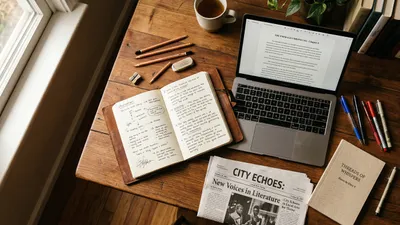
These poetry writing prompts are built to sharpen your craft, not just fill a page. Each one targets a specific skill — imagery, form, sound, constraint, or perspective — so every poem you draft teaches you something.
Pick one. Set a timer for fifteen minutes. Write without stopping.
Imagery and Sensory Detail
These prompts train you to write with concrete, physical detail instead of abstract statements.
- Describe the inside of your refrigerator using only smell and texture.
- Write about a thunderstorm without mentioning rain, lightning, or thunder.
- A stranger’s hands at a bus stop. What do they tell you?
- Capture the sound of an empty house at 2 a.m. — no visual descriptions allowed.
- Write about hunger as if it were a landscape you could walk through.
- Describe a specific shade of blue by comparing it to three memories.
- The taste of a word. Pick any word and write a poem about what it would taste like on your tongue.
- Write about heat using only cold imagery.
- A piece of fruit is rotting on the counter. Slow it down to one hour per line.
- Describe a city intersection using only sound.
Form-Based Challenges
Each prompt locks you into a specific poetic form. Constraints breed creativity.
- Write a haiku about a moment of regret. Stick to the 5-7-5 syllable count and include a seasonal reference.
- Draft a Shakespearean sonnet (ABAB CDCD EFEF GG) about an argument with someone you love.
- Write a villanelle where the repeating lines are a question and its answer.
- Compose a limerick about a serious topic — death, taxes, or heartbreak.
- Write a tanka (5-7-5-7-7) about the last text message you received.
- Draft a pantoum about a recurring dream. Let the repeating lines build obsession.
- Write a ghazal about longing. Each couplet must be self-contained but connected by the refrain.
- Compose a cinquain (2-4-6-8-2 syllable pattern) about an ordinary object on your desk.
- Write a concrete poem where the shape of the text on the page mirrors the subject.
- Draft a sestina using these six end-words: salt, window, hand, dark, river, open.
First Line Starters
Sometimes the hardest part is the first line. These give you one. Write whatever follows.
- “I stopped believing in maps the day I found — ”
- “The thing about silence is it has a color.”
- “My mother’s kitchen smelled like — ”
- “There is a door I keep walking past.”
- “The last honest thing I said was — ”
- “Before the diagnosis, I used to — ”
- “This is not a love poem, but — ”
- “I inherited my grandmother’s hands and nothing else.”
- “The ocean does not care about your metaphors.”
- “Every scar has a season.”
Sound and Musicality
Poetry lives in the ear as much as the eye. These prompts make you listen to your own language.
- Write a poem using only one-syllable words.
- Draft eight lines where every line ends with an “-ing” word, but no two lines have the same rhythm.
- Write a poem built entirely on alliteration — every word in each line starts with the same letter.
- Compose a poem in iambic pentameter about doing laundry.
- Write four couplets that rhyme, then break the pattern in the final couplet. Make the break meaningful.
- Draft a poem where every line contains an internal rhyme hidden in the middle.
- Write about anger using only soft, quiet sounds — no hard consonants (k, t, p, g, d).
- Compose a poem that sounds like a lullaby but is about something unsettling.
- Write a poem where the last word of each line becomes the first word of the next.
- Draft a poem using assonance (repeated vowel sounds) to create a mood of unease.
Constraint Prompts
Artificial limits force your brain off its default path. These are deliberately restrictive.
- Write a poem in exactly 50 words. Not 49. Not 51.
- Compose a poem using only words from a single page of a dictionary. Pick the page at random.
- Write a love poem without using the words love, heart, soul, or forever.
- Draft a poem where every line is a question.
- Write a poem using only words you could find on a grocery receipt.
- Compose a poem with no adjectives. Zero. Rely on nouns and verbs alone.
- Write a poem backward — the last line is the first line of the story, the first line is the conclusion.
- Draft a poem of exactly fourteen lines where no line exceeds four words.
- Write about grief using only the language of weather forecasts.
- Compose a poem where every sentence is a lie, but the poem tells the truth.
Perspective Shifts
These prompts push you out of your own head and into unfamiliar points of view.
- Write from the perspective of a statue in a public park. What has it watched for fifty years?
- You are the last book on a library shelf that no one has checked out in a decade. Speak.
- A stray dog in a city you have never visited. Write its evening.
- Draft a poem from the point of view of a river — not the romantic version, the real one, carrying trash and sediment and memory.
- Write as your own skeleton. What does it know that you do not?
- A house is being demolished. Write from the house’s perspective.
- You are a letter that was written but never sent. What do you say from inside the drawer?
- Write from the perspective of a word that has fallen out of common use.
- A mirror in a hotel room. Write about every face it has seen this week.
- You are the echo in an empty cathedral. What are you still holding onto?
Emotion and Memory
These prompts dig into personal experience. Write fast, edit later.
- The last meal you ate with someone who is no longer alive. Focus on the food.
- Write about a place you can never return to — not because it is gone, but because you have changed.
- A fight you lost, not the argument kind but the kind where you gave in. What did giving in feel like?
- The moment right before you cried in public. Stay in that moment.
- Write about joy as if explaining it to someone who has never felt it.
- A childhood toy you forgot about until right now. Where is it?
- The specific silence after someone says something they cannot take back.
- Write about a scar — not what caused it, but what it felt like to watch it heal.
- The longest night of your life. Do not explain why it was long. Just describe the night.
- Write about forgiveness from the body’s perspective — not the mind’s.
Nature and the World
These go beyond simple observation. Each prompt asks you to transform what you see.
- A single tree in a parking lot. Write its biography.
- Describe a sunset without using any color words. Rely on metaphor and simile instead.
- Write about the ocean as a factory — what does it produce?
- A field of wildflowers from the perspective of the soil beneath them.
- The moon as a character witness in a trial. What testimony does it give?
- Write about a mountain as if it were tired and wanted to lie down.
- A rainstorm as an orchestra. Assign instruments to each part.
- Describe a forest fire in the language of desire.
- Write about winter as an uninvited guest who stays too long.
- A garden is overgrown because someone stopped tending it. Write about who left and why, but only through the details of the garden.
Experimental and Hybrid Prompts
For writers who want to push outside conventional poetry.
- Write a poem as a recipe. The dish does not have to be food.
- Draft a poem structured as a list of things your character would pack in a suitcase if they had to leave home in ten minutes.
- Write a poem that is also a set of directions to a place that does not exist.
- Compose an erasure poem — take a page from a news article, cross out words, and see what poem remains.
- Write a poem in the form of a voicemail no one will listen to.
- Draft a poem as a museum exhibit label for an imaginary artifact.
- Write a poem that is a series of deleted text messages.
- Compose a poem in the form of a math proof, but the thing being proven is an emotion.
- Write a found poem using only words from your last five emails.
- Draft a poem structured as a FAQ page for something that cannot be explained.
How to Turn a Poetry Writing Prompt into a Finished Poem
A prompt gets the words on the page. Revision turns those words into a poem.
After you draft, try this: read the poem aloud. Mark every line where your voice stumbles or your attention drifts. Those are the weak spots. Cut or rewrite them.
Then ask yourself three questions. Does every line earn its place? Is there a moment of surprise or shift? Could a stranger read this and feel something specific?
If you are building a body of work — a chapbook or a full poetry collection — prompts are how you generate raw material. Not every prompted poem will survive revision, and that is exactly the point. You need volume to find the pieces that matter.
For poets working on a manuscript, Chapter.pub can help you organize, sequence, and format your collection. It is built for authors assembling longer works from individual pieces — which is exactly what a poetry book requires.
If you want to learn the fundamentals of how to write a poem or you are ready to submit your work for publication, those guides will take you through each step.
Now pick a prompt, open a blank page, and write.