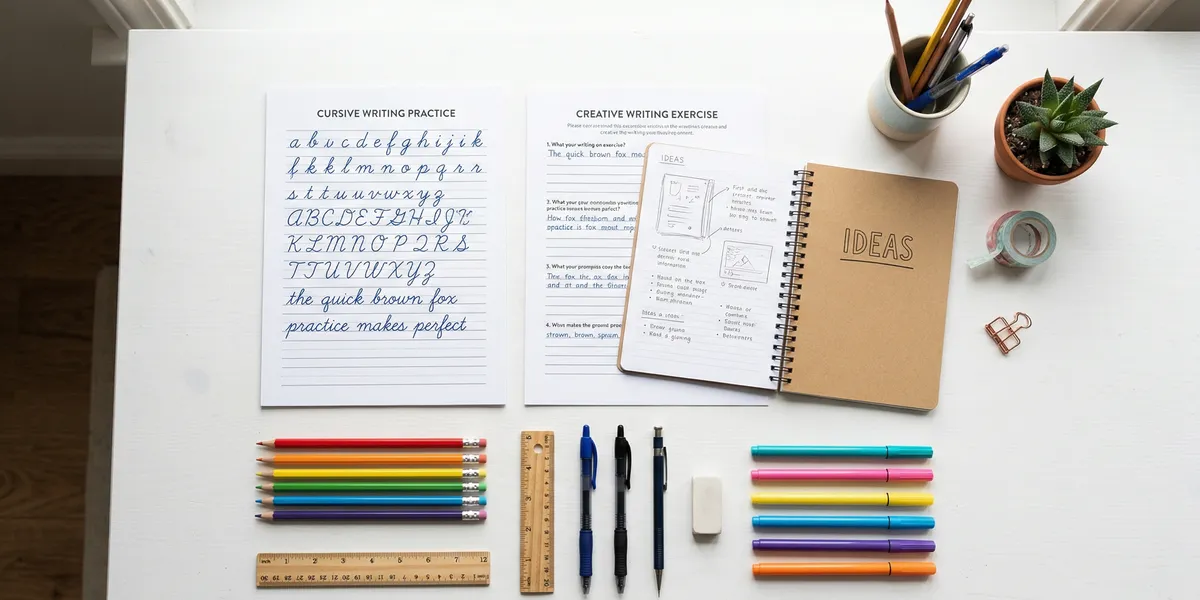
Good practice writing worksheets do more than fill a page. They target specific skills, build muscle memory, and give you concrete ways to measure improvement.
Whether you’re a complete beginner working on sentence construction or an experienced writer sharpening your craft, the exercises below will push your writing forward. Each section focuses on a different skill area and includes worksheets you can use immediately.
How to Use These Writing Worksheets
Don’t try to complete every exercise in one sitting. Pick the skill area where you need the most growth and start there.
For best results:
- Set a timer. Most exercises work best with 10-15 minute time limits. Constraints force creativity.
- Write by hand first. Research from the University of Tokyo shows handwriting activates deeper cognitive processing than typing.
- Don’t edit while writing. Complete the exercise first. Evaluate afterward.
- Repeat weekly. One round won’t transform your writing. Regular practice will.
Section 1: Grammar and Sentence Structure Worksheets
Strong grammar is the foundation of clear communication. These exercises isolate common problem areas.
Exercise 1.1: Active Voice Conversion
Rewrite each passive sentence in active voice.
| Passive Voice | Your Active Version |
|---|---|
| The report was written by the committee. | |
| The cake was eaten by the children before noon. | |
| A decision will be made by the board next Tuesday. | |
| The ball was thrown over the fence by Marcus. | |
| New regulations have been proposed by the agency. |
Why this matters: Active voice is more direct and engaging. It forces you to identify who is doing the action, which almost always makes your writing clearer. Our how to write guide covers this principle in depth.
Exercise 1.2: Sentence Combining
Combine each pair of short sentences into one fluid sentence without losing any information.
- The dog sat on the porch. The dog was old and tired.
- Maria finished her manuscript. She sent it to three publishers.
- The restaurant opened last month. It already has a two-week waitlist.
- Rain fell all morning. The soccer game was canceled.
- He studied architecture in college. He now designs hospitals.
Goal: Practice varying your sentence structure. Good writing mixes short and long sentences for rhythm.
Exercise 1.3: Comma Placement
Add commas where needed in these sentences. Some may be correct as written.
- After the meeting ended we went to lunch.
- The author who wrote the bestseller lives in Portland.
- I need to buy eggs milk bread and butter.
- She didn’t just edit the manuscript she rewrote it entirely.
- On Tuesday the publisher called with good news.
Check your work against the rules at Purdue OWL’s comma guide.
Section 2: Style and Voice Worksheets
Style separates competent writing from memorable writing. These exercises help you find and strengthen your voice.
Exercise 2.1: Tone Shifting
Write a single paragraph about making coffee. Then rewrite that same paragraph three times, each in a different tone:
- Academic/formal tone
- Humorous/casual tone
- Suspenseful/dramatic tone
The content stays the same. Only the style changes. This exercise teaches you that how you say something matters as much as what you say.
For a deeper understanding of different approaches, read our guide on writing styles.
Exercise 2.2: Word Economy
Take this 68-word paragraph and rewrite it in 35 words or fewer without losing the core meaning:
“There are many different reasons why people from all walks of life and backgrounds decide to write a book about their personal experiences and life stories. Some people want to help others by sharing what they have learned, while other people simply feel a deep personal need to get their story out into the world for others to read and understand.”
Target: Under 35 words. This is harder than it sounds.
Exercise 2.3: Show Don’t Tell
For each “telling” statement, write 2-3 sentences that show it instead.
- “She was nervous.”
- “The town was run down.”
- “He loved cooking.”
- “The meeting went badly.”
- “It was a beautiful morning.”
Example:
- Telling: “He was angry.”
- Showing: “He gripped the steering wheel until his knuckles turned white. When the light changed, he hit the gas hard enough to chirp the tires.”
Section 3: Storytelling and Creative Writing Worksheets
Storytelling isn’t just for fiction writers. Nonfiction authors, marketers, and business professionals all need to tell compelling stories.
Exercise 3.1: The Five-Sentence Story
Write a complete story in exactly five sentences. Each sentence must serve a purpose:
- Setup — Introduce the character and situation
- Conflict — Something goes wrong or changes
- Escalation — The problem gets worse or more complex
- Climax — The decisive moment
- Resolution — The outcome
Do this five times with different characters, settings, and conflicts. This exercise forces you to distill storytelling to its essential elements.
Exercise 3.2: Dialogue Practice
Write a conversation between two characters who want opposite things. Rules:
- No dialogue tags other than “said” and “asked”
- Each character must have a distinct speaking pattern
- The conversation must be at least 10 exchanges
- One character must change their position by the end
Strong dialogue is one of the hardest writing skills to develop. This exercise builds it through direct practice. If fiction interests you, explore our fantasy writing prompts or horror writing prompts for additional story starters.
Exercise 3.3: Opening Line Workshop
Write 10 different opening lines for the same story concept. A detective arrives at a crime scene on a rainy night.
Vary your approach:
- Start with action
- Start with dialogue
- Start with setting description
- Start with an internal thought
- Start with a surprising statement
Then rank them from strongest to weakest. What makes the good ones work?
According to The Writer magazine, the first line determines whether most readers continue or stop. Practice writing strong ones.
Section 4: Nonfiction Structure Worksheets
Clear structure separates helpful nonfiction from confusing content. These exercises train your ability to organize information.
Exercise 4.1: Outline from Chaos
Below are 10 disconnected facts about a topic. Organize them into a logical outline with 3-4 main sections and supporting points under each.
Topic: Starting a Vegetable Garden
- Tomatoes need 6-8 hours of sunlight daily
- Sandy soil drains too quickly for most vegetables
- Start seeds indoors 6-8 weeks before the last frost
- Raised beds give you more control over soil quality
- Water deeply twice a week rather than lightly every day
- Companion planting can reduce pest problems
- Most beginners should start with 4-6 plant varieties
- Compost improves any soil type
- Garden zones determine what grows in your region
- Harvest in the morning when produce is coolest
Your outline:
Create three to four main headings and sort each fact as a supporting point. This mirrors the actual process of structuring a blog post, article, or book outline.
Exercise 4.2: Summary Writing
Read any article from a source like The Atlantic or Wired. Then:
- Write a one-sentence summary of the main argument
- Write a one-paragraph summary (50 words max)
- Write a three-paragraph summary with the main argument, key evidence, and conclusion
This skill is essential for research-based writing. It also trains you to identify the core point of any piece — a skill that strengthens everything you write. Our guide on how to write a summary breaks this down further.
Exercise 4.3: Explanation Scaling
Pick any concept you understand well (a hobby, work process, or skill). Write three explanations:
- For a 10-year-old (simple language, analogies, no jargon)
- For a peer (some shared knowledge assumed)
- For an expert (technical language appropriate, focus on nuance)
This exercise teaches audience awareness — arguably the most important nonfiction writing skill.
Section 5: Daily Writing Warm-Ups
Use these as 10-minute warm-ups before your main writing session.
| Day | Warm-Up Exercise |
|---|---|
| Monday | Write about one thing you observed yesterday in 150 words |
| Tuesday | Describe a room you’re in using only sensory details (no opinions) |
| Wednesday | Write a persuasive paragraph about an opinion you don’t hold |
| Thursday | Take a paragraph from your current project and rewrite it in half the words |
| Friday | Write a letter to someone explaining why they should read your favorite book |
| Saturday | Free write for 10 minutes without stopping — don’t lift your pen |
| Sunday | Review your week’s warm-ups and identify one technique to improve |
These daily exercises build the writing habit that research from Psychology Today confirms is more important than talent for long-term improvement.
How to Track Your Progress
Improvement in writing is gradual. You need a system to notice it.
Keep a Writing Log
Record the date, exercise completed, time spent, and one observation about your writing each session. After 30 days, read your earliest entries and compare them to your latest. The growth will be visible.
Self-Scoring Rubric
Rate each practice piece on these five dimensions (1-5 scale):
| Dimension | What to Evaluate |
|---|---|
| Clarity | Can a reader follow every sentence without re-reading? |
| Conciseness | Are there unnecessary words or repetitions? |
| Voice | Does it sound like a real person wrote it? |
| Structure | Does the piece flow logically from point to point? |
| Impact | Does the opening grab attention? Does the ending satisfy? |
Track your average scores over time. Focus your practice on your weakest dimension.
Taking Your Writing Further
These worksheets build fundamental skills. When you’re ready for the next step, consider these paths:
Write a book. If you’ve been practicing consistently, you have the skills to start. How to write a book for beginners maps out the full process. Tools like Chapter.pub can help you structure and draft your book with AI assistance — over 5,000 books have been created on the platform.
Start a blog. Regular public writing accelerates improvement because it adds accountability. It also builds an audience for future projects.
Join a writing group. Feedback from other writers reveals blind spots you can’t see yourself. Look for groups at local libraries or on platforms like Meetup.
Read about craft. On Writing by Stephen King, Bird by Bird by Anne Lamott, and On Writing Well by William Zinsser are excellent next steps.
Download and Print
To use these worksheets offline, save this page or copy the exercises into a document you can print. Write your responses by hand for deeper processing, then type up your best work to keep a digital portfolio.
The gap between where you are now and where you want to be closes one exercise at a time. Pick a worksheet. Set your timer. Start writing.